
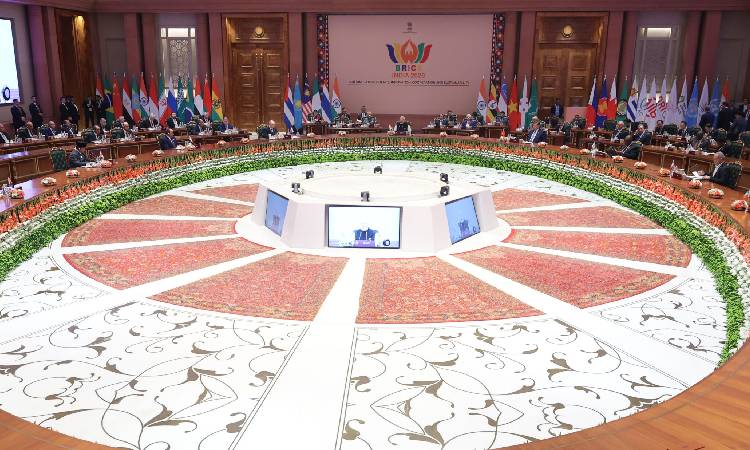
The most watched moment at the BRICS Summit in New Delhi could have been the redux of Tianjin – the coming together of Xi Jinping, Narendra Modi and Vladimir Putin. While the Tianjin handholding had triggered buzz about an impending Russia-India-China axis, the New Delhi summit had a far deeper meaning – of the Global South finding its feet through the BRICS: by expanding room to bargain for financial autonomy and yet not jettisoning the West-dominated order, pushing for institutional reform and pursuing norm entrepreneurship for a new technological order. Also mended, even if in incremental terms, was the sparring relationship with China, with Xi Jinping describing both countries as ‘partners, not rivals’ and of 'opportunities, rather than threats' for each other’s development. While Modi referred to the ‘weaponisation of critical minerals,’ Xi talked about sharing Chinese AI with the Global South. As the host, India showcased its convening power, deftness in multifaceted diplomacy, including an unlikely mediation facilitated for two West Asian neighbours at war, and, through the New Delhi Declaration, the ability to draw consensus among varied partners towards common interests. Vipul Tamhane provides this first-hand report.
Summits are usually judged by their photographs! The 18th BRICS Summit at New Delhi’s Bharat Mandapam on 12-13 September 2026 produced its share: the family portrait, the tree-plantation drive, the handshakes.
Yet the most consequential outcome of India's chairship was not visual at all. It was a 140-paragraph text, adopted by consensus on the opening day, and a reframing of the terms on which the Global South expects to be heard.
New Delhi did not merely host BRICS; it attempted to convert a rotating administrative role into agenda-setting authority. Whether that conversion held is the question the summit leaves behind.
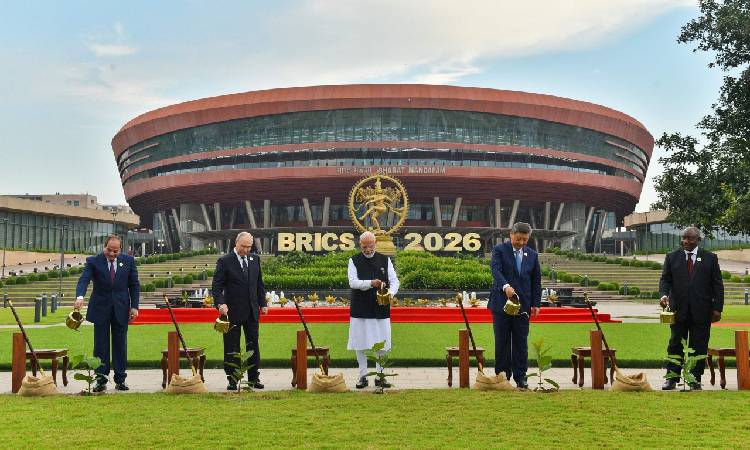
BRICS leaders watering the plants in front of the Bharat Mandapam during the Summit
An implausible consensus
Begin with the document itself, because its very existence is the headline. BRICS operates by unanimity: any one of eleven members can veto a joint statement.
In May 2026, the foreign ministers' meeting in New Delhi had failed to produce a communiqué precisely because Iran and the United Arab Emirates, now sitting inside the same bloc while on opposite sides of the West Asian war that began with the joint US-Israeli strike of late February, could not agree on language.
That the leaders’ summit last week closed that gap and finalised it on Day 1 is a genuine diplomatic feat.
The mechanism was strategic ambiguity. The New Delhi Declaration expresses “deep concern over the continued escalation of tensions in the Middle East/West Asia” and calls for “maximum restraint” (paragraph 28), while pointedly naming no aggressor.
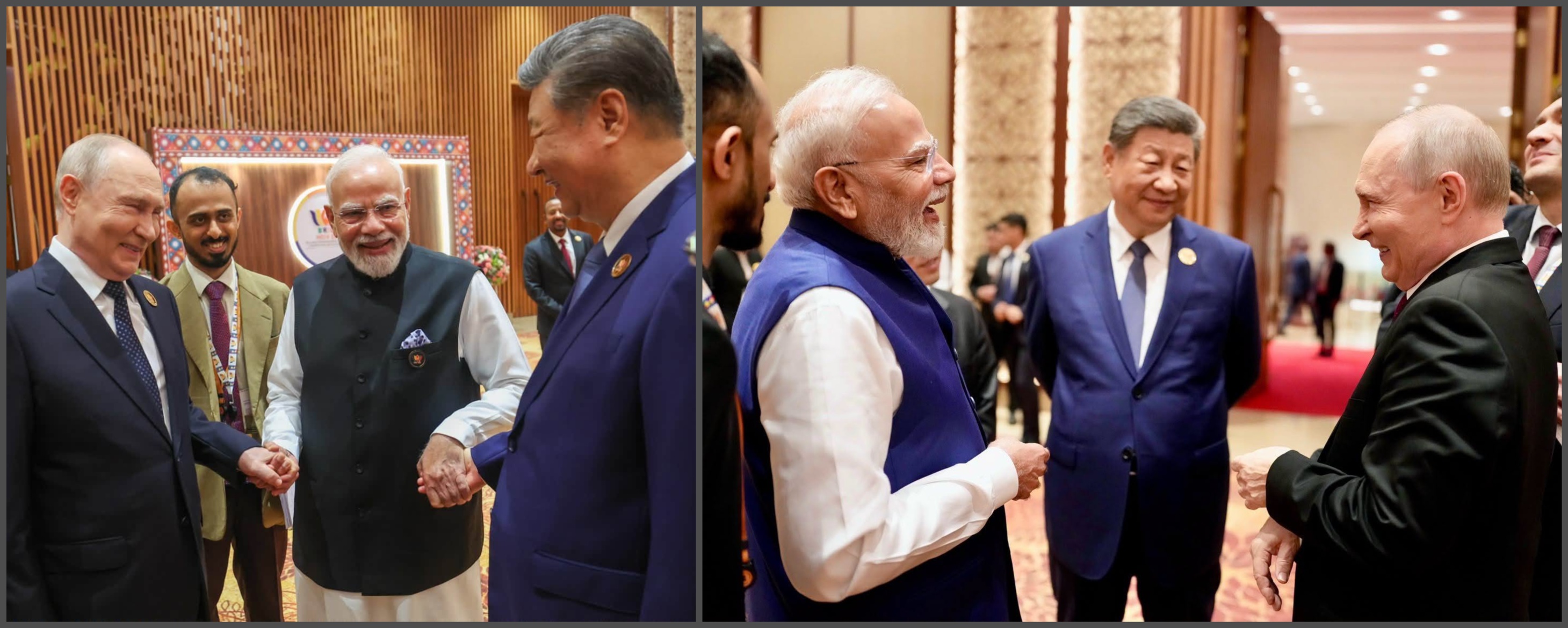
That moment again: President Vladimir Putin, Prime Minister Narendra Modi and President Xi Jinping holding hands and chatting during the New Delhi Summit, similar to their close bonding at the Shanghai Cooperation Organisation (SCO) Tianjin Summit, August-September 2025
It records “serious concern over deliberate attacks on civilian infrastructure and peaceful nuclear facilities under full safeguards of the International Atomic Energy Agency” (paragraph 29), a formulation Tehran can read as vindication and Abu Dhabi can read as a general principle.
The Indian negotiators, by their own anonymous account, worked past midnight to secure it.
The lesson for students of coalition management is instructive: BRICS did not resolve the Iran-UAE fault line; it engineered a text elastic enough to survive it. That is not weakness. It is the ordinary craft of holding a heterogeneous bloc together, and India performed it competently.
The bilateral theatre, and the Modi-Xi pivot
If the declaration was the summit’s spine, the bilaterals were its nervous system. Government sources counted fifteen bilateral engagements over three days – from Putin and Xi to Ramaphosa, Prabowo, el-Sisi, Marcos, Tokayev and a clutch of African leaders.
The throughput alone matters: a host that can process that volume of face-to-face diplomacy is demonstrating convening power, which is itself a form of soft-power capital.
But one meeting overshadowed the rest. Xi Jinping’s arrival was his first visit to India in roughly seven years, and his encounter with Narendra Modi carried weight beyond protocol. Xi offered a formula that could define the next phase of Asia's central relationship: China and India are “partners, not rivals,” and “opportunities, not threats” for each other’s development.
According to the Chinese readout, Xi framed relations as having moved from a “restart” at Kazan (2024) and Tianjin (2025) to a “new elevation” in New Delhi, the third consecutive annual Modi-Xi meeting. Modi, for his part, held to the solemn position that ‘peace and tranquillity along the Line of Actual Control (LAC)’ remain a precondition for everything else, and that differences must not become disputes.
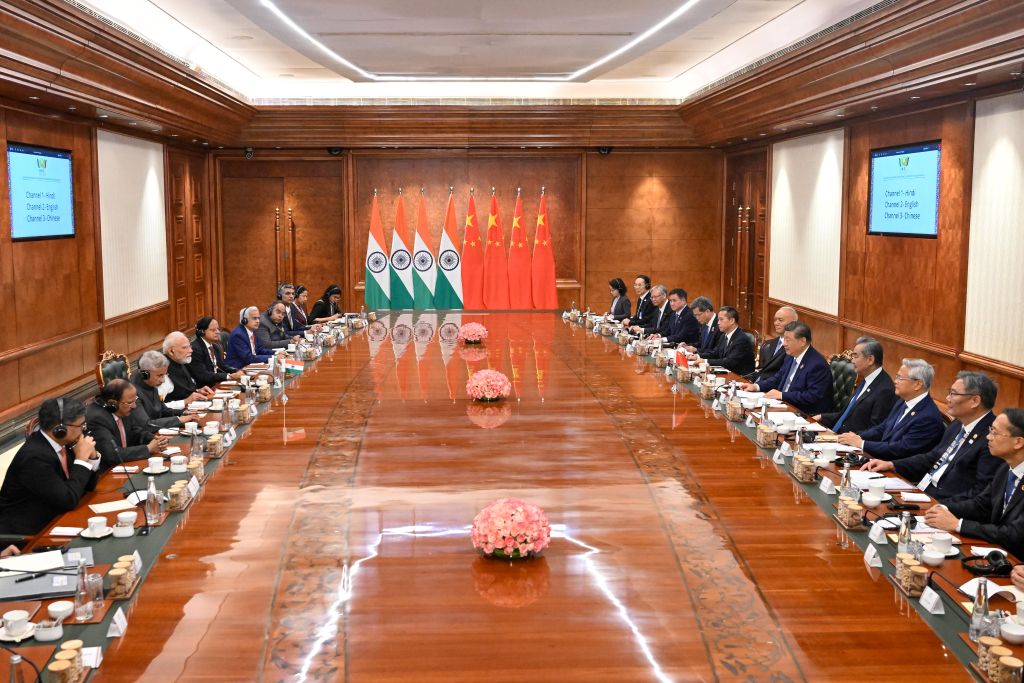
PM Narendra Modi and President Xi Jinping lead the bilateral meeting between India and China on the sidelines of the BRICS Summit 2026
There were tangible deliverables underneath the rhetoric: the phased resumption of direct flights suspended since 2020, the easing of Chinese export curbs on rare earths and fertilisers, and a shared interest in trimming a lopsided trade balance.
Add to this was the striking detail – confirmed by the Kremlin – that Modi and Xi jointly offered to mediate between Russia and Ukraine during their respective meetings with Vladimir Putin, an offer Moscow “welcomed,” with talks not ruled out for October.
Two Asian powers positioning themselves as brokers of a Eurasian war is precisely the multipolar inversion that Jeffrey Sachs, among others, has been forecasting.
Sobriety is warranted here. A single summit does not dissolve six years of post-Galwan mistrust, nor does it erase China’s supposed “String of Pearls” posture in India’s maritime neighbourhood, nor Beijing’s tilt toward Pakistan during Operation Sindoor.
The rapprochement is real but reversible, and India's own strategists know it. What the summit changed is the register of the relationship: from managed hostility to competitive coexistence, conducted in the open. For a bilateral this consequential, moving the register is not a small thing.
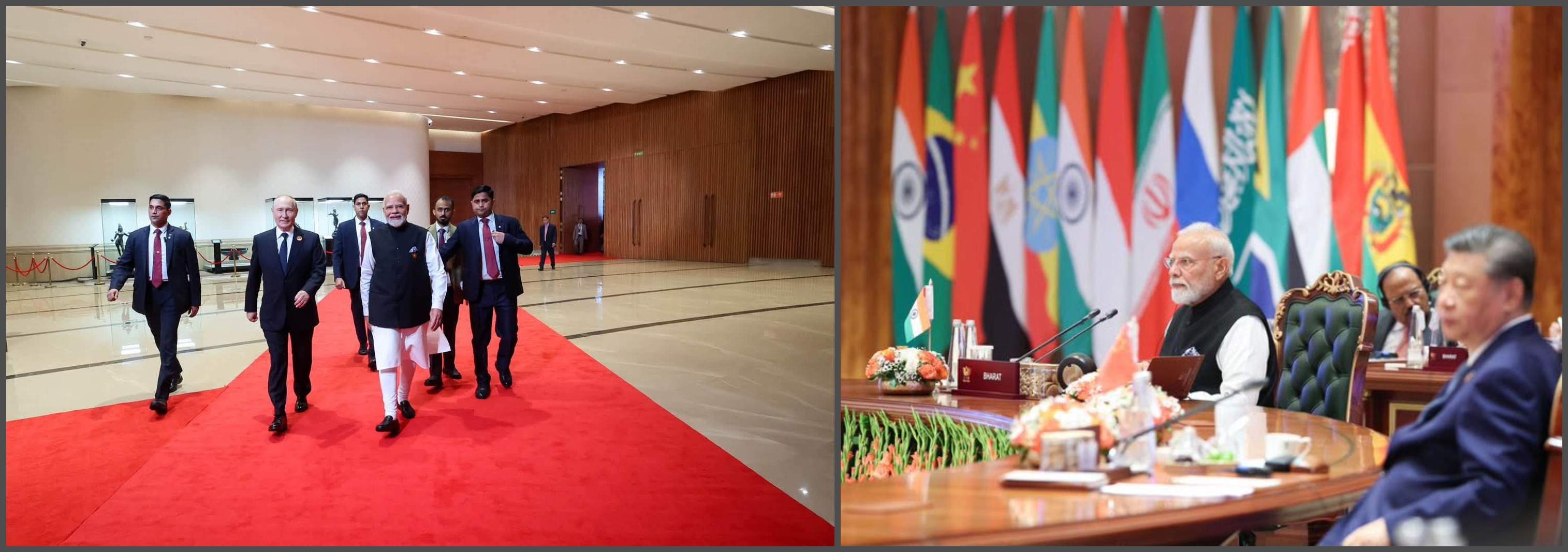
President Vladimir Putin and PM Narendra Modi headed towards the BRICS Business Forum (left), PM Modi chairing the Leaders' Summit with President Xi Jinping by his side
Security reframed: terror finance, sea lanes and strategic posturing
The New Delhi Declaration’s most substantive advances are in the non-traditional domain. Paragraph 40 condemns the 22 April 2025 Pahalgam attack by name, and commits the bloc to combating “the cross-border movement of terrorists, terrorism financing and safe havens.” It reiterates India’s position on the need for “zero tolerance” and a rejection of “double standards.”
The indirect message to Islamabad is unmistakable, and its inclusion in a consensus text that Beijing signed is a quiet Indian win.
More interesting is where the counter-terror agenda now sits: inside the financial plumbing. Paragraphs 41 through 43 read like a financial-intelligence charter. They flag illicit financial flows, terrorism financing, trade-based money laundering through the “misuse of invoicing practices,” the abuse of virtual assets, and, notably, the proliferation of “organised scam networks” and “scam compounds.”
The Declaration calls for coordination among financial intelligence units, customs, tax and supervisory bodies, and welcomes a new BRICS Expert Network on Asset Recovery. This is capability financing and counter-capability financing rendered as multilateral policy: the recognition that adversaries are financed before they are armed, and that the interdiction point is the ledger, not only the border.
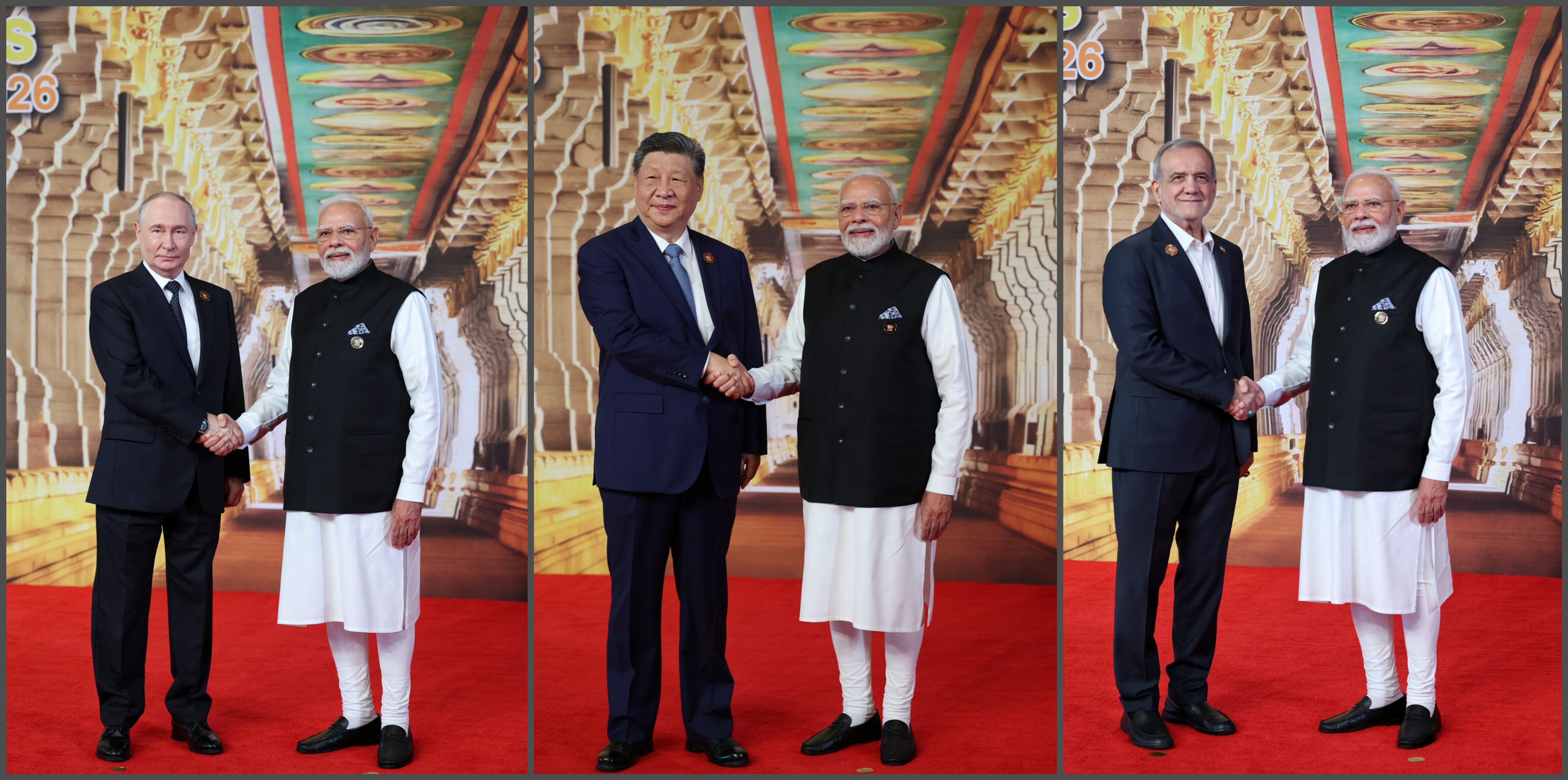
PM Modi welcomes President Putin (left), President Xi Jinping (centre), and Iranian President Masoud Pezeshkian (right)
The summit also surfaced a maritime-security instrument with strategic reach. In his address, Modi proposed a Seafarers’ Emergency Support Network, responding directly to attacks on merchant vessels in the Strait of Hormuz since the onset of the US-Iran war.
The proposal is modest in scope but revealing in intent: it stakes an Indian claim to stewardship of the sea lanes on which the entire bloc’s energy security depends – a claim that subtly competes with the assumption that such stewardship is a Western prerogative.
This is where the summit’s strategic subtext lies. BRICS is careful in insisting it is “not against anyone,” and Modi repeated the line. Yet the declaration’s opposition to “unilateral coercive measures… including non-UN Security Council authorised sanctions” (paragraph 22) and its concern over “the growing risks of nuclear danger and conflict” (paragraph 26) function as collective insulation against Western economic and military primacy.
The strategic dimension that manifests is not military but structural: the more the Global South builds parallel institutions, the less any single power can weaponise the existing ones.
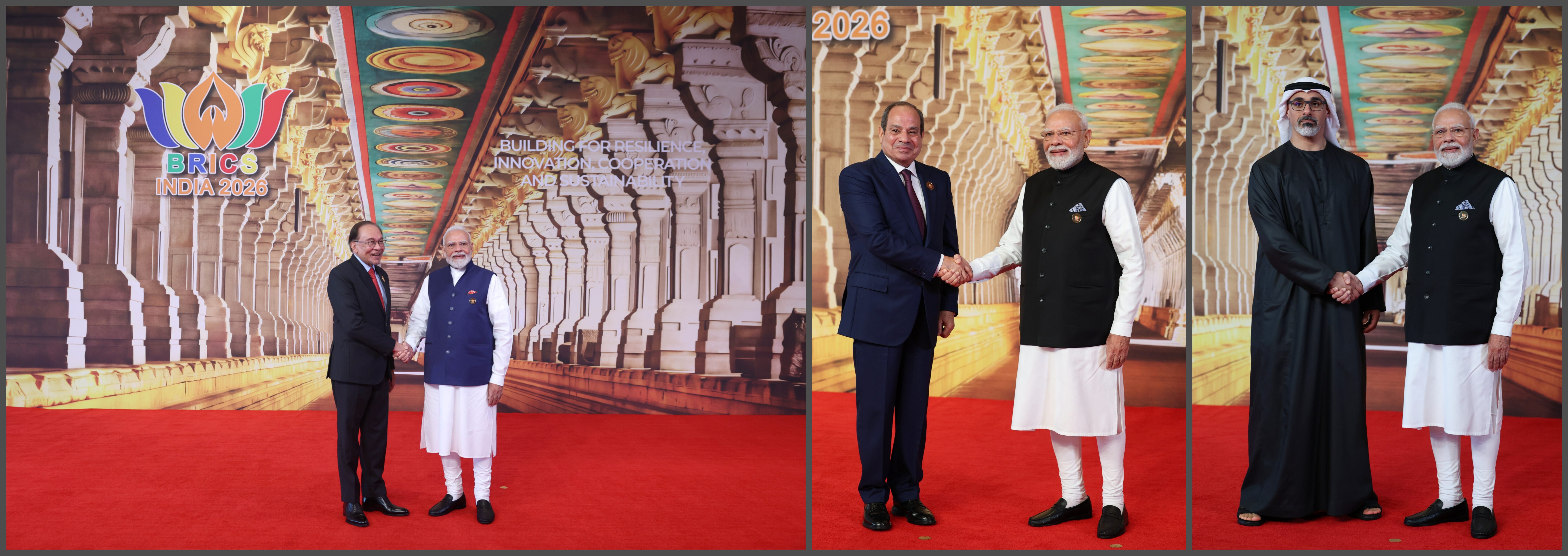
PM Modi welcomes Malaysian Prime Minister Anwar Ibrahim (left), Egyptian President Abdel Fattah el-Sisi (centre) and UAE President Crown Prince of Abu Dhabi Sheikh Mohamed bin Zayed Al Nahyan
Trade, currency and de-dollarisation
Nowhere is that structural logic clearer than in the economic text.
BRICS used the Summit to voice “serious concerns about the rise of unilateral tariff and non-tariff measures” (paragraph 21) and demanded the restoration of a “fully functioning, two-tier binding World Trade Organisation (WTO) dispute settlement mechanism” (paragraph 20), the body which the United States has kept paralysed for years.
In the same breath, the grouping also backed Ethiopia's and Iran's WTO accession bids.
On currency, the summit was disciplined rather than declamatory. There was no move toward a single BRICS currency, a point that independent observers at the summit were quick to confirm.
Instead, the bloc advanced the BRICS Payment Task Force and the Cross-Border Payments Initiative (paragraph 90), pushing interoperability of national payment systems and local-currency settlement while explicitly conceding “there is no one-size-fits-all approach.”
India’s contribution was its own infrastructure: the Unified Payments Interface (UPI), which. PM Modi informed the Business Forum, as it now accounts for roughly half the world’s real-time payments, pitched as a template for digital public infrastructure the Global South can own outright.
The Jaipur Consensus on an invoice-discounting mechanism (paragraph 85) and new credit-assessment frameworks for export-oriented MSMEs translate the anti-dollar ambition into something usable by a small exporter in Indore or Lagos.
This restraint is strategically shrewd. Donald Trump has called BRICS “anti-American” and threatened 100 per cent tariffs on any member that moves to displace the dollar, which still anchors around 58 per cent of global reserves.
By declining to build a rival currency while quietly building rival rails, BRICS reduce dependence without triggering the tripwire. It is de-risking, not de-dollarisation, and it is far harder to sanction a payment protocol than a coin.
The bloc’s aggregate weight makes the wager credible: roughly 40 per cent of global GDP and close to half the world’s population, with intra-BRICS trade being already substantial. India’s own trade with the grouping has more than doubled in five years, even as its deficit with it has widened – a reminder that access to these markets is not costless.
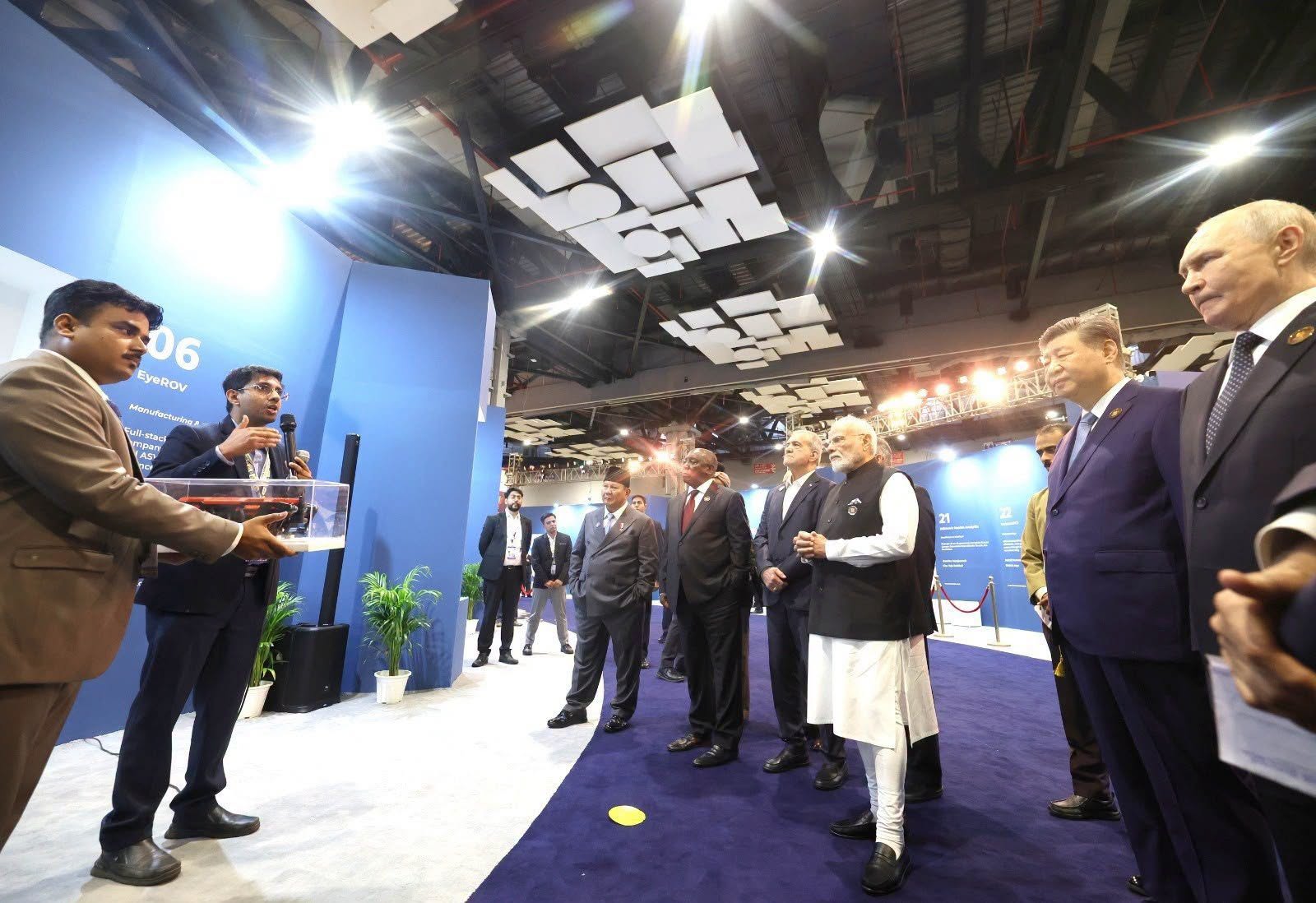
The leaders at a technology stall as part of the BRICS Summit
Technology as the new terrain of rule-making
India’s sharpest conceptual move was to relocate the contest for global influence from institutions to standards. “Domains such as Artificial Intelligence (AI), cyberspace, outer space, biotechnology and critical technologies,” PM Modi argued, “are not only shaping future opportunities but also defining future rules.”
The declaration follows through: it commits members to implement the July 2025 BRICS Leaders’ Statement on the Global Governance of Artificial Intelligence (paragraph 81), builds on India’s February 2026 AI Impact Summit, and threads AI, quantum, submarine-cable resilience and the peaceful use of outer space through the text.
The showcase – 37 deep-tech innovations at the Bharat Innovates exposition, including a 64-qubit quantum processor and AI systems for cervical-cancer screening and maternal health – was more than pageantry. It was an argument that frontier technology can be a development tool rather than a great-power monopoly.
Coupled with PM Modi’s warning that the “weaponisation of critical minerals” could obstruct shared growth (echoed in paragraph 67’s insistence on sovereign rights over mineral resources), the technology agenda amounts to a bid for technological sovereignty across the bloc.
If BRICS can co-author the norms for AI and space before those norms harden in Western fora, it converts catch-up into co-authorship. That is the ‘norm entrepreneurship’ in its purest form.
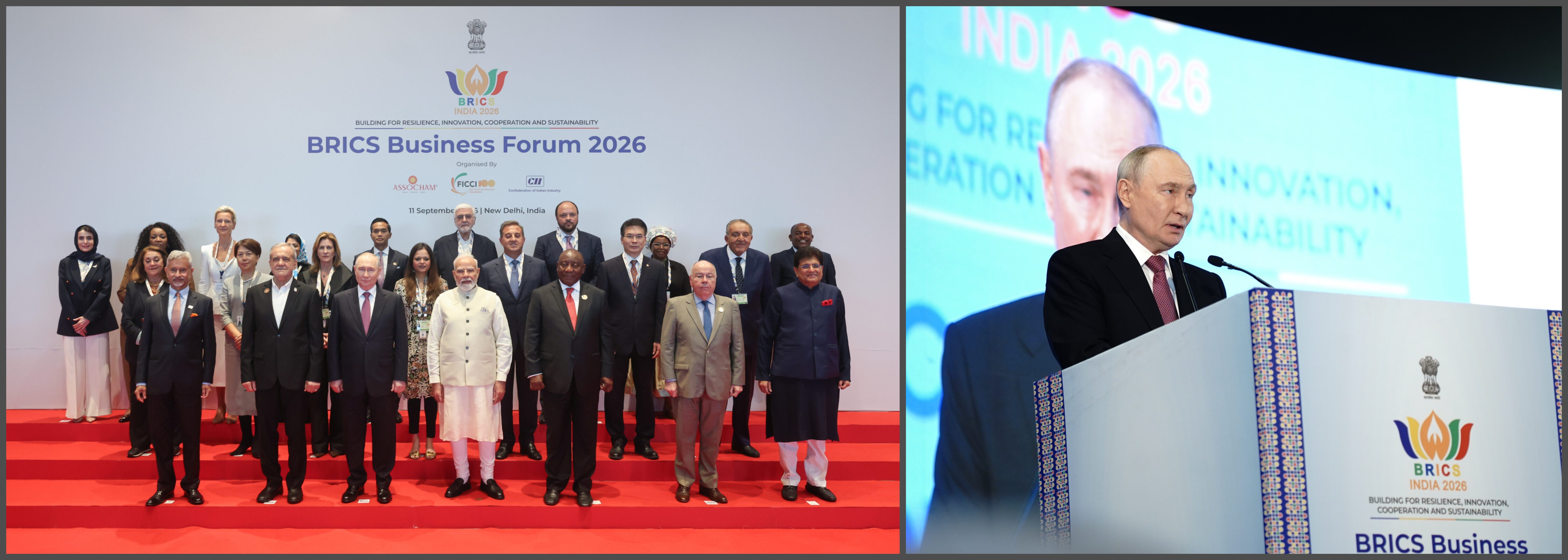
PM Modi, President Putin, President Pezeshkian and other leaders at the BRICS Business Forum (left), and President Putin addressing the Forum (right)
Alliance building and the soft power ledger
The Summit’s institutional expansion was equally deliberate. Beyond the eleven members, ten partner countries and a wide outreach segment gave the bloc the texture of a network rather than a club.
Once again, India secured Chinese and Russian backing for its and Brazil’s membership in a reformed and expanded United Nations Security Council (paragraph 14), alongside recognition of African claims under the Ezulwini Consensus.
The Summit pressed for movement on the International Monetary Fund (IMF) quota realignment under the 17th General Review (paragraph 18) and World Bank shareholding reform (paragraph 19).
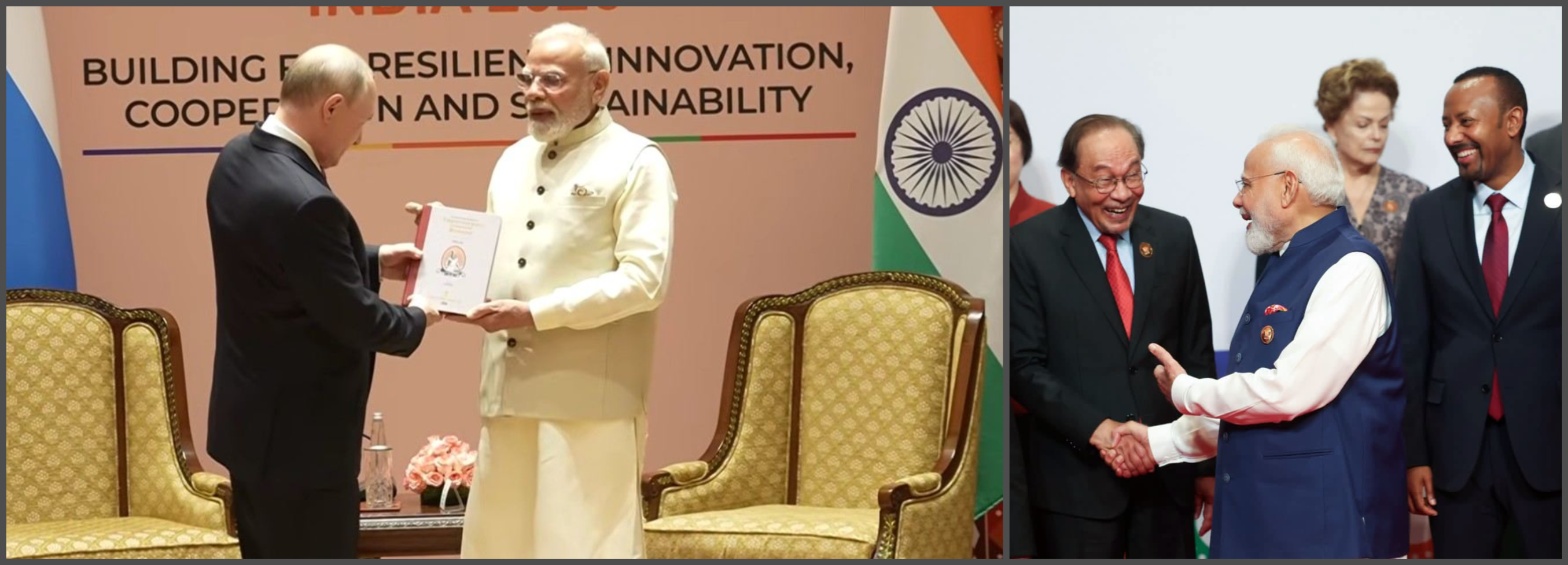
PM Modi gifting a copy of the Russian translation of Thirukural to President Putin (left), and sharing a laugh with PM Anwar Ibrahim (right)
The soft-power podium was extensive: more than 400 engagements across thirty Indian cities (paragraph 6), a BRICS Bazaar of crafts from 18 countries, and cultural gestures calibrated for meaning, Modi gifting Thirukkural’s Russian translation to President Putin, the International Big Cats Alliance folded into the biodiversity text (paragraph 111), and even the all-vegetarian state dinner, which drew controversy, signalling a civilisational self-confidence.
PM Modi’s framing tied it together: the Global South “stands in the front row of global crises but in the back row of decision-making,” and the task is to turn the “pyramid of privilege” into a “platform of partnership.”
Rhetoric, yes, but rhetoric that names a real asymmetry, and that India is better placed than most to monetise into influence.
The fault lines, honestly stated
None of this should be mistaken for a finished project.
China remains the bloc’s economic centre of gravity while India, Brazil and Russia are engaged in a permanent, low-key effort to prevent BRICS from becoming a Beijing-centric platform – an effort that constrains how far cooperation can go.
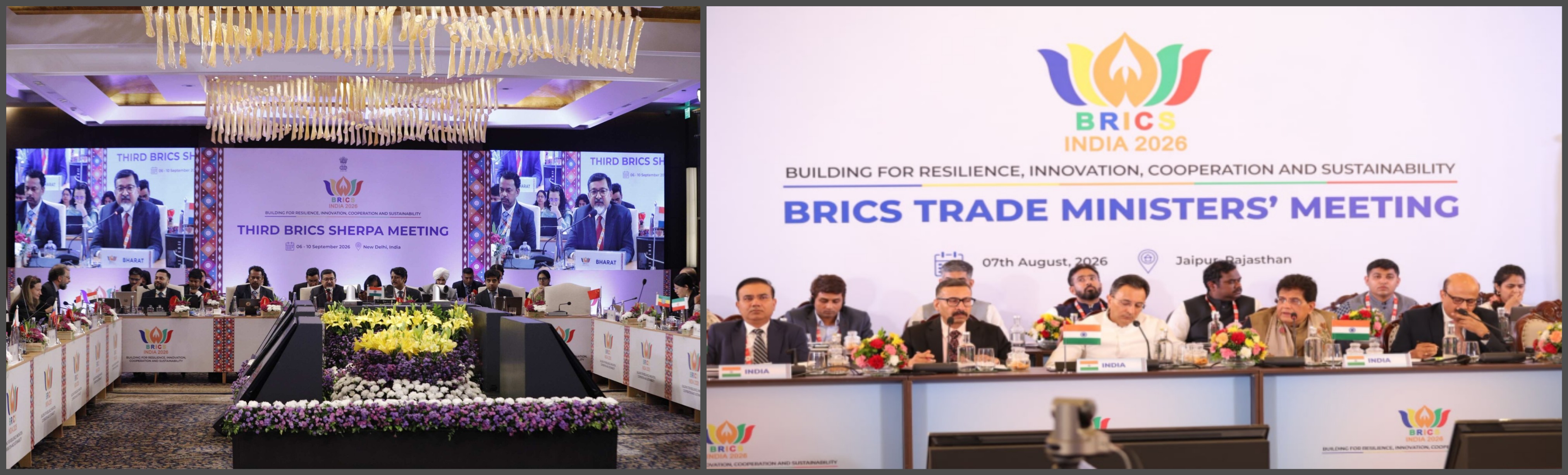
The Sherpas meeting in preparation for the BRICS Summit (left), and the BRICS Trade Ministers' Meeting (right)
The Iran-UAE rift is structural, not rhetorical. Tehran’s strikes on Gulf states have widened it, and no communiqué dissolves it. The Gulf monarchies inside BRICS remain long-standing American partners, hedging rather than defecting.
And there is the perennial gap between a 140-paragraph declaration and delivery: task forces, ‘study groups,’ and ‘feasibility studies’ recur throughout the text, as a syntax of intention rather than achievement. A grouping that must accommodate Iran and the UAE, China and India, Russia and Saudi Arabia in a single sentence will always trade ambition for consensus.
What India gained from BRICS 2026?
Measured against those constraints, India’s ‘win’ at BRICS XVIII is architectural rather than dramatic. It did not birth a new world order, and it was careful to say so.
What it did was expand the room in which the Global South can bargain, a little more financial room through payment rails, a little more institutional room through reform advocacy, a little more normative room through AI and space, a little more diplomatic room through a stabilised China relationship and fifteen bilaterals in three days.
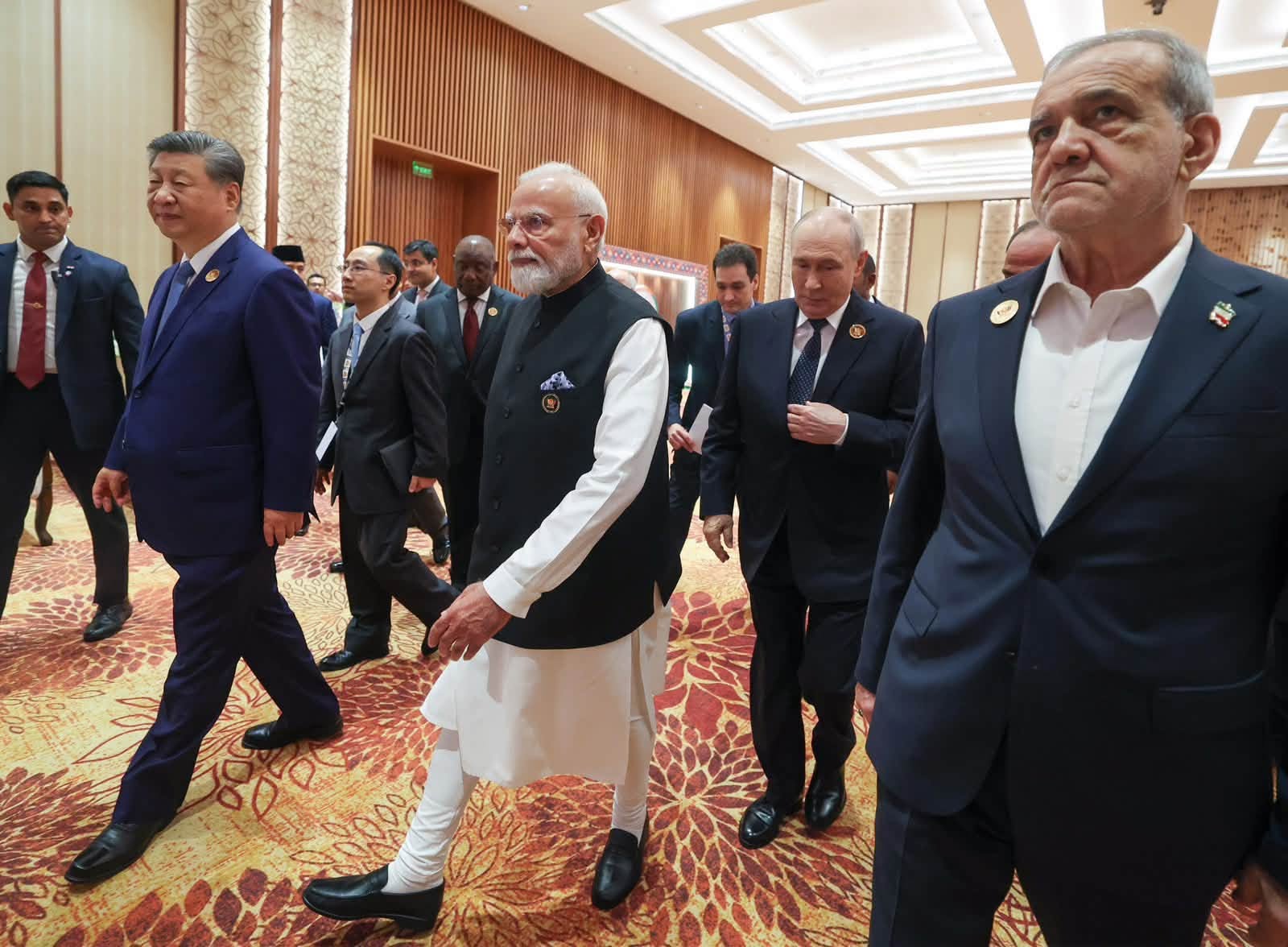
All in the same frame: President Xi Jinping, PM Modi, President Putin and President Pezheskian walking together
The Summit positioned India as a bridge power fluent with Moscow, Beijing, Tehran and the West at once, and it did so while insisting the bloc threatens no one. That posture – agenda-setting without confrontation, hedging as strategy, strategic autonomy exercised offensively rather than defensively – is the summit’s real gain.
The nineteenth summit passes to China in 2027, and the durability of India’s framework will be tested there. Yet, if the twentieth-century order was built by those who wrote the rules, the New Delhi Declaration is India's wager that the twenty-first will be shaped by those who insist on holding the pen.
From rule-taker to rule-shaper: it remains a claim, not yet a fact. After Bharat Mandapam, it is a more credible claim than it was before.
(Views expressed in this report are the author's own.)
Follow us on WhatsApp
Follow us on Facebook
Follow us on X @vudmedia
Follow us on Substack
