
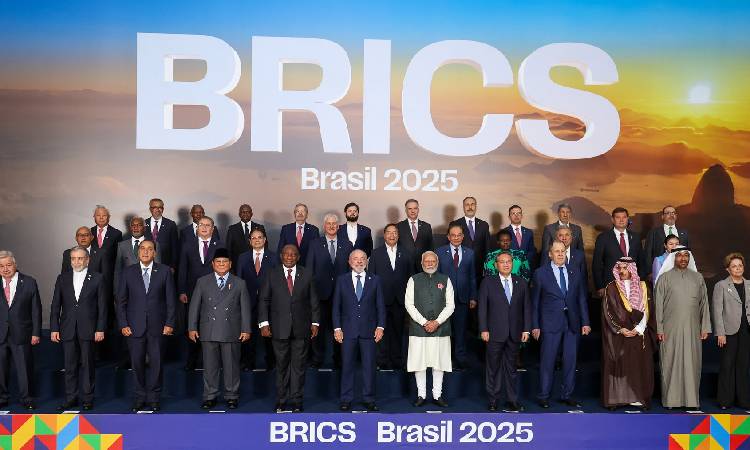
The world will be watching in anticipation as 11 members and 10 partner states of BRICS meet for their 18th annual summit in New Delhi this weekend. Besides questions of how the grouping will reconcile their vastly divergent positions – from de-dollarisation to energy transition and ongoing conflicts in Ukraine and Iran, the bigger endeavour will be how BRICS will cast itself in the multipolar geopolitical landscape. At stake is the imperative of facilitating consensus on issues of shared interests that could turn BRICS into a practical collective agency despite divergent national priorities. India, as the host nation, could seek to construct sufficiently broad areas of agreement through ‘dichotomous multilateralism,’ which is not organised around uniformity but through consensus. India’s long-held position that BRICS is a non-Western but not anti-Western forum that seeks to reform global governance to make it more equitable and representative could be a guiding principle of the Summit, says Professor Swaran Singh in this 31st edition of Asia Watch.
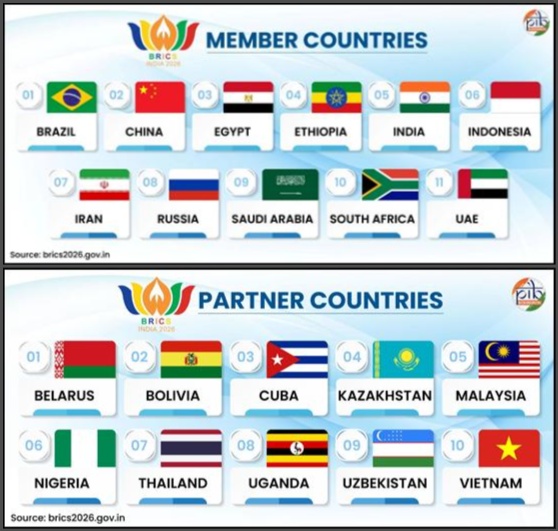
Less than 48 hours from now, eleven member states of BRICS – a grouping of emerging markets and developing countries initially formed by Brazil, Russia, India and China in 2006, and South Africa joining them at the inaugural summit in 2009, and later expanded to 11 members and 10 partner states – meet in Delhi this weekend (12-13 September) for their 18th annual summit.
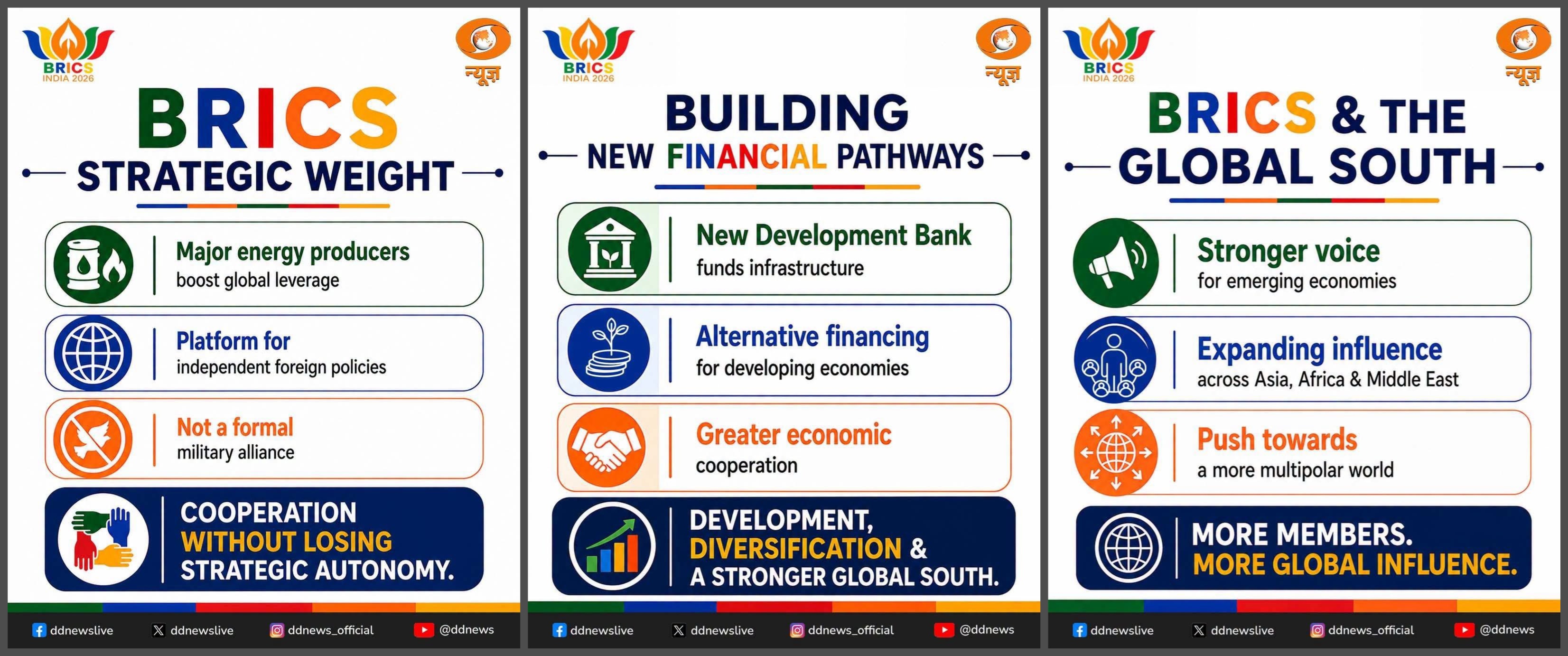
As a grouping, often described as one of the newly industrialised states – representing 49.5 per cent of the global population, 40 per cent of global gross domestic product (GDP) and 26 per cent of global trade – BRICS has emerged as a formidable forum, with their collective action seen in areas like the Climate Summit and global economic governance.
The 2026 summit in Delhi comes in the shadow of the raging conflict in West Asia and the long-running war in Ukraine – both of which are slated to shape the proceedings.
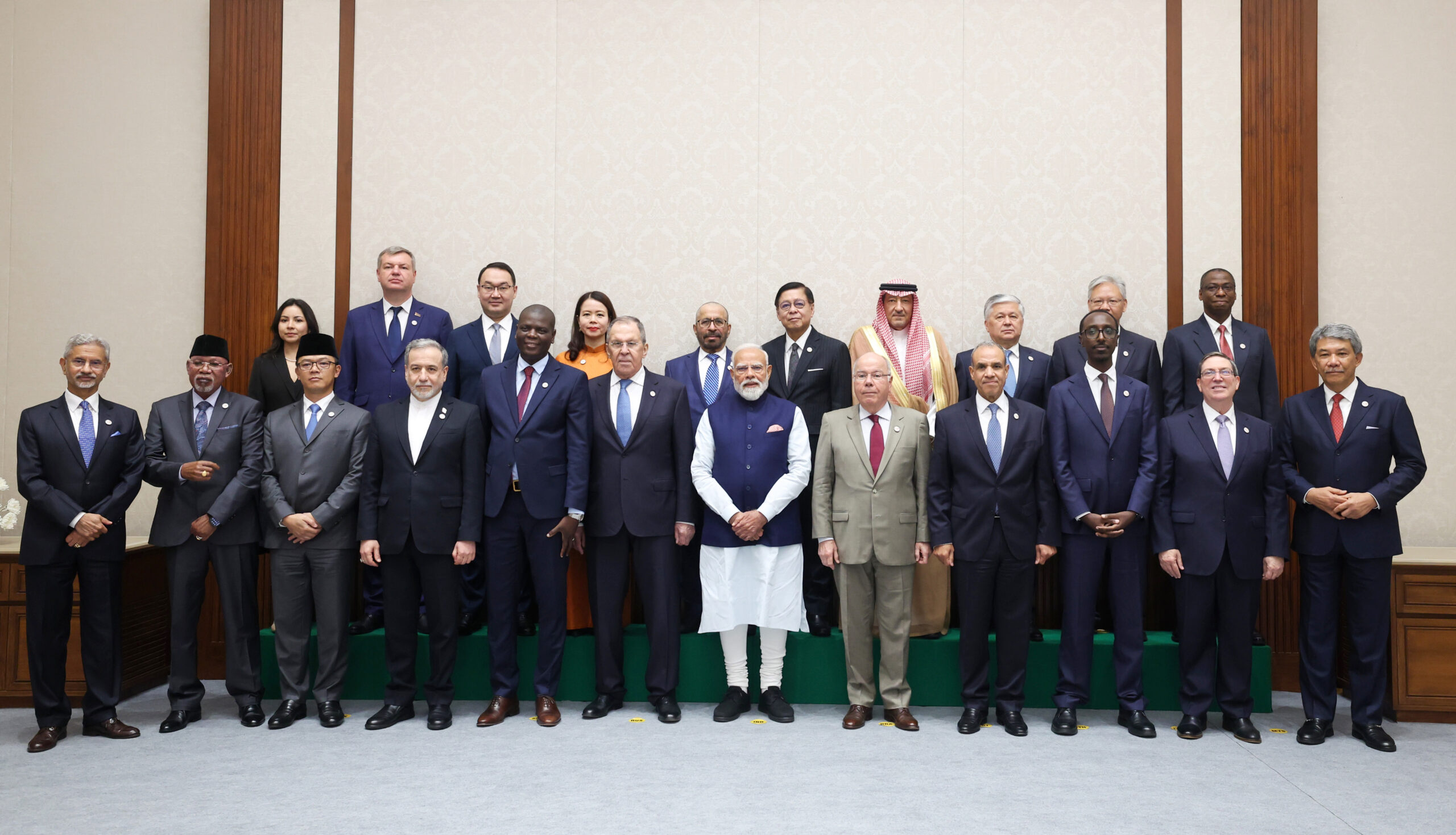
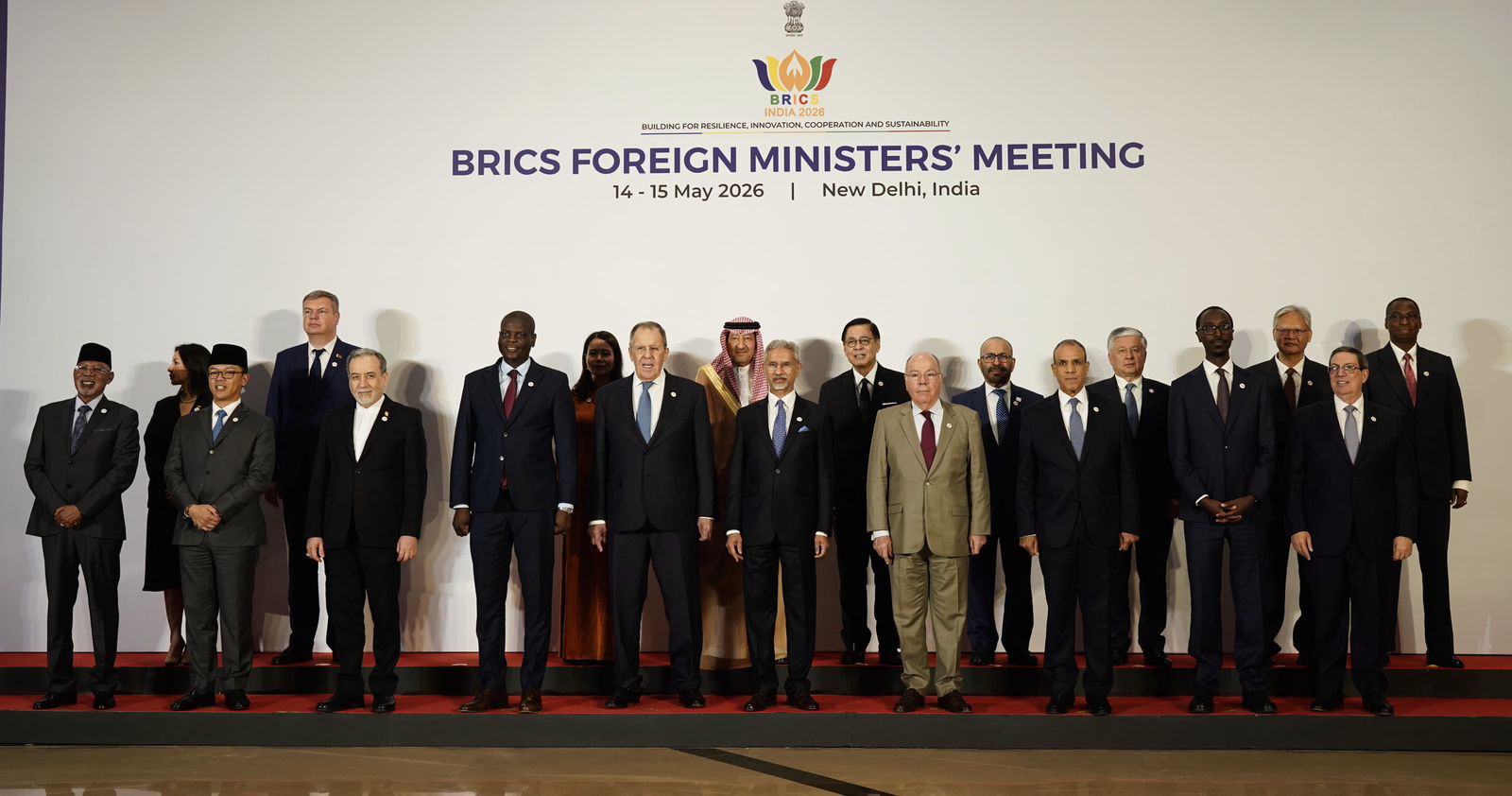
Prime Minister Narendra Modi with Foreign Ministers of BRICS members after their preparatory meeting in New Delhi, May 2026
The likelihood of Iran seeking to push the forum to condemn the US-Israel ‘aggression’ against it is likely to test the host nation’s ability to shape the proceedings and form consensus for a joint communique. As in the 2025 summit, the foreign ministers' preparatory meeting in May 2026 also failed to issue a joint communique.
Needless to emphasise, the intra-BRICS divergences would be India’s most difficult challenge in building consensus amongst the leaders of member and partner countries gathering in New Delhi.
On the other hand, China has confirmed the participation of President Xi Jinping at the New Delhi summit, marking his visit to India after seven years, ending speculation that he would give a miss this year as well after skipping the 17th BRICS Summit in Rio de Janeiro in April 2025.
China singularly accounts for over 58 per cent of the total BRICS GDP. This brings to Beijing inordinate leverages though President Xi Jinping’s visit to New Delhi also entails equally critical bilateral anticipations and consequences.
A Modi-Xi meeting has been tentatively scheduled for Saturday, assuming the Chinese president arrives that morning.
With India assuming the BRICS chair again this year, after holding it previously in 2012, 2016 and 2021, it has inherited an institution that had acquired something rare in contemporary international politics: its 2023-2024 expansion — from five to eleven members plus ten partner nations — had suddenly added to its weight and size without corresponding political coherence accompanying it.
The grouping today brings together states spanning Asia, Africa, the Middle East and Latin America, with divergent strategic alignments, economic and political priorities and structures as well as divergent regional rivalries.
India’s challenge at the New Delhi leaders’ summit this weekend, therefore, is not just ensuring unanimity in sentimental speeches, but also demonstrating how their diversity need not stymie their collective consensus-building for action.
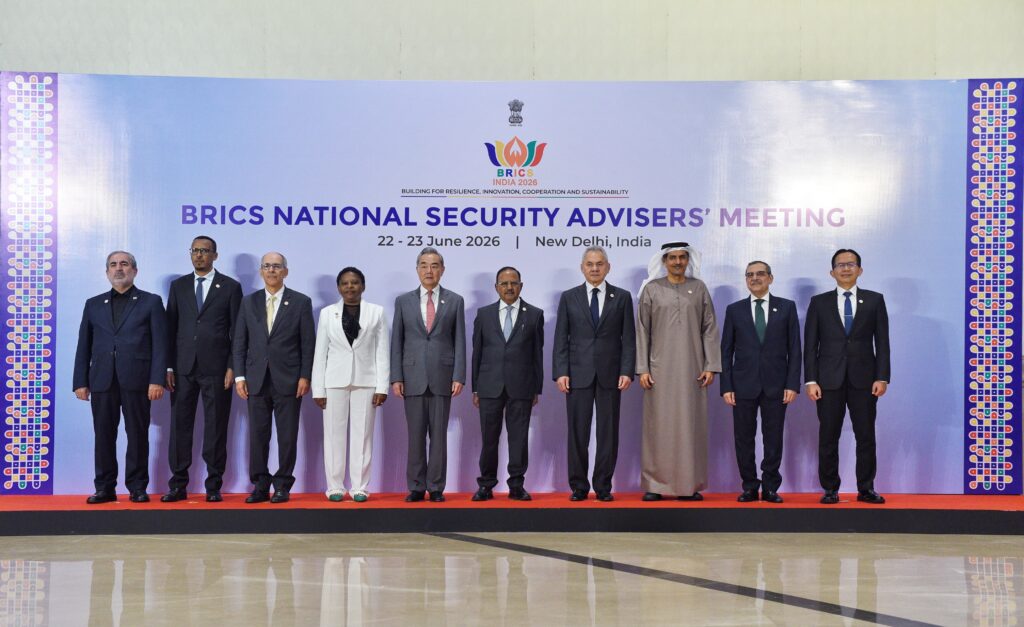
The warning had come at the BRICS Foreign Ministers’ Meeting in New Delhi on May 14-15. That meeting had ended with a Chair’s Statement and Outcome Document rather than a collective ministerial declaration.
That episode had revealed BRICS’ deeper challenges in its post-extraordinary enlargement edifice. Indeed, the old BRICS of five nations had already experienced significant differences.
But now, in the wake of expanded BRICS and unending wars involving members like Russia and Iran, and tensions between India and China, India will see its convening power and diplomatic dexterity put to the test with an onerous task of addressing these structural antinomies.
The question facing New Delhi is consequently less whether BRICS can speak with one voice than how much it can accomplish without one, and whether it can evolve BRICS from empty exhortations into an action-oriented agency.
Unending wars and rivalries
The inclusion of Iran, Saudi Arabia and the UAE has made, for the first time, their Asian rivalries an integral part of BRICS deliberations. Tehran, Riyadh and Abu Dhabi do not share identical assessments of regional security or of their relations with Washington DC.
The Iran war has made these differences even more acute and consequential. It remains uncertain if they will be able to evolve any shared language on their regional security while still maintaining their divergent alliance commitments.
Russia — also in the eye of the storm for its 54-month-long war in Ukraine — views BRICS as part of a wider transformation away from Western powers’ dominance that has sought to isolate it. However, many members, including India, Brazil and Indonesia, have little interest in making BRICS an extension of Moscow’s geopolitical rivalry with the United States.
Yet, Russia happens to be India’s time-tested friend and has expectations of reciprocity from New Delhi. In this, it remains unclear how India’s advocacy for dialogue, respect for sovereignty and a negotiated settlement will be able to make BRICS members cooperate in endorsing some broad shared interpretation of the war.
The joint communique of 2025 made a nuanced reference to Ukraine by recalling “our national positions concerning the conflict in Ukraine as expressed in the appropriate forums, including the UN Security Council and General Assembly… we expect the current efforts will lead to a sustainable peace settlement.”
Whether New Delhi will pull off a similar balanced approach, vis-à-vis both Ukraine and Iran, could be among the most anticipated outcomes of the 2026 summit this weekend.
The most consequential divergence, on the other hand, lies between the two nations whose relations sit closest to the heart of BRICS: China and India, which also constitute the largest and second-largest BRICS economies. Indeed, India and China together constitute 71 per cent of BRICS’ GDP and 74 per cent of its population.
Both have shown strong shared commitment to ensuring greater voice for the Global South and early reforms in extant Bretton Woods financial institutions. But, again, they have had divergent strategies and varying roadmaps on how they wish to achieve these shared objectives.
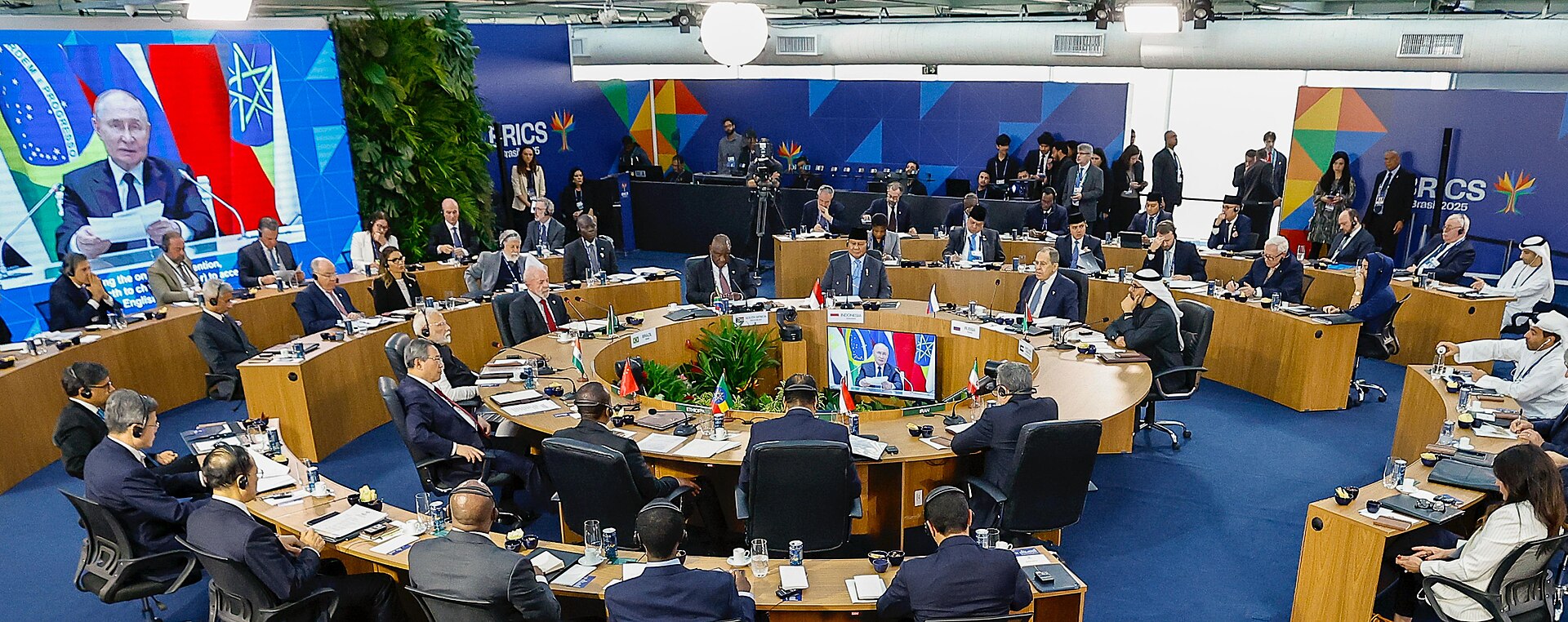
Delegates listening to the Russian President Vladimir Putin at a BRICS summit
This is precisely why the recent improvement in India-China ties makes President Xi Jinping’s presence in New Delhi promising both for the BRICS summit consensus building and for reviving the thaw in India-China bilateral relations.
No doubt, with most major powers having increasingly become transactional, both Beijing and New Delhi have also sustained their functional cooperation, keeping bilateral disputes compartmentalised rather than allowing them to paralyse their overall bilateral relations and, by extension, the BRICS consensus-building.
Reforms, not confrontation
However, BRICS also face far deeper philosophical divergences. Today, Russia and Iran have strong incentives to portray BRICS as a counterweight to the US-led Western world order. China also advocates a substantial restructuring of what it calls post-Western global governance.
In contrast, India, Brazil, Saudi Arabia, the UAE, Indonesia and a few others continue to have deep economic and strategic relationships with China as well as with the United States and its European alliance partners.
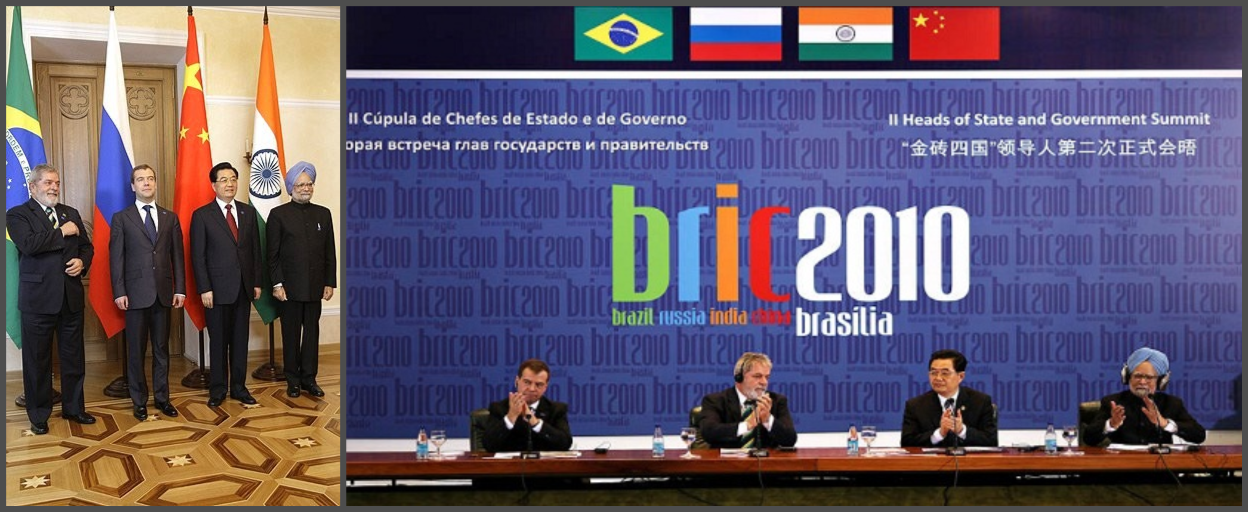
The leaders of the BRICS nations in the first two summits of 2009 and 2010
The de-dollarisation debate has come to be the other most divisive issue defining divergent imaginations of China, Russia and Iran from most other BRICS members and partners. No doubt, BRICS members have a shared interest in reducing vulnerabilities arising from excessive dependence on any single currency, especially if that currency begins to be weaponised.
But this does not mean that all members agree on a wholesale abandonment of the US dollar. India continues to push for realistic strategies in incremental reform, enhancing local-currency settlement, cross-border payment interoperability, financial resilience and diversification.
China’s economic size itself presents a structural anxiety for most BRICS members and partners. Chinese capital, technology, infrastructure and market access have accelerated development in a large number of developing and least developed countries.
But Chinese manufacturing dominance — with a 32 per cent share in global manufacturing — has also intensified import dependence among these recipient nations and created competitive pressures on peer emerging economies. This produces one of the Global South’s central dilemmas: how to benefit from Chinese economic power without becoming excessively dependent on it.
For the majority of BRICS members and partners, multipolarity does not become anti-Americanism. India, for instance, calls BRICS a non-Western but not anti-Western forum that seeks to reform global governance to make it more equitable and representative.
At BRICS, India keeps pushing for actionable, pragmatic choices like building resilient and diversified supply chains, critical-mineral cooperation, startups, mutual investments and technology partnerships while retaining strategic autonomy.
Interdependence versus vulnerability
BRICS’ original mandate lay in creating deeper intra-BRICS trade and investment links; yet experiences of pandemic disruptions, unending wars and Western sanctions have demonstrated the costs of concentrated dependencies.
While the BRICS New Development Bank represents one of its most tangible achievements, the last decade has not seen BRICS deliver any major new initiative. Also, even its New Development Bank is sometimes presented from a rather narrow perspective of being BRICS’ challenge to Western financial institutions.
For most BRICS, it is affordable infrastructure, energy, transport, health and climate finance that remain their immediate need; not geopolitical symbolism.
Energy security debates on fossil fuels versus energy transition for climate change mitigation present another Asia-driven dichotomy that has sown new divisions within BRICS. BRICS contain some of the world’s largest oil and gas producers, alongside top energy consumers and ambitious renewable and clean energy-advocating economies.
Their interests naturally diverge over the use of fossil fuels, transition timelines, climate finance and the overall energy security paradigm. But all this diversity also makes BRICS unusually powerful, provided these producers and consumers of energy can evolve complementary relationships and build sustainable partnerships.
On this issue as well, India has been advocating for an energy transition keeping in mind affordability, energy access, technology transfers and climate justice rather than building abrupt and angry binaries between hydrocarbons and renewables, or West versus East dominated supply lines.
Indian art of managing divergence
Indeed, the very diversity that makes consensus difficult also gives BRICS much of its contemporary significance. India’s inherent diversities in all spheres of life also enable it to address these divergences with its quintessential strategic patience streak.
For instance, India does not need Saudi Arabia and Iran to agree on their varying visions on West Asian regional security before they can cooperate on some of BRICS development initiatives. It does not need China and India to first resolve each of their strategic disputes before they can work together on climate or global-health governance.
It does not need Russia and Brazil to share identical views of the Ukraine war before they can discuss food or energy security. Nor does BRICS need to agree on the future of the dollar before its members can improve cross-border payments partnerships.
This also presents an innovative conception of dichotomous multilateralism: consensus by compartmentalisation. India’s aim at the 2026 BRICS summit will not be unanimity across all issues. It will be to construct sufficiently broad areas of agreement such that disagreement elsewhere does not become a veto over all decisions.
New Delhi has consistently argued that the world is moving toward plurilateralism of flexible groupings and networks, with multiplayer minilateral silos working within the larger overarching shared theme. Naturally, a genuinely multipolar world will inevitably be a world of competing interests, overlapping coalitions and partial agreements.
That is precisely where the New Delhi BRICS summit of 2026 will have an opportunity to showcase its inheritance of ‘unity in diversity’ and recast BRICS’ future trajectories. The success of the 2026 BRICS summit will not be measured simply by the warmth of its rhetoric or the length of its final declaration.
It will be measured by whether eleven increasingly diverse economies were able to identify enough common interests to turn BRICS’s growing weight into a practical collective agency. The irony is that BRICS’s internal divergences may be less a threat to its own future than a trailer of the world unfolding before our eyes.
If India manages these divergences without suppressing them, it will demonstrate something even more fundamental: that twenty-first century dichotomous multipolarity can be organised not around uniformity, but around negotiated coexistence and that the Global South can acquire greater agency without becoming a geopolitical bloc.
This is why even the May BRICS foreign ministers’ outcome should be read more carefully.
A Chair’s Statement in a grouping as heterogeneous as BRICS is not necessarily a sign of institutional weakness. It reveals its limits — and perhaps its new possibilities — of building broad consensus without its members having to subordinate their core national priorities.
Follow us on WhatsApp
Follow us on Facebook
Follow us on X @vudmedia
Follow us on Substack
