
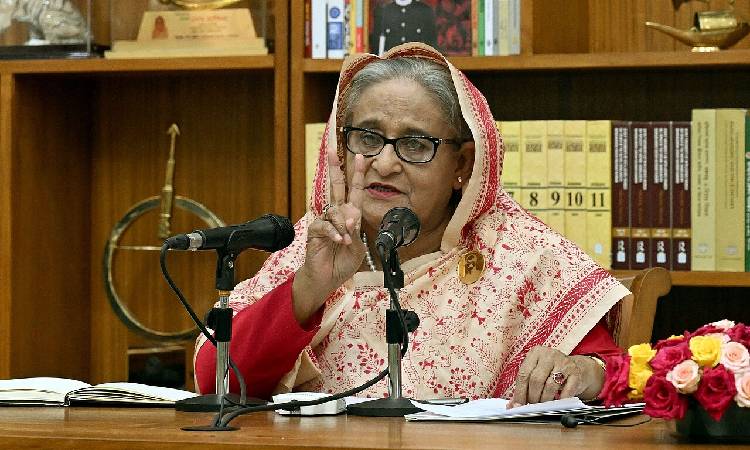
August 5th marked two years since the departure of Sheikh Hasina from Bangladesh, as a result of the July Uprising with student unrest, large-scale violence and a clampdown by security forces leading to an upheaval. In the subsequent months, her party, the Awami League, was banned. Hasina was sentenced to death for alleged atrocities during the Uprising. Now in exile in India, the Bangladesh government has sought her extradition, on which India has not acted yet. On the 2nd anniversary of her exit, Hasina addressed the media in New Delhi, reiterating her desire to return to the country and possibly surrender, as indicated in two recent interviews. The Tarique Rahman government, in response, has severely criticised India for allowing such media interactions even as political groups in the country see her execution as the only outcome of her return. In this first of the two-part series on Awami League, and its beleaguered leader, Tapas Das examines Hasina’s statements and their immediate manifestations.
On August 5, 2026, the second anniversary of the July Uprising in Bangladesh, Sheikh Hasina, who was ousted as Prime Minister during the protest movement and is now in exile in India, addressed the international media via an audio link at the Foreign Correspondents Club of South Asia in New Delhi.
Declaring that she wants to return to Bangladesh in December, “our victory month” (referring to the Bangladesh Liberation War), Hasina declared that she is “not worried about my own future,” and that she wants to return because the “people deserve security, development, prosperity and peace. They deserve a state that protects them, an economy that gives them opportunity, and a democracy that gives them rights.”
Considering that Hasina seeks to return despite the ‘death sentence’ against her, the deposed former premier of Bangladesh remarked thus in a detailed press statement, accessed by The Polity:
“Whatever fate awaits me, I will return to my people. I cannot stay away while my beloved countrymen are suffering. I know I may be detained. I may be sent to prison. They may try to enforce verdicts issued in fabricated cases. But fear cannot decide my duty to the people. My life moved beyond calculations of personal safety long ago. In 1975, I lost my family. I spent six years in exile. After returning home, I fought against military rule, dictatorship, assassination attempts and political conspiracies. Even the grenade attack of 21 August 2004 could not stop me.”
The former Bangladesh Prime Minister affirmed that her and the Awami League’s return to the democratic process “is not about power.” It is about “putting Bangladesh back on the right track… about reviving the country’s path of development, progress, secularism and stability,” adding that her return is for “one purpose: to stand beside the people and help improve their lives. The people are the source of all power. I believe in them. I trust them. And I will return to them.”
In the same vein, Hasina also listed a set of demands, which included: The ban on the Awami League be withdrawn, political prisoners released, false cases dropped, freedom of speech be restored, media freedom be protected, judicial independence be guaranteed, and that law enforcement agencies must serve the people, not those who use power for revenge.
Hasina spoke at length about the ‘persecution’ of Awami League, both in the form of targeted attacks on the party members during the July Uprising and also the attacks, arrests and cases after the interim government led by Professor Muhammed Yunus took charge.
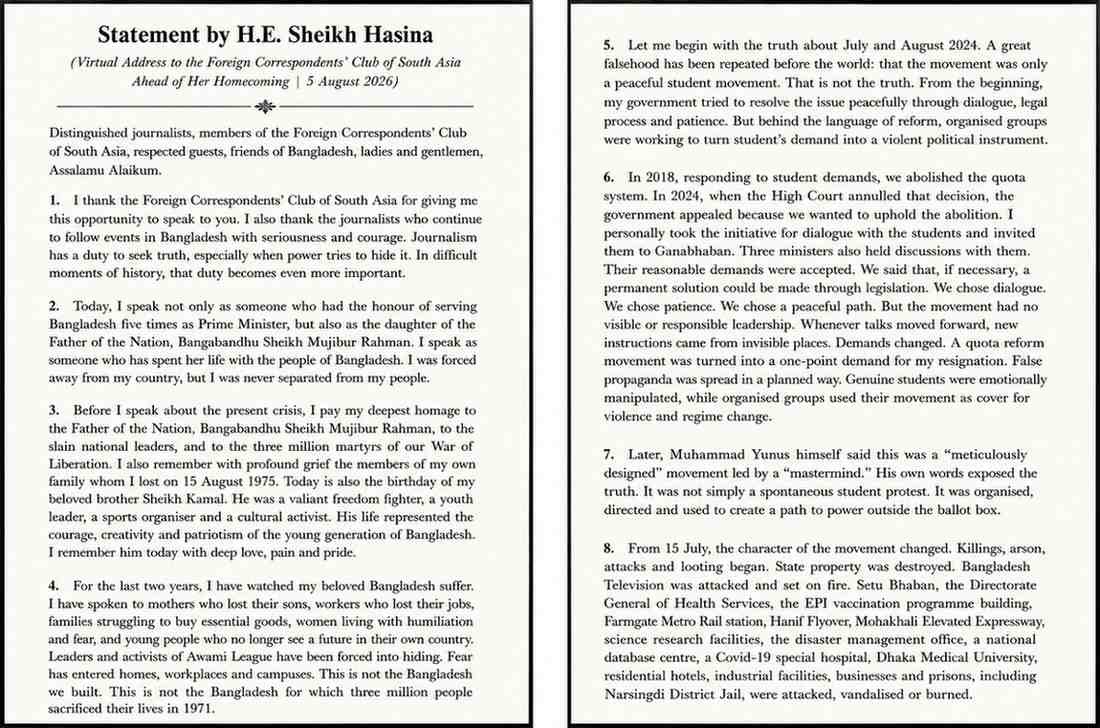
“Awami League leaders and workers are being killed, disappeared, arrested, driven from their homes and buried under false cases. At least 10,000 have been killed or disappeared. Around 650,000 have been arrested over the last two years. Around 3,500 cases have been filed, naming nearly 450,000 leaders, workers and supporters as accused. More than 1,000,000 others have been listed as unnamed accused. Women activists of Chhatra League, Youth League and other affiliated organisations are facing abuse, humiliation and torture in custody. Many leaders and workers have also died in prison amid documented accounts of torture, denial of medical treatment, deprivation of food, negligence and denial of basic rights,” Hasina alleged.
Lamenting the violence during the July Uprising, Hasina not only indicated a conspiracy behind the agitation but also spoke at length about her version of the events leading up to her exit. Claiming that a great falsehood has been repeated, Hasina rejected the July Uprising as a “peaceful student movement.” Insisting that her government tried to resolve issues through “dialogue, legal process and patience,” Hasina asserted that “organised groups were working to turn students' demands into a violent political instrument.”
Despite taking the initiative for dialogue and “reasonable demands accepted,” new instructions came from “invisible places,” and demands changed, Hasina stated, adding that the “quota reform movement turned into a one-point demand for my resignation.” Backed by false propaganda, Hasina claimed, “genuine students were emotionally manipulated while organised groups used their movement as cover for violence and regime change.”
Training her guns on the former interim administrator, Hasina quoted Muhammed Yunus as stating that the movement was “meticulously designed” and led by a “mastermind.” Stating that Yunus’s words proved that it was “not simply a spontaneous student protest,” but “organised, directed and used to create a path to power outside the ballot box.”
Claiming that the violence, including killing, arson, looting and attacks on the state machinery, was proof of the conspiracy and that she had merely sought law enforcement. Hasina also pointed out having formed a ‘judicial inquiry commission’ on July 18 (2024), and that the interim government stopped that investigation, and “did not allow the truth to come out… gave idemnity to those involved in killings… protected the killers.” This decision, Hasina insisted, “tells the truth. They did not want justice. They wanted power.”
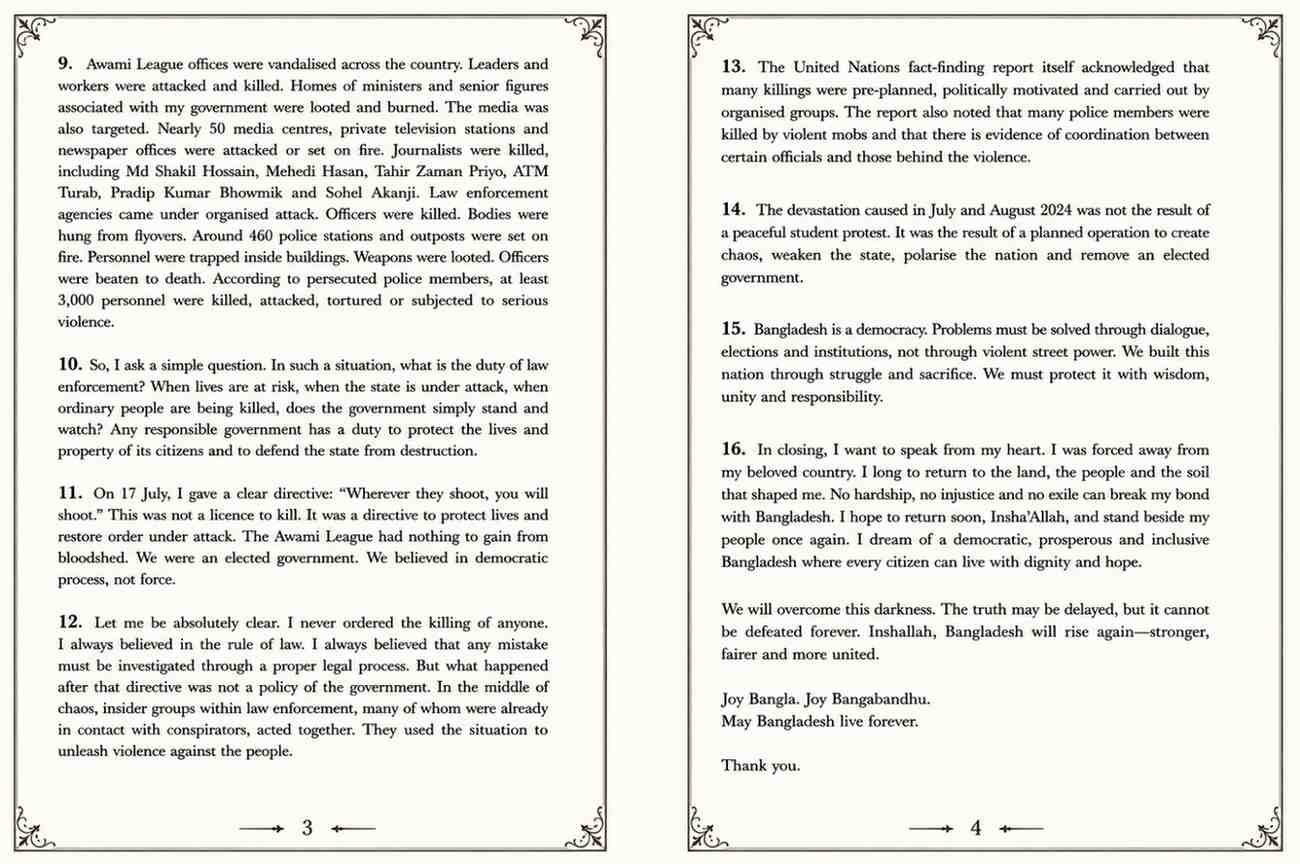
The Awami League supremo also cited statements by a leader of the National Citizen Party (NCP), the party formed by students of the July Uprising claiming that the “revolution” would not have succeeded if police had not been killed and the metro rail had not been set on fire, and of a Bangladesh Nationalist Party (BNP) leader in Sirajganj claiming publicly that Enayetpur Police Station was burned and police were killed to make the movement succeed.
The conspiracy did not end on 5th August, after her exit, but became a campaign of political persecution targeting Awami League and its workers, she insisted.
Citing Yunus’s statement about “pressing a reset button to wipe away the country’s history,” Sheikh Hasina alleged that the violence and conspiracy were to “erase the spirit of the Liberation War from Bangladesh.”
They want to erase the Liberation War and Bangabandhu, she remarked, adding that “they want to rewrite Bangladesh against the foundation on which it was born,” and that convicted war criminals, militants and top terrorists have been freed, with “a staged election” bringing the BNP to power.
Lamenting on the economic situation in the country, which she termed as “progress being destroyed and ordinary people paying the price,” for falling growth, poverty, and industrialists’ and business owner either in hiding or being jailed, Hasina talks about her five terms in office during which she claimed to have used “long-term planning, sound financial management and disciplined implementation to place Bangladesh on a strong foundation.”

Image supposedly of Sheikh Hasina escaping shortly before the protestors took over the Prime Minister's residence
Demanding the ban on the Awami League to be lifted and political prisoners to be released, Hasina calls for healing and national reconciliation, while also seeking legal action against “those who conspired against the country, committed crimes and caused suffering.”
Shortly after Hasina’s media interaction in New Delhi, the Bangladesh Ministry of Foreign Affairs released a hard-hitting statement expressing ‘outrage’ and criticising the Indian government for allowing this event “in spite of concerns expressed apriori… about the likely ramifications… on the reset of our bilateral relations.”
Describing Hasina as an “absconding convicted genocider,” the Ministry alleged that India allowed her to engage in a live interaction with the media “where she and her henchmen launched venomous vitriol against the state of Bangladesh and her people.”
The statement further said:
“On a day when the people of Bangladesh are observing the second anniversary of the July Revolution, this interaction… on the Indian soil stands as an affront to the sovereignty of Bangladesh and a grievous insult to the martyrs of the July Revolution. The denial of facts established by the United Nations, including the gruesome killing of innocent civilians…during July-August 2024 by the fascist regime, stands as a futile attempt by the absconding convicted mass murderer Hasina and her criminal cohort to reverse the tide of history.”
Affirming the people of Bangladesh have resolved not to go back to the “dark days of fascism,” the Ministry used the opportunity to declare that Bangladesh “will never be a client state,” and that Hasina and “her mafia enterprise will never have a place in the polity of Bangladesh.”
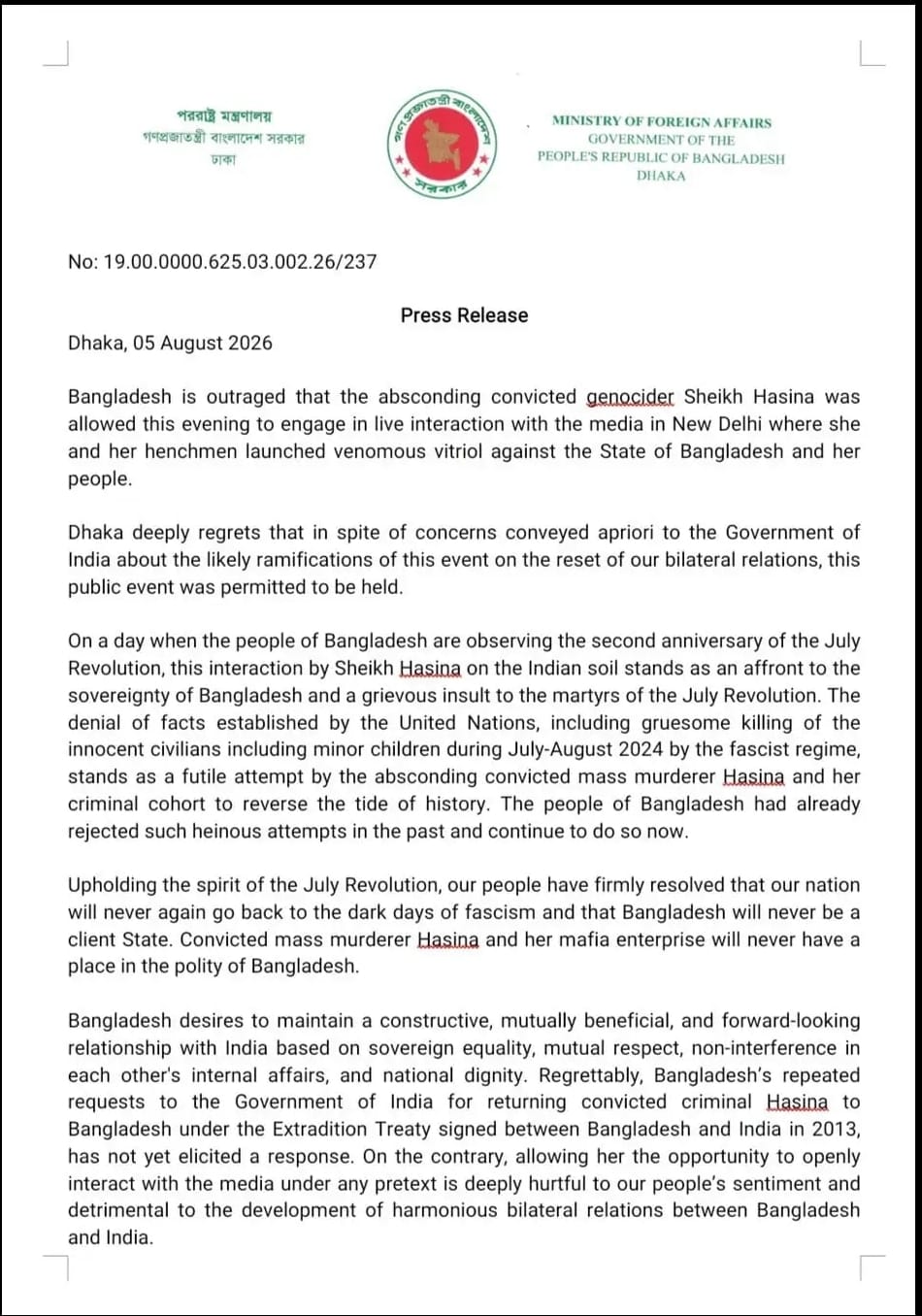
The statement makes it clear that Bangladesh desire “a constructive, mutually beneficial and forward-looking relationship with India based on sovereign equality, mutual respect, non-interference in each other’s internal affairs, and national dignity.” While this might be seen as an implicit warning, the statement reminds that India did not respond to the request to return Hasina despite the request under the Extradition Treaty signed by both countries in 2013.
On the contrary, the statement notes, India had allowed Hasina the opportunity to “interact with the media under any pretext.”
The hard-hitting statement, though on expected lines, was a departure from the earlier toned-down response from Bangladesh to the two interviews given by Hasina in June and July, in which Hasina expressed her desire to return to Bangladesh and surrender, along with her party members.
In response to Hasina’s statement in these interviews about returning to the country, the Prime Minister’s Adviser Zahed Ur Rahman remarked that while the Awami League leaders currently absconding in India are making provocative statements, the party facing a ban on its activities, “no longer has the means to destabilise Bangladesh.”
Similarly, the BBC reported an unnamed advisor to the Prime Minister as highlighting the ongoing trial of the killings during the July Uprising.
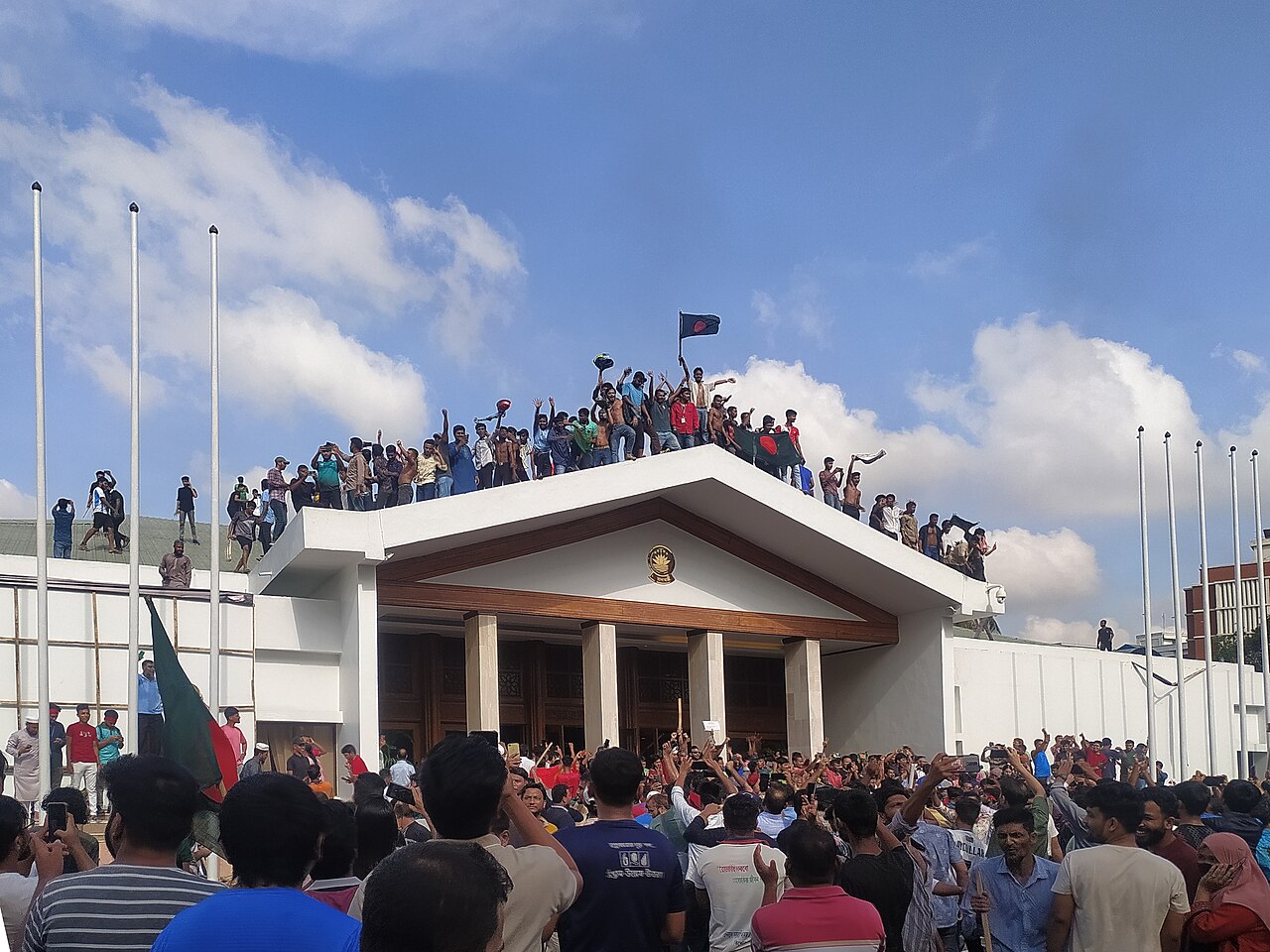
Protesters cheering from atop and in front of the Prime Minister's residence after Sheikh Hasina's exit
‘Return and surrender’
In the first interview published by to NDTV on June 29, 2026, Hasina had declared that she “will return to my country this year,” while asserting that her party is not merely an organisation but a ‘force’.” Hasina remarked that her return is “not a question of personal ambition,” but tied to the larger question of “political rights of the people of Bangladesh, the restoration of democracy, the rule of law, and the spirit of our Liberation War.”
Asserting that she does not fear death, Hasina declared in that interview that the verdict against me is not justice, but part of an “illegal, unconstitutional, and politically motivated process.” The judiciary, she claimed, has been turned into an instrument of political revenge to make the Awami League leaderless. In the same vein, Hasina declared that the Awami League is “not a paper organisation, but a political force rooted in the soil of Bengal.”
In her second interview, published by Reuters on July 10, 2026, Hasina repeated her decision to return to Bangladesh and informed that her party members will also join “voluntarily,” appear in court and surrender. “
“Almost all our leaders and activists have been charged, and many are in hiding. So, I said, this time I am returning home, and one day you all come too. We will all surrender to the court together,” Hasina is quoted by Reuters.
Stirring the ‘political’ waters
Other major parties in Bangladesh have responded to Hasina’s statements, in fact, well before the New Delhi press conference.
The convenor of the National Citizen Party (NCP), the party formed by students of the July Uprising, Nahid Islam, remarked, “ Hasina should return only to face execution of her death sentence”.
Independent member of parliament from Brahmanbaria-2, Rumeen Farhana, stated that there is no legal barrier to Sheikh Hasina’s return to Bangladesh and that she would have to follow the legal process upon her return.
Apart from political commentary, Bangladesh’s national and international newspapers are assessing the feasibility of Hasina’s return and the political conditions that would accompany it.
A popular Bengali daily, Prothom Alo, published a column titled “What is the political future of the Awami League, whose activities have been banned?” Another column in the same newspaper went by the headline: “How realistic is the announcement of Sheikh Hasina’s return, and how prepared are the leaders and activists?”
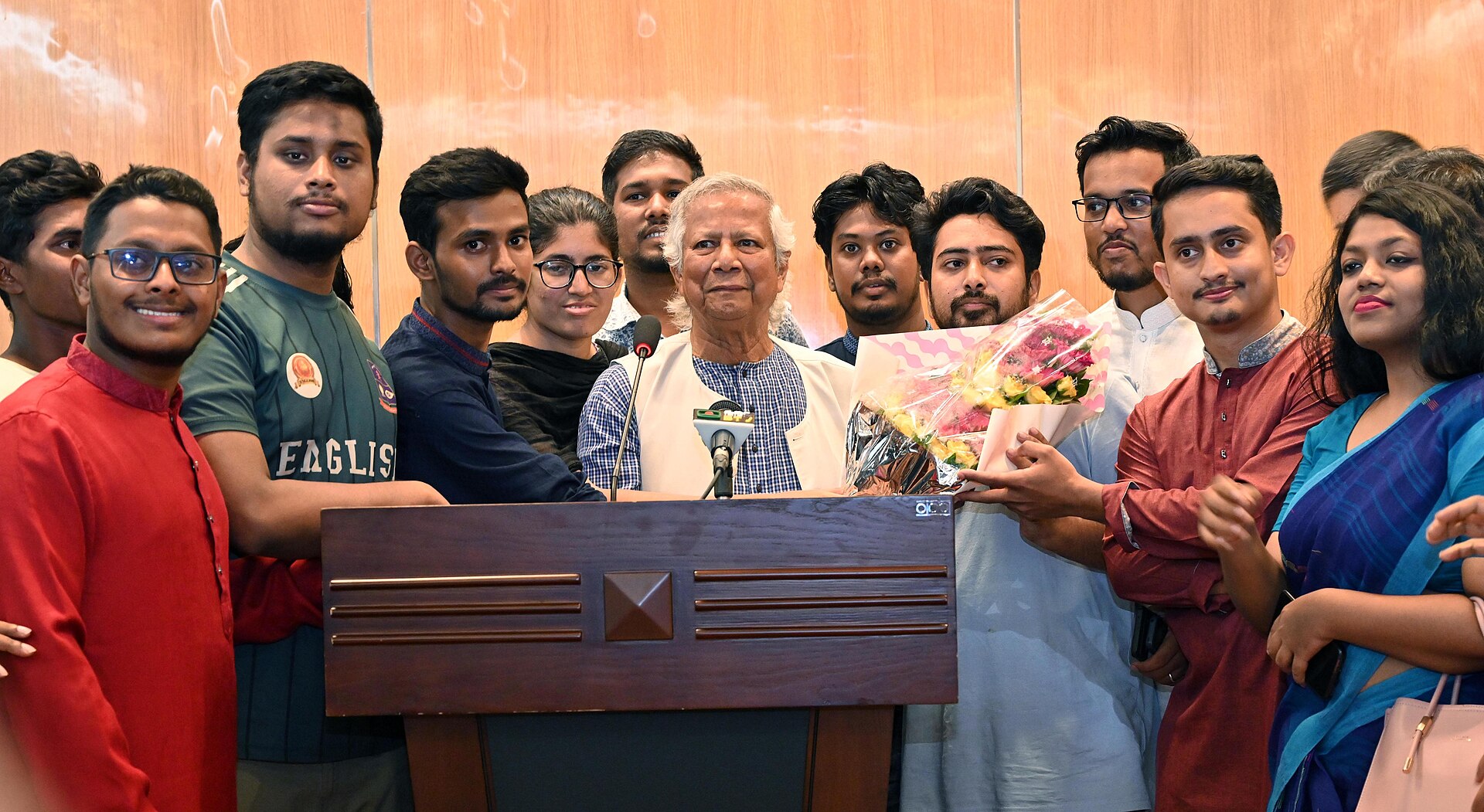
Professor Muhammed Yunus being received by the Students Against Discrimination coordinators upon his arrival in Bangladesh on 8 August 2024
The Ganotaar headlined “Why Hasina’s December Return Might Be About Everything Except Actually Returning.” The BBC, for its part, headlined: “What will happen if Sheikh Hasina returns to the country?”
More importantly, on 26 July, the International Crimes Tribunal-2 took cognisance of the charges against 11 people, including ousted prime minister Sheikh Hasina, former home minister Asaduzzaman Khan, and Awami League General Secretary Obaidul Quader, over the killing of former Teknaf municipality councillor Akramul Haque.
The charge sheet also names former lawmaker Abdur Rahman Bodi, former inspector general of police Benazir Ahmed, and six former Rapid Action Battalion (RAB) officials in the crimes against humanity case.
On July 5, the chief prosecutor of the ICT announced that an investigation is currently underway to try the Awami League as an organisation under the International Crimes Tribunal (ICT) Act, with the legal possibility of banning the party and confiscating its assets if the allegations are proven.
Hoist by one’s own petard
An interesting paradox was evident in the tactics used by the Interim Administration of Bangladesh, headed by the Chief Advisor Professor Mohammed Yunus, who allegedly went on to employ authoritarian methods to maintain power.
This reflects the dynamics explained in a December 2025 letter from three UN Special Rapporteurs to Professor Yunus. While the document is cautious in its legal language, its content engenders considerable concern.
The three communications, signed by the Special Rapporteur on counter-terrorism and human rights, the Working Group on Arbitrary Detention, and the Special Rapporteur on the independence of judges and lawyers, raised concerns about the broad prohibition on the Awami League from May 2025.
The Rapporteurs tried not to “prejudge the accuracy” of underlying allegations, but the evidence that they marshalled did not afford much space to indulge in charity.
It was particularly interesting to carefully consider the legal frameworks put in place to support the ban. In the span of mere months, the Interim Administration changed both the Anti-Terrorism Act 2009 and the International Crimes (Tribunals) Act 1973.
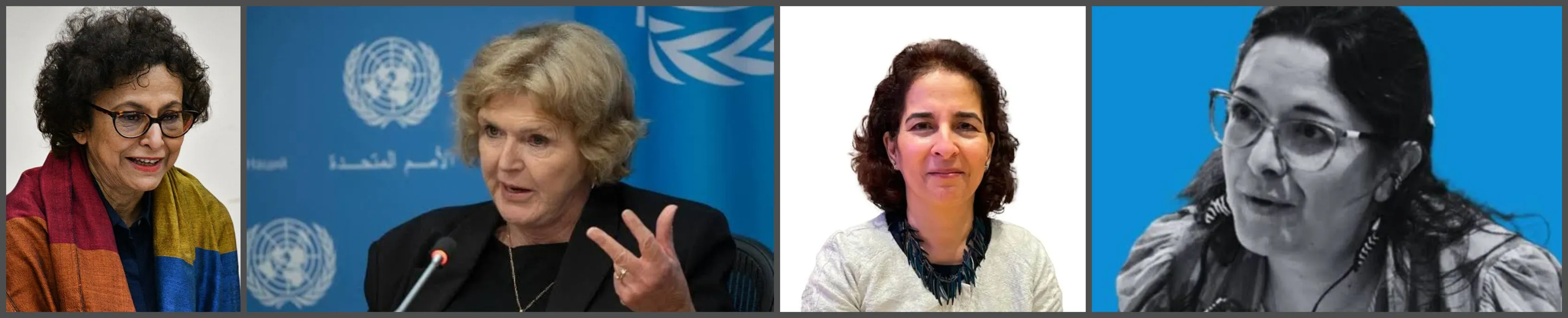
The UN Rapporteurs (from the left): Irene Khan, Mary Lawlow, Nazila Ghanea and Gina Romero
The latter is a law introduced to punish such atrocities during the 1971 Liberation War and to empower the organisations to be suspended, dissolved, and have their assets confiscated for activities of “aiding, inciting or facilitating” international crimes.
The revoked Anti-Terrorism Ordinance extended the ban to include not just the party’s actions, but “any publicity” issued in connection with them. This comprised the recorded statements of the press, social media posts, and public gatherings.
Both these amendments were published in the gazette, followed by an immediate ban on the Awami League. The timing of these legislative modifications being enacted and enforced, without prior notification to the affected party, judicial oversight, or a hearing, represented a set framework.
This was explicitly criticised by the UN Rapporteurs, who pointed out that it evaded the established legislative process, did not satisfy the international legal requirement for restrictions on association to be “properly authorised by law, and did not provide fundamental due process protections.
Perhaps the most destructive aspect of this episode was the deployment of counter-terrorism powers against a political party. The Rapporteurs pointed out that, under international standards, an organisation must have a “substantial purpose” to be deemed a terrorist organisation, rather than merely having some affiliated individuals engage in violent activities.
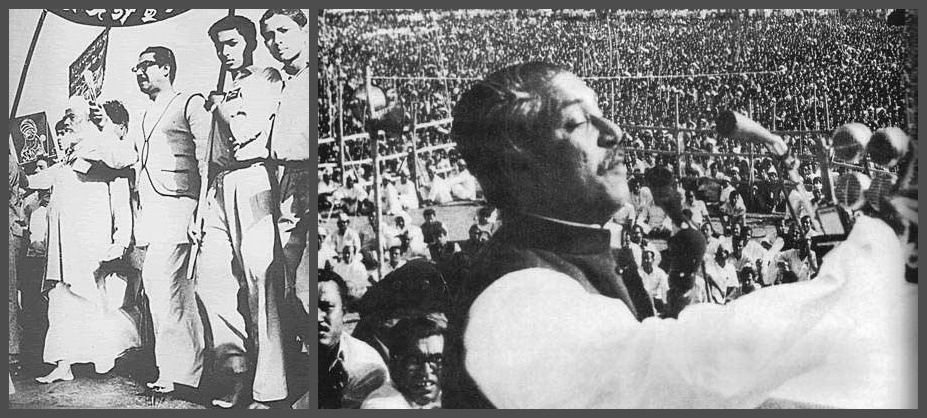
Moulana Abdul Hamid Khan Bhashani and Sheikh Mujibur Rahman marching barefoot to pay their tributes on Language Movement Day of 1953 (left), and Mujibur Rahman addressing a huge crowd after the formation of Bangladesh
The Awami League is a party with over seven decades of parliamentary engagement, established in 1949, and has a membership of 1 million. The terrorism designation effectively suspended the entire organisation, banning all its activities from democratic life for an indefinite period.
During the trials, the whole organisation was banned from democratic life, not lifted because of the terrorism label and the ban on all of its activities. The Rapporteurs were not looking to underestimate the seriousness of the Hasina government’s actions.
The Office of the United Nations Commissioner for Human Rights (OHCHR) had already recorded about 1400 deaths in the protests during the year 2024. Extrajudicial killings, torture, and arbitrary detention were allegedly being practised systematically during the Sheikh Hasina reign.
Those crimes are justifiable and warrant accountability, though it is not seen as legitimate to conflate a specific criminal offence with the general punishment given to an entire political movement.
The pace of these sessions left the Rapporteurs with little doubt that preparation time for defence was inadequate, a point echoed by Human Rights Watch and Amnesty International. Those trying to defend the former government were reportedly targeted for harassment due to inequality of arms.
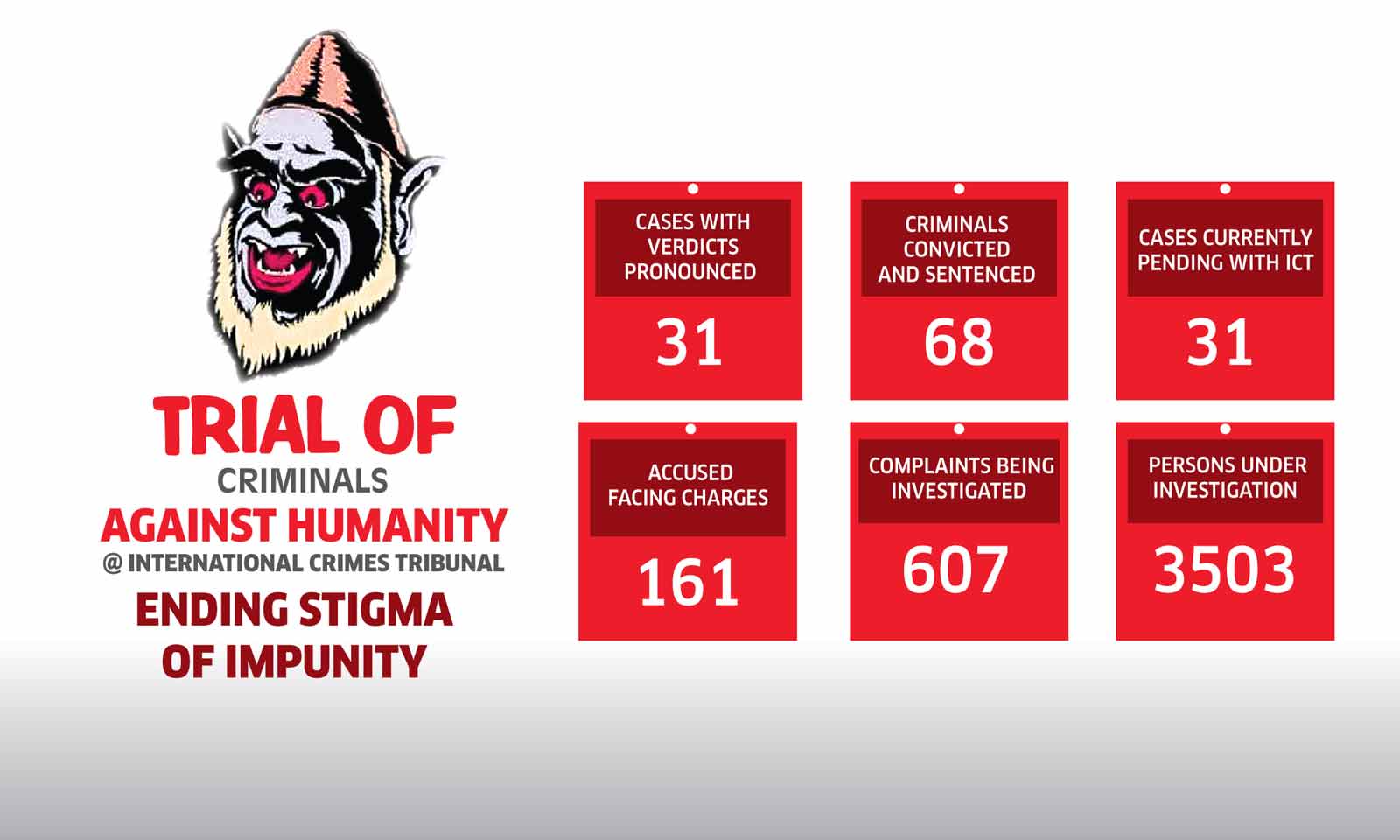
An Awami League poster of the 1971 war crimes trial
Hasina, in fact, had characterised the tribunal as an “unelected” government's “rigged” tool. She has used the same court that convicted in 2010 political figures suspected of war crimes in 1971 against opponents such as the Jamaat-e-Islami (JeI).
A court that failed to meet international standards under Hasina has now been used against her. Yet again, it has failed to meet these norms: the symmetry is striking and not entirely reassuring. Amnesty International deemed the trial and its subsequent execution “neither fair nor just” and a “compounding of human rights violations.”
In the meantime, a blanket immunity order will shield those who attacked and killed AL members during the transition of power in August, 2024. The message was clear: “Violence against supporters of the old regime will be forgiven, and the persecution of the regime will be sped up.”
The larger picture painted during the interim administration’s period strengthens this impression: between 11,000 and more than 14,500 arrests under Operation Devil Hunt (actual numbers from police and rights organisations), the presence of journalists and lawyers in prison, and an important political party barred from the country’s first elections in many years.
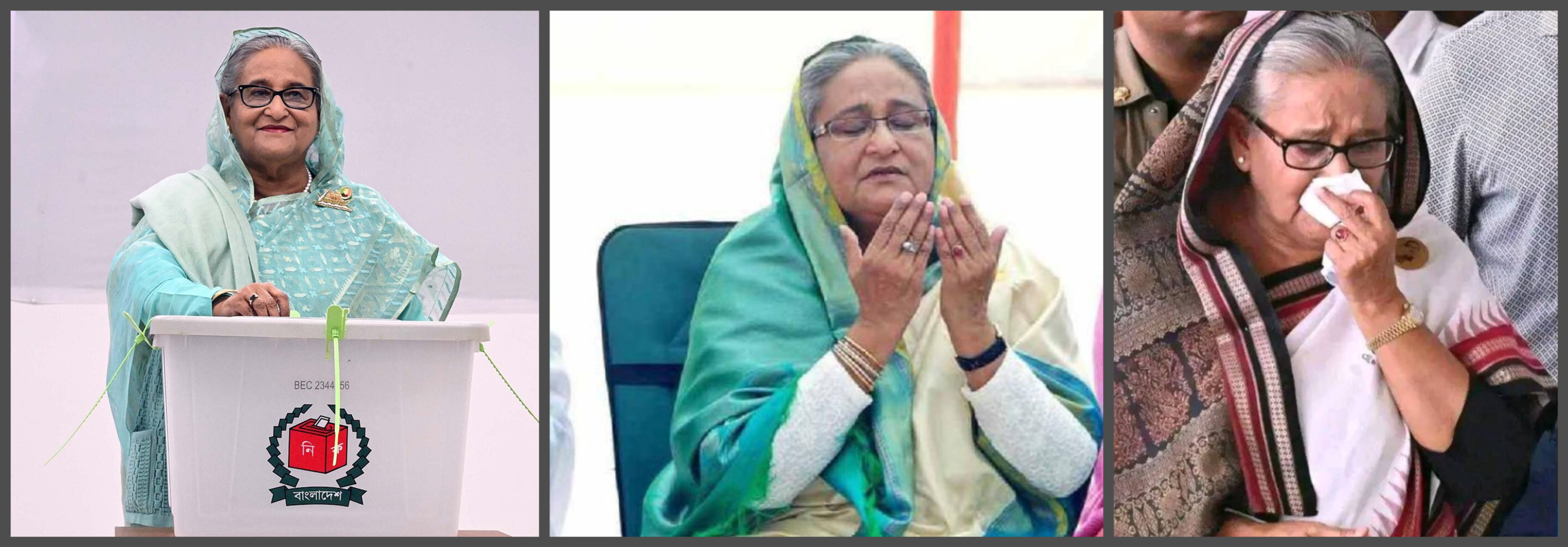
Many shades of a fallen leader
This is noted on the formal record in the United Nations letter. In the short term, it does very little other than preventing one from claiming lack of oversight. The larger connotation is the complete elimination of a level playing field and prospects of a free and fair legal process.
While Sheikh Hasina was alleged to have practised these same circumstances when the alleged “war criminals” of 1971 were tried, it would be a déjà vu if and when she returns to the country, seeking to reopen cases against her for a fresh trial while annulling the ‘death sentence,’ which, in the current conditions, looks improbable.
(Views expressed in this report are the author's own.)
Follow us on WhatsApp
Follow us on Facebook
Follow us on X @vudmedia
Follow us on Substack
