
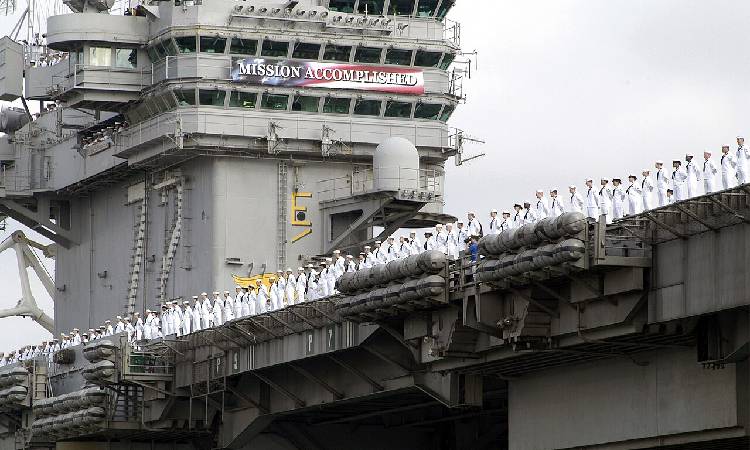
For someone who had declared, “no more stupid wars,” during the 2024 presidential campaign, and having consistently projected himself as antithetical to Washington’s ‘deep state’ since his 2015 campaign, US President Donald Trump’s decision to launch military strikes on Iran, twice in a gap of nine months, in his second tenure, might not just be reflective of his whimsical behaviour, but could more be echoing how American presidents have approached statecraft once in office. By exercising war powers without constitutional accountability or congressional sanction, US Presidents have sought to pursue wars that have rarely proven beneficial for American grand strategy and, instead, more often bled its military might. From Vietnam through Somalia, Iraq and Afghanistan, Trump’s Iran campaign comes in a long list of military setbacks that are a result of presidential action that sidestepped wise counsel, says Professor Stephen Burgess.
Home page image: A Boeing B-52 dropping bombs over North Vietnam during Operation Rolling Thunder, Photo credit - USAF
Text page image: The crew up on the deck of USS Abraham Lincoln carrying the 'mission accomplished' banner, after operations against Iraq; photo credit - Mate 3rd Class Juan E. Diaz (US Navy)
Banner image: The Marine One takes off with President Donald Trump from the White House lawn
The United States of America, or the US, continues to fight wars with no clear strategy and unrealistic goals, leading to suboptimal outcomes and even defeat. The powerful US military instrument allows American presidents, who often downplay strategic advice and are largely unchecked by the US Congress, to use force with overconfidence in the outcome.
American airpower and sea power enable presidents to use force without concern for the cost as long as casualties are minimised. Without much knowledge of the military and strategy, they still tend to believe that sufficient force will defeat adversaries and enable the US to dictate post-conflict terms.
The US President Donald Trump and Israeli Prime Minister Benjamin Netanyahu began the Iran war on February 28, 2026, with the expectation, evidently unrealistic, that an intense bombing campaign and leadership decapitation would lead to regime change and an end to Iran’s nuclear enrichment campaign and the possibility of developing nuclear weapons.
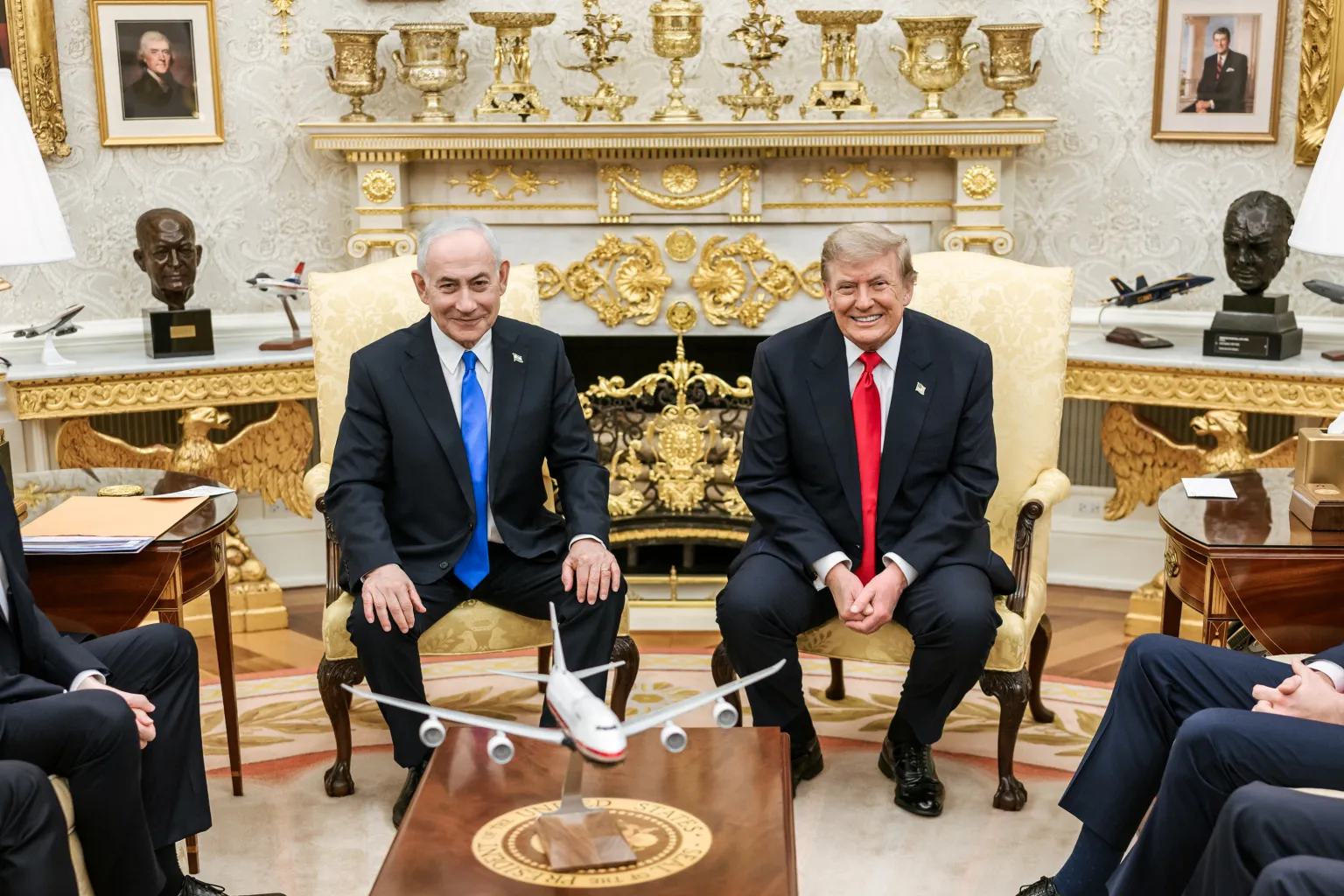
President Donald Trump and Israeli Prime Minister Benjamin Netanyahu at the White House, in their July 28, 2026 meeting
Both leaders were unwilling to risk high casualties by putting “boots on the ground” to remove the regime.
Both started the war without definitive intelligence that regime change or nuclear curbs were even possible, though the US Central Intelligence Agency (CIA) and Israel’s Mossad were reportedly tracking the Iranian leaders and reportedly guided the initial strikes on the top Iranian leadership, including the attack that killed the Iranian Supreme Leader Ayatollah Khamenei.
Trump and Netanyahu disregarded the fact that the Iranian regime had powerful security forces with regional military reach and with the demonstrated ability to repress internal opposition.
Days after the war began, it became clear that US and Israeli goals were unachievable. Leadership decapitation did not achieve regime change nor led to the establishment of a more pliable negotiating partner with the new Ayatollah – Mojtaba, son of slain leader Khamenei – known to be a hardliner, and staying away from public appearances, reportedly fearing assassination attempts by the US-Israeli forces.
Iran’s new leadership does not trust the US President, Donald Trump. After all, he had rejected the 2015 Joint Comprehensive Program of Action (JCPOA) that placed curbs on Iran’s nuclear programme. In June 2025, Trump ordered Operation Midnight Hammer, which targeted Iranian nuclear sites in Fordow, Isfahan and Natanz.
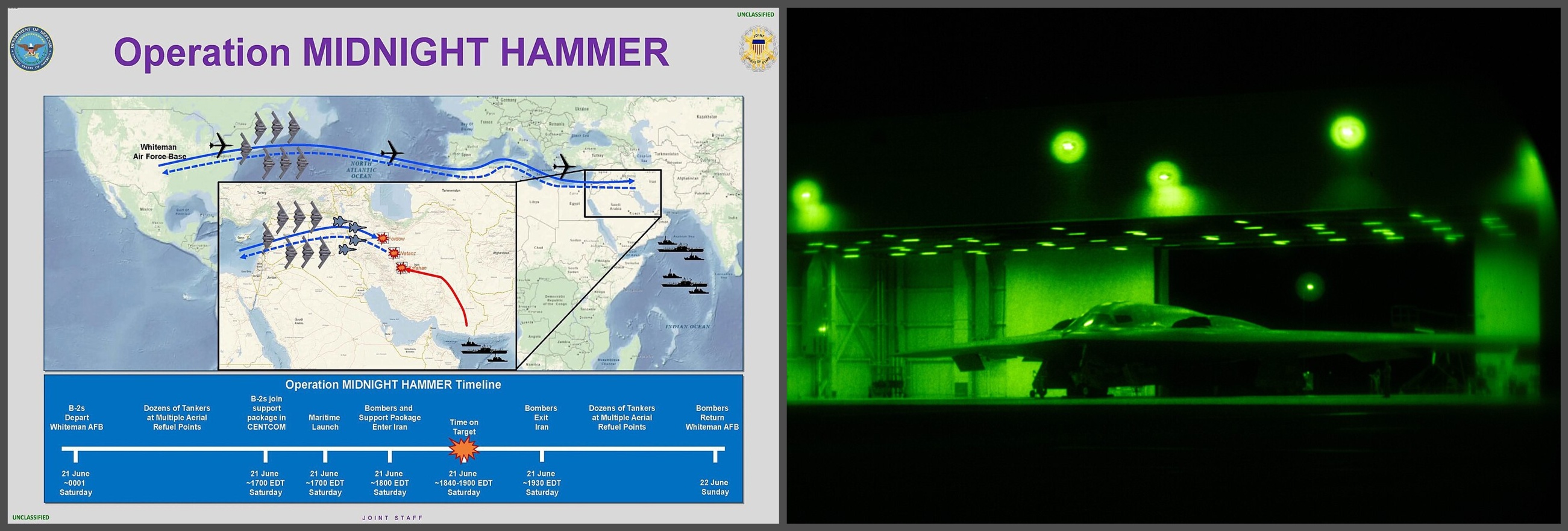
An infographic on Operation Midnight Hammer (left), and a B-2 Spirit deployed for the Operation, at an undisclosed location
Declaring Operation Midnight Hammer ‘historically successful,’ US Secretary of War Pete Hegeseth remarked that the “…most complex and secretive military operation in history” was a “resounding success, resulting in a ceasefire agreement, and the end of the 12-day war.” Because of decisive military action, President Trump “created the conditions to end the war, decimating – choose your word – obliterating, destroying, Iran’s nuclear capabilities.”
In his 8-minute video of February 28, 2026 justifying Operation Epic Fury, Trump had repeated these claims – of Operation Midnight Hammer having “obliterated the regime’s nuclear program at Fordo, Natanz and Isfahan” – and claiming that the US sought to repeatedly make a deal to ensure that Iran did not resume “their malicious pursuit.”
Trump went on to remark:
“They wanted to do it. They didn’t want to do it. Again, they wanted to do it. They didn’t want to do it. They didn’t know what was happening. They just wanted to practice evil. But Ian refused, just as it has for decades. They’ve rejected every opportunity to renounce their nuclear ambitions, and we can't take it anymore. Instead, they attempted to rebuild their nuclear program… and can now threaten our good friends and allies in Europe, our troops stationed overseas, and could soon reach the American homeland.”
In his first tenure, Trump had ordered the strike on Baghdad airport in January 2020 that killed General Qassem Soleimani, head of Iran’s elite Quds Force and Abu Mahdi al-Muhandis, the deputy commander of the Iran-backed Popular Mobilisation Forces.
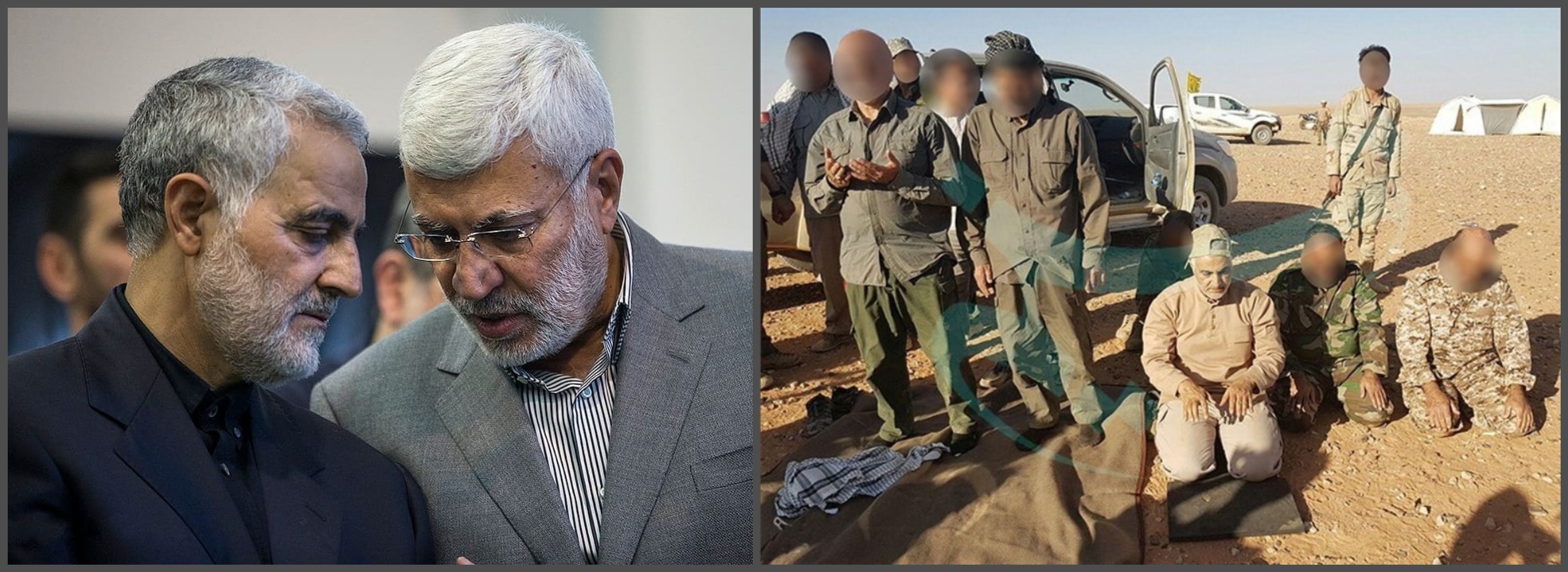
Qassem Soleimani with Abu Mahdi al-Muhandis, photo source - Fars Media Corporation (left), and Soleimani praying with soldiers in the Syrian_Desert, June 2017, photo source - Tasnim news agency (right)
The objective of enforced regime change was inherent in how Iran’s top leadership, including Ayatollah Khamenei, became the initial targets at the beginning of Operation Fury/Roaring Lion. Having decapitated many of the country’s leaders, and swerving from use of force to ceasefires and negotiations, Trump is detested and distrusted by the new regime in Tehran.
It might also explain the regime’s intransigent approach when it comes to progressing from the Memorandum of Understanding (MoU) signed between Trump and his Iranian counterpart, Masoud Pezeshkian, on June 17, 2026, which led to what many had felt would be the conclusion of the war.
Instead of capitulating to the combined forces of the US and Israel, Iran quickly used its “trump” card by closing the Strait of Hormuz and attacking US allies in the Persian Gulf. Iran’s Lebanese ally, Hezbollah, attacked Israel with drones and missiles that drove a wedge between Netanyahu, who wanted to continue to counterattack and President Trump, who pushed for a ceasefire to placate the Iranians.
Quickly, it became evident that the war had produced a strategic setback for the US and Israel. Even so, President Trump continued to order the use of military force months later.
A president on the loose
In the US, the war against Iran quickly became unpopular as gas prices and inflation rose, increasing the prospect that Trump’s Republican Party would lose control of one or both houses of Congress in November’s midterm elections.
Even though he would be facing a hostile Congress in 2027, President Trump has continued to order the use of force to open the Strait and curb Iran’s nuclear programme. The temptation to use force has outweighed Trump’s emphatic presidential campaign promise – of “no more stupid wars.”
The inability to hold the president accountable reflects flaws in the American democratic system, rooted in the articles of the US Constitution, giving the president command over the US military and Congress the power to declare war.
American presidents have a record of ordering the use of military force without consultation with or checks by Congress. Presently, a Republican-controlled Congress is unwilling to use the 1973 War Powers Act in an attempt to stop the use of force.
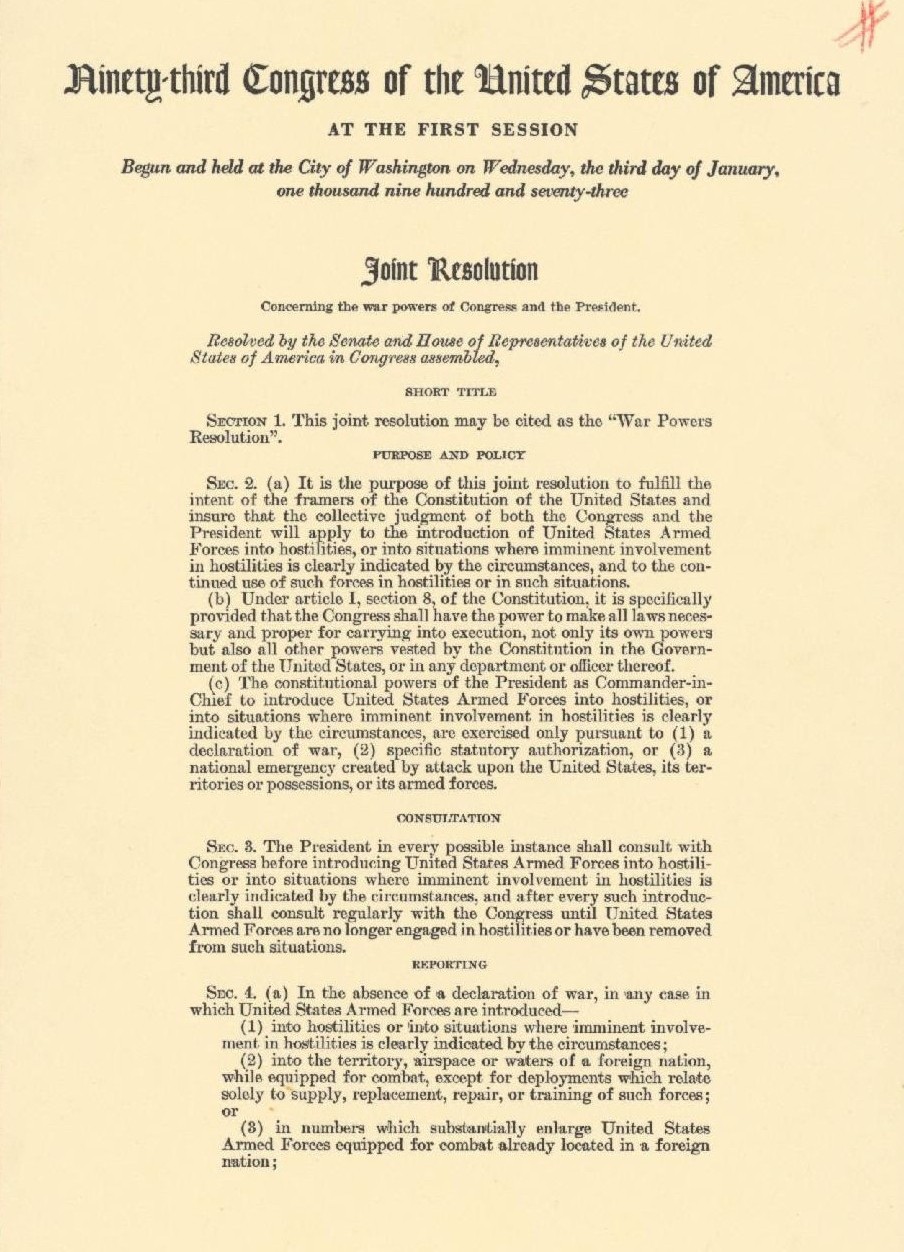
This is mainly because Republican senators and representatives are fearful of Trump’s ability to remove them through primary elections. Even if a Democratic-controlled Congress invoked the act, there is no guarantee that President Trump would abide by it, given his claim of unfettered presidential authority.
Another flaw is presidential term limits. President Trump does not face re-election; hence, he can continue the war as long as he sees fit without electoral consequences. This is besides the fact that Trump had on numerous occasions espoused his interest in fighting for a third term, which the US Constitution does not provide for.
Citing the 22nd Amendment, which forbids a third term, supporters of Trump’s presidential chances in 2028 claim that the amendment only prohibits a re-election to a third term, but not a succession.
Various scenarios, including Trump contesting as running mate to J.D. Vance and then succeeding the latter to White House, following his resignation, are being mulled. Others cite the provision in the 22nd Amendment, which makes a two-term president ineligible to hold the office of the vice-president.
The checkered record of presidential war powers
The present crisis is eight decades in the making. The rivalry with the Soviet Union during the Cold War led to an enormous expansion of presidential military power, especially the power to launch nuclear weapons and incur tens of millions of casualties without congressional approval.
Most of the conflicts that the US has been involved in since World War II have encountered setbacks due to overly empowered presidents with unrealistic strategies and Congress’ inability to assert its authority.
On many occasions, presidents have used their commander-in-chief power to send troops into harm’s way. Presidents John F. Kennedy, Lyndon B. Johnson, and Richard Nixon escalated US involvement in the Vietnam War with an unrealistic strategy and a Congress that initially rubber-stamped troop deployment.
The US Congress was only able to check the president’s powers in 1973 by cutting off funding for the South Vietnamese military. The war led to huge losses of blood and treasure and a humiliating defeat.
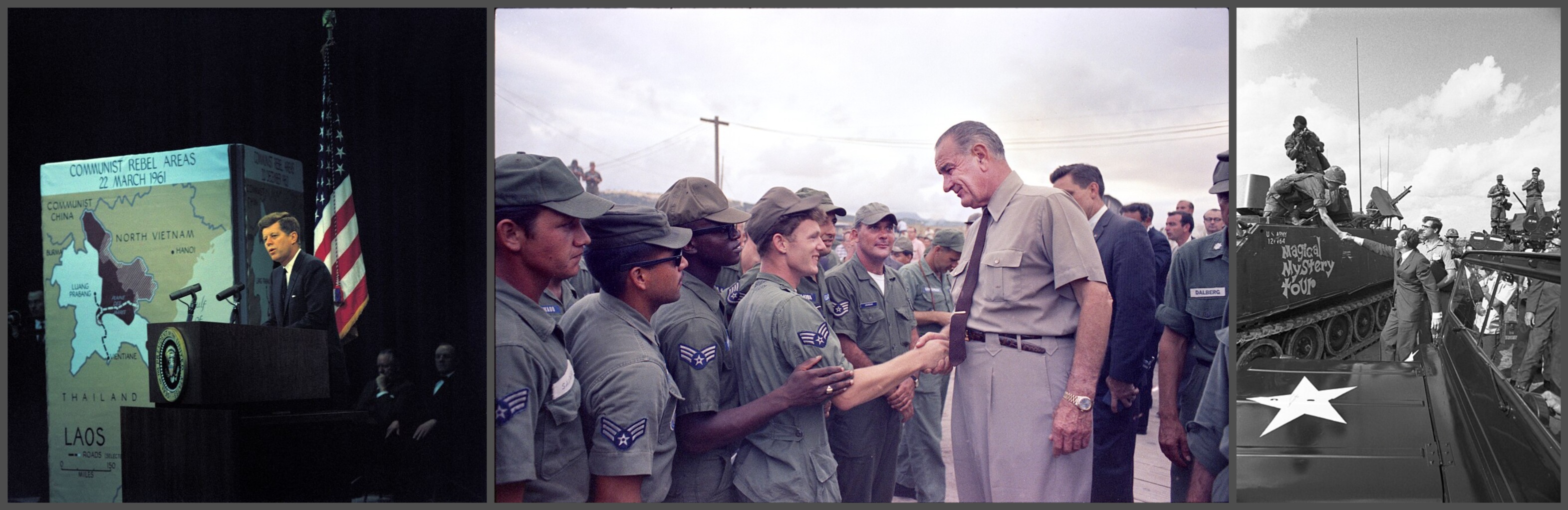
The three presidents of the Vietnam War: Kennedy speaking at a White House press conference, photo credit - Cecil W. Stoughton (left), Johnson visits US soldiers at Cam Ranh Bay in South Vietnam, October 1966, photo credit - Yoichi Okamoto (centre), and Richard Nixon greets US Army soldiers in South Vietnam, July 1969, photo credit - Nixon Library
In the wake of the Vietnam War, the US Congress passed the War Powers Act into law over President Nixon’s veto. Many presidents, though, had disputed its constitutionality.
In 1982, President Ronald Reagan sent 1,800 US Marines as “peacekeepers,” without clear intelligence and a strategy, into a violent civil war zone in Lebanon, with the resulting loss of 241 service personnel by October 1983.
President George H.W. Bush deployed the US military to anarchic Somalia in 1992, in what was said to be a humanitarian mission, but without an end state. This mission went through an escalation during the tenure of the Clinton administration in 1993. The resultant military setbacks, especially the death of US military personnel, caused the mission to retreat.
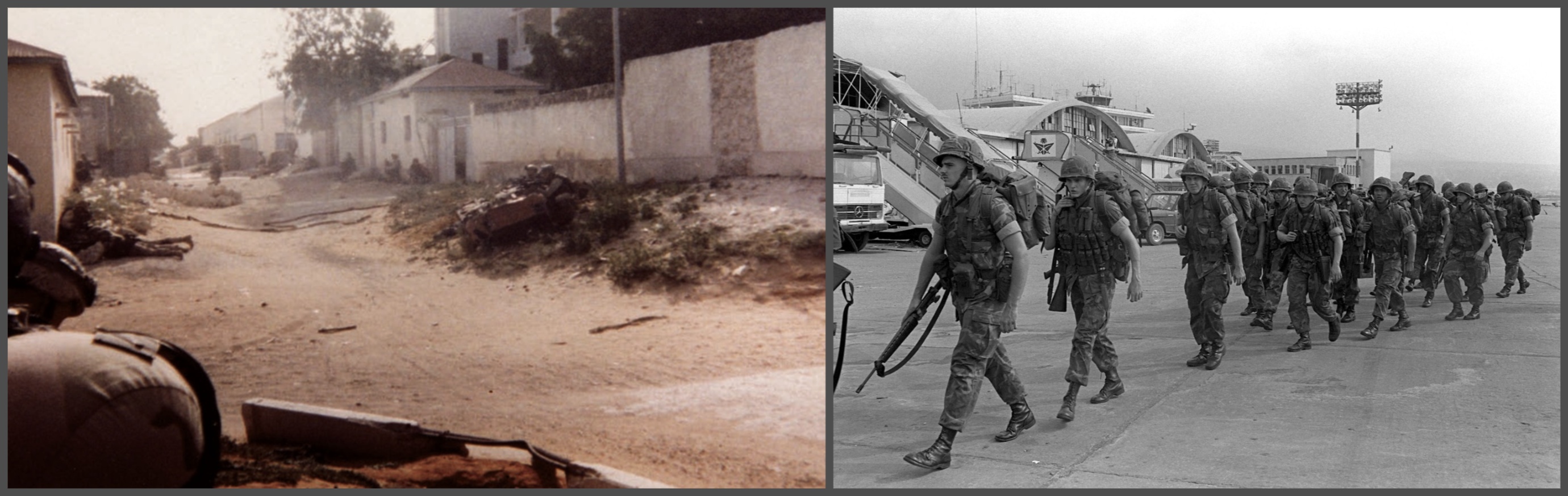
Members of Task Force Ranger under fire in Somalia on October 3, 1993, during Operation Code Irene, also known as the Battle of Mogadishu (where a Black Hawk was also downed), (left), and US Marines marching across the runway apron of Beirut International Airport upon arrival in Lebanon
Congressional outrage led to the rejection of militarised humanitarian missions that risked the lives of US military personnel. Multiple American presidents have deployed US forces to Afghanistan between 2001 and 2021, by indulging in the use of force with no clear endgame, and ever-expanding goals that could not be fulfilled.
Pakistan's support for the Taliban, until their recent estrangement, made it impossible for the US to help consolidate the regimes it had established – by Hamid Karzai (2001-14) and Ashraf Ghani and Abdullah Abdullah (2014-21). Nevertheless, the US persisted in maintaining the military mission in Afghanistan even after the death of Osama bin Laden, the al Qaeda chief and 9/11 mastermind, in May 2011.
During this time, the US Congress was unable to use the War Powers Act to compel the president to withdraw US troops. Eventually, though, the US had to withdraw in a humiliating fashion in August 2021, following the Taliban’s return to Kabul.
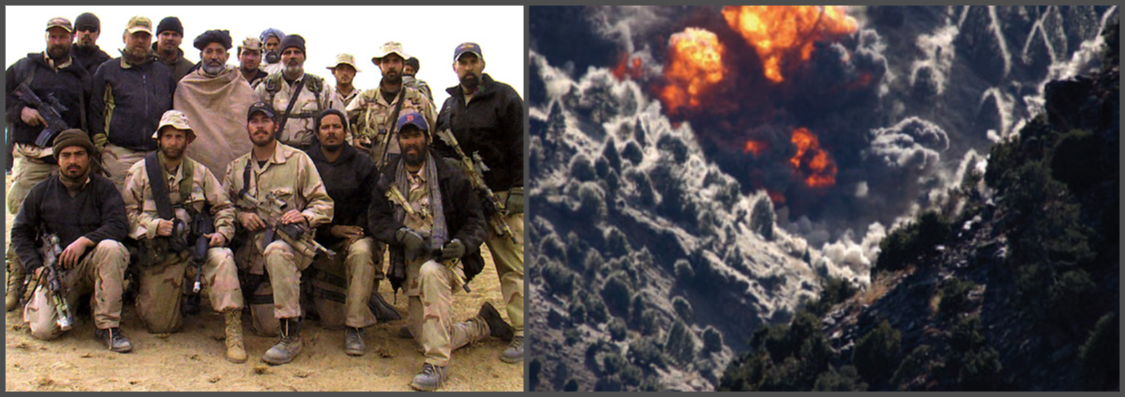
US Army Special Forces with Hamid Karzai in Kandahar province (left), and Air strikes on Tora Bora caves, photo credit - Juliet Forward (right)
Even worse was the US strategic failure in Iraq. The George W. Bush administration used American anger after the 9/11 attacks, and the alleged conspiracy to assassinate ex-president George H. W. Bush, to gain authorisation from a compliant Congress for the invasion of Iraq.
The administration used flawed intelligence to convince the US Congress to authorise the invasion, as well as form a ‘coalition of the willing’ nations. The lack of a strategy to deal with the collapse of the Saddam Hussein regime led to eight years of deadly conflict and eventual withdrawal of US and coalition forces in 2011.
In 2007, the Democratic Party used popular disapproval of the war to gain control of Congress and attempted to impose the War Powers Act. When it was unable to do so, it was unwilling to cut off funds for operations in Iraq due to popular support for the military.
President Bush ignored congressional disapproval and pressed ahead with the “surge” of military forces to Iraq, also emboldened by the fact he, being in his second term, did not have to face re-election.
These cases demonstrate the president has unrestrained power to use the most powerful military instrument in the world, and that Congress and the American people have usually been unable to curb this power.
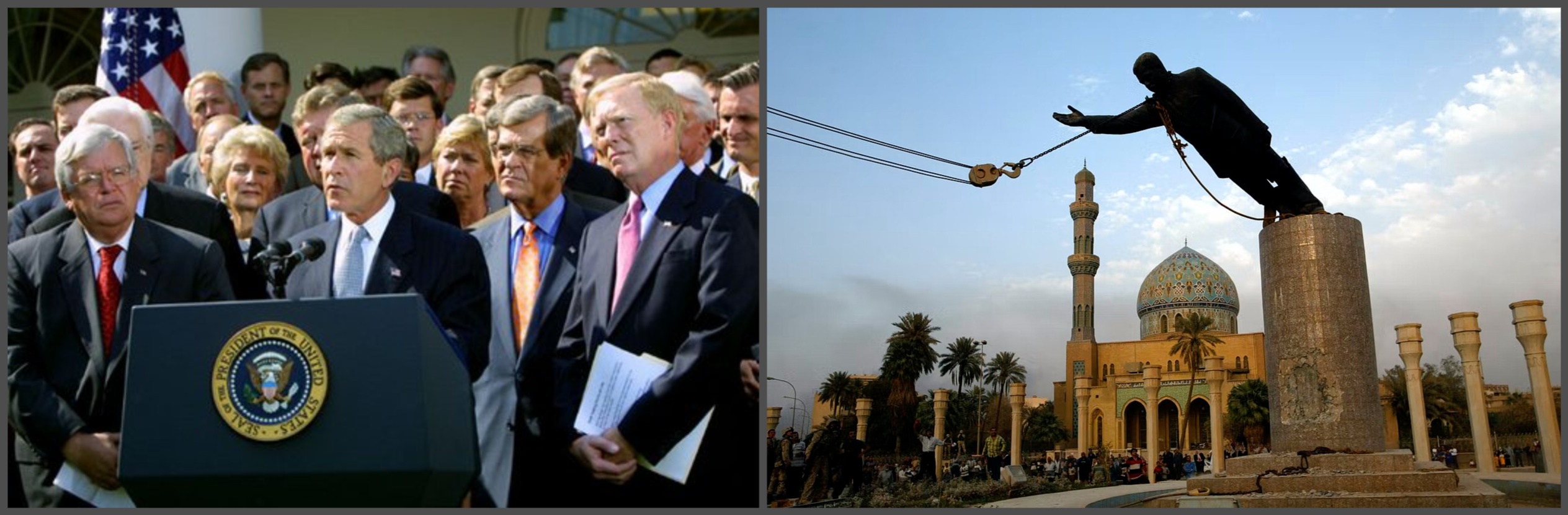
President Bush, along with members of Congress, announcing the Authorisation for Use of Military Force Against Iraq Resolution, October 2002; photo credit - Paul Morse (left), and a statue of Saddam being toppled in Firdos Square, Baghdad in April 2003; photo credit - Wikimedia Commons
Most democracies limit war powers
American presidents continue to use military force without a clear path to success and with little concern for national interest. By that standard, American presidential power is closer in nature to that of a dictatorship than to a democratic executive.
In many ways, Trump’s unfettered decision to go to war with Iran most closely resembles Vladimir Putin’s decision to invade Ukraine in 2022. As in Russia, the Trump administration provided little information to the legislative branch and to the population and did not request to wage war.
In contrast, executives in major democracies around the world are constrained by constitutional curbs that enable parliaments to approve or disapprove the use of military force. Also, most democracies have nothing close to the level of military capabilities that the US possesses.
Hence, even if democratic leaders were given the green light to use military force, operations would be limited in size and scope, as opposed to the massive campaign of bombing that the Trump administration unleashed against Iran.
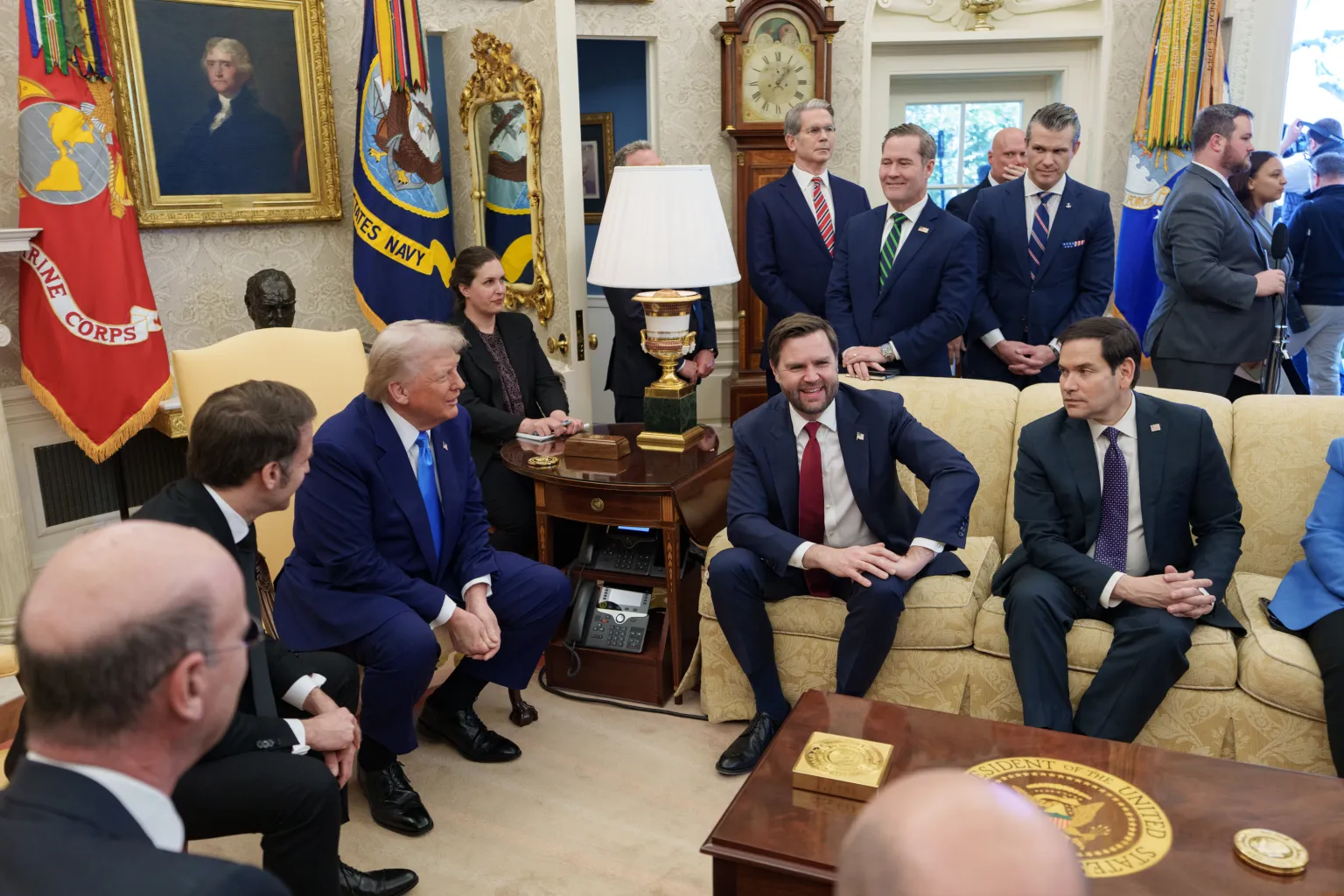
President Trump, Vice President J D Vance and Secretary of State Marco Rubio with the French President Emmanuel Macron at the White House
President Trump, for his part, continues to be unconcerned with the rising unpopularity and costs of the war and the growing likelihood that his party will lose control of one or both houses of Congress at the end of the year.
Equally, the American president also seems less worried about the economy, performance of stock exchanges and the bond market than he was at the outset of the war.
At the moment, the US is running short of weapon stocks, including defensive missiles to protect troops and allies in the region, as well as the Iranian targets to bomb. The war seems to have ground to a halt, with Trump and Netanyahu failing to achieve any of their key political goals.
Besides ending up facilitating a more hardliner regime in Tehran, Trump and Netanyahu are unable to counter the continuing Iranian stranglehold over the Strait of Hormuz, even while intimidating US allies in the region. With no major commitments offered by Tehran on the nuclear programme in the MoU of June 2026, the argument about curtailing and obliterating Iran’s ‘nuclear ambitions’ also falls by the wayside.
More widely, the US allies and partners in Asia, Europe, Africa, and Latin America continue to suffer the economic fallout of the war. Trump’s last hope of pressurising the Islamic regime to negotiate a settlement through the naval blockade also ended up a failure.
In January 2027, a Democrat-dominated Congress is likely to initiate public hearings into the war and invoke the War Powers Act to stop further military action. It could also decide whether or not to cut off funding for this war – whose outcome could be a long-running constitutional confrontation between the US President and Congress.
(Views expressed in this report are the author's own.)
Follow us on WhatsApp
Follow us on Facebook
Follow us on X @vudmedia
Follow us on Substack
