
In 2021, before the assembly elections in Kerala, the CPI(M) State Committee decided to impose the two-term rule, which means sitting legislators for two terms cannot contest in the polls that year. Kerala’s Chief Minister Pinarayi Vijayan then told the media that this rule will apply to him as well, for the next election. In late 2025, the CPI(M) Kerala party congress in Kollam declared Vijayan as the ‘captain’ to lead the party and the LDF in the assembly elections of April 2026. Some weeks later, the CPI(M) also decided to exempt Vijayan from the 75-year age threshold, which led to a whole generation of leaders being moved out of the Politburo. While the ‘captain’ failed to steer the party to a historic third term, what stood out was not just the party succumbing to the will of one leader, but also its collective failure to pursue a leader transition in Kerala, and at the national level, when it needed to. In Part II of this analysis on the CPI(M) political decline in India, Rejimon Kuttappan traces the period from Sitaram Yechury’s stewardship to the fall of the last bastion, Kerala, also cautioning why a party that mistook loyalty for line and longevity for leadership has no obvious mechanism for the generational rupture any revival would demand.
Home page image: An AI-generated image, for representational purposes
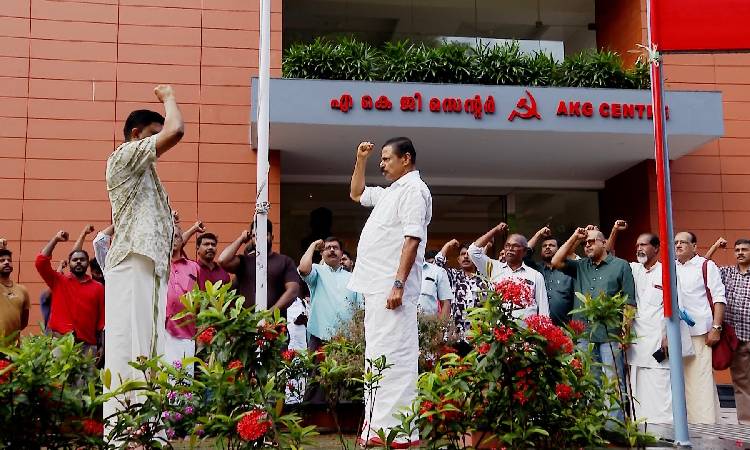
Text page image: CPI(M) Kerala State Secretary M V Govindan saluting the party flag at the AKG Centre in Thiruvananthapuram
Part 1 of this report traced the rise of Indian Communism — from E M S Namboodiripad’s swearing-in at Thiruvananthapuram on April 5, 1957, through A K Gopalan’s walking conscience and Harkishan Singh Surjeet’s coalitional craft.
The first part covered the slow corrosion that began with the 1996 refusal of Jyoti Basu’s Prime Ministership, the 2008 withdrawal of support to the United Progressive Alliance (UPA) government that Prakash Karat insisted upon, the bloodletting in Singur and Nandigram that cost Bengal in 2011, and the Bharatiya Janata Party (BJP)-Rashtriya Swayamsewak Sangh (RSS) organisational sweep that took over Tripura in 2018.
Part 2 picks up where the citadels ended — with the last General Secretary who tried to halt the slide, the sociological disconnect that no electoral arithmetic could repair, and the leadership choices that, on the afternoon of May 4, 2026, brought the world’s first elected Communist movement to the end of its sixty-nine-year arc.
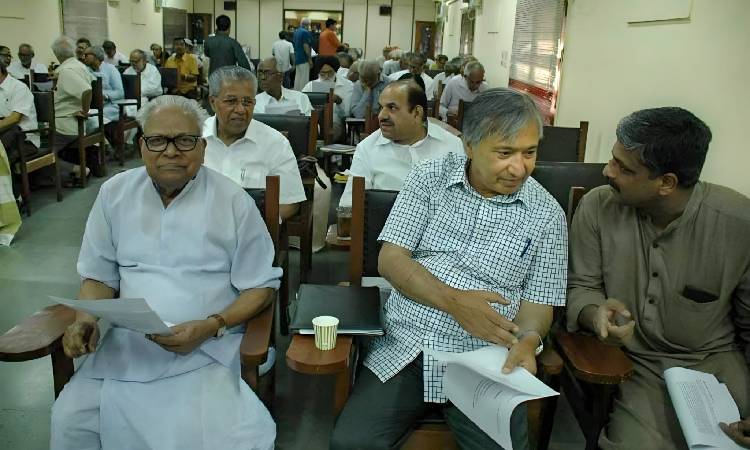
A file picture of former Chief Minister V S Achuthanandan and former CPI(M) State Secretary Kodiyeri Balakrishnan with Pinarayi Vijayan, Vijoo Krishnan and other leaders at a Central Committee meeting of the CPI(M) in New Delhi
Yechury's Quiet War
Sitaram Yechury succeeded Prakash Karat as the General Secretary of the Communist Party of India (Marxist) or CPI(M) in April 2015. An alumnus of Jawaharlal Nehru University (JNU), like his predecessor, and married to journalist Seema Chishti, he was seen as the most cosmopolitan of the comrades.
Yechury was known to have privately disagreed with Karat over the 2008 nuclear withdrawal — having painstakingly negotiated the deal's conditions through the UPA-Left coordination committee, only to be overruled.
Yechury believed the Left’s only path forward was the Surjeet path: broad, secular, anti-BJP coalitions. The CPI(M)’s official Review of the 18th Lok Sabha Elections — June 2024 Central Committee Report framed the task in unambiguous terms: “the Lok Sabha elections are about saving India, against the effort of the BJP to transform the secular, democratic character of the Indian Republic into a rabidly intolerant… authoritarian and fascistic Hindutva Rashtra.”
He carried the Left into the INDIA alliance for 2024 — winning four seats, including a historic CPI(M) victory in Sikar, Rajasthan, by Amra Ram, the first non-Kerala-non-Bengal Lok Sabha seat for the party in years.
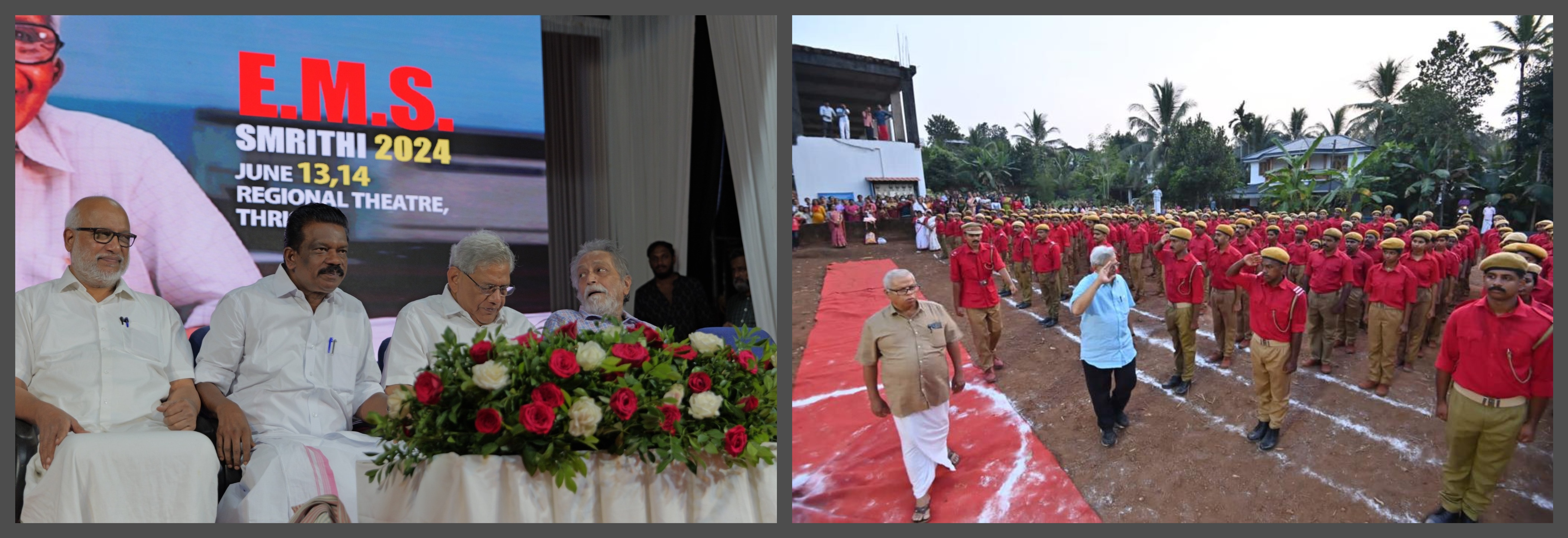
Sitaram Yechury with M A Baby, K Radhakrishnan and Professor Prabhat Pattnaik at the EMS Smrithi in Thiruvananthapuram (left), and Yechury taking salute of Red Volunteers at Kannur, Kerala (right)
But Yechury was fighting an unequal war. The Karat faction in the Politburo blocked an open alliance with the Congress in West Bengal in 2016 and 2021, then permitted it tactically, then withdrew it. Yechury’s son Ashish died of COVID-19 in April 2021, aged 34. Yechury himself died on September 12, 2024, at AIIMS Delhi.
The CPI(M) was leaderless for ten months. In April 2025, M A Baby — the Kollam-born former Education Minister of Kerala — was elected the fifth General Secretary, taking over a party that, within thirteen months, would lose its last state.
The disconnect: How the Left lost the ‘Working Man’
The deepest wound was not electoral. It was sociological.
The CPI(M)’s industrial wing, the Centre of Indian Trade Unions (CITU), was founded in May 1970 at the Brigade Parade Ground in Kolkata. As the International Labour Organisation’s working paper on political unionism in India observes, India’s trade union federations have long been compromised by an inability to translate political access into industrial bargaining power.
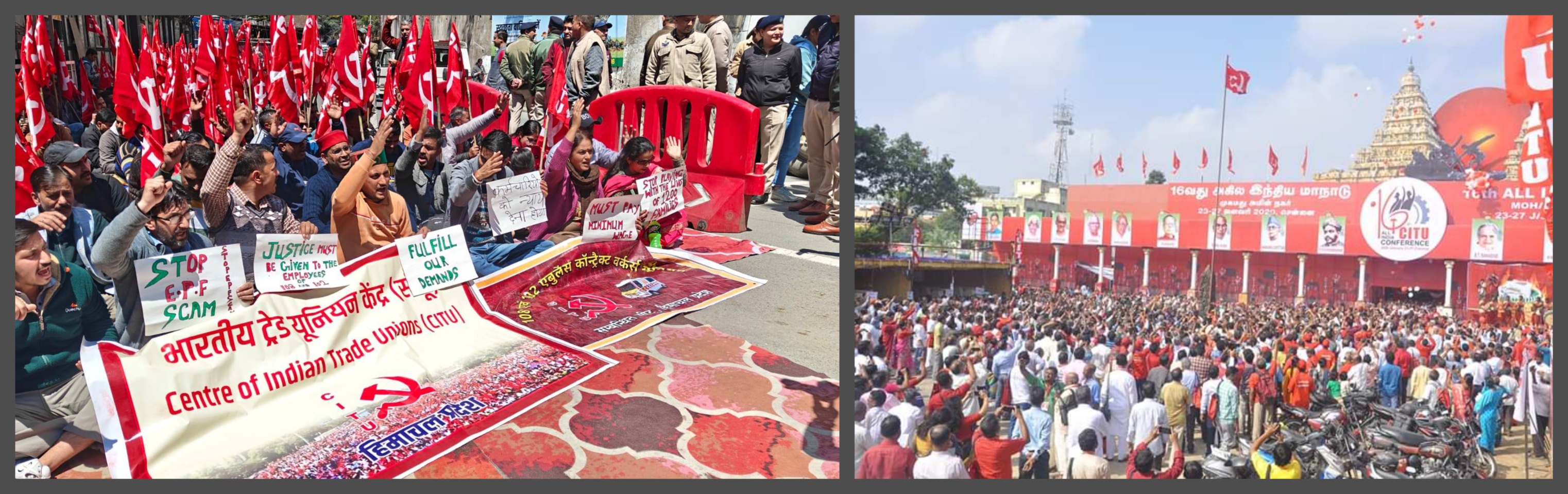
CITU members at a protest (left) and at its 16th Annual Conference held in Chennai in January 2020 (right)
When AKG was organising coffee house workers, organised industrial labour was the vanguard of social transformation. Today, India’s organised sector accounts for less than 10 per cent of total employment.
More than 90 per cent of Indian workers — gig workers on Swiggy and Zomato, contract loaders in Adani’s ports, women home-based stitchers in Tirupur, cyber-scam-trafficking survivors I have interviewed in Cambodia and Myanmar — work in the informal economy.
The CITU model — factory gates, bargaining cycles, May Day rallies — speaks a language these workers do not hear. The Left did organise the Anganwadi workers, the ASHA workers, and the domestic workers’ federations. It produced sharp critiques of the four Labour Codes the Modi government notified in November 2025.
But critique without mobilisation is not power.
The disconnect with the common man runs deeper still. The CPI(M)’s cadre culture in Kerala and West Bengal ossified into a hierarchy where the area secretary mattered more than the panchayat member, where the Politburo's “line” mattered more than the adivasi widow’s land claim.
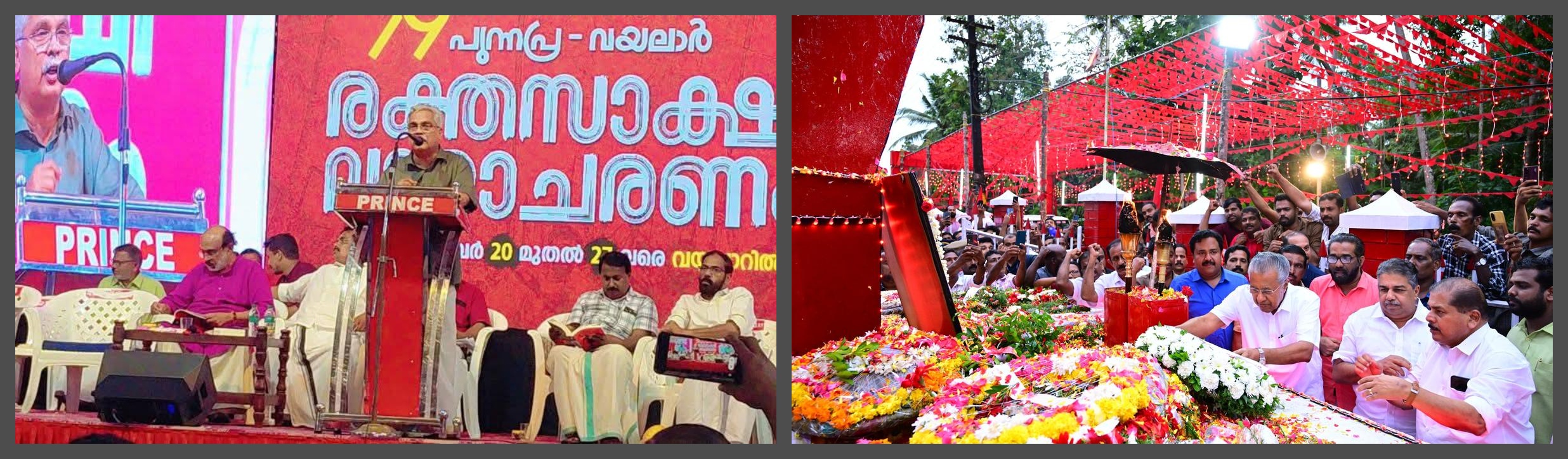
CPI Kerala State Secretary Binoy Vishwam (left) and Pinarayi Vijayan (right), at the 79th anniversary of the Punnapra-Vayalar revolt
In Pinarayi Vijayan’s second term (2021–2026), his daughter T Veena’s IT firm Exalogic Solutions was reported to have received payments from the Kochi-listed Cochin Minerals and Rutile Limited — a transaction which the Opposition alleged was a retainership without commensurate services rendered, which the family has denied.
Vijayan’s son-in-law, Mohammed Riyas, a cabinet minister, became a lightning rod for accusations of dynastic privilege. The K-Rail Silver Line project — a INR 64,000-crore semi-high-speed corridor that would have displaced over 30,000 families — was rammed through over the protests of homeowners, environmentalists, and seventeen Opposition members of Parliament.
One of the first decisions of the United Democratic Front (UDF), led by Chief Minister V D Satheesan, was to cancel this project.
The 2026 verdict was, in the words of Kerala Pradesh Congress Committee (KPCC) president Sunny Joseph, “a clear verdict against the arrogance, corruption, and nepotism of the CPI(M)-led LDF government.”
It was the verdict of a state that had once seen its government as a scaffold for the dispossessed, and now saw it as a closed shop for the entitled.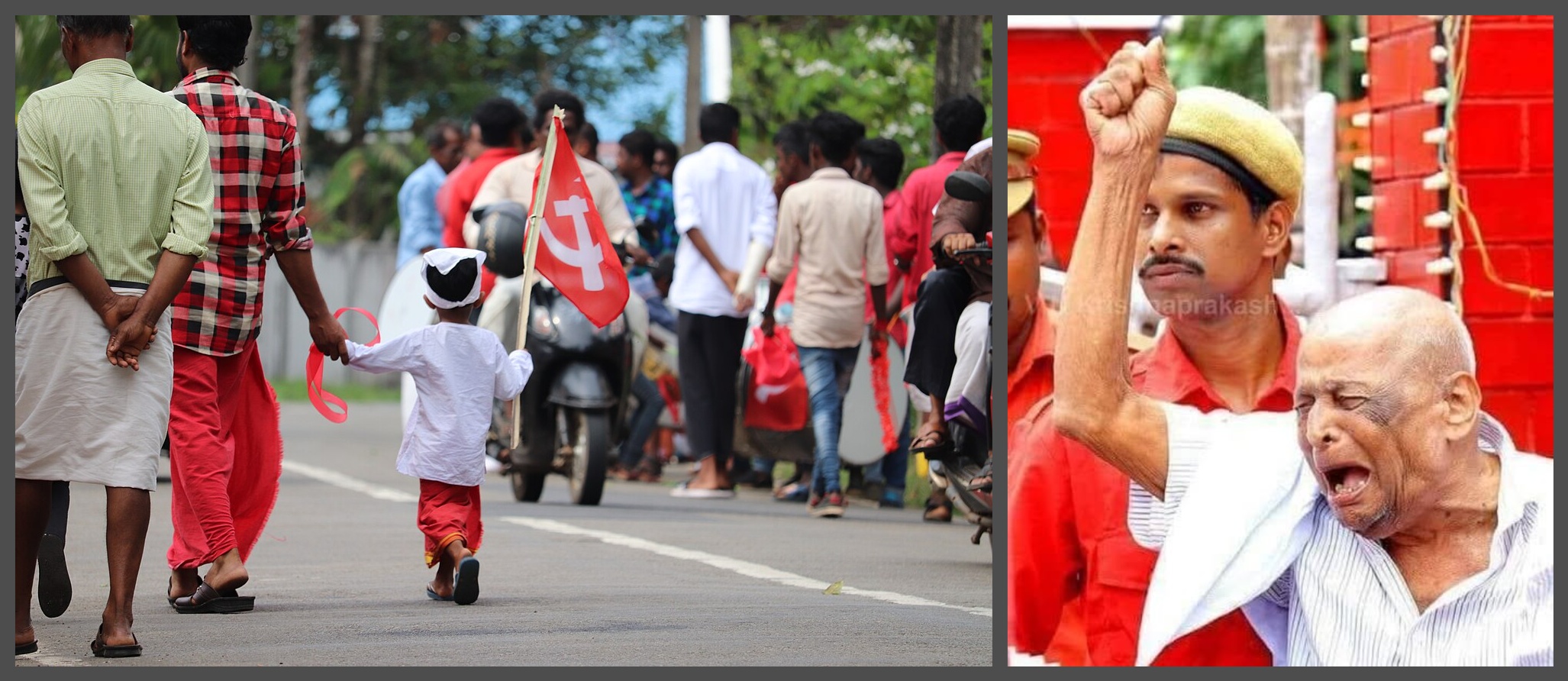 The CPI(M) continues to be deeply entrenched in the grassroots of Kerala polity, as these images will testify; photo courtesy - Wikimedia Commons
The ‘Captain’ who bent the rules
The 2026 outcome was, for any sensible observer of Kerala, a foregone conclusion. The party had a clear off-ramp in 2024–25 to refresh its leadership. It chose, instead, to throw its own rulebook out — and the man for whom it threw it out was Pinarayi Vijayan.
Before the state assembly election of 2021, the CPI(M) state committee decided to apply the ‘two-term’ rule for all its sitting legislators. Members of the outgoing assembly from the party, including outgoing Finance Minister Thomas Issac and Cooperation Minister G Sudhakaran, were denied a third term.
At a press conference, Pinarayi Vijayan claimed that the two-term rule applies to everyone and will apply to him as well in the next election.
After the historic re-election of the Left Democratic Front (LDF) in May 2021, the CPI(M) state committee announced that every single minister from the outgoing 2016–21 cabinet would be dropped, with the lone exception of the Chief Minister.
As Outlook India recorded, “the CPI(M) strictly enforced its two-term policy, under which leaders who had served two consecutive terms as MLAs were denied tickets… the party also denied ministerial positions to all members of the previous cabinet, with the sole exception of Chief Minister Pinarayi Vijayan.”
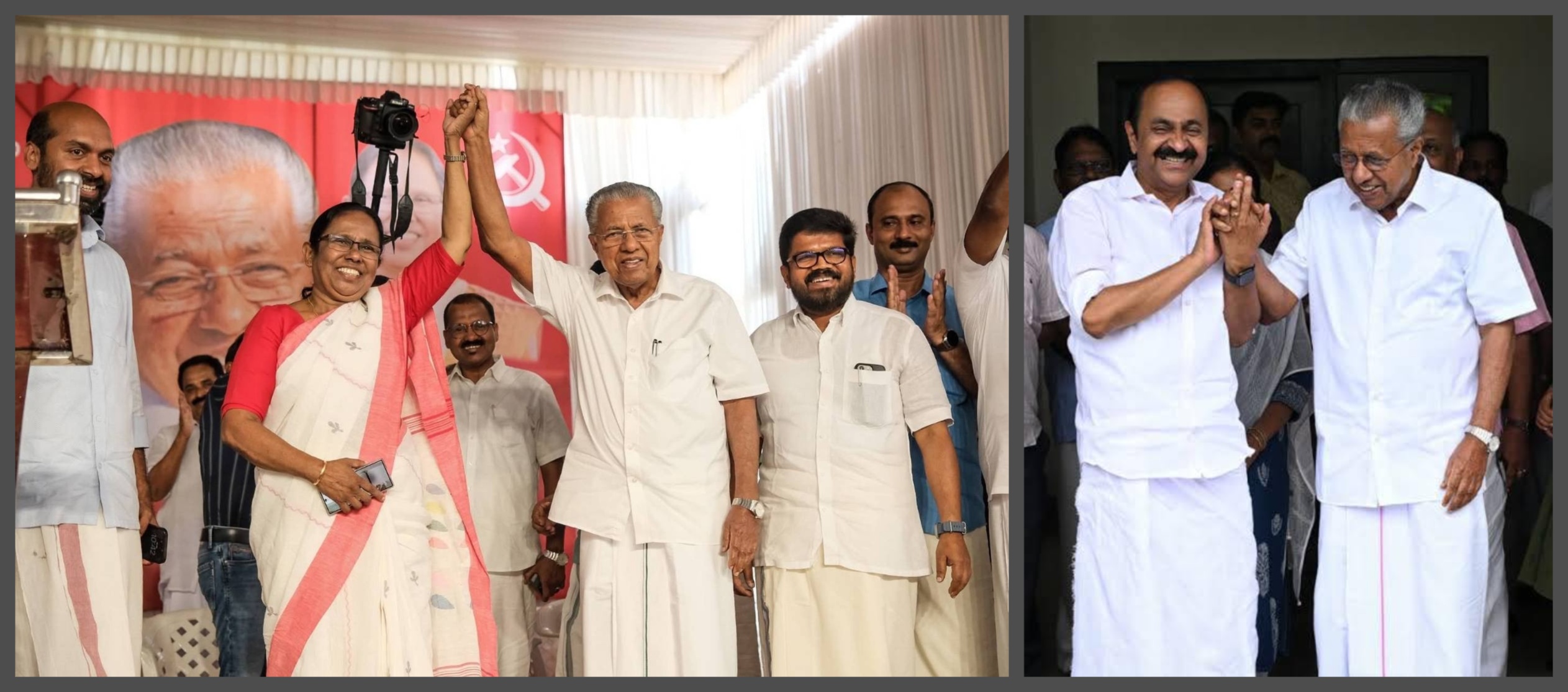
Pinarayi Vijayan at the election campaign meeting of K K Shylaja (left), and with V D Satheesan before the latter's taking over as Chief Minister of Kerala (right)
The notable casualty was K K Shailaja, the Health Minister, whose stewardship through the 2018 Nipah outbreak and the COVID-19 pandemic had earned her the Sansad Ratna and front-page coverage in The Guardian and Vogue. The party dropped her, citing the very two-term and “fresh face” norm Vijayan, alone, was permitted to ignore.
The defence offered to the press was a single line: “It is our party’s collective decision taken by a collective leadership.” Three and a half years later, “collective leadership” had become an empty phrase.
The CPI(M)'s 23rd All-India Party Congress in Kannur in April 2022 had introduced a 75-year age ceiling for the Politburo and Central Committee. By the 24th Kerala State Conference at Kollam, March 6–9, 2025, Vijayan was 79.
Eight of the 17 sitting Politburo members had crossed 75. Strict enforcement would have triggered a generational reshuffle.
The Kollam conference made one strategic exception. South First reported it was decided to “exempt Kerala Chief Minister Pinarayi Vijayan from the age limit for holding posts in the party” Onmanorama confirmed that “only Pinarayi Vijayan will be granted an exemption, meaning nearly 15 members will have to be removed from the State Committee.”
The cadre was to be culled to make room for one octogenarian.
K Sudhakaran, the then president of the KPCC, made a barb which, in retrospect, sounded prescient: “The CPI(M) in Kerala is essentially the Communist Party of Pinarayi Vijayan.”
Within the CPI(M) itself, even loyalists were briefing journalists similarly. As Open magazine quoted a serving CPI(M) leader: “Vijayan has been an undisputed leader within the CPM in the sense that within party forums very few people question his decisions and choices.”
When the 2026 candidate list was unveiled, the rule-bending was on the ballot paper. As Outlook reported, “the two-term norm has not been applied as a rigid policy, with several leaders — including Pinarayi Vijayan — contesting for a third term.”
Vijayan, now 80, filed his nomination from Dharmadom on March 19, 2026; his Election Commission affidavit lists his age as 82, with six criminal cases — most legacies of decades-old political-violence prosecutions in Kannur.
There was a parallel breach: State Secretary M V Govindan — by long convention, state secretaries do not contest assembly elections — vacated his Taliparamba seat to field his wife, P.K. Shyamala, a district committee member.
Senior leader G Sudhakaran walked out and contested as an Independent from Ambalapuzha — and defeated the official CPM candidate by 27,935 votes. District leaders like K V Kunhikrishnan and T K Govindan in Kannur did the same, accusing the leadership of “nepotism and corruption.”
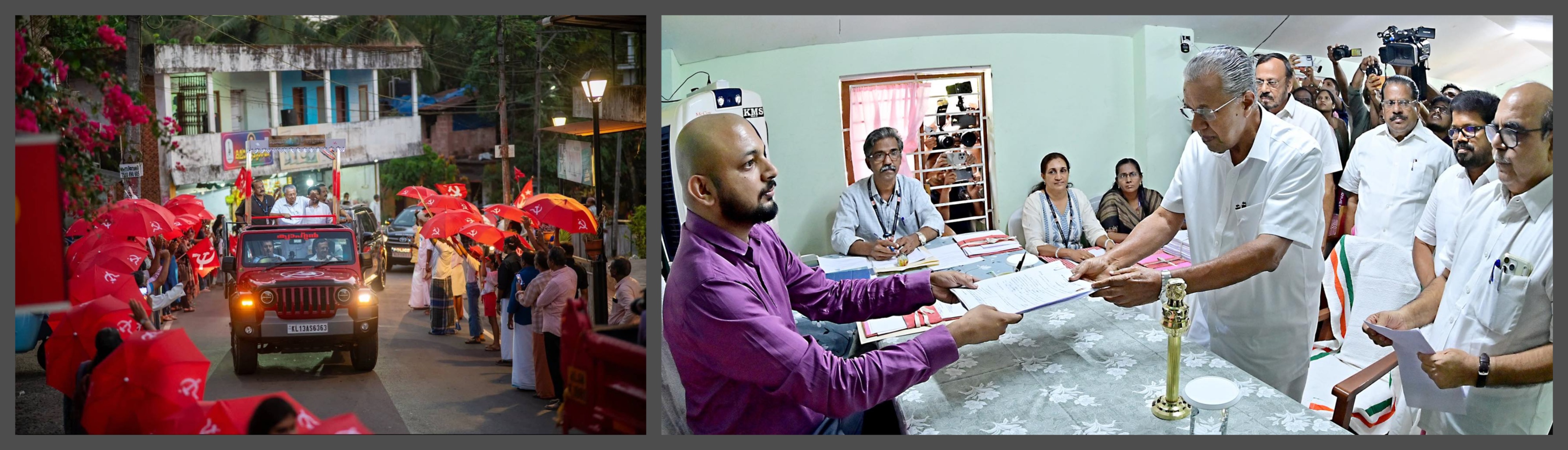
Pinarayi Vijayan during his election campaign in Dharmadom (left), and submitting his nomination papers (right)
They stood in the election with the backing of the UDF and resoundingly won in these seats.
A party that in 2021 had benched the woman who saved Kerala from Nipah and COVID was, by 2026, fielding the State Secretary’s wife while the Chief Minister himself contested a third consecutive term at 80, in violation of the very norm he had imposed on Shailaja.
The LDF’s 2026 campaign, Open magazine reported, was “unmistakably presidential: over 2,000 hoardings of the 81-year-old leader dotted highways across the state.”
The same Politburo that in 1996 had blocked Jyoti Basu from the Prime Minister’s chair on grounds of ideological purity, in 2025 amended its own age and term rules to keep an octogenarian in the Chief Minister's chair on grounds of pure electoral expediency.
The men who had once read Lenin too carefully had, by 2026, stopped reading him at all.
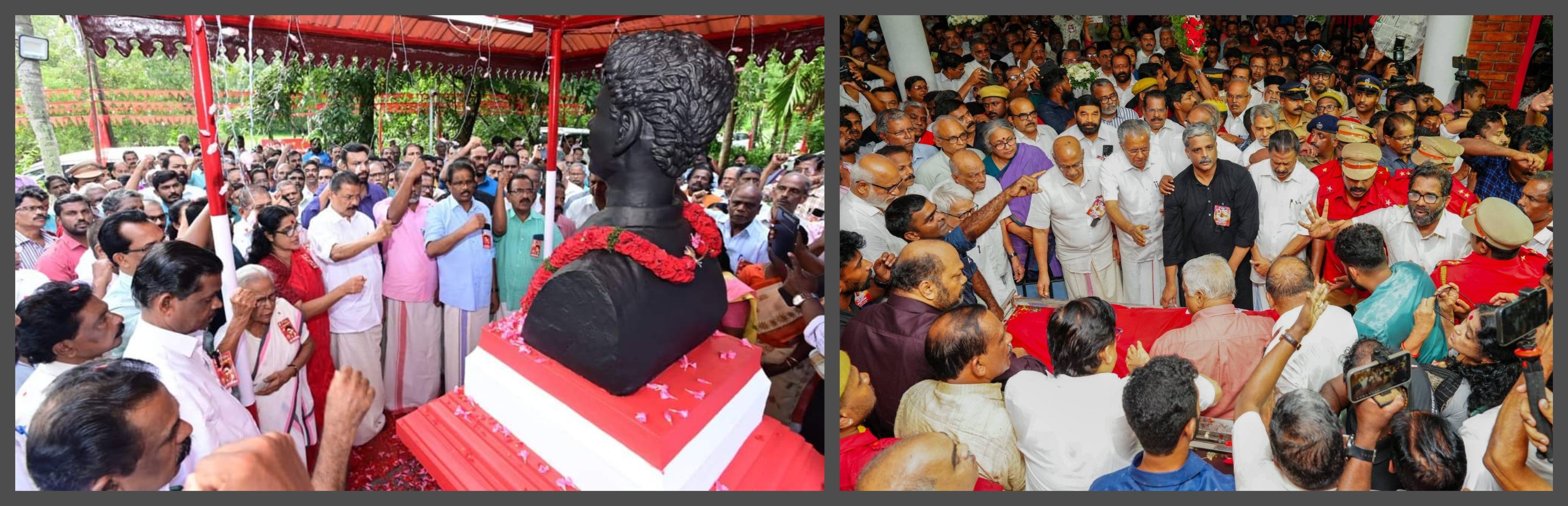
CPM Kerala leaders at the memorial of P Krishna Pillai (left), and CPM Politburo members place the party flag over the mortal remains of V S Achuthanandan (right)
The last identity: What has been lost
The Indian Left’s tragedy is not that it was defeated. Defeat is the ordinary weather of democratic politics. The tragedy is that, in the long arc from EMS to Pinarayi, it forgot its raison d'être.
It was for the kudikidappukaran — the hutment dweller — given title to his quarter-acre by the Kerala Land Reforms Act of 1969, conceived by EMS. It was for the woman teacher whose salary was guaranteed by the Education Bill of 1957.
It was for the Kayyur martyrs and the Punnapra-Vayalar comrades who died in 1946 against the Diwan of Travancore. It was for the coffee house workers AKG organised, the railway workers Jyoti Basu organised, and the Punjab peasants Surjeet organised against the Anti-Betterment Levy in 1959, among others.
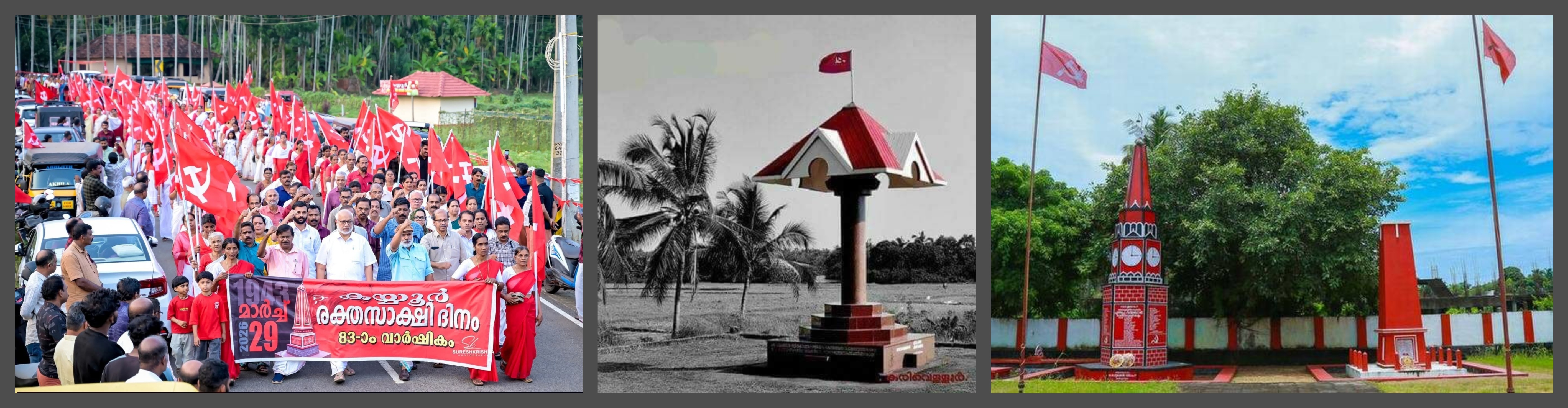
M A Baby leads a rally to mark the 83rd anniversary of Kayyur Martyrs Day (left), a Martyrs memorial at Karivellur (centre), and the Punnapra-Vayalar memorial (right)
By 2026, the LDF was for none of these, in any ideological sense. It was for itself. The cadre culture had calcified into a parivar of its own. Meanwhile, the idea the Left had given India — that the poorest could vote themselves out of subjection — was being taken up by parties more nimble and less encumbered: Mamata Banerjee in Bengal, Arvind Kejriwal in Delhi, M.K. Stalin in Tamil Nadu, and so on.
The Aam Aadmi Party (AAP), the Dravida Munnetra Kazhagham (DMK), the Jharkhand Mukti Morcha (JMM), the Rashtriya Janata Dal (RJD) — and even, in its strange Hindutva inflection, the BJP’s welfarism — borrowed the rhetorical clothes the Left had stitched and walked away wearing them better.
In Tripura today, the BJP Chief Minister Manik Saha governs the state that Manik Sarkar built. In Bengal, on May 4, 2026, the BJP swept past Trinamool to 206 seats and power for the first time.
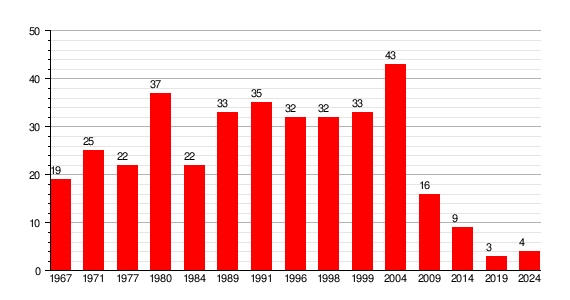
Graph showing the CPI(M) strength in the Lok Sabha since 1967 to the present; image courtesy - Wikimedia Commons
In Kerala, the UDF, with Congress at 63 and the Indian Union Muslim League at 22, has the largest mandate it has had since 1977. The BJP, which won three seats — Nemom, Kazhakoottam, and Chathannoor — has finally pried open the southern door it has battered against for forty years.
The funeral and the future
After the setback, Pinarayi Vijayan resigned and has largely remained silent, not yet ready to significantly reflect upon the defeat. At the time of this writing, Vijayan, having been nominated as the Leader of Opposition by the CPI(M) State Committee, had briefly spoken at an event in Kannur, lamenting that the defeat is temporary and that the party will bounce back strongly.
Party secretary M V Govindan, for his part, accepted the defeat.
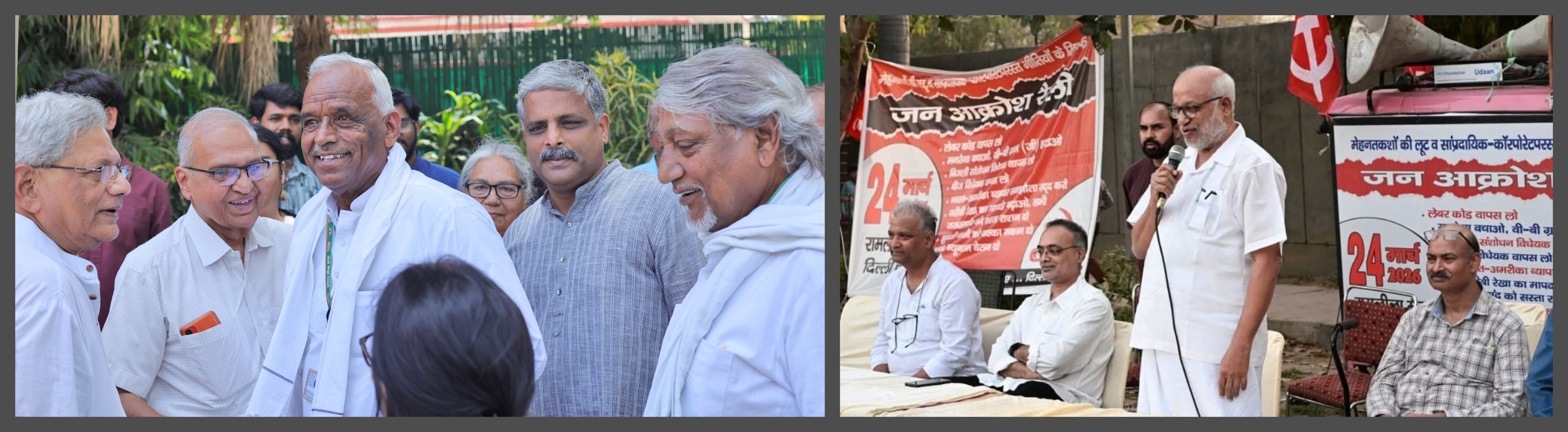
Former CPI(M) legislator from Rajasthan and member of the current Lok Sabha, Amra Ram, with Yechury, Vijoo Krishnan and other leaders (left), is a prominent face of the party in the "Hindi Belt," even as M A Baby (right), the current General Secretary, may find it hard to make any impact in this region
The story is not finished. Movements have died and been reborn before. The CPI(M) still has 26 MLAs in Kerala, 10 in Tripura, 2 in Tamil Nadu and 1 each in West Bengal, Assam, Jammu and Kashmir, Maharashtra, and Odisha. The party currently has four Members of Parliament in the Lok Sabha, including the surprise of Sikar, represented by Amra Ram in the Lok Sabha.
On the other hand, the frontal organisations of the CPM, along with the Centre for Indian Trade Unions (CITU), have national presence and influence, often beyond the electoral and parliamentary imprint of the party.
The All India Kisan Sabha’s work in Punjab, Maharashtra and other farming belts, the proactive space carved out by the Students Federation of India’s (SFI) in national student politics, and the All India Democratic Women’s Association’s (AIDWA) significant role in women’s mobilisation are instances of the party’s mass base being increasingly delegated to these frontal organisations.
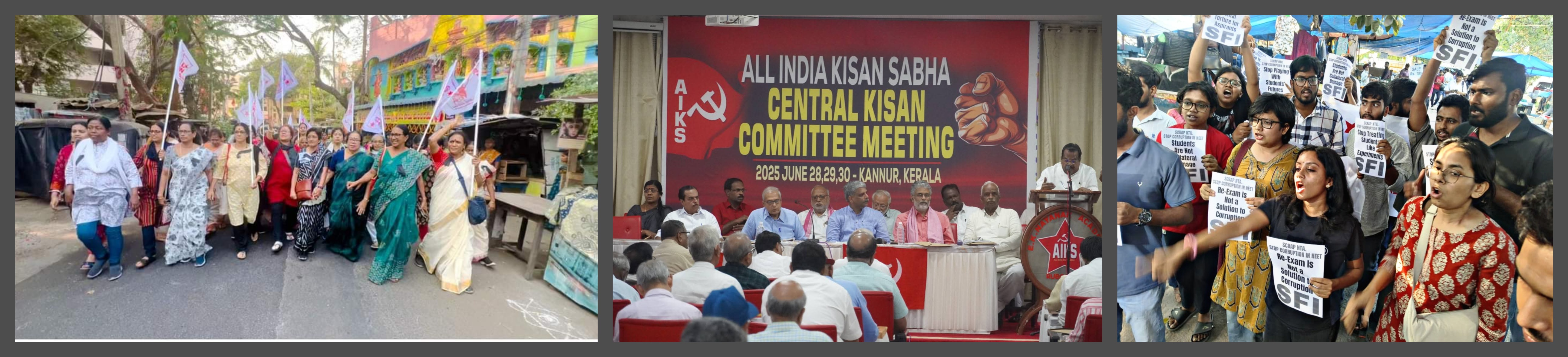
AIDWA members marching (left), a meeting of the AIKS (centre) and SFI cadre protesting the NEET paper leak (right)
Accordingly, the institutional residue of seventy years — the libraries, the cooperatives, the thinking — is real. But the symbolic loss is total.
There is no longer, anywhere on the Indian map, a state where the Red Flag flies over the Secretariat. The ideological movement marked by the world’s first elected communist government, born in Kerala in 1957, has now lowered its flag on its soil of origin.
While many debate whether Kerala’s CPI(M) will go the Bengal way, the well-entrenched organisational base, and the deeply-grounded socialist ethos among the populace might ensure that the party and movement remain and sustain itself for the short term, before it is either wiped out, like in Bengal, or bounces back, as Pinarayi Vijayan and other CPI(M) leaders allude to.
When Namboodiripad climbed the Raj Bhavan steps that April morning sixty-nine years ago, he had no notes, no file, no entourage. He believed, with that stubborn faith peculiar to communists who had read both Marx and the Mahabharata, that the wretched of the earth would inherit it through the patient arithmetic of the ballot.
He was right, and then for a long time he was right, and then he was not. The arithmetic, in the end, was less patient than he was. And the inheritance, as it turned out, would have to be claimed by other hands.
The last Communist tower in India has fallen. What rises in its place is the work of a generation that has not yet found its EMS, its AKG, its Surjeet, its Jyoti Basu — and may, perhaps, never need to.
While the communists might be out of power in India, the ideas the movement carried — that the poor may organise, that labour has dignity, that the state owes the dispossessed more than charity — are not in retreat.
If anything, the gig economy, agrarian distress, and widening inequality have made the socialist case more urgent than at any point since 1957. The question is not whether those ideas will survive; they will. The question is whether the CPI(M) will be the vessel that carries them.
Revival through the party structure looks improbable. The same machinery that bent its own rules for one octogenarian cannot easily renew itself; the cadre culture that calcified into a parivar will not produce the next EMS by the methods that produced the last Pinarayi.
A party that mistook loyalty for line and longevity for leadership has no obvious mechanism for the generational rupture revival would demand.
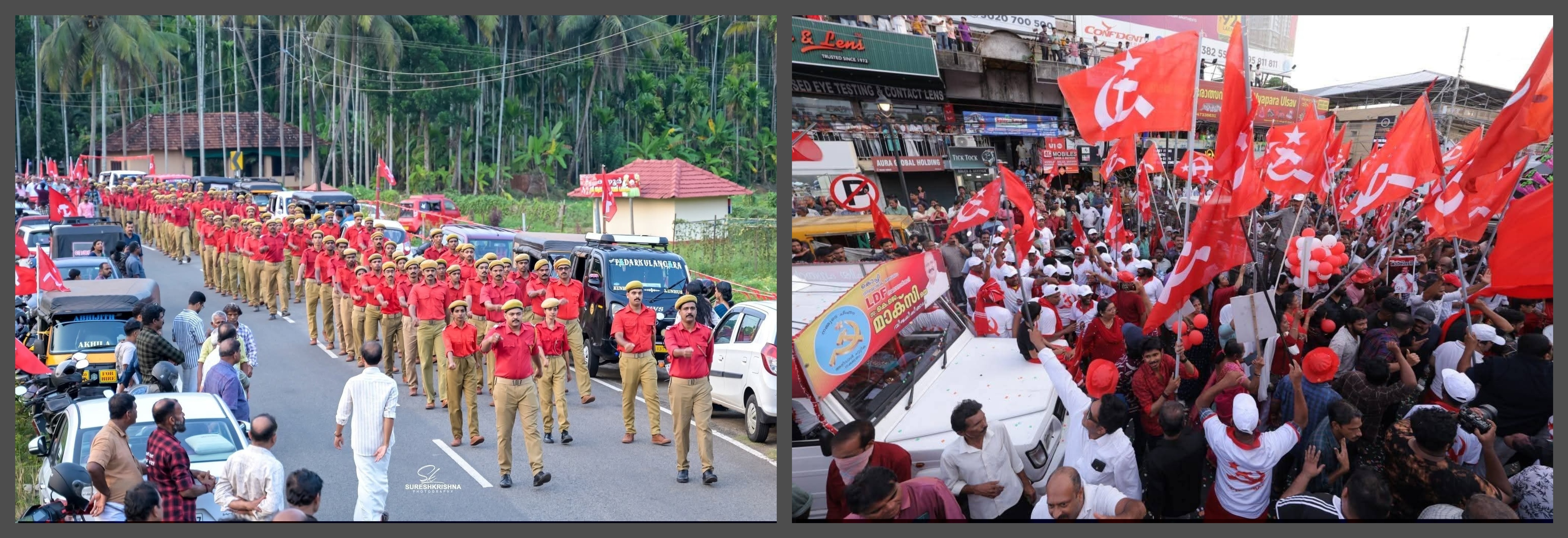
The likelier afterlife lies in the frontal organisations: the CITU, All India Kisan Sabha, SFI, and AIDWA retain a reach that already exceeds the party’s electoral footprint — mobilising farmers, students nationally, women across states where no Left MLA sits.
Should the parliamentary party wither, this is where the ethos persists: not as government, but as a movement.
That may be the Indian Left’s final irony. It began by proving the wretched could vote themselves out of subjection. It may end by surrendering the ballot and returning to the street — to the union, the campaign, the picket — where it was strongest before it ever held a Secretariat, and where, perhaps, it belongs.
(Views expressed in this report are the author's own)
Follow us on WhatsApp
Follow us on Facebook
Follow us on X @vudmedia
Follow us on Substack

