
Two telling tales could describe the rise and fall of mainstream communist parties in India – the CPI(M) politburo's 1996 decision to deny Jyoti Basu the opportunity to become Prime Minister, and its 2008 decision to withdraw support from the Manmohan Singh-led UPA government.
To realise how the Communist parties were central to India’s parliamentary politics, these numbers tell the story: From 16 of the undivided CPI in the first Lok Sabha to 27 in the second, 29 in the third, the numbers only grew even after the split of 1964, with the CPI getting 23 and CPM 19 in the fourth Lok Sabha of 1967.
The communists flourished in national politics even in the subsequent years, with CPM’s 25 and CPI’s 23 in the fifth Lok Sabha, 22 and 5 in the sixth, 37 and 10 in the seventh. 23 and 6 in the eighth, 34 and 12 in the ninth, 36 and 14 in the tenth, and 32 and 12 in the eleventh, until the summit peak of 43 (CPM) and 10 (CPI), along with 3 each of RSP and Forward Bloc, giving a combined strength of 59 in the 14th of 2004. From that peak of 43, the CPM’s tally crashed to 16 in 2009, 9 in 2014, 3 in 2019, and currently stands at 4, with CPI and CPI(ML) having 2 each.
After thirty years of rule, the CPM lost West Bengal in 2011 and Tripura in 2018, and was reduced to single digits in recent elections. The last citadel was Kerala, leading to taunts from rivals, terming the CPM as the Communist Party of Kerala. After two continuous terms, the CPM-led Left Democratic Front miserably lost in the April election, thus bringing down the last citadel.
Home page image: An AI-generated image, for representative purposes
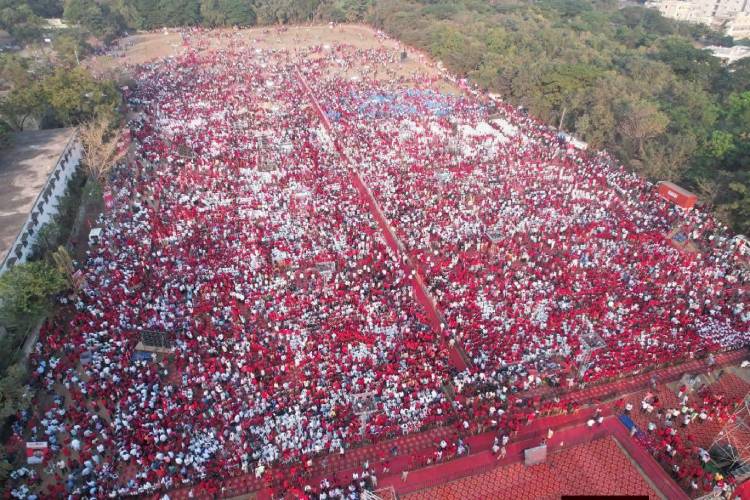
Text page image: A huge gathering at a CPM event
Banner image: Prakash Karat addressing the 24th Party Congress
On the morning of April 5, 1957, a slight, stammering man from Elamkulam, with thick spectacles and ink-stained fingers, walked up the steps of the Raj Bhavan in Thiruvananthapuram. Elamkulam Manakkal Sankaran Namboodiripad — EMS to the comrades, a man who had renounced his Namboodiri inheritance to live underground for years — placed his hand on a copy of the Constitution and was sworn in as Chief Minister of Kerala.
In Moscow, Pravda sang. In Washington, alarm bells rang. Ambassador Ellsworth Bunker would later admit, in conversations recounted by Daniel Patrick Moynihan in his 1978 memoir A Dangerous Place, that the CIA would soon channel money into Kerala to prevent “additional Keralas.”
It was the first time in human history that a Communist Party had captured power not through the barrel of a gun, not through a winter palace stormed at midnight, but through the patient act of marking a ballot. As historian P.N. Venugopal documented in his anniversary essay for India Together, “the inaugural April 1957 Kerala government was the first communist government in the world to come to power by the ballot.”
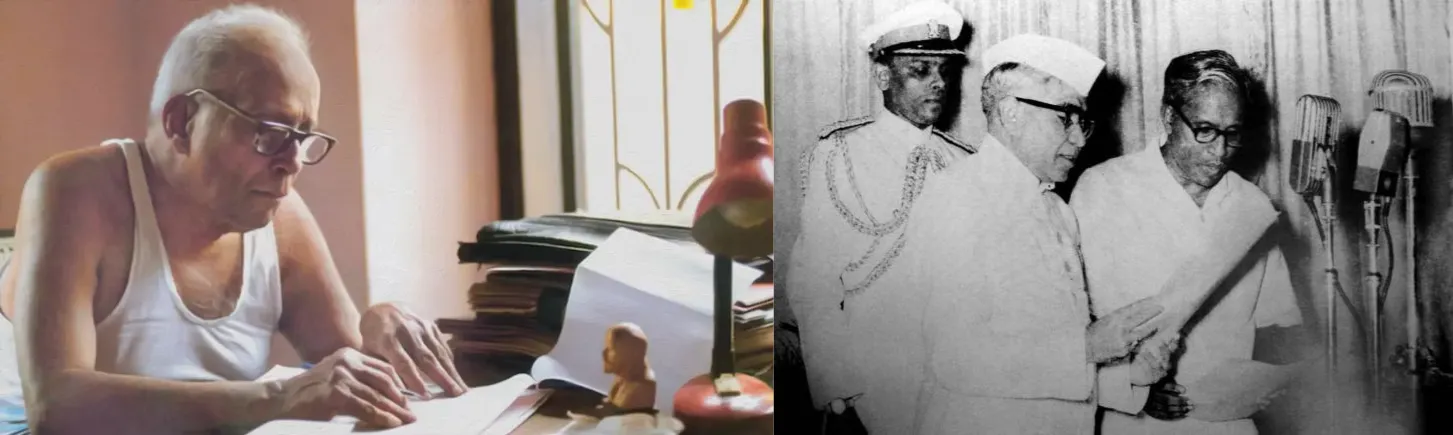
EMS in his later years (left) and the first communist ministry in India, led by EMS, being sworn in (right); photo courtesy - Left Views and LV archives
According to the Election Commission of India's Statistical Report on the 1957 Kerala General Election, the Communist Party of India fought 100 of the 126 seats, won 60, and formed the government with the support of five Independents — making this, after San Marino in 1945, only the second elected communist government anywhere on earth, and the first on the Asian mainland.
However, the government could not complete its term. Twenty-eight months after EMS climbed the Raj Bhavan steps, the world’s second-elected communist government had been ended, not at the ballot box, but at Rashtrapati Bhavan.
Now, sixty-nine years later, on the afternoon of May 4, 2026, in the Dharmadom constituency of Kannur, Pinarayi Vijayan, the last communist Chief Minister standing on Indian soil, watched the counting agents weep. He had clung to his own seat by 19,247 votes, trailing for six rounds before postal ballots saved him.
The Left Democratic Front, led by the communists, was reduced to 35 seats in a 140-member House. The Indian National Congress-led United Democratic Front (UDF) swept 102 seats. Thirteen of Vijayan’s ministers lost. By evening, he had resigned before Kerala Governor Rajendra Vishwanath Arlekar.
Now, for the first time since 1977, for the first time in fifty years, there is no Left government anywhere in India. The hammer and sickle, which once flew over Writers' Buildings in Calcutta and the secretariat in Agartala, has been folded away. India’s last communist tower in Kerala also has fallen. This is the story of how it happened.
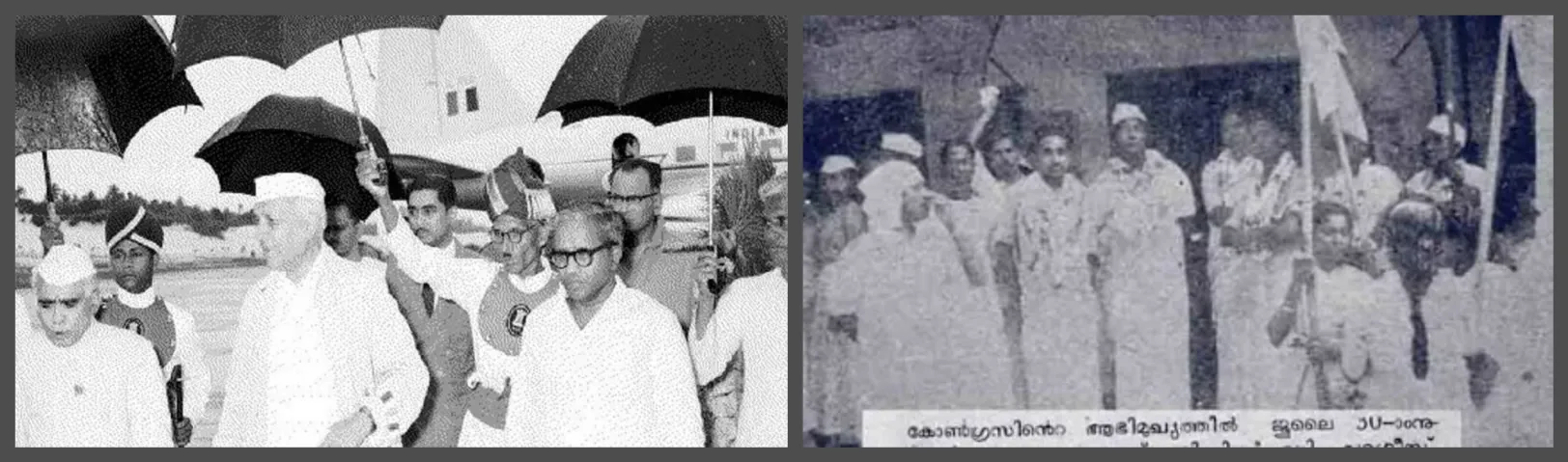
Prime Minister Jawaharlal Nehru with EMS on the former's visit to Kerala (left), and the Vimochana Samaram in action (right); photo courtesy - Peoples' Democracy archives and Comrade FB page
The Spring of 1957: When the idea took root
Kerala, when EMS inherited it, was a polity being knit together. On November 1, 1956, the States Reorganisation Act stitched together Travancore and Cochin with the Malabar district of the Madras Presidency.
Caste was a daily violence: in Payyannur, as the AKG Centre archives record, lower-caste men were forbidden to walk the public road past the Kandoth Thiyya temple.
The Kayyur uprising of 1941, when peasants drove a policeman to drown himself in the Tejaswini River, and four young communists were hanged for it, was still a living memory. Land was concentrated in the hands of jenmis, the feudal landlord class.
The Communist Party of India (CPI) had taken organisational shape in Kerala in 1939 with three figures at its core: EMS, the theoretician; A.K. Gopalan, the schoolteacher who had walked away from the Congress; and P. Krishna Pillai, the underground organiser – all three from the upper castes. As the CPI(M)’s archival biography records, EMS “donated the proceeds of his landed property to the Party.”
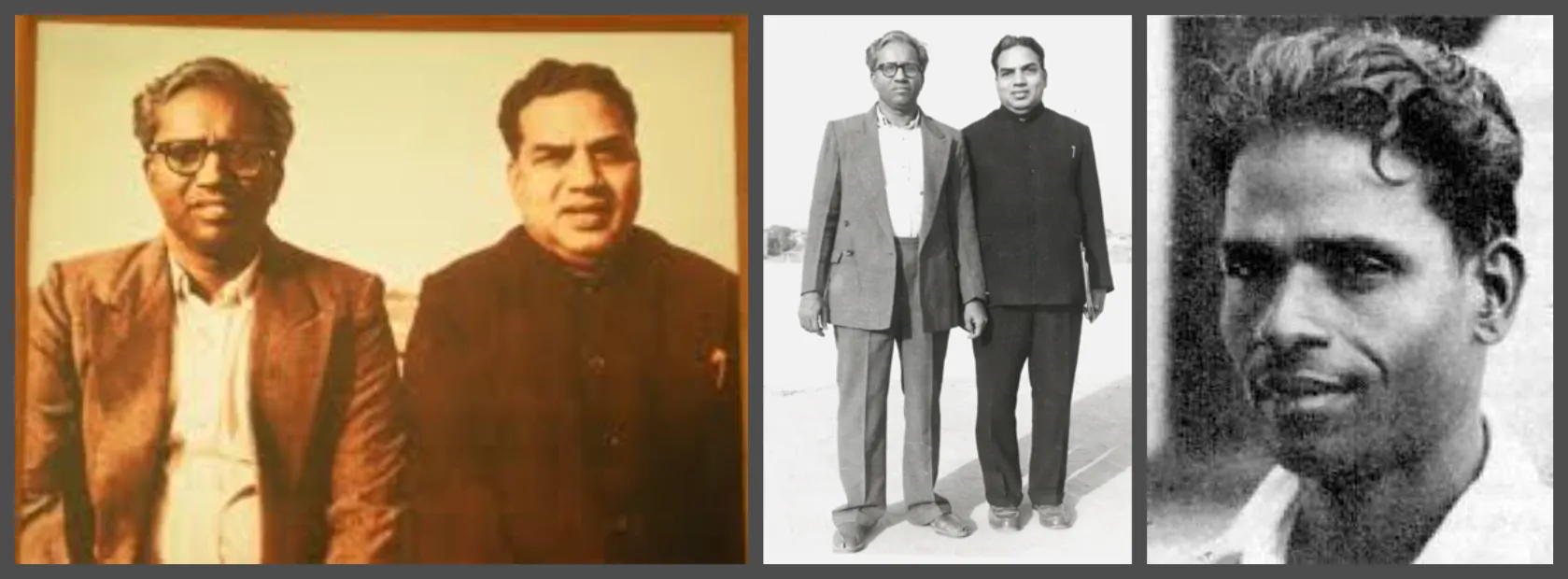
EMS and AKG (left and centre), and P Krishna Pillai (right)
Within months of forming the government, Education Minister Joseph Mundassery, a literary critic who had defied the Catholic Church, introduced an Education Bill making schoolteachers state employees, ending the absolute dominion of Christian managements over the chalk and the cane.
The Land Reform Ordinance went further. The Statement of Policy EMS announced on April 5, 1957, set out the agrarian aim: “fixing fair rent, giving fixity of tenure to the tenant, fixing a ceiling on landholdings… distributing surplus land… [it] will be necessary to bring in emergency legislation staying all evictions.”
The reaction was apocalyptic. In the Vimochana Samaram, the Liberation Struggle, the Catholic Church, the Nair Service Society of Mannathu Padmanabhan, the Muslim League, the Praja Socialist Party, and the Congress united in agitation.
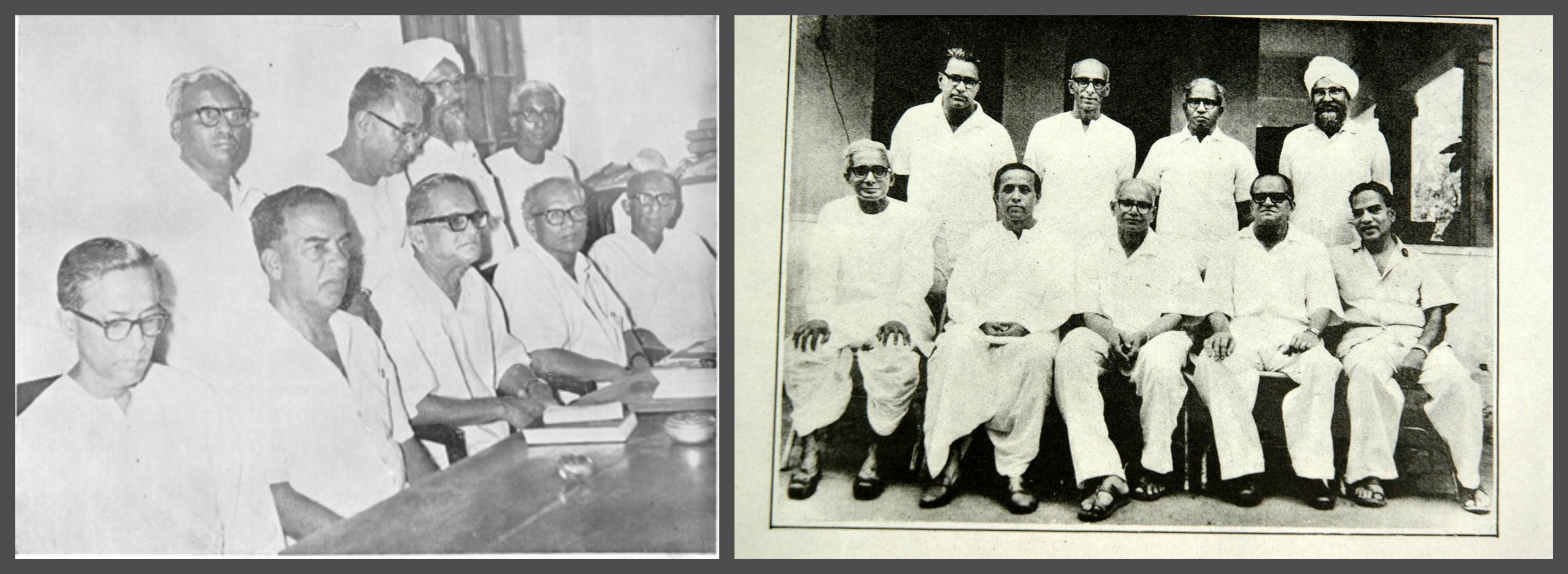
The members of the first Politbureau of the Communist Party of India; photos courtesy - Peoples' Democracy archive and Comrade FB page
Lathi charges, deaths in police firings, pamphlets dropped from chartered planes. As Nehru’s motorcade drove from Trivandrum airport to the Raj Bhavan, the streets thundered: dismiss EMS. Nehru asked the Chief Minister, with a tired affection, “How could you make so many enemies in such a short time?” — a moment recorded by Venugopal.
On July 31, 1959, the Government of India invoked Article 356 — for the first time in independent India's history — and dismissed the EMS ministry. The first elected communist government in the country had lasted just twenty-eight months.
But the idea that the dispossessed could vote themselves into power had by then taken root, and would not be uprooted for two-thirds of a century.
The golden age: AKG, the ‘walking conscience’
If EMS was the brain of Indian Communism, A.K. Gopalan was its feet.
Born in Peralasseri, Kannur, on October 1, 1904, into a Nair family of comfortable means, Ayillyath Kuttiari Gopalan Nambiar (AKG) could have settled into the colonial middle class. Instead, he became a primary school teacher, quit to follow Mohandas Karamchand (Mahatma) Gandhi, and then quit Gandhi to follow Karl Marx.
The AKG Centre archives record “the Kandoth assault” — when Gopalan led a procession of Harijans through a public road forbidden to lower castes, and was beaten unconscious for it. He was still in Cannanore Jail when India became free at midnight on August 14, 1947.
In 1952, AKG became one of sixteen CPI members elected to the first Lok Sabha and the first Leader of the Opposition in the Indian Parliament. He served five consecutive terms until his death on March 22, 1977.
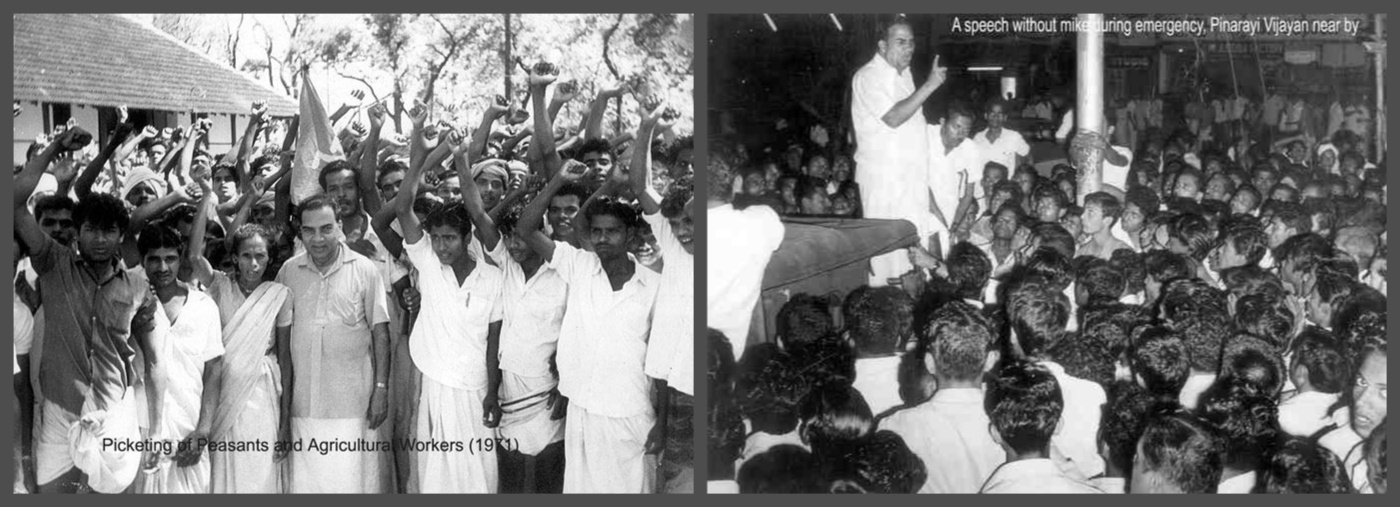
AKG picketing along with peasants and workers (left), and speaking without a mike at a protest during the Emergency, with Pinarayi Vijayan by his side (right); photos courtesy - FB pages of CPM/AKG
The Nehru Archive preserves at least sixty-seven items of correspondence between Nehru’s office and AKG — including a 1957 letter that begins: “I agree with you that the circus in Kerala is certainly worth preserving and encouraging.”
When AKG died, V.S. Achuthanandan — who would himself become Kerala's Chief Minister three decades later — wept openly at the cremation in Payyambalam Beach. He left behind no property. AKG Bhavan, the squat brick CPI(M) headquarters at 27-29, Bhai Vir Singh Marg, New Delhi, bears his name, as do many other buildings of the party across the country.
The CPI split in 1964 over the Sino-Indian War. AKG, EMS, and the future Punjab patriarch Harkishan Singh Surjeet walked out with the breakaway faction that became the Communist Party of India (Marxist). They took with them the moral and organisational spine of the movement.
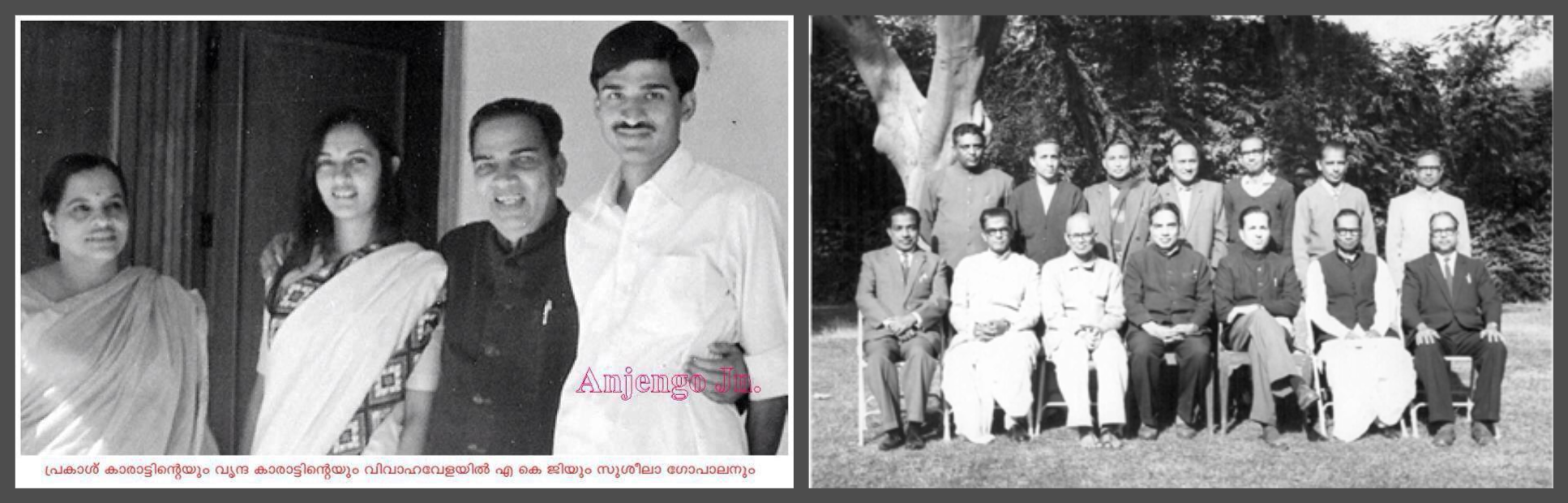
AKG and Susheela Gopalan with the just-wedded Karats (left), and AKG with CPI members of parliament (right); photos courtesy - FB page devoted to AKG
The strategist: Surjeet, ‘the kingmaker’
Harkishan Singh Surjeet was a Jat Sikh from Bundala village in Jalandhar, born March 23, 1916 — sharing his birthday, as he was never tired of pointing out, with Bhagat Singh’s hanging.
As the CPI(M)’s official Politburo homage records, “He hoisted the tricolour in March 1932 at the district court in Hoshiarpur at the age of 16” and “spent ten years in jail, of which eight were in the pre-independence period; he also spent eight years underground.”
Surjeet was elected General Secretary in 1992 and held the post until 2005. Under him, the party reached its apogee. By the 2004 Lok Sabha elections, the CPI(M) had 43 MPs, the CPI ten, the Forward Bloc and Revolutionary Socialist Party three each — a Left bloc of 59 in a House of 545. The Left ruled three states.
From his modest study at AKG Bhavan, Surjeet assembled coalitions like a man arranging chess pieces — the National Front of 1989 that toppled Rajiv Gandhi, the United Front of 1996, and the United Progressive Alliance (UPA) of 2004 that kept Vajpayee out and gave India Manmohan Singh.
But the moment that haunted Surjeet’s life was the May–June crisis of 1996. The Vajpayee government had collapsed after thirteen days. The United Front turned to Jyoti Basu, the towering 82-year-old Chief Minister of West Bengal, and asked him to be Prime Minister. Basu was willing. Surjeet was willing.
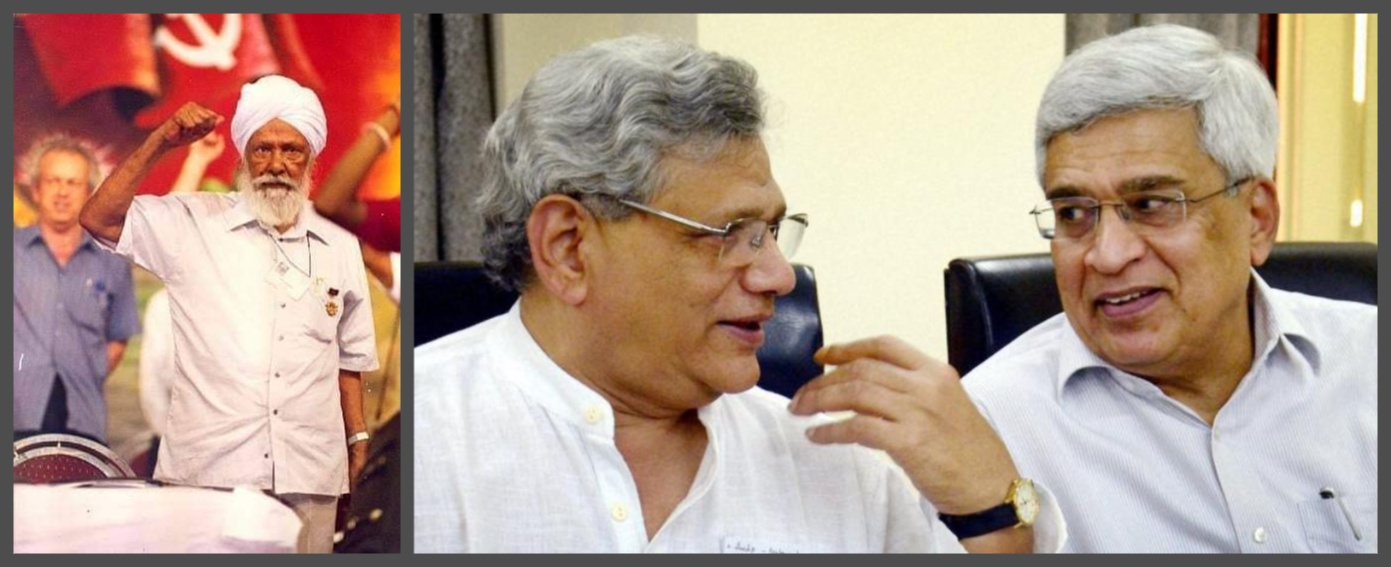
Harkishen Singh Surjeet (left), and Prakash Karat with Sitaram Yechury (right)
Even Congress mentor Arjun Singh wanted it. But the CPI(M) Politburo — with Prakash Karat in agreement with Sitaram Yechury and the Kerala patriarchs V.S. Achuthanandan and E.K. Nayanar — voted against. The party had only 32 MPs.
The argument was ideological purity. The post went to H.D. Deve Gowda, then to I.K. Gujral. Basu, in a rare public rebuke of his own party, called it a “historic blunder” — and would say it again, and again, until he died in January 2010.
That single decision — taken in an air-conditioned room on Bhai Vir Singh Marg by men who had read Lenin more carefully than they had read India — was the moment Indian Communism reached its ceiling and began, imperceptibly, to descend.
The failure of Karat: The 2008 gamble
Prakash Karat succeeded Surjeet in 2005. He was a man of texts. When the Manmohan Singh-led UPA government, supported externally by 59 Left MPs, signed the India-US civil nuclear agreement, Karat saw a betrayal of non-alignment. As the UPA-Left committee wound through 2007 and into the summer of 2008, Surjeet, ailing, and Basu, retired but lucid, urged restraint.
External Affairs Minister Pranab Mukherjee, in his memoir The Coalition Years, recorded that he sought Basu’s intervention: “Basu spoke to Prakash Karat and suggested that there might be value in Karat meeting me. Karat did meet me, but remained vehement in his opposition, and maintained that the Left would join hands with the BJP to vote the UPA out.”
On July 8, 2008, Karat sent the letter withdrawing Left support to Rashtrapati Bhavan. The UPA had only 234 MPs, 38 short of a majority. Karat believed the government would fall. Instead, on July 22, the Manmohan Singh government won the trust vote 275–256, with Mulayam Singh Yadav’s Samajwadi Party crossing the floor and the air thick with allegations of cash-for-votes.
It was a calamity. By the Election Commission’s tally, the party’s Lok Sabha seats crashed from 43 in 2004 to 16 in 2009; to nine in 2014; to three in 2019; to four in 2024. The party’s vote share, which had hovered above 5 per cent from 1971 to 2009, fell to 1.75 per cent in 2019 — flirting dangerously with the threshold for retaining its national party status.
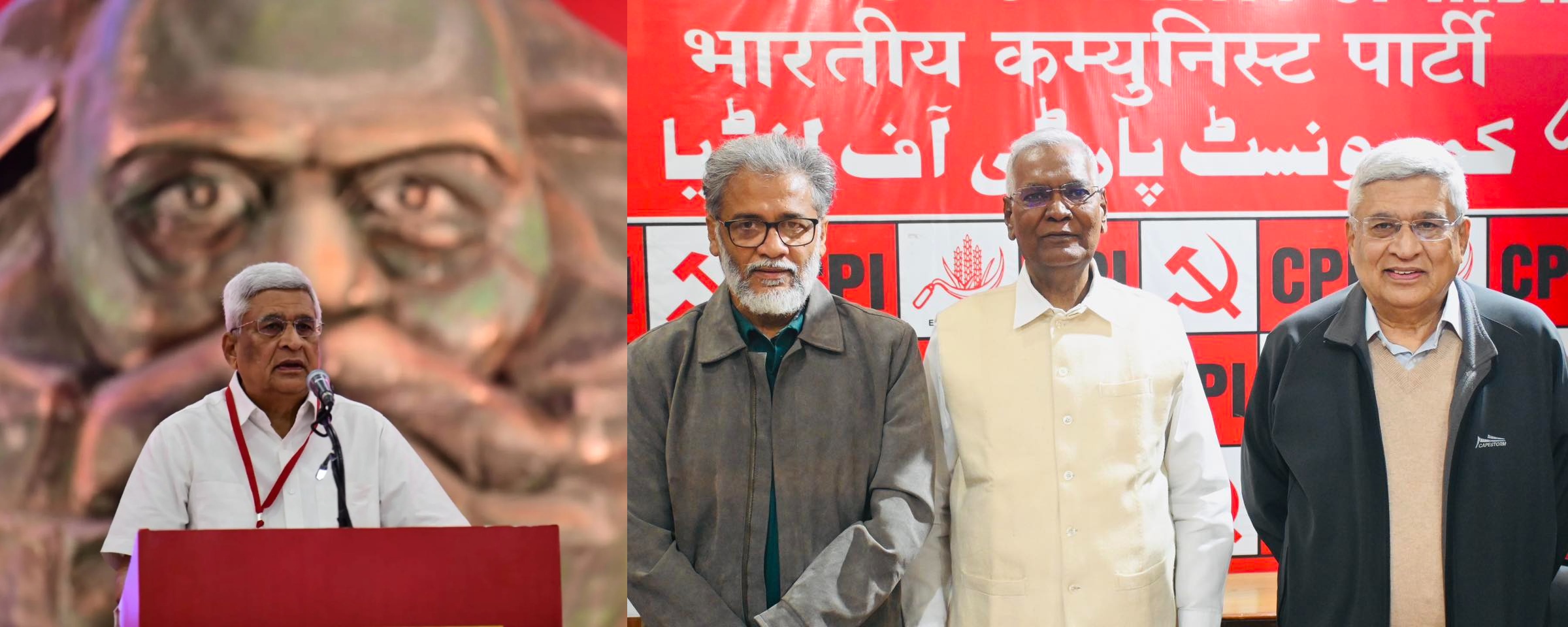
Prakash Karat (left), and with D Raja of CPI and Dipankar Bhattacharya of CPI(ML) (right)
Bengal falls: The long twilight begins
While Karat was gambling at the Centre, the foundations were cracking in Kolkata.
Buddhadeb Bhattacharjee — Basu’s chosen successor, a poet, a translator of Mayakovsky and Marquez, a man who wore kurta-pyjama and chain-smoked Charminars — had inherited a Communist machine that had run West Bengal continuously since June 21, 1977, for thirty-four years, the longest democratically elected Communist government in history.
Bhattacharjee believed Bengal needed industry. The Left Front had completed land reforms — Operation Barga had distributed pattas to 1.5 million sharecroppers — but Bengal’s youth were boarding trains to Bangalore and Bombay. So, Bhattacharjee invited the Tatas and the Salim Group of Indonesia.
In May 2006, his government acquired 997 acres of fertile, multi-cropped land in Singur for the Tata Nano factory. A household survey by Boston University economists Maitreesh Ghatak, Sandip Mitra, Dilip Mookherjee and Anusha Nath found the compensation inadequate, and that significant proportions of acquirees neither consented nor received the assessed market price.
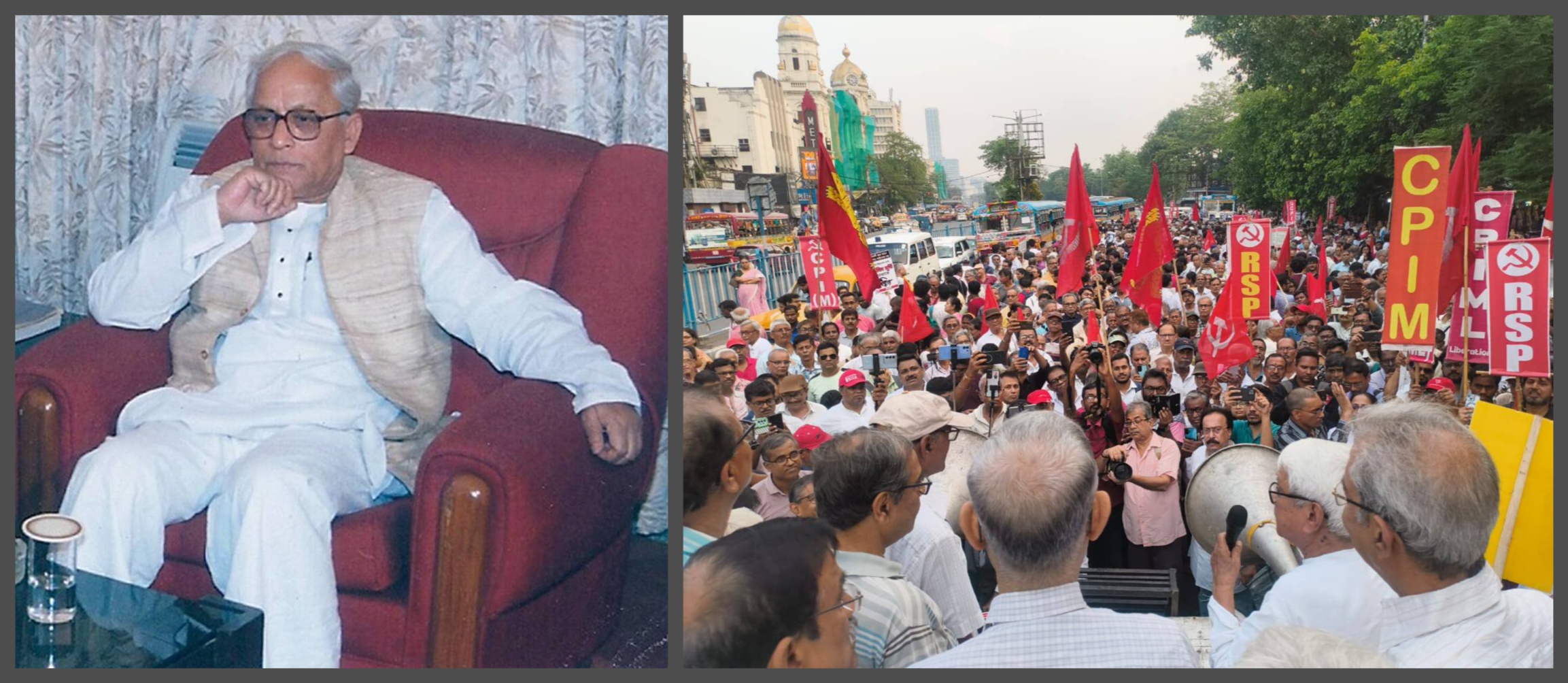 Buddhadeb Bhattacharjee as Chief Minister (left), and Biman Bose addressing a CPM election rally in the recent West Bengal election; photo courtesy - Wikimedia Commons
An academic study in SAMAJ traced how “the political managers of the ruling Communist Party of India (Marxist)” engineered consent through what the author called the “shadow-state.”
In Nandigram, the government announced a 10,000-acre Special Economic Zone for a Salim Group chemical hub. On March 14, 2007, three thousand policemen — many marching alongside CPI(M) cadres — opened fire on five thousand villagers blocking the road.
The official death toll was fourteen; over a hundred were declared missing. Amnesty International’s 2007 brief recorded allegations that “the farmers were attacked by armed men affiliated to the CPI-M acting in complicity with the police… [who] fired at the farmers and branded some of them with hot iron rods as ‘punishment' for protesting.”
Bhattacharjee defended the carnage in the Assembly with a phrase that would crucify him: “They have been paid back in their own coin.”
The party of land reform had become the party of land grab. Mamata Banerjee took up the slogan Maa, Maati, Manush. As the Economic and Political Weekly’s body of land-acquisition scholarship records, Singur and Nandigram were the inflection points. In May 2011, the Left Front lost. Bhattacharjee himself lost his Jadavpur seat.
The CPI(M) was reduced to 40 seats in a 294-member House. By 2016, to 26; by 2021, to zero; by 2026, to a single legislator, elected from Domkal, Murshidabad.
The Bengal cadre — the kaaka-mama network of teachers, panchayat secretaries, party clubs and recommendation letters — had spent three decades fusing party and state until they were indistinguishable. When the state turned, the party had nowhere left to retreat.
Tripura falls: A citadel gone
Tripura was the smaller, quieter citadel. The Left Front had ruled the hill state from 1978 to 1988, briefly lost to Congress, and returned in 1993. Manik Sarkar — born in Radhakishorepur, son of a tailor — became Chief Minister in 1998 and held the office for twenty unbroken years.
He was the poorest Chief Minister in India: his Election Commission affidavit declared assets of just over a thousand rupees in cash. He didn’t own a house. He drew no salary, donating it monthly to the party.
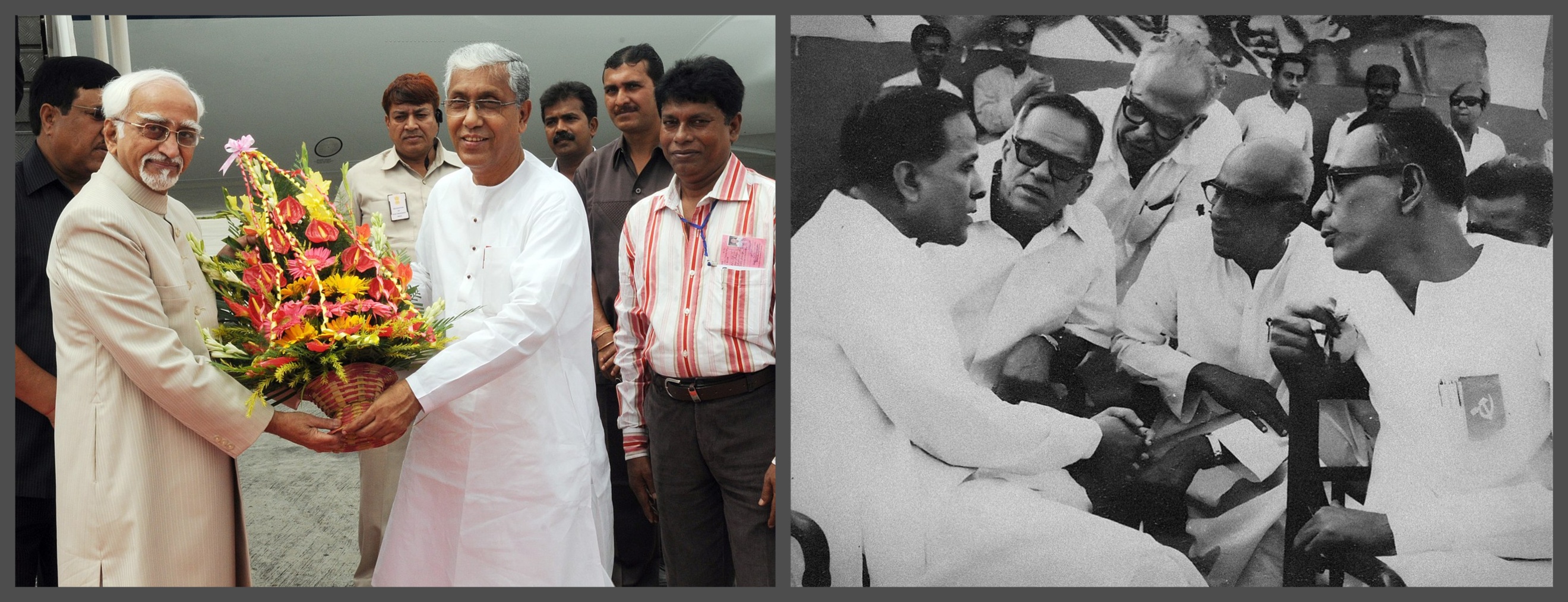
Manik Sarkar with then Vice President Hamid Ansari (left); and Jyoti Basu with B.T. Ranadive, Samar Mukherjee, Makineni Basavapunnaiah, Hare Krishna Konar, at the 20th All India Kisan Sabha Conference of 1969; Photo courtesy - Wikimedia Commons
Sarkar’s incorruptibility could not save him from the BJP-RSS organisational machine. According to the Election Commission’s Statistical Report on the 2018 Tripura General Election, the BJP went from 1.5 per cent of the Tripura vote in 2013 (forfeiting deposits in 49 of 50 seats it contested) to 43 per cent in 2018.
The BJP-IPFT alliance won 43 of 59 seats on March 3, 2018. The CPI(M) was reduced to 16 seats — and then, in 2023, to 11.
After Sarkar’s defeat, Assam Chief Minister Himanta Biswa Sarma sneered that he ought to be “deported to Bangladesh.” It captured the new register of Indian politics, in which an old Marxist’s poverty had become a punchline rather than a virtue.
End of Part 1. The story continues in Part 2 — from Yechury's quiet war to the final fall of the last red tower in Kerala on May 4, 2026.
Follow us on WhatsApp
Follow us on Facebook
Follow us on X @vudmedia
Follow us on Substack
