
From the ground realities, the Special Intensive Revision (SIR), 2025, cannot be seen as a routine electoral roll update. It, evidently, is a calculated rewriting of India’s democratic process. Framed as an administrative ‘clean-up,’ the revision shifts the burden of legitimacy from the state to the citizen, making voting a conditional act of proof rather than a guaranteed right of citizenry and democratic participation. Confusion over Aadhaar-linked verification, convoluted forms, and genealogical requirements risk excluding migrants, tenants, women, and the poor — groups historically vulnerable to bureaucratic erasure. Large-scale deletions seen in Bihar reveal how technical revisions can reshape political outcomes, disregarding calls for public scrutiny. As verification overtakes inclusion, the electorate itself narrows, transforming participation into compliance. SIR 2025 ultimately raises a fundamental question: Can a democracy remain free and fair when the very definition of its voters becomes fluid, discretionary and data-driven?
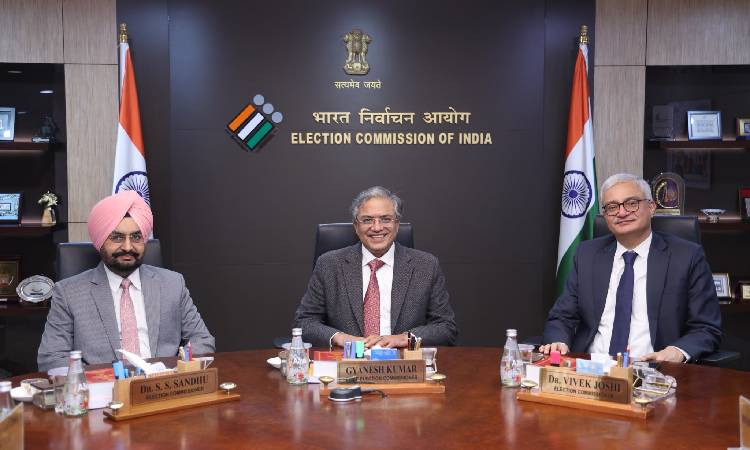
Home and text page images: The Chief Election Commissioner, Gyanesh Kumar, flanked by the two Election Commissioners, S S Sandhu and Vivek Joshi
Banner image: Women voters queue up at a polling booth
The Election Commission of India (ECI, or popularly known as the EC), on 4 November 2025, launched the Special Intensive Revision (SIR) 2025, a nationwide drive supposedly aimed at ‘cleaning up’ and updating the electoral rolls across 12 states and Union Territories. Officially, the exercise is presented as an effort to enhance accuracy, transparency and authenticity — the ECI’s usual trinity whenever public confidence begins to waver.
In a 1 December 2025 submission before the Supreme Court, the EC claimed that “the SIR exercise adds to the purity of elections by weeding out ineligible persons from the electoral roll.” The affidavit further asserts that “the guidelines issued with respect to the SIR exercise are constitutional and in the interest of maintaining the purity of electoral rolls, which is a pre-requisite for free and fair elections that form a basic feature of the constitution.”
As much as such submissions, these assertions sound noble, on paper. In practice, the timing is nothing short of extraordinary — coming months before crucial state and national elections, when even the smallest change in voter lists could tilt the scales of representation. The EC insists that this is routine, technical and administrative.
Yet what appears ‘routine’ in procedure may be progressive or regressive in its consequences.
When the very determination of who gets to vote is under ‘revision,’ the question presents itself: Can a democracy still call itself free and fair if the list of its citizens — the very foundation of the vote — is open to selective correction?
The EC’s mandate, constitutional boundaries — and the Aadhaar paradox
At the heart of India’s electoral democracy lies Article 324 of the Constitution, which grants the EC the power of superintendence, direction and control over elections to Parliament and the state legislatures. The framers envisioned it as a neutral trustee entrusted with ensuring that every eligible adult, as guaranteed under Article 326, is able to vote freely. The EC was never meant to function as an arbiter of demographics or a quasi-citizenship-verification authority.

