
When French students blockaded their schools over teacher shortages and crowded classrooms, the unrest spread far beyond the classroom. The right wing around the world blamed religion and migration instead of budgetary cuts and rising costs, as India’s right wing is also doing now. Yet India is unlikely to follow France, because social divisions run deep here, with parties winning elections by courting dominant blocs. However, a jobless Gen Z, led by the Cockroach Janta Party, is organising around shared hardships rather than birth. Its real test is yet to come, and it will need institutions, not just moods, to turn promise into lasting change, says Pradeep Kaimal, explaining why the emerging youth mobilisation in India could build a new politics of the many that the few cannot divide.
Home page image and Banner images are AI-generated
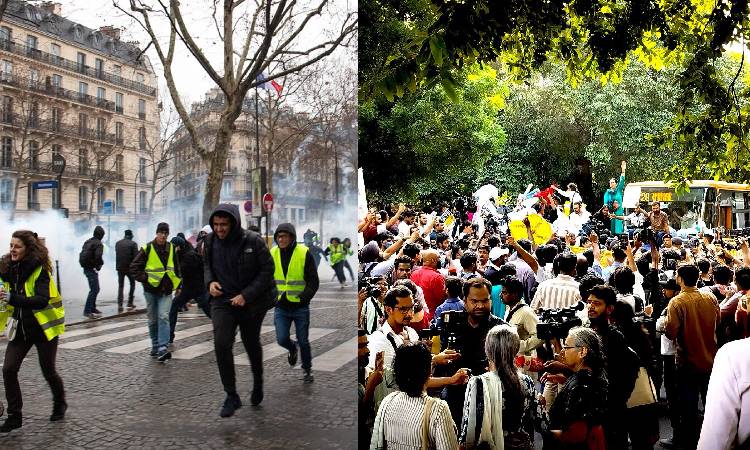
Text page image: A gilets jaunes demonstration in Paris, December 2018; photo by Olivier Ortelpa via Wikimedia Commons (left), and an SIR protest in New Delhi (right)
It began in a rather humble manner, when students of a lycée in Créteil, a working-class suburb of Paris, came out on 17 September 2026 to protest against the shortage of teachers, the overcrowded classrooms and the poor conditions of their school. Those protests quickly spiralled into strikes, blockades of schools and larger demonstrations across France.
The state, instead of listening, allowed the matter to drift. By October 5th, hundreds of schools were partly or fully shut, and the education minister stated that 24 had been burned or ransacked. All this happened alongside public sector strikes against planned budget cuts.
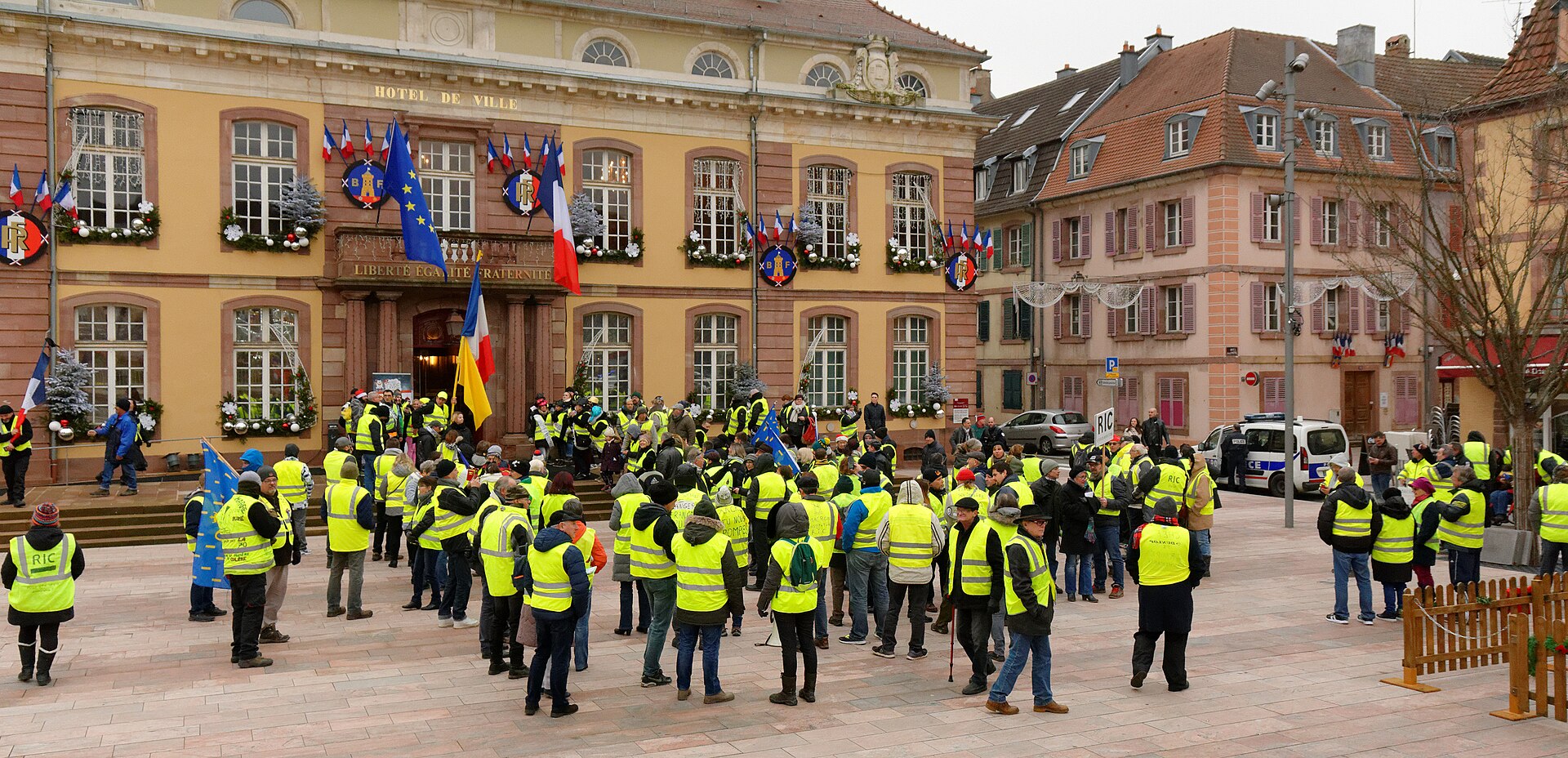
The Yellow Vests protests in Belfort; photo credit - Thomas Bresson via Wikimedia Commons
The movement then widened, with unions and workers joining in, some violent elements appearing and curfews following. By mid-October, the demand was about the cost of living, with over 200 to 300 protest actions on October 17th, backed by the Yellow Vest figures, the General Confederation of Labour (CGT), France Unbowed (La France Insoumise) and the Communist Party.
Look at the demands –teachers and classrooms, fuel prices and frozen salaries. It is clear that this is not a story about religion, but about a state that is cutting public goods while expecting ordinary people to bear the cost of its crisis.
The lie that travels well
Yet, a very different story has gone around the world, since far-right figures in the US and UK have shared videos of the unrest to push their immigration claims. France 24’s fact-checkers found that the footage was often genuine, but that this did not prove the larger claims attached to it.
A European media monitor makes the sharper point that the hardest-hit neighbourhoods, with run-down schools and too few teachers, are also home to families of immigrant origin, which the far right ignores while explaining everything through some inherent difference of the people. Poverty, in simple words, is converted into ethnicity, and that is the whole trick.
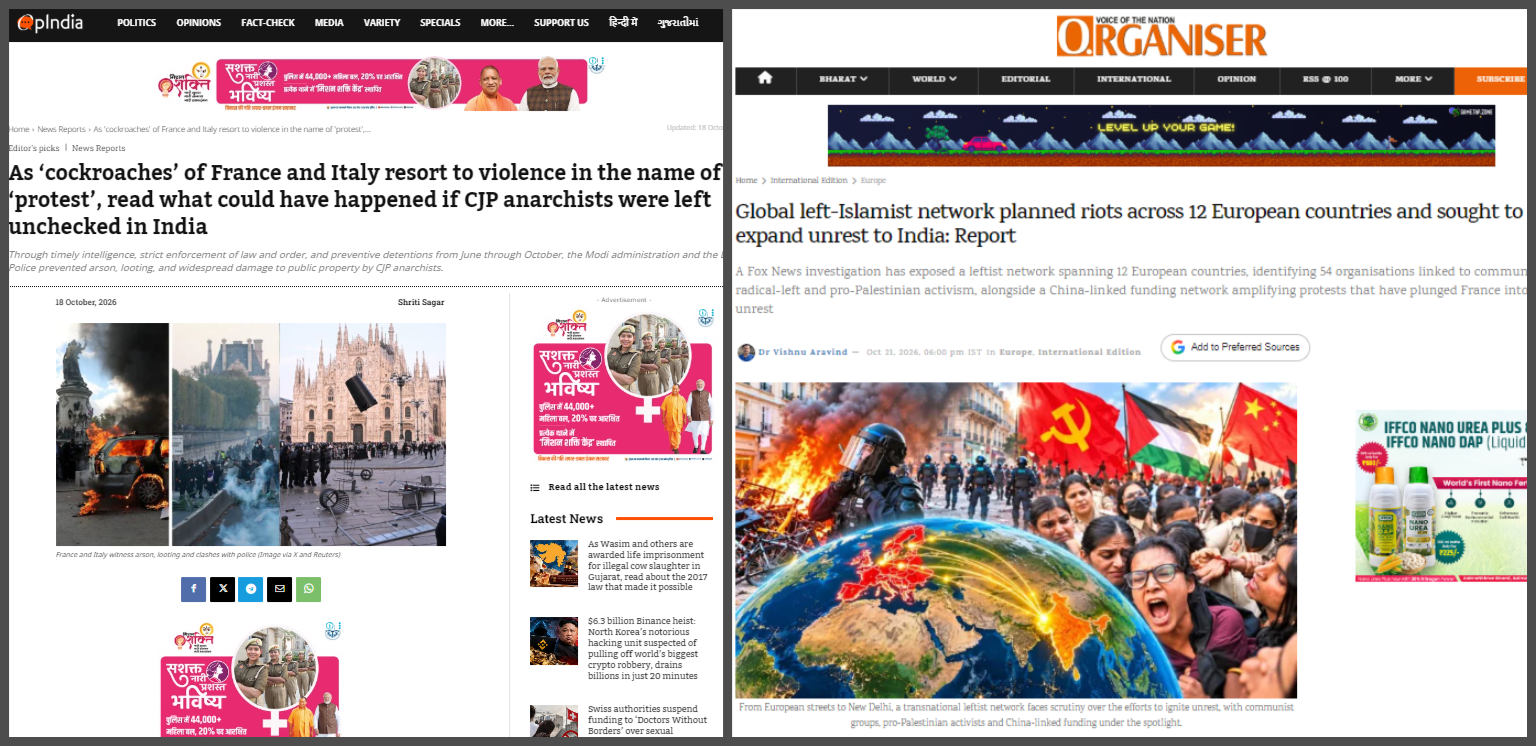
India’s right wing has played this game before, because during the 2023 riots in France Hindutva supporters in India openly backed the French far right, while the RSS mouthpiece Organiser concentrated on the alleged role of ‘Islamists’.
It is happening once more, for even Organiser’s own report of October 7th admits that the protests began in Créteil over staffing and conditions. Yet, the same publication has since carried one report calling the riots proof of a radical left-Islamist nexus and another on Islamist networks exploiting public anger across Europe.
One claim in them needs care; the French intelligence is reported to have blamed France Unbowed, which the party rejects, and that is an allegation, not a finding.
The line has reached India directly. When the Cockroach Janta Party (CJP) took its protest to Delhi on October 10th, Fox News editor Asra Nomani wrote that India was next, and OpIndia carried her warning of a French-style ‘communist-Islamist’ playbook.
Notice what this achieves, which is that a protest about voter rolls in Delhi gets tied to a school protest in a Paris suburb, and both get tied to a religion.
Naturally, such viewpoints should be abhorred and called out for being diversionary, whose purpose is to make dissent look foreign, violent and illegitimate before it has found its feet. For, if the protester is a threat to the nation, then his or her questions need never be answered.
Why India is not France
Now we come to the harder question, which is whether India can see a French-style upheaval. The honest answer is: very unlikely in the near future.
France has a long tradition of the street as a political actor and a shared idea of the citizen, however battered, so that a teacher in Lille and a firefighter in Marseille can both feel that they are fighting the same state.
Whereas in India, the idea of one people exists mostly in the Constitution, while life on the ground is organised around deep social divisions, thousands of castes and clans among them, the dominant of which set the terms.
Even the biggest elections in the world are decided, by and large, less by ideology than by the interests of the dominant castes and clans of a particular area. A consensus across these clusters has been almost impossible to find.
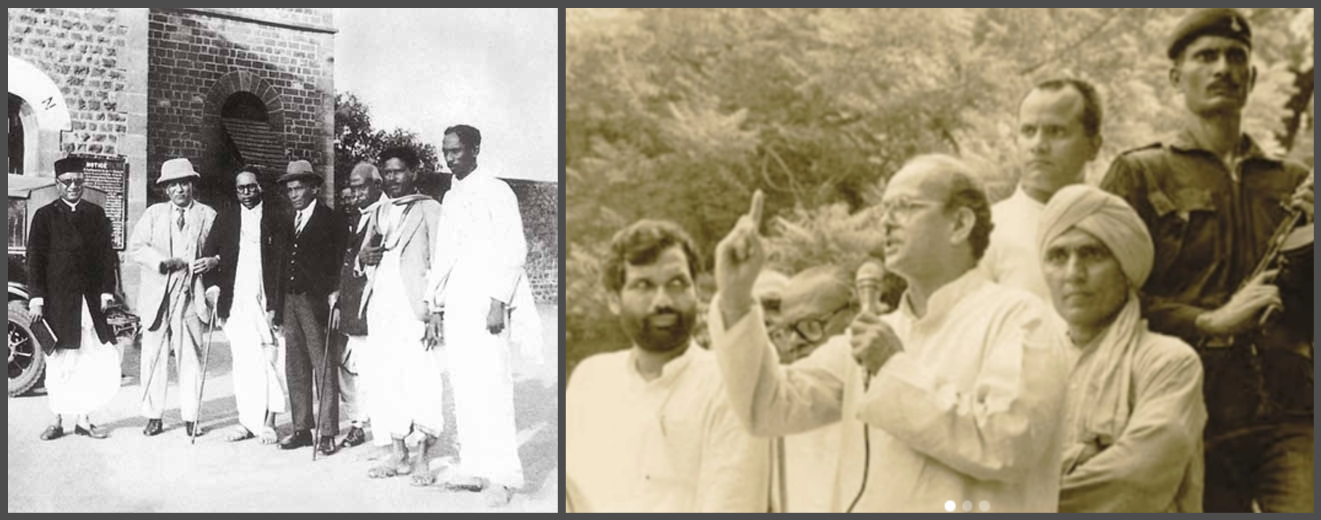
Members of the Poona Pact (left) and V.P. Singh, Ram Vilas Paswan and Swami Agnivesh during the Mandal Commission agitation period (right); photos procured from various social media pages
The Poona Pact of 1932 – an agreement signed on September 24, 1932, at Yerwada Central Jail in Poona (now Pune) between B.R. Ambedkar and Madan Mohan Malaviya (on behalf of Mahatma Gandhi and upper-caste Hindus) – was a hard bargain between upper-caste leaders and the leaders of the oppressed castes; the agitation against the Mandal Commission recommendations in 1990 split the country on caste lines; and the Jat, Patidar and Maratha quota movements, each led by landed, locally dominant castes, pushed narrow demands, often against other groups.
It is true that a shared faith has often given people a common platform, as with the Black church in the American civil rights movement. In the Abrahamic faiths, one book, one prayer and one community of believers can build a protest around a single demand.
In India, however, the larger society is not one community in that sense but a cluster of social groups, castes and clans, each with their own hierarchy, customs and interests. A common label binds people on a census form but seldom at the bargaining table, since caste identities keep reasserting themselves at the ballot box.
There is a quiet irony in how our deeply divided social fabric seems to hold together as one only at certain moments: it happens mostly when values presented as common to all, though they have often served some sections more than others, are seen as threatened from outside.
The present dispensation, in particular, seems to understand this, and so it has little fear that the majority will rise against it on questions of their daily lives.
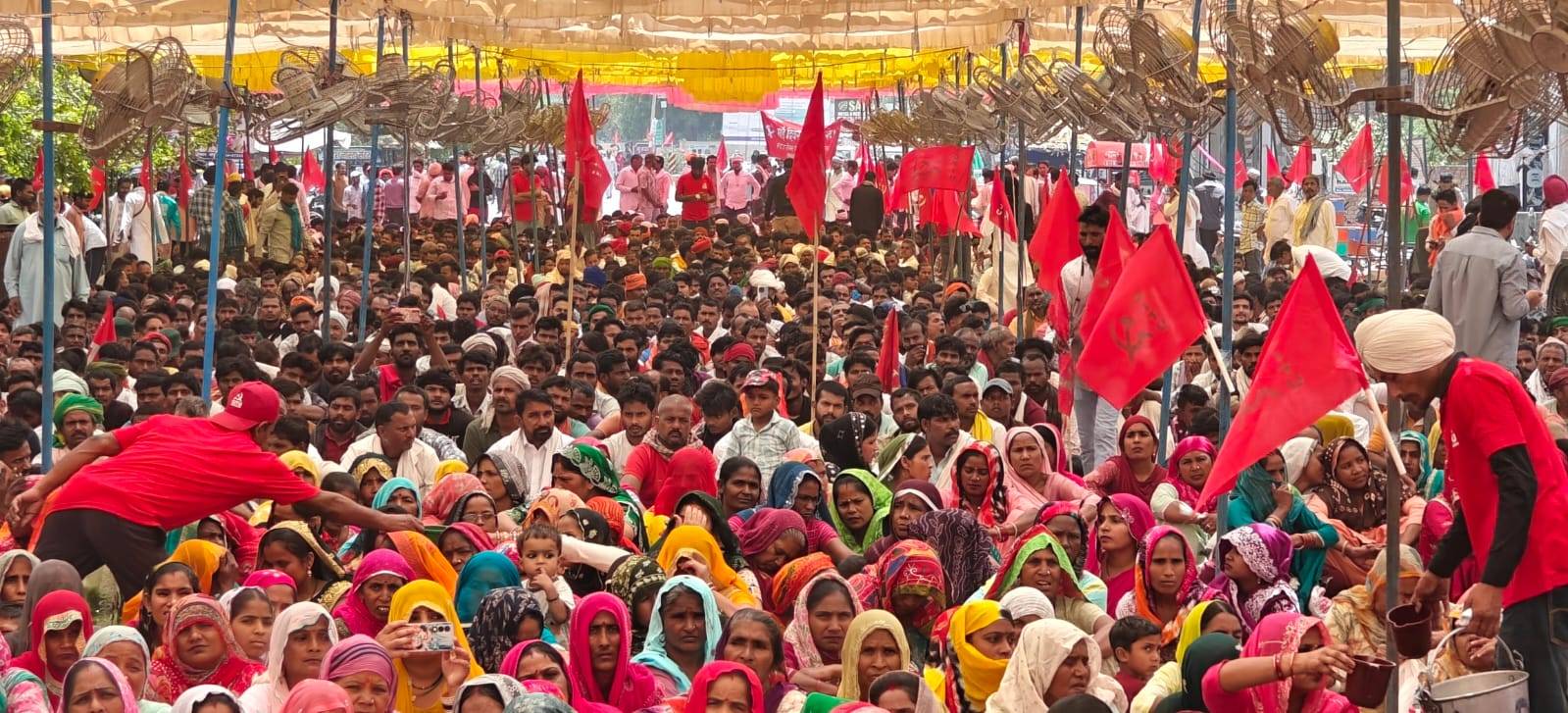
Farmers at an All India Kisan Sabha rally
Even the farmers’ protest of 2020-21, so often cited as an exception, was led mainly by the landed farmers of Punjab, Haryana and western Uttar Pradesh. They mainly hailed from dominant communities like the Jat Sikhs, with Dalit labourers extending solidarity to the dominant Jats while their own grievances stayed largely out of the speeches.
Karl Marx did not write on caste as such, but he would have understood its function, for a society whose working people are split into ranked and hereditary groups and has a built-in arresting mechanism on class solidarity.
The farm labourer and the small landlord of the same caste are told that they are brothers, while farm labourers of two different castes are told that they are rivals, with the arresting mechanism working every single time.
Social division, of course, is no iron law. A fair critic could ask why youth movements toppled governments in Bangladesh and Nepal, while those in Indonesia, India and Timor-Leste won policy reversals, when Nepal too has deep social divisions.
India is not immune, but its movements have so far stayed non-violent and won concessions, while the state so far has kept the larger order intact.
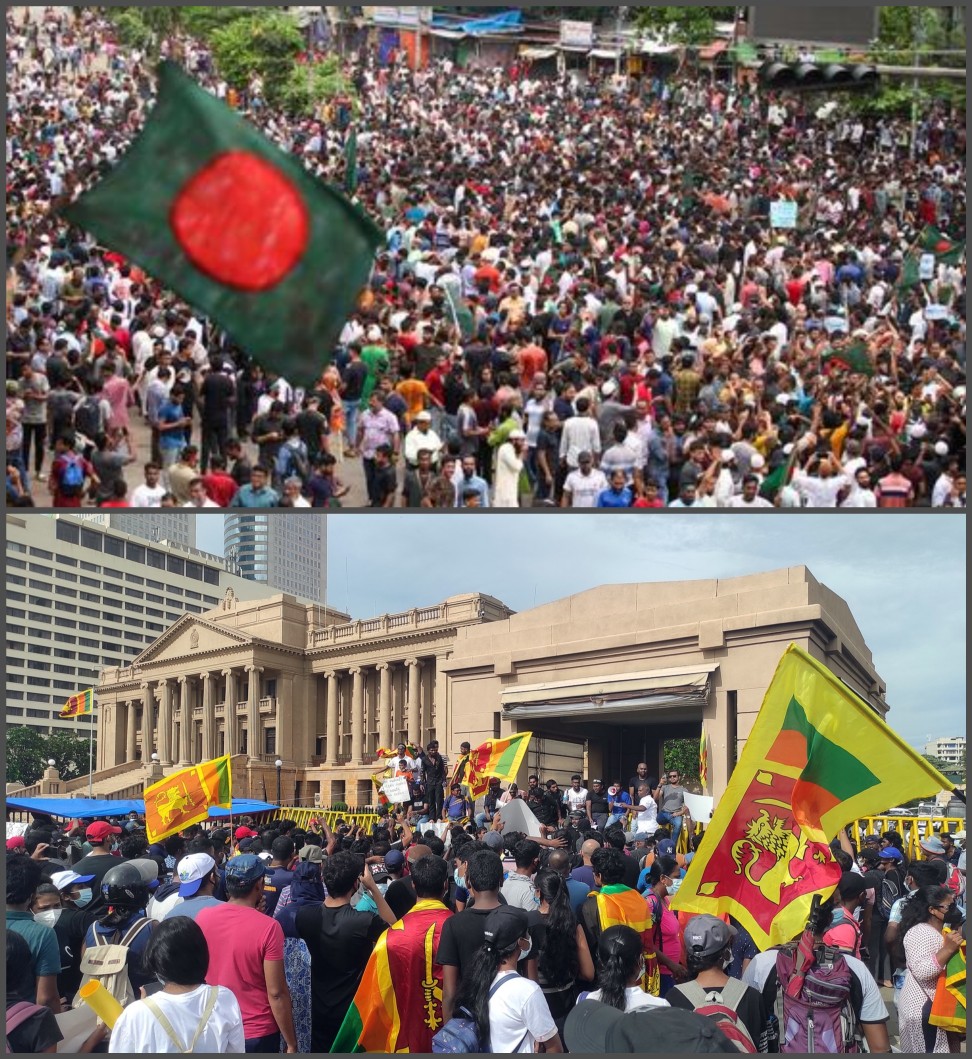
The July Uprising of 2024 in Bangladesh (above), and the Aragalaya protests of 2022 in Sri Lanka (below)
The party of the bloc
Our political parties know all this and use it. Most are not ideological in any strict sense but machines for winning elections. And since elections are won by catering to the dominant interests of a region, religion or caste, no party is an exception.
In 1985, when the Supreme Court ruled in the Shah Bano case that a divorced Muslim woman could claim maintenance, conservative leaders of the community protested. The Congress government led by Prime Minister Rajiv Gandhi passed the Muslim Women’s (Protection of Rights on Divorce) Act in 1986, effectively diluting the verdict (by keeping Muslim Personal Law outside the ambit of the CrPC).
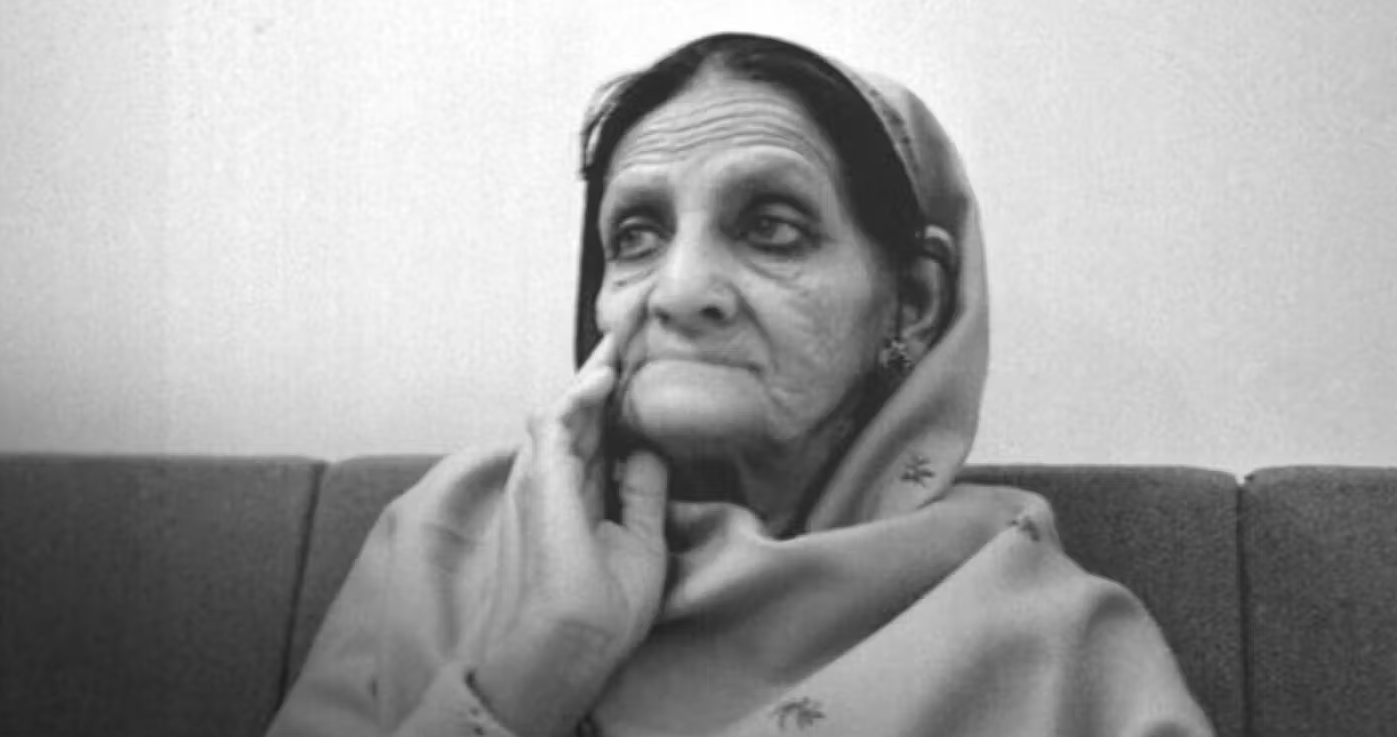
A photograph of Shah Bano; photo sourced via LinkedIn
The Congress government was then literally trading a woman’s rights for a block of votes. In the same year, the locks of the Babri Masjid were opened for Hindu worship, widely seen as a balancing act to mollify the Hindu right, which protested against the appeasement of the Muslim conservatives.
The mosque was eventually demolished on 6 December 1992, and how a Ram Temple came up in its place through a Supreme Court verdict could be a repeat of the same political sleight seen in 1986, but of a different character, and a collusive role by the apex court, unlike in the earlier version.
The parties see a bloc and make a bid, which is why a party-led movement mobilises its own community and stops where that community stops, and also the reason why the ongoing unrest will go a certain distance and no further.
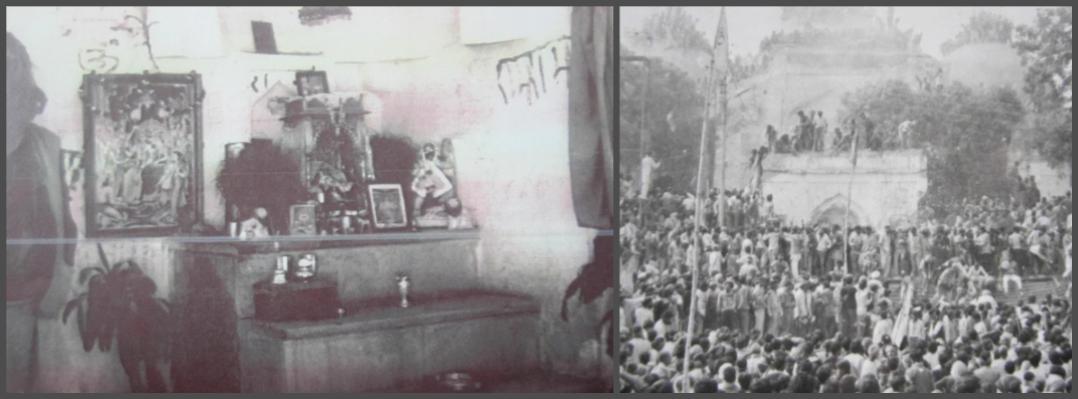
The idols of Ram Lalla (left) and crowds around and atop the Babri Masjid during the demolition (right); photo source - X page of Reclaim Temples
A different kind of youth
Yet, something new is moving. On 15 May 2026, Chief Justice of India, Surya Kant, likened unemployed youth to cockroaches, later clarifying that he meant those with fake degrees. The remark inspired the CJP, a satirical take on the BJP’s name, whose format was nothing like that of a traditional party.
Within days, it had more than 20 million Instagram followers, more than the BJP or the Congress, aptly echoing the deep-rooted resentment. What began as online satire became a serious protest movement on the ground.
Its content was also different; most established parties, in general, organise people in the name of community or religion for electoral gain, whereas the CJP asked people to come as the jobless. And so far, its appeals have been largely free of conventional political templates.
Its first big fight was over the mismanaged NEET (National Eligibility cum Entrance Test) medical entrance exam and the alleged paper leak. The education minister, Dharmendra Pradhan, had to resign on July 25th, after which the CJP called off its protests and began a campaign to fix public schools in several states.
It was a rare concession by this government.
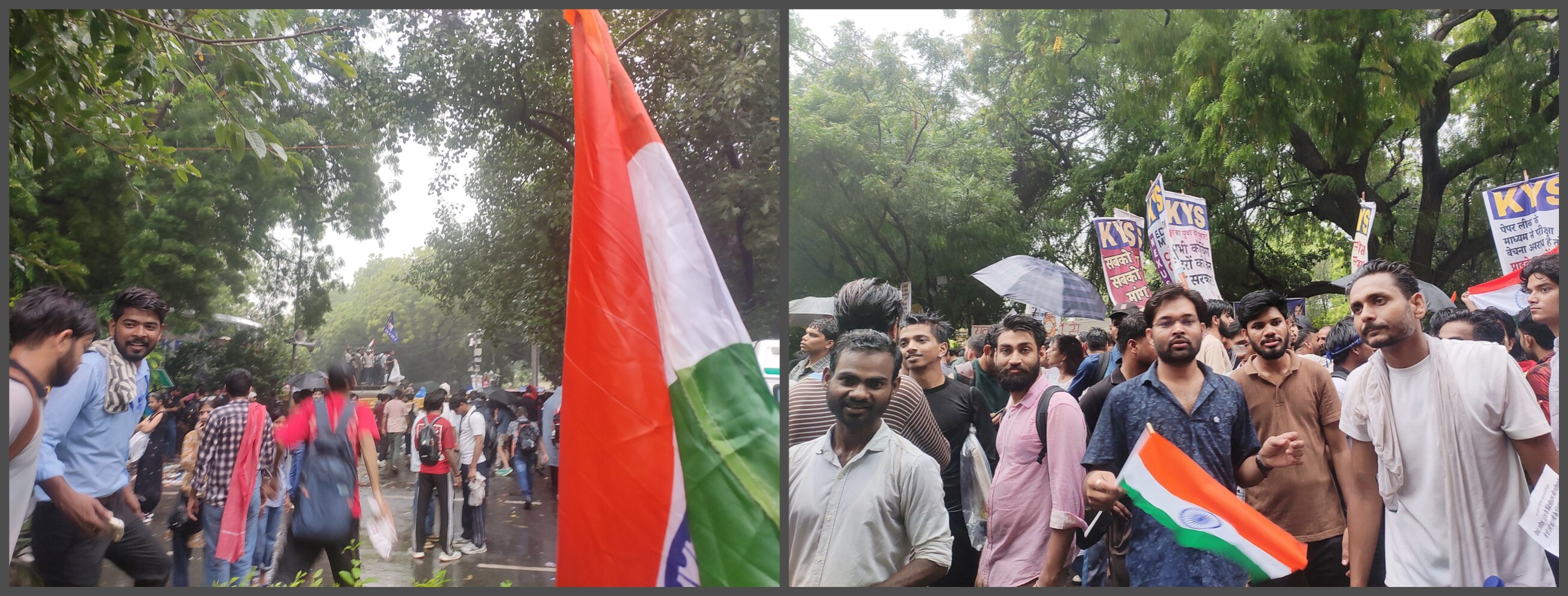
Students led by the Cockroach Janta Party protesting against 'paper leaks' at Jantar Mantar in New Delhi - photo credit - Sumita Roy Dutta via Wikimedia Commons
It would be wrong, however, to think that this generation is one solid bloc, or that old divisions have vanished from it.
A C-Voter survey found that only about a quarter of young respondents would prefer a candidate of their own caste, and nearly half reject caste-based voting in principle, but the survey is small and records stated preference, not behaviour. The young are not united on this.
One writer argues that the right has its own youth army in the Akhil Bharatiya Vidyarthi Parishad (ABVP), the Vishwa Hindu Parishad (VHP) and the Bajrang Dal, so that a rally of jobless graduates is only one side of a divided generation.
Yet the movement’s own face is telling. Its founder Abhijeet Dipke is a Dalit man, and its leadership has widened to include more women and religious minorities.
The first win, we must admit, was an easy one, since exam integrity is a grievance every student shares, and the demand was met by an otherwise obstinate government not known to bend before public outcries.
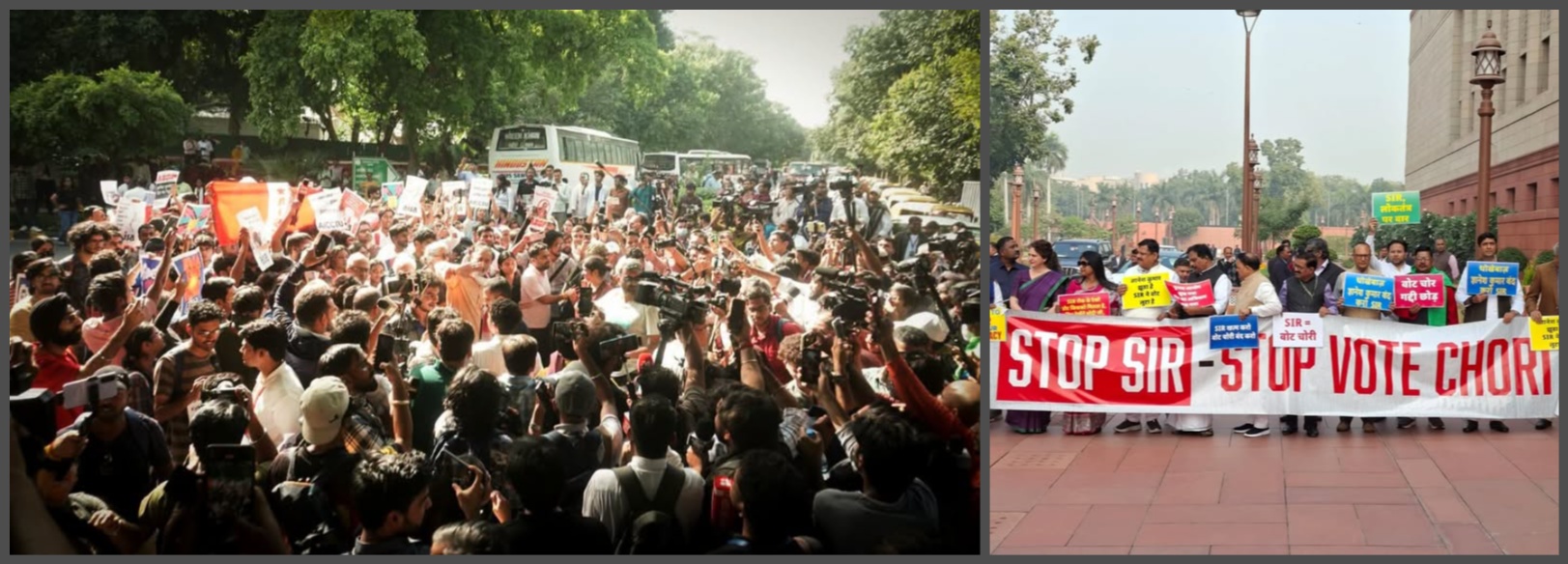
The protests against the Special Intensive Revision and the CEC in New Delhi
The harder test is the present campaign against the Chief Election Commissioner (CEC) over the voter-roll revision, termed the Special Intensive Revision (SIR). Over 35,000 police and paramilitary personnel were deployed in central Delhi on October 10th and over 45 metro stations were shut to halt the mobilisation.
Dipke and other CJP leaders were detained, some released on court intervention and others forced to sign ‘peace bonds’ dictated by the Delhi Police.
The promise and the limits of the individual
Why did this generation break from the old pattern? Its parents could hope that loyalty to caste and community would bring a job, a school seat or a licence, but the young seem to know better.
Behind it all lies a hard economic fact. The State of Working India 2026 report finds that two out of three young unemployed people in India are graduates.
Observers link these protests to youth unemployment and the lack of economic mobility. The young look at their own lives and ask what they are owed, which is a form of individualism which, in our society, is a liberating one.
It says that my worth does not come from my surname, and that a jobless Dalit and a jobless Brahmin have more in common than either has with the landlord of their own community.
This does not mean caste discrimination has ended. Affirmative action is still justified for those who still face it. The point is only that shared hardship can now bring people together across caste.
There is a bitter irony here. The young are not turning away from the collective but forming a new one, based not on birth but on shared conditions. What looks like individualism is, at its root, a class position – of the precarious, the educated and the unemployed.
Still, liberal individualism has its limits. For where the individual is supreme, solidarity turns thin. While a citizen without an organisation is easy to pick off, a movement built on a viral moment can vanish with the next one.
The French students had unions and a long tradition behind them, whereas India’s young have a hashtag and each other, though the CJP’s school-fixing campaign suggests that some are already trying to build something with roots.
Faith in the new
What, then, is the claim? Not that India will have its own France, because social divisions, region and a state quick to use force make that unlikely in the near future.
The claim is more modest, and perhaps more important – that a new kind of cross-caste pressure on the state is taking shape, real but untested, and resting on shared material conditions rather than inherited identity.
The old social order will not reform itself, because the dominant castes and parties that serve them gain from the present arrangement. The right wing will go on telling the poor to blame each other’s gods. The young will have to free themselves, and their break from tradition is exactly what makes this possible, as they owe little to the old loyalties and have less to lose.
If this generation can turn a mood into an institution, and join individual freedom to collective responsibility, it may build the one thing this country has never had – a politics of the many that the few cannot divide.
Follow us on WhatsApp
Follow us on Facebook
Follow us on X @vudmedia
Follow us on Substack
