
Most Europeans do wish the Trumpian nightmare to end, but until that happens, European leaders differ on how best to deal with their unpredictable friend turned foe. Europeans may hope for the best, but they may have to prepare for the worst, which includes the disintegration of NATO. The unwarranted American military assault against Iran, prodded by Israel, has put the Europeans on notice, with Trump’s declared ambition to acquire Greenland and integrate the province into the American ambit. The Greenland episode is the epitome of the European dilemma, wherein the protector has turned the tormentor. Stig Toft Madsen provides this glimpse from a European vantage point.
Home page image: The flags of the European Union and the United States, as carved in the American territorial mass; image source - IEP@BU
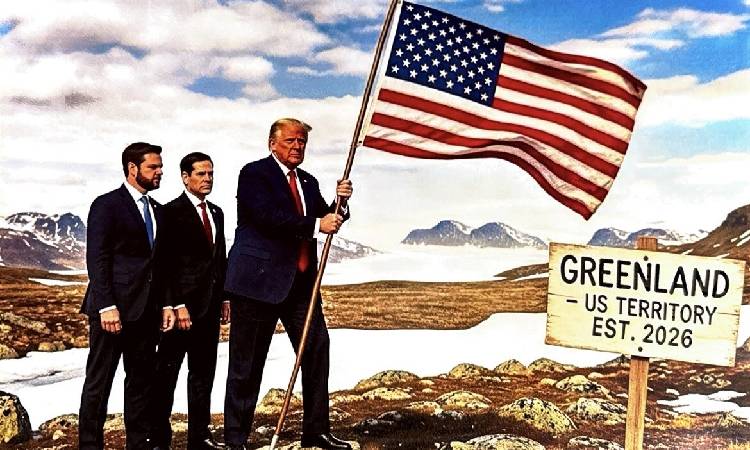
Text page image: Image posted by the US President Donald Trump on his Truth Social page dated 20 January 2026, depicting an American takeover of Greenland
Banner image: King Charles with US President Donald Trump at the White House, with the US First Lady and the British Queen
In his much-maligned 1996 bestseller The Clash of Civilisations and the Remaking of World Order, Samuel P. Huntington identified three Christian civilisations: the “Orthodox” civilisation centred on Russia and including Ukraine and Greece; the “Latin” civilisation covering almost the whole of Latin America; and the “Western” civilisation.
Huntington’s world map of civilisations at the beginning of the book shows the “Western” civilisation as both transatlantic and transpacific. It comprises the United States of America (USA or US), Canada, Europe (including the Baltic and Visigrád countries), as well as Australia and New Zealand.
Israel is not discernible on the map, but elsewhere in the text, he indicates that Israel, too, is Western. Thus, Huntington saw the West as a civilisational entity with Europe and the USA joined at the hip.
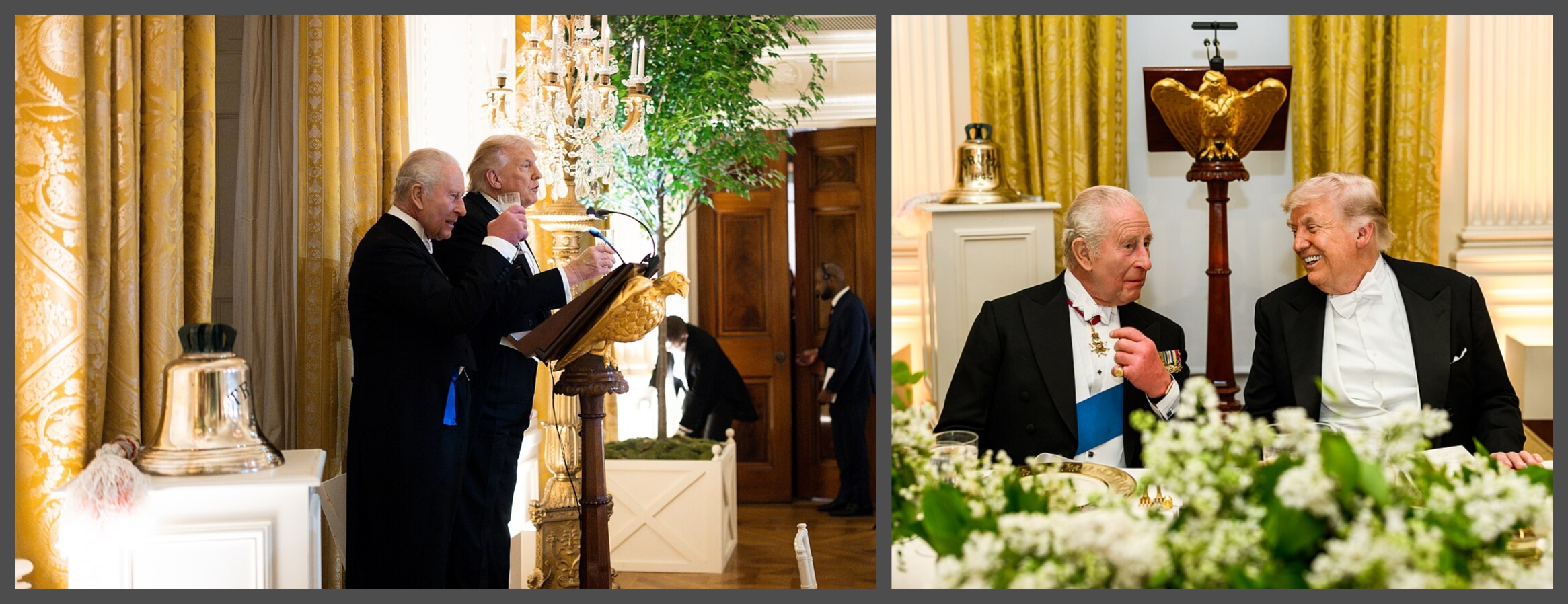
King Charles and President Donald Trump at the White House banquet
When King Charles of Britain visited Washington in late April this year, he did his best to shore up this unity. Reiterating the historical bond tying the US to the UK, he said these two “instinctively like-minded” nations enjoyed an “indispensable partnership.”
“Our defence, intelligence and security ties are hardwired together through relationships measured not in years, but in decades”, he added.
Two months earlier, the US Secretary of State Marco Rubio, in his speech at the Munich Security Forum, had this to say:
“So, in a time of headlines heralding the end of the transatlantic era, let it be known and clear to all that this is neither our goal nor our wish – because for us Americans, our home may be in the Western Hemisphere, but we will always be a child of Europe.”
Thus, Rubio would seem to agree with King Charles in his portrayal of the transatlantic relationship. However, in November 2025, the US had already formulated a National Security Strategy, which had torn asunder the transatlantic partnership eulogised by King Charles and Rubio.
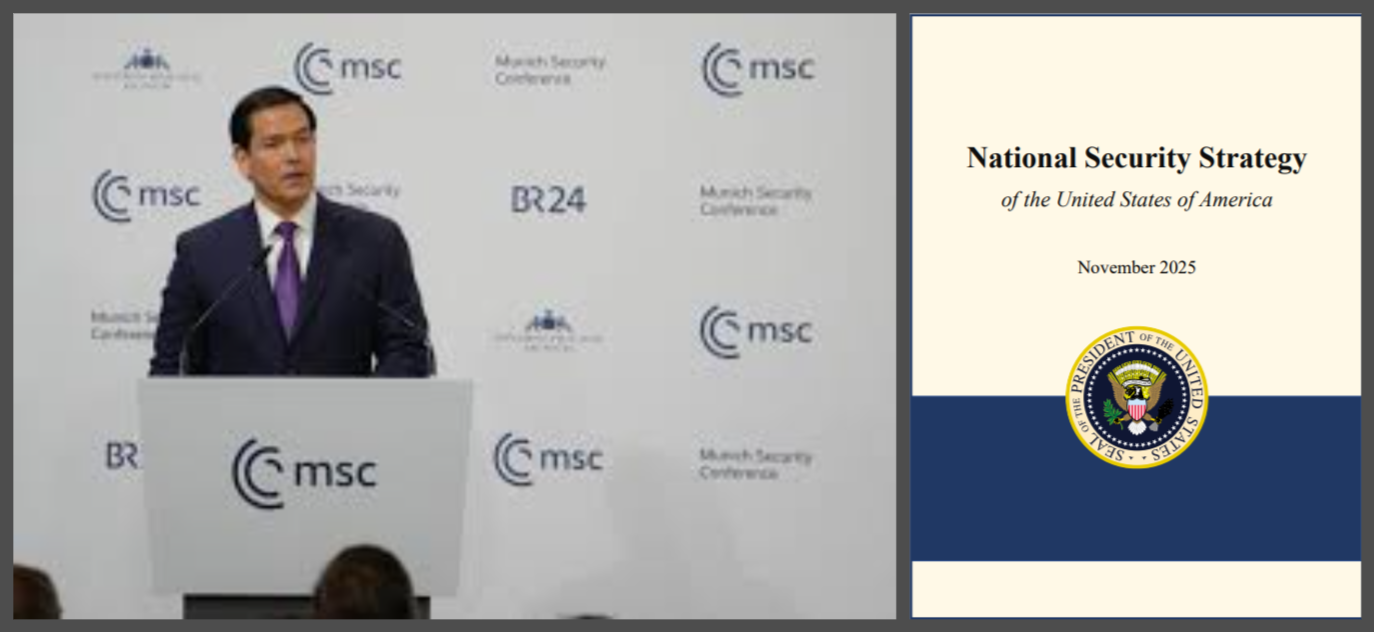
US Secretary of State Marco Rubio at the Munich Security Conference (left), and the opening page of the US National Security Strategy (right)
This strategy asserted that the US would be an American power of the Western hemisphere, if anything, more concerned with China than with Europe. Europe would have no choice but to manage its environment on its own.
Europe, the strategy asserted, is on the brink of “civilisational erasure”:
“The larger issues facing Europe include activities of the European Union and other transnational bodies that undermine political liberty and sovereignty, migration policies that are transforming the continent and creating strife, censorship of free speech and suppression of political opposition, cratering birthrates, and loss of national identities and self-confidence. Should present trends continue, the continent will be unrecognisable in 20 years or less.”
Unapologetically harsh, the strategy stops short of writing off Europe entirely, condescendingly reassuring Europe that:
“Our goal should be to help Europe correct its current trajectory. We will need a strong Europe to help us successfully compete, and to work in concert with us to prevent any adversary from dominating Europe.”
In other words, the US – the civilisational “child” of Europe - would stop short of civilisational patricide, not because Europe deserves to live, but because the US does not want to see Europe fall into the hands of its enemies.
What should European leaders do in this situation? Should they patiently wait for normalcy to be restored, or take action to avoid being sidelined, or out-pivoted, by a raging superpower?
When Joseph Biden came to power after defeating Donald Trump in 2020, he declared that “America is Back.” European leaders accepted Biden’s invitation to restore the relationship. This time around, transatlantic relations may have been shattered to the extent that Humpty-Dumpty cannot be put together again.
Defending Greenland – Prevaricating on Iran
In January 2026, Trump escalated his threats to take Greenland by force. In response, Denmark reinforced its military presence in Greenland.
The Danish soldiers hastily sent to Greenland, it is now known, brought with them enough explosives to blow up the two major airports in Greenland, thereby making it more difficult for the US to land troops on the island. The Danish soldiers also brought blood transfusion supplies to treat the wounded, should a military confrontation happen.
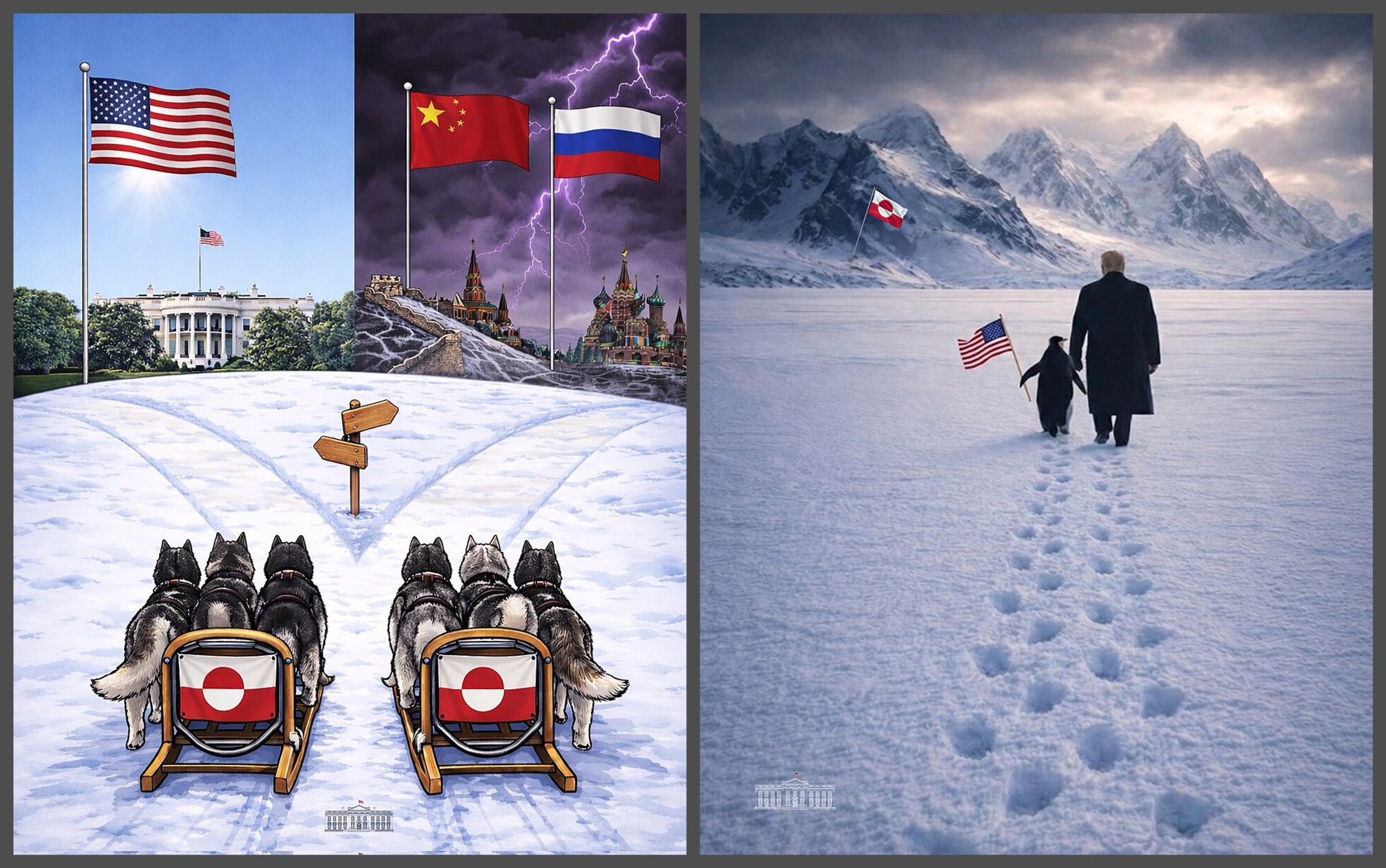
AI-generated images posted by the White House on 14 January 2026 (left), and 23 January 2026 (right), during the Greenland crisis
Other European powers backed Denmark. In effect, these powers signalled that they, too, were willing to face the US militarily to help Denmark withstand US aggression. In a series of manoeuvres, the Danish government succeeded in calming down the situation, and at the Davos meeting late in January, Trump de-escalated his threats.
Instead, he started a war against Iran together with his Israeli ally, who, according to the New York Times, may have goaded him to take this step.
In Europe, the consequences of this war have, so far, been felt mainly economically and politically, not militarily. Politically, most European countries have distanced themselves from the US and Israeli attacks on Iran and on Lebanon, but to varying degrees.
More stridently than others, the Spanish Prime Minister Pedro Sánchez has campaigned against the US-Israeli war. Leading an impressive gathering at the Global Progressive Mobilisation initiative in support of democracy, multilateralism, and international law in Barcelona in April, Sánchez was flanked by many European socialist leaders, including prominent Swedish social democrats.
From the US, the democratic Vice-Presidential candidate and Governor of Minnesota, Tim Walz, turned up in person, while Zohran Mamdani and Bernie Sanders participated on a video link from the US. From India, Rahul Gandhi and Salman Khurshid participated.
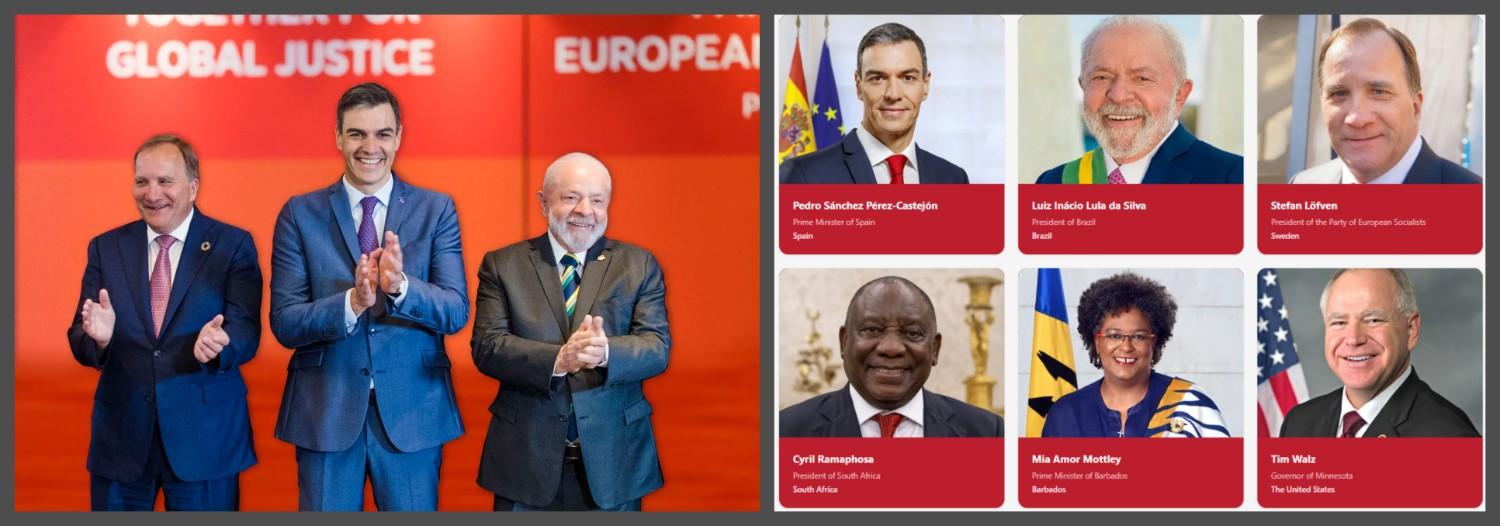
Minnesota Governor Tim Walz, Prime Minister of Spain Pedro Sanchez and President of Brazil Lula da Silva at the Global Progressive Mobilisation (left), and speakers at the Initiative (right)
Together with Italy and Germany, Spain also refused US warplanes permission to use US bases in their countries for the war against Iran. On top of this, the German Chancellor, Friedrich Mertz, added that the US lacked a strategy in its war against Iran, and that the Iranians “humiliated” the Americans.
Trump’s response to Mertz’s attempt to call a spade a spade came quickly. The US threatened to withdraw 5,000 or more of its troops stationed in Germany. Such a threat may take time to materialise, but it was serious enough to make Mertz back down.
The US has approximately 35,000 troops in Germany, 12,000 in Italy and 3,200 in Spain. If thousands of US troops are withdrawn, Europe’s ability to defend itself will be significantly weakened. To forestall this scenario, the leaders of both Lithuania and Poland have offered to host thousands of US troops should they leave Germany.
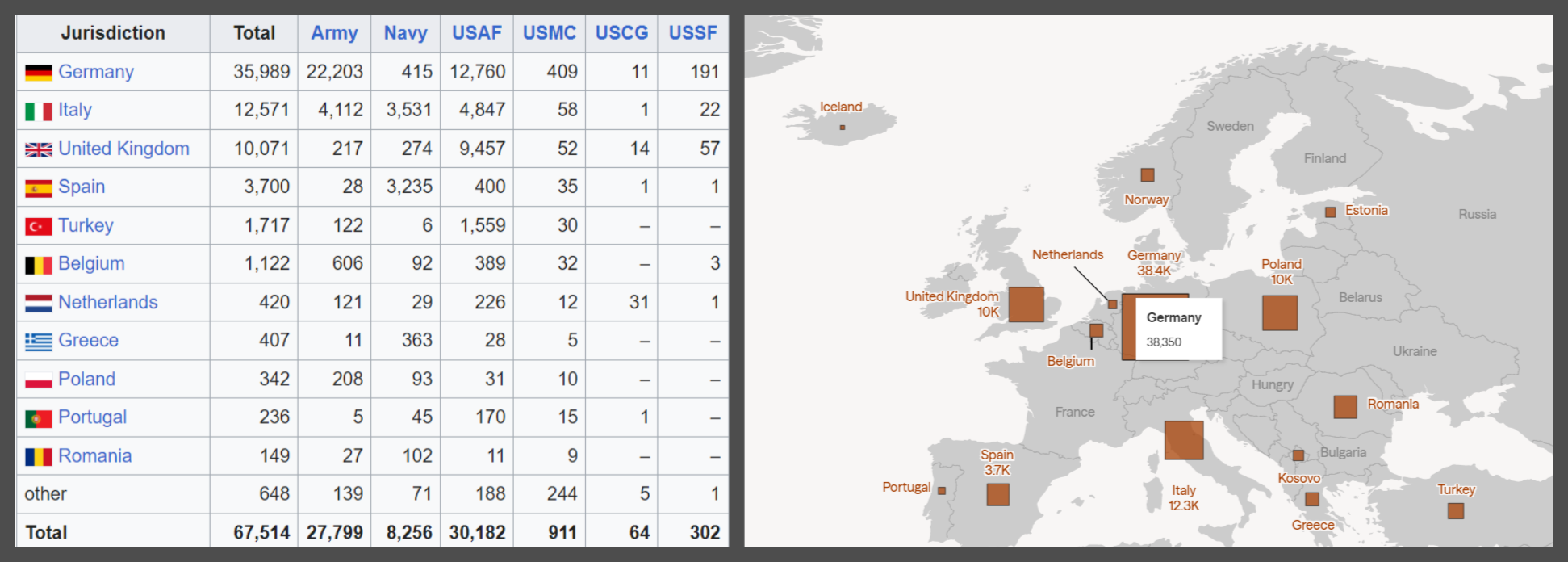
Table showing US troops in Europe (left), and their deployments across Europe (right)
Strategic chamchagiri
The recurrent element in these situations is the question of how to face a rogue superpower like Trump and his administration team, who openly and gleefully work hard to “drain the swamp,” i.e. to dismantle the architecture of the post-WWII liberal order at home and abroad in the dogged pursuit of their (mis-)perceived self-interest.
Should one, like the NATO General Secretary Mark Rutte, the Pakistani army chief Field Marshal Asim Munir, who suggested that Trump be awarded the Nobel Peace Prize, or the FIFA President Gianni Infantino, who awarded Trump the FIFA Peace Prize, engage in strategic chamchagiri?
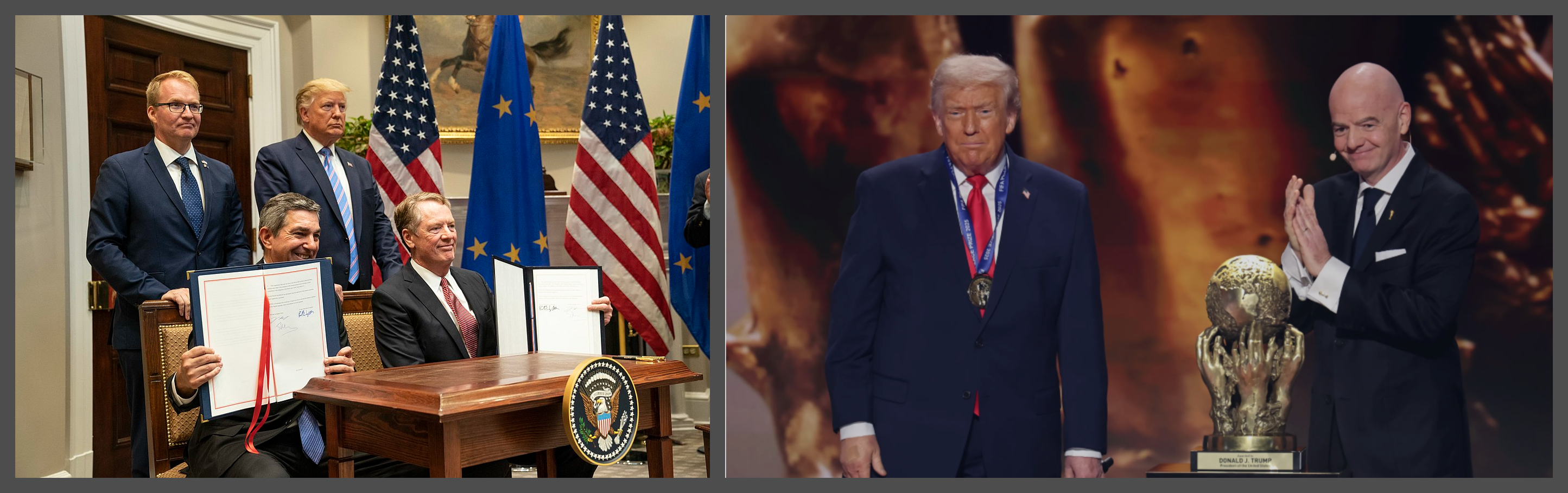
US and EU officials sign a deal on beef exports in 2019 during the first Trump Administration (left), and Donald Trump with the FIFA chief (right)
Will assuaging the ego of a vain president by offering him praise and gifts work or, at least, buy time for a crisis to evaporate?
While Europeans may try to laugh off Trump’s antics, they have had to accept that Trump has been right on some points. In particular, there is now widespread acknowledgement that the US was right all along to criticise the lack of military preparedness of most European countries.
To put this realisation in another way: Prime Minister Netanyahu said in an interview in January with The Economist that Israel would be militarily independent of the USA within ten years. Europe, the Danish commentator Klaus Wivel has argued, would do well to make a similar commitment.
In Denmark, for instance, the armed forces have long had to live under poor and unhygienic conditions on a meagre salary. Their equipment has often been substandard. The Danish navy, which patrols the sea around Greenland and the Faroe Islands, suffers a huge deficit in man-power.
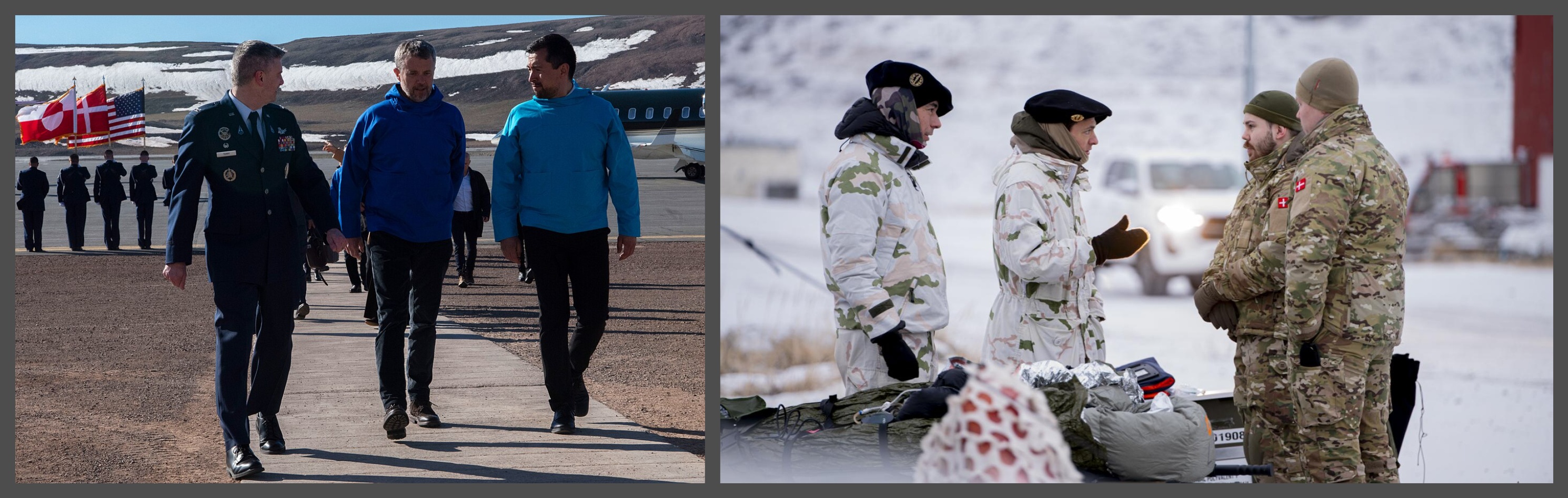
Greenland's head of state, King Frederik X of Denmark and Greenland PM Múte Inequnaaluk Bourup Egede, in traditional Greenlandic blue anoraks, at the Pituffik Space Base in June 2024 (left), and Danish and French soldiers during Operation Artic Endurance, designed to stop a US invasion (right)
A recent leaked internal report has revealed that one in four positions remain vacant on the key ocean patrol vessels maintaining Danish sovereignty in the area. Recent recruits often leave their job after completing their training. As a result, older officers are forced to work many hours overtime, gradually wearing them out. More than half the personnel have thought of quitting.
The sorry state of the military apparatus in Denmark reflects a lack of trust in armed defence across Europe. In several countries in Europe, many young people state that they are not willing to defend their country should it be attacked. The least willing to defend their country, according to a Gallup study, are the Italians: 78 per cent of adults declare themselves unwilling. By contrast, 76 per cent of Indians declare themselves willing to fight.
There are European exceptions. People in non-European Union (EU) countries are keener to fight than the people already inside the EU. Within the EU, the Finns stand out as more ready to defend themselves.
The Finns never harvested the peace dividend after the collapse of the Soviet Union, but maintained a high degree of preparedness. Finland has around 27,000 conscripts, while Sweden has 7,500, and Denmark only 4,500. Every year, around 200,000 Finnish reservists are called for training in Lapland.
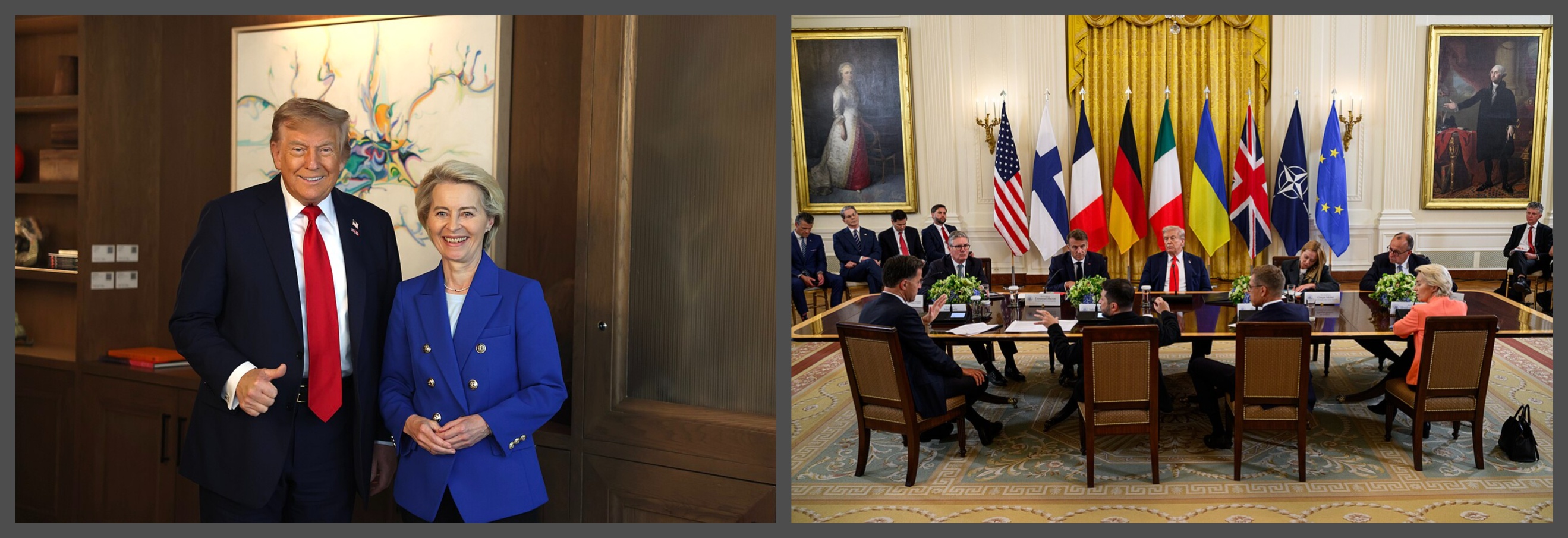
President Donald Trump with the European Commission President Ursula von der Leyen (left), and Trump chairing a meeting of European leaders with Ukrainian President Volodymyr Zelenskyy in Washington (right)
Finland presently has a President, Alexander Stubb, who can play golf with Trump and match the eloquence of Shashi Tharoor at Raisina Hills. This all helps bolster Finland’s image in times of flux, but Finland is a European exception.
There is no doubt that the situation in Europe remains tense. At the same time, it is less noisy now than during Israel’s campaign in Gaza. In those months, the streets of many European cities echoed with pro-Palestinian marches and slogans. Now, there are fewer demonstrations.
More surprisingly, the US-Israeli war against Iran has provoked fewer acts of terror than could be expected. Jews in London, however, have been repeatedly hit, and the Metropolitan Police has responded by dedicating one hundred officers to the protection of Jews in London.
In a way, some of the situations most fraught with a violent potential have arisen not in urban centres, but at sea.
Thirty years after ‘The Clash of Civilisations’
In the last chapter of the book, Huntington looked at the future of civilisations, the West in particular. He saw the West as a zone of peace where “intra-West wars, apart from an occasional Cold War, are virtually unthinkable.”
On closer inspection, however, he saw a real clash emerging in the USA between multiculturalists looking for their roots all over the world, and Americans who saw their roots in Europe.
Warning that “In the clash of civilisation, Europe and America will hang together or hang separately,” Huntington saw the likelihood of Americans losing their European roots as greater than the threat of Europeans ignoring the transatlantic link.
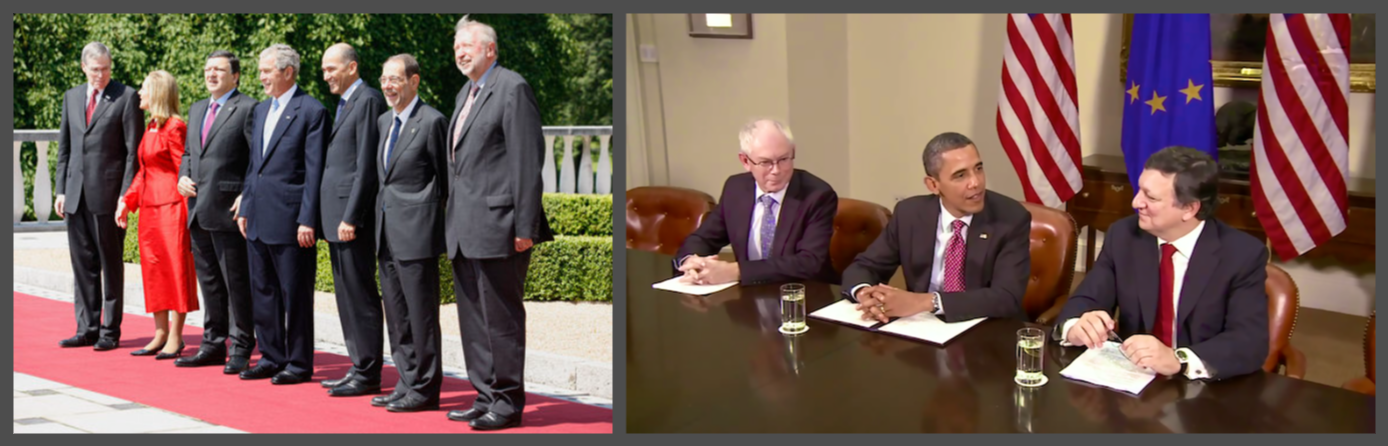
The US-EU summits of 2008 during the George W. Bush Administration (left), and of 2011 during the Barack Obama Administration (right)
Thirty years down the road, the US has, indeed, distanced itself from multiculturalism, but, ignoring its own limitations, it has also pushed aside its indispensable partner, Europe. Trump’s Kautilyan world, where the big fish eat the small fish, and where social media defines the truth, has become the new normal.
For the time being, Europe and America hang together, but barely so.
(Views expressed in this report are the author's own.)
Follow us on WhatsApp
Follow us on Facebook
Follow us on X @vudmedia
Follow us on Substack


