
Another May Day – commemorating the International Workers’ Day – has passed. With the Modi government’s new labour laws taking effect in the past year, their effects are showing in India’s industrial landscape. While workers are feeling the detrimental effects of the diluted rules, including compensation, safety, wages, and job security, among others, even the small-scale entrepreneurs are fearing regulatory friction. Furthermore, the industrial accidents of the past many months, which have taken the lives of unorganised workers, especially migrants, underline the lax safety regulations and relaxation of the inspection regime, making more and more workers susceptible to industrial hazards, with the pursuit of compensation turning into a painful sojourn. Until the definition of a factory once again includes every place where a worker can die in it, the factories of India will turn into graveyards for voiceless men and women whose right to work with dignity has been eliminated by the new labour laws, says Rejimon Kuttappan, in this detailed analysis.
Home page image: AI image of a foundry, for representational purposes
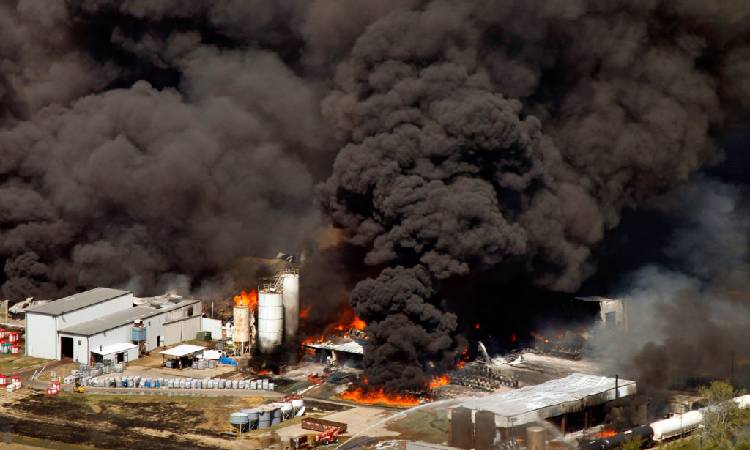
Text page image: An explosion at a factory/production unit, for representational purposes; photo source - Health Safety and Environment
Banner image: AI images of various factories, for representational purposes
At 2:33 pm on 14 April 2026, a high-pressure steam tube at Vedanta’s 1,200 MW Singhitarai thermal power plant in Chhattisgarh's Sakti district ruptured with the force of a munitions strike. Superheated steam, estimated at around 600 degrees Celsius, was released in an instant, scalding everyone within reach. Four workers died on the spot.
Over the following forty-eight hours, the death toll climbed to twenty, with sixteen more fighting severe burns and trauma across hospitals in Raigarh Medical College Hospital, Apex, and Metro.
A preliminary technical report from the Chief Boiler Inspector, later backed by the Forensic Science Laboratory at Sakti, pointed to “excessive fuel buildup inside the furnace, which caused dangerous pressure surges and displaced critical piping, leading to the catastrophic failure.”
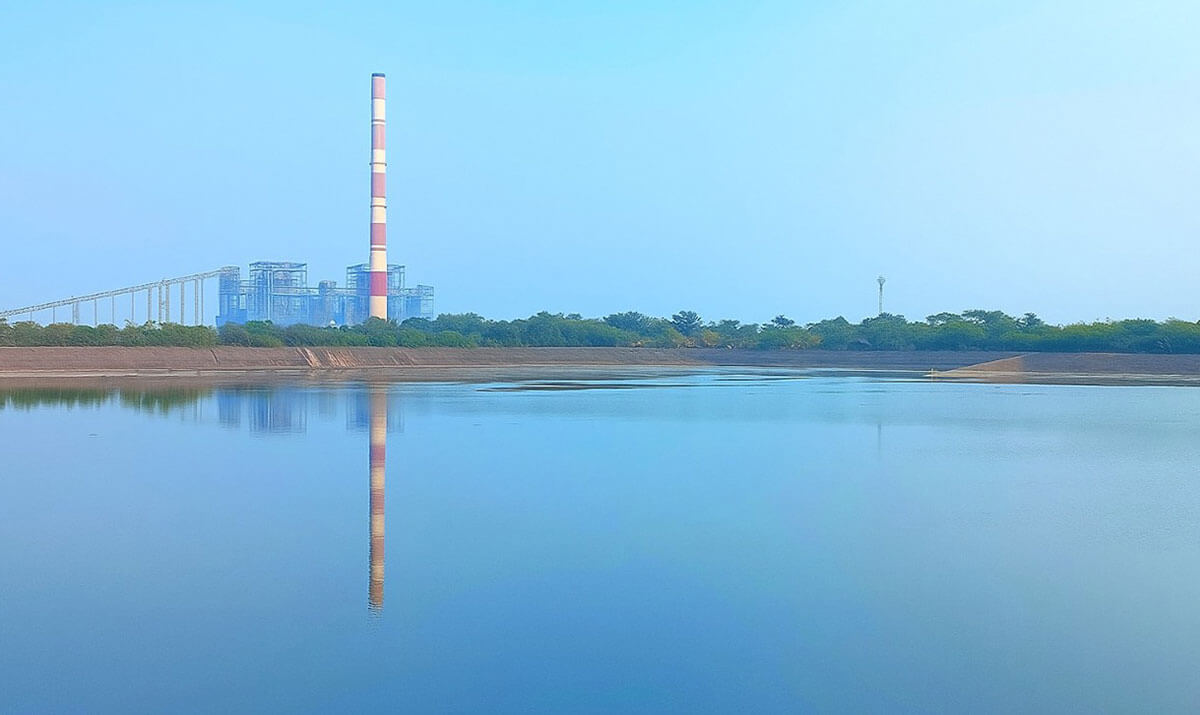
Vedanta’s 1,200 MW Singhitarai thermal power plant in Chhattisgarh's Sakti district
In plain English: fuel overload in a boiler that should never have been allowed to accumulate. Further probes revealed what the families had already suspected: “serious lapses in maintenance and safety protocols” by Vedanta Limited and its contractor NGSL, with “repeated negligence in equipment upkeep and failure to address pressure fluctuations.”
The workers who died were not Vedanta’s own. They were employees of NTPC GE Power Services, a subcontractor tasked with operating and maintaining the boiler. The plant itself had been acquired by Vedanta in 2022; one of its units was commissioned only last year, the other still under construction on the day of the blast.
The Chhattisgarh police have registered an FIR against Vedanta's director Anil Agarwal, plant manager Devendra Patel, and others under Sections 106(1), 289, and 3(5) of the Bharatiya Nyaya Sanhita, “causing death by negligence and endangering lives.”
The state government announced 5 lakhs to each family of the deceased and 50,000 to each injured person. A Special Investigation Team has been constituted. These are familiar rituals.
What should not be familiar is the pattern. A 2010 compendium of London-listed firms had flagged Vedanta Resources Ltd as recording 67 deaths, the highest among mining companies on the exchange at the time. The British Safety Council withdrew a safety award it had earlier conferred on the company and its subsidiary BALCO.
In a separate incident, a chimney collapsed at Korba in Chhattisgarh, killing 40 workers, with police filing culpable homicide charges; the company blamed the weather. Workplace fatalities across Vedanta's operations rose from seven in FY20 to thirteen in FY23, dipped, and rose again to seven deaths in FY25.
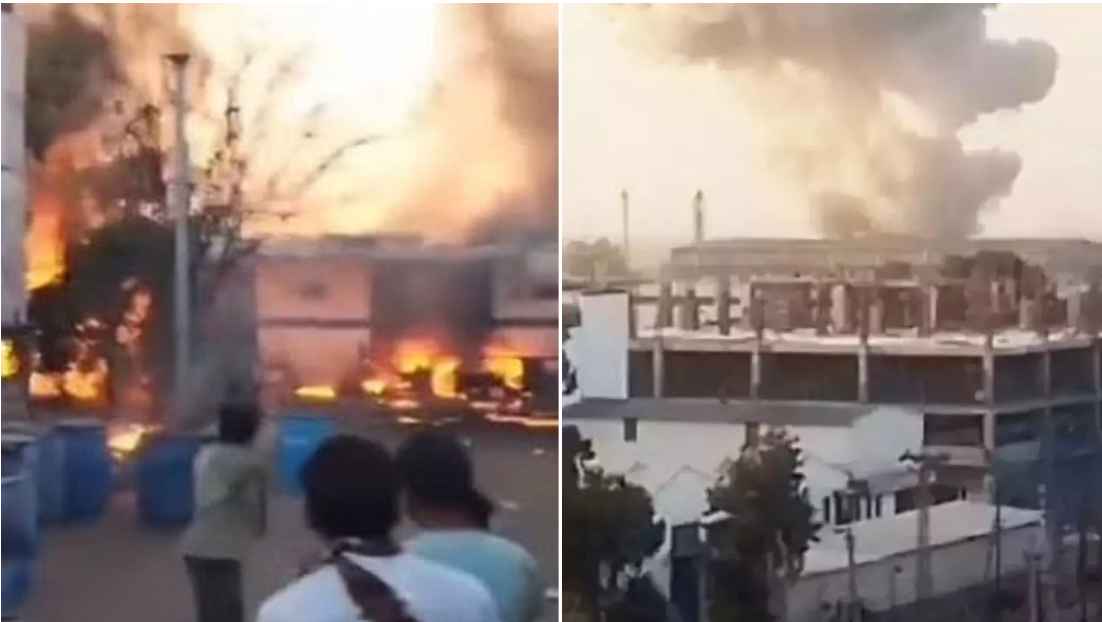
Video grabs of a factory fire and damage
Chhattisgarh alone has recorded 296 worker deaths in industrial accidents over the past three years. Twenty more were added to that list through the April disaster.
Roll back to 26 March 2026. Around 9 am at Cee Gee Lubricants in Edayar, Kochi, a storage tank suspected of holding oil caught fire. The blaze spread rapidly to a godown packed with lubricants, throwing off dense black smoke that choked the escape routes.
By the time the Kerala Fire and Rescue Services brought it under control, one worker lay dead, and at least seven others were injured. The dead man was Shathru Mukhya, 45, a migrant worker from Bihar.
What followed was painfully instructive about the distance between a company’s legal obligations and a worker’s life. The Edayar Junction was filled with protestors: the family, the residents, and activists. They had been offered 5 lakhs, later raised to 10 lakhs. They were demanding 25 lakh and the dignity of acknowledgement.
The body was kept at the junction; the protest intensified; officials, including the DySP, were forced to arrive at the scene. The District Collector, G Priyanka, eventually directed the company to provide immediate assistance of 5 lakh, bear the children's educational expenses, and offer employment to the widow if she was willing.
Place Edayar beside Singhitarai, and the symmetry is brutal. One is a 1,200 MW plant owned by a conglomerate whose founder sits atop the Forbes lists; the other is a lubricants unit in Kerala's industrial belt.
In both, the workers who died were subcontracted or migrants – the invisible spine of Indian manufacturing. In both, the fire or the steam came before the safety officer. In both, the company’s first public act was to dispute the quantum of compensation, not the quantum of negligence.
This is not a coincidence. It is design.
Begin with the government's own figures. The Directorate General Factory Advice Service & Labour Institutes (DGFASLI) accessed by IndiaSpend through a Right to Information request records that between 2017 and 2020, an average of three people died and eleven were injured every single day in India's registered factories.
Between 2018 and 2020 alone, 3,331 workers died in factory accidents. In the same three-year window, the number of persons imprisoned for offences under the Factories Act, 1948, was exactly fourteen.
Three deaths a day, fourteen prosecutions for three years of carnage. That ratio, roughly one conviction for every 238 dead, is not a statistic. It is a licence.
Zoom out further. According to labour ministry data and RTIs collated in a parliamentary affairs brief, at least 6,500 workers have lost their lives in industrial accidents in India over the past decade. The Indian Institutional Investor Advisory Services, analysing Nifty 500 companies –the country's largest and best-resourced – found 463 workplace fatalities in Financial Year (FY) 2023 and 587 in FY2022.
Workplace injuries rose to 10,733 in FY2023 from 9,889 in FY2022, with high-consequence injuries up 33 per cent to 907. Remember: these are Nifty 500 firms. The true national figures, which include 90 per cent of India’s workforce in the informal sector, are unknowable.
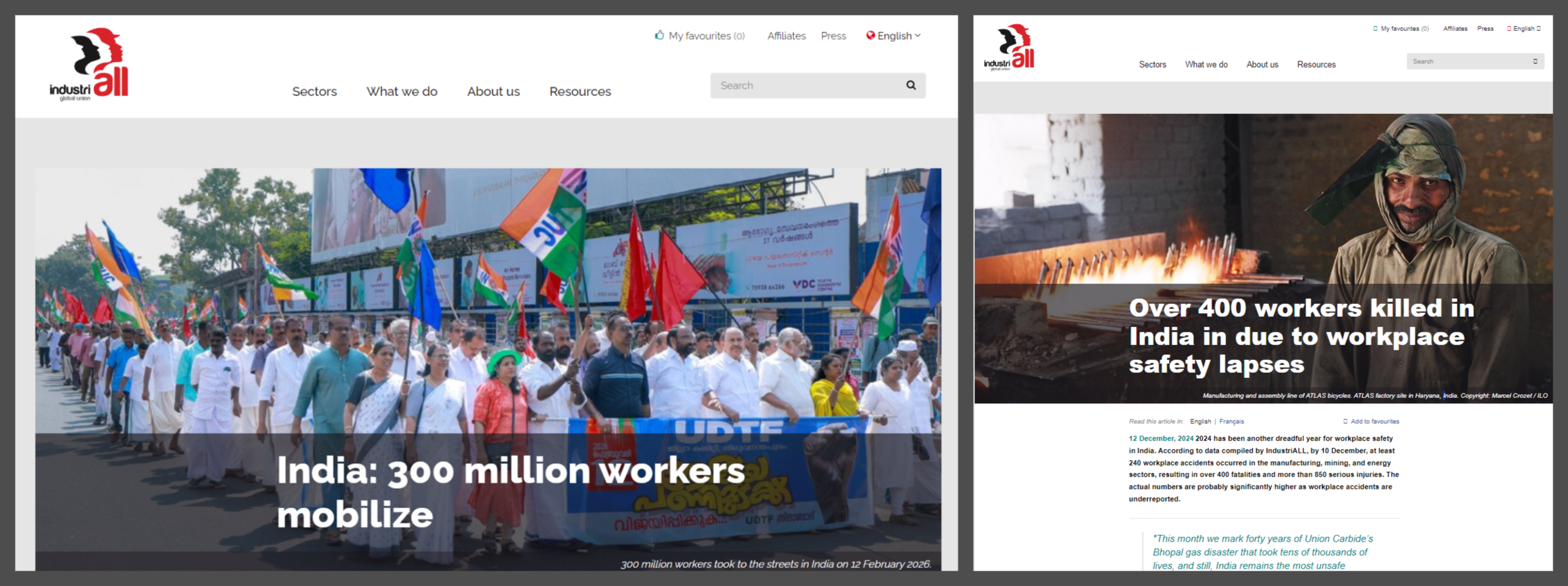
The global union IndustriALL’s India count for 2024 alone, up to 10 December, was chilling: 240 workplace accidents in manufacturing, mining and energy, more than 400 fatalities, and over 850 serious injuries. The chemical and pharmaceutical sector was the deadliest, with 110 accidents, 220 dead, and 550 seriously injured.
“India remains the most unsafe workplace with more industrial fatalities than anywhere else in the world,” Gautam Mody, IndustriALL's executive committee member, was quoted as saying.
The incidents are not hypothetical. On 30 June 2025, a dust explosion and fire ripped through Sigachi Industries’ chemical factory at Pashamylaram in Telangana's Sangareddy district. Forty-four workers died; over thirty were injured.
According to reports, the Telangana Fire Department later found that the plant “lacked adequate safety measures, including fire alarms and heat sensors.” Families alleged that workers had repeatedly raised concerns with management regarding outdated equipment, concerns that were ignored. Most of the dead were migrant workers from Bihar, Jharkhand, Odisha, and West Bengal.
In August 2024, an explosion at Escientia Advanced Sciences in an Andhra Pradesh SEZ killed 18. In May 2024, an explosion at Amudan Chemicals in Mumbai killed at least 13 and injured over 60, with “safety lapses, including insufficient precautions in the mixing and storage of chemicals,” as per media reports. In February 2024, eleven people died in a paint factory fire in Delhi; the Delhi Municipal Corporation confirmed the factory was operating illegally.
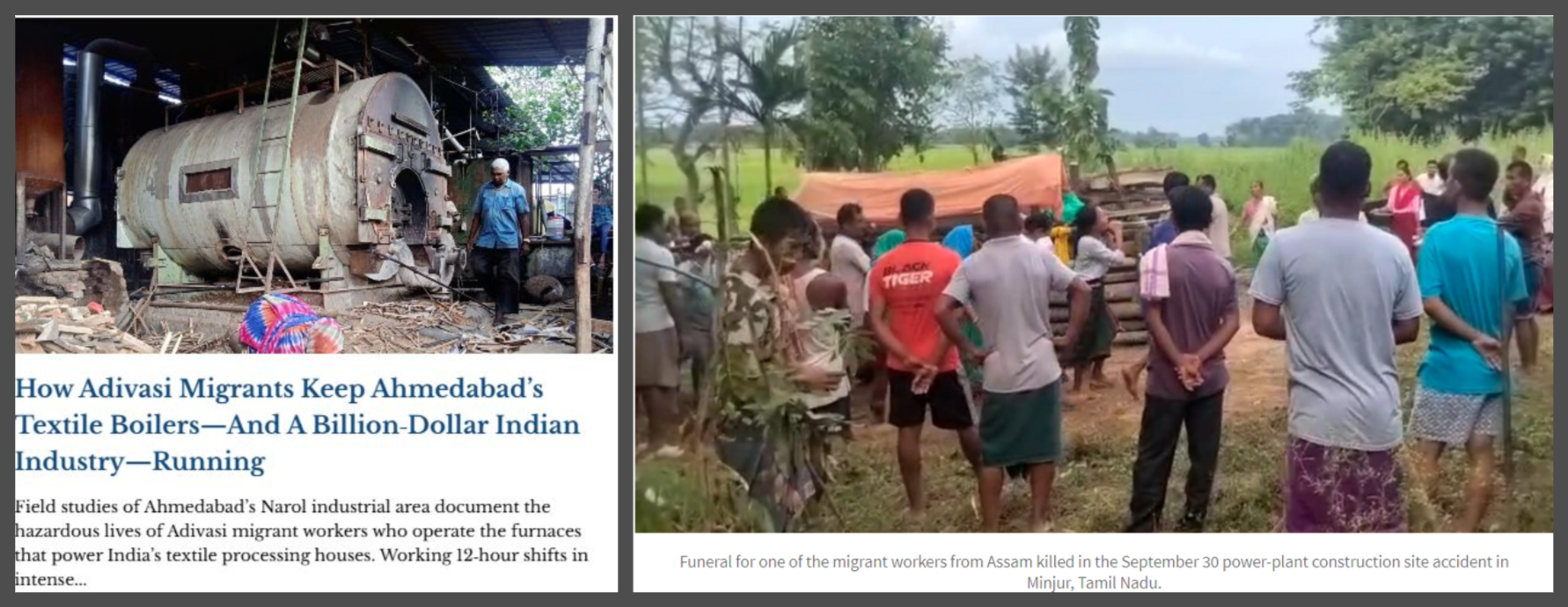
A report on Advasi migrants at Ahmedbad's textile factories (left), and funeral of a migrant worker from Assam killed at a power plant site in Tamil Nadu
In October 2025, nine migrant construction workers died at a BHEL power-plant project site in Ennore, Tamil Nadu. None were permanent employees; all were on piece-rate contracts, without provident fund or insurance.
Read these names like a litany, because officially, we are told these are exceptional events.
An enabling environment of rules and apathy
On 21 November 2025, the Government of India did something it had been threatening to do for five years. It notified all four labour codes – the Code on Wages (2019), the Industrial Relations Code (2020), the Code on Social Security (2020), and the Occupational Safety, Health and Working Conditions (OSH) Code (2020) into force in their entirety.
The 29 central labour laws that they subsume were repealed. The notifications contained no transition period. At the centre of this overhaul sits a quiet but consequential change: the definition of a factory itself has been rewritten.
Under the old Factories Act, 1948, a “factory” was any premises employing 10 or more workers with the aid of power, or 20 or more without. Under the OSH Code now in force, those thresholds have been doubled: 20 workers with power, 40 workers without power.
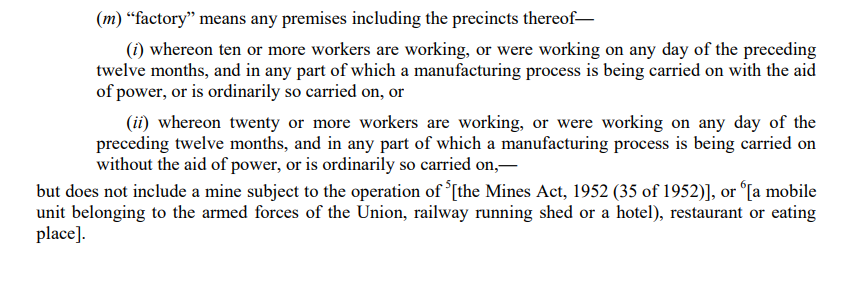
This single arithmetic adjustment carries enormous human consequences. Every workshop, fabrication unit, paint mill, chemical blending shed, lubricants godown, and plywood hot-shop that employs between 10 and 19 workers with power, or between 20 and 39 workers without power, has been lifted out of the safety regime of the Factories Act.
Legal experts and labour researchers have flagged precisely this: “Raising the factory threshold to 20/40 workers exempts many micro-enterprises from strict safety checks. The most vulnerable workers, according to critics, are left unprotected.”
The most vulnerable workers – that is not a rhetorical flourish. That is a description of the very workforce – migrant, contract, untrained, non-unionised that appears in the body counts from Perumbavoor and Pashamylaram to Edayar.
The OSH Code also raised the threshold for application of the Contract Labour (Regulation and Abolition) Act, 1970, from 20 to 50 workers. A contractor supplying fewer than 50 contract labourers now requires no licence. The Code simultaneously permits contract labour in “core activities” under broad discretionary conditions – a clause that dissolves a restriction the old Act had kept in place for 50 years.
Under the new Industrial Relations Code, establishments need government permission for layoffs, retrenchment, or closure only if they employ 300 or more workers, up from the earlier threshold of 100. Smaller firms can now hire and fire at will.
In effect, the state has redefined what a factory is, redefined who a regular worker is, and the threshold at which any of these protections apply. It has done so, in the words of the Ministry itself, to promote “ease of doing business” and create a “business-friendly regulatory environment.”
The Edayar lubricants unit that killed Shathru Mukhya, the plywood factories of Perumbavoor where migrant workers have died, the countless small chemical units in the industrial belts of Gujarat, Maharashtra and Tamil Nadu – are precisely the ones that now sit in the exempted zone.
Any safety regime, however well drafted, is only as effective as its enforcement. Here, too, the picture is grim.
The OSH Code introduces “web-based inspections,” allocated randomly through an electronic portal, and encourages “self-certification” of compliance by employers. Unannounced inspections – the single most effective tool a factory inspector historically possessed – are effectively eliminated.
In its own analysis, IndustriALL's 2024 report noted that “unannounced inspections are no longer permitted, and companies can self-certify their compliance with safety standards, further reducing accountability”
Even where inspectors exist on paper, they often do not exist on the ground. State labour departments across India have, for years, left the posts of factory inspectors, deputy directors of industrial safety, and chief inspectors of factories vacant or under-recruited.
Public service commissions in West Bengal, Bihar, Tamil Nadu, Rajasthan and Maharashtra have run recruitment drives for these positions as recently as 2024-2026, with tiny intake numbers against enormous registered-factory bases.
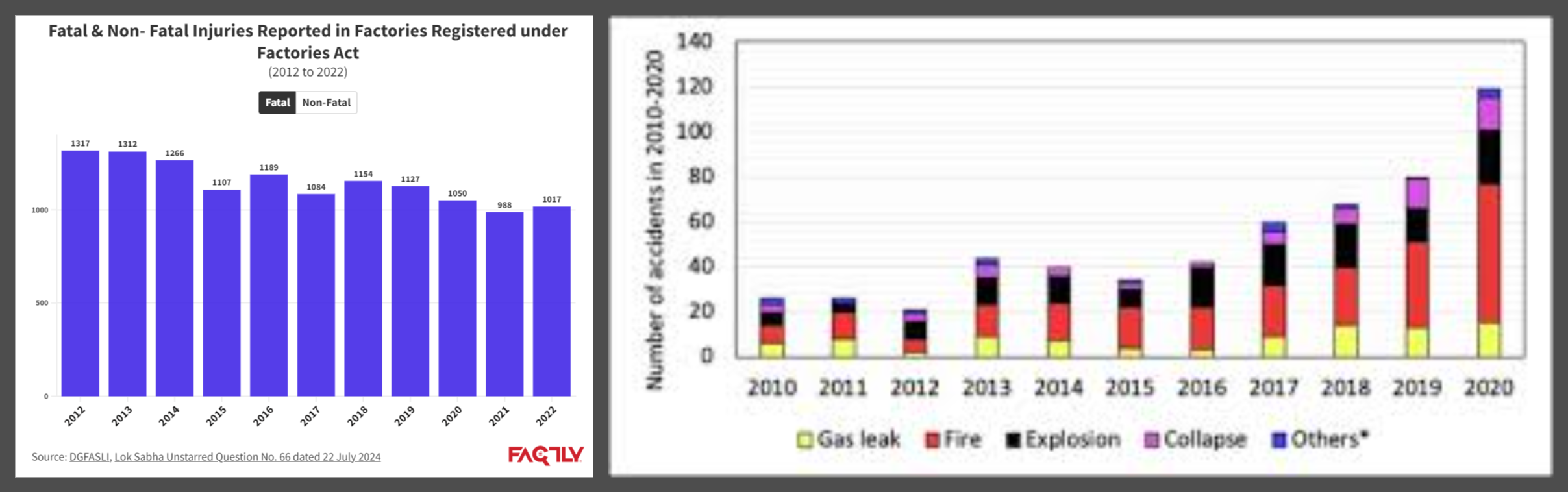
India had 363,442 registered factories in 2020, of which 84 per cent were operational, employing 20.3 million workers. The number of filled, functional safety inspectors against that base has never been sufficient for meaningful enforcement.
The position of Safety Officer within factories is similarly hollowed out. Under the OSH Code, a Safety Committee is mandated only for factories with 500 or more workers, or factories with hazardous processes employing 250 or more, or construction sites with 250-plus workers.
Below those thresholds, the law assumes employer self-discipline. The thousands of plywood units, chemical blending shops, and power-plant subcontractor operations that have produced the fatalities above do not meet these thresholds.
The global union ITUC-Asia Pacific, responding to the Sigachi explosion that killed 44, pointed to India’s violation of International Labour Organisation Convention No. 81 (Labour Inspection), which mandates “regular, impartial, and effective inspections.”
Its Indian affiliate INTUC identified “a deeply entrenched pattern of manipulated, forged, or absent inspection reports that allowed factories to continue operations despite non-compliance with labour and OSH standards.”
Fewer inspections. More self-certification. Smaller units outside the net. A definition of factory rewritten upwards. It is not difficult to see whose survival is encoded in these paragraphs – and whose is not.

Graphs describing industrial accidents in India in recent years; data source - ScienceDirect
The new normal, or political indifference?
Why does this regime persist? Why, after Bhopal and after decades of documented fatalities, does the Indian state continue to lower the bar rather than raise it? The answers lie not in oversight but in choice.
The Ministry of Labour’s own framing – repeated in the PIB factsheet accompanying the OSH Code – speaks of “reducing the burden of compliance” and “promoting ease of doing business.”
The Fisher Phillips legal briefing for multinational employers is unusually candid about the direction of travel: “Higher threshold for layoffs and re-skilling fund... expanded overtime flexibility, reduced eligibility for paid leave (from 240 to 180 days)” all positioned as gains for employers. Whatever the merits of these individual reforms, their cumulative tilt is unambiguous.
On 26 November 2025, five days after the codes came into force, ten central trade unions –INTUC, AITUC, HMS, CITU, AIUTUC, TUCC, SEWA, AICCTU, LPF, UTUC – along with the Samyukt Kisan Morcha, observed a “Black Day” across the country against the codes. They argued that the codes hand “disproportionate authority to employers and dilute essential safeguards.”
The consortium pointed out that the Indian Labour Conference, India's apex tripartite forum between government, employers, and workers, has not been convened since 2015 – a decade of unilateral drafting. “These labour codes are designed to push the workforce into conditions akin to slavery,” read their joint statement.

The PIB press release showcases the purpose of the new labour codes as including "ease of doing business"
The Association of Indian Entrepreneurs, speaking for small and mid-sized employers, has expressed concern that the codes will increase operating costs. Foreign investor-facing publications, by contrast, celebrate “single registration, single all-India license, deemed approvals” as precisely the frictionless compliance environment they have long lobbied for.
Between these two framings – the worker who dies on the floor and the investor who fears friction – the Indian state has made its choice. The choice is legible in the threshold numbers. It is legible in the abolition of unannounced inspections. It is legible in the vacant inspector posts that no one is rushing to fill.
The voiceless, at the receiving end
Return, then, to Shathru Mukhya – the 45-year-old Bihari man who died of smoke inhalation in the Kochi lubricants godown. His family travelled hundreds of kilometres to collect his body. The employer offered 5 lakhs. A protest was needed to raise it to 10 lakhs. The district collector has to intervene to secure educational support for the children and a job offer for the widow.
The mandatory compensation under the century-old Workmen Compensation Act of 1923 – the law that, astonishingly, still governs such payments across most of India – remains opaque, slow, and contested.
A media house documented what this means in practice for Kerala, a state often held up as migrant-friendly: a 23-year-old from West Bengal falling into a 15-foot fire pit at a Perumbavoor plywood unit in April 2023; four West Bengal labourers choked to death under mud at a Kochi SEZ construction site in March 2022; a 20-year-old from Odisha killed in a plywood-factory blast the same month; a four-year-old child, Asmina, drowning in a waste-water pit at her mother's factory.
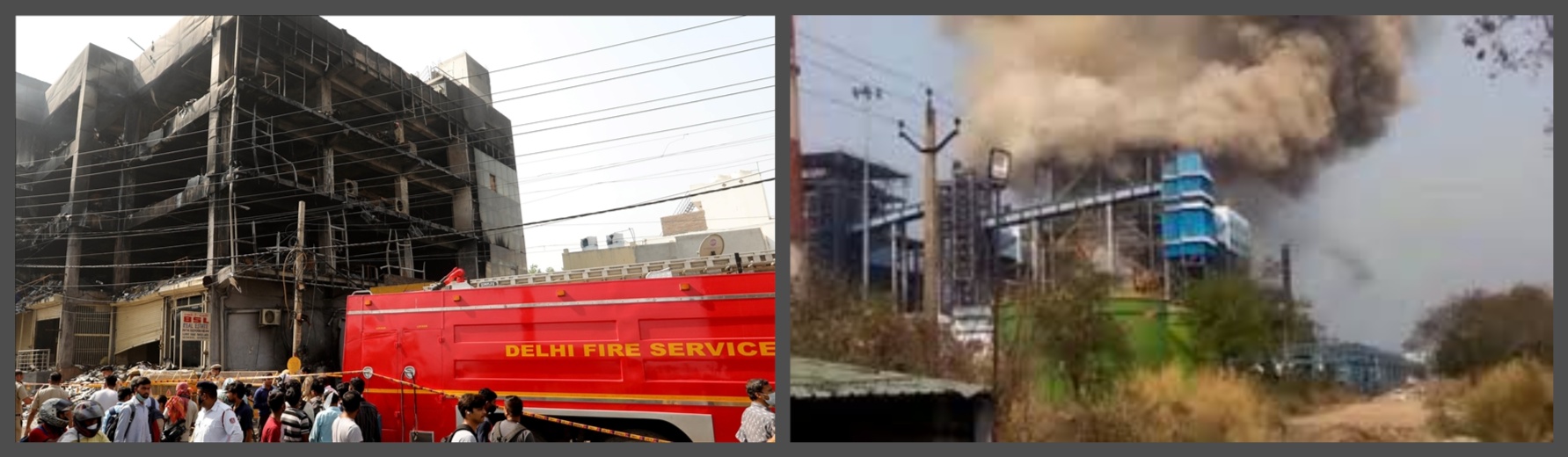
The aftermath of the fire at the paint factory in Delhi (left), and smoke billowing out of the Vedanta plant after the incident
The common thread: no training, no safety mechanism, no regular inspections, and compensation that frequently “does not reach migrant labourers.”
Shathru Mukhya died the same way Fijul Mondal and Nazeer died, the same way 44 workers died at Sigachi, the same way 20 have now died at Singhitarai. The method varies – fire, mud, dust explosion, and steam. Sociology does not.
In almost every case, the dead are migrants, contract workers. Almost always, the employer first lawyers up and last settles.
The old regime had its merits
An op-ed that only diagnoses is only half a piece. Hence, let me discuss the possible solutions.
Restore the definition of a factory: The old thresholds of 10 with power and 20 without power were not sacred – they were cautious. Raising them by an arbitrary factor of two, with no occupational-hazard justification, served no worker. It should be rolled back.
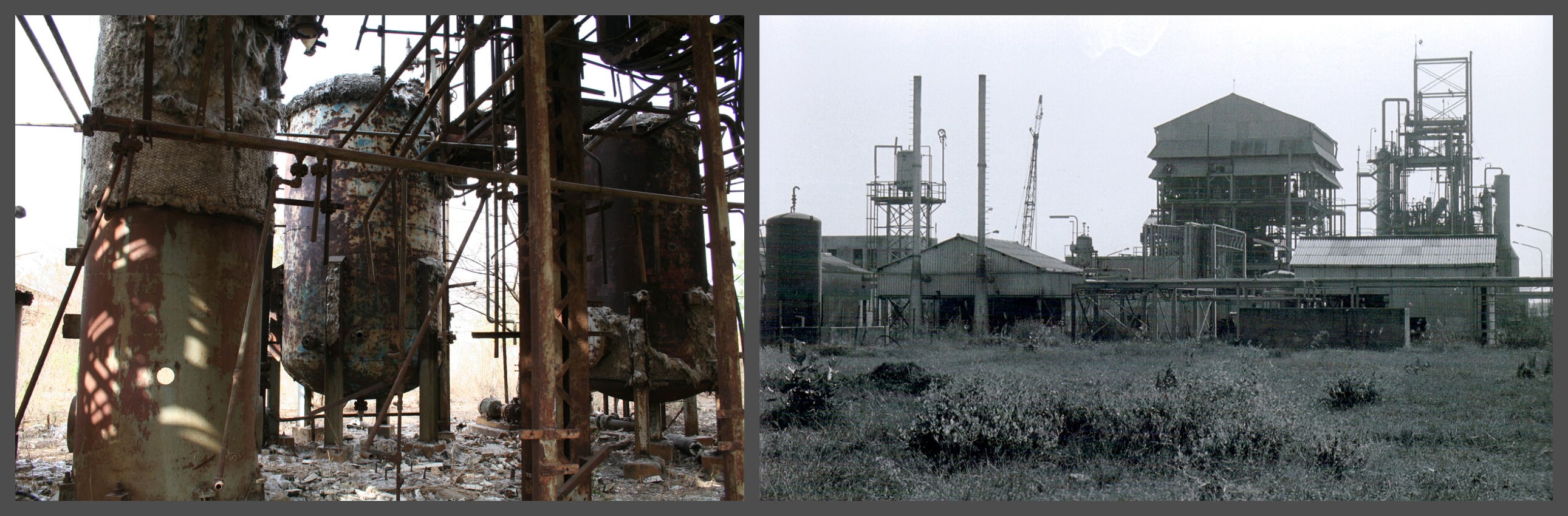
Remains (left) of the Union Carbide factory in Bhopal (right); photo source - Wikimedia Commons
End self-certification for hazardous processes: Boilers, chemical reactors, storage of inflammables, dust-producing operations, and any Schedule-I hazardous industry must be subject to physical, unannounced inspection. Web-based portals are useful for compliance filings; they are not a substitute for an inspector walking a shop floor.
Fill inspector vacancies and publish the data: Every state labour department should publish, quarterly, the number of sanctioned posts, filled posts, and inspections conducted –disaggregated by district. Without such transparency, the promise of “simplified compliance” becomes a fig leaf for a vanishing state.
Make the Principal Employer liable by default: The OSH Code already casts responsibility on principal employers for contract workers' welfare and wages. That liability must extend, unambiguously and first-in-line, to fatal accidents. No more NGSL-versus-Vedanta rounds; no more contractor as sacrificial buffer.
Statutory compensation floor-indexed: The Workmen's Compensation Act, 1923, is literally a century old. A nationally uniform, statutorily fixed compensation amount for fatal workplace accidents – for instance, 25 lakhs indexed to inflation, paid within 30 days of the incident –would end the undignified bargaining that turned Edayar Junction into a protest site.
Bring tripartism back: The Indian Labour Conference has not met since 2015. That is not a clerical lapse; it is a policy choice. No labour framework of this scale should have been notified without it.
Reality of failed reforms
On the afternoon that the Singhitarai boiler tube ruptured, a great deal of commentary focused on the technical failure – the pressure surge, the displaced piping, the fuel overload. These are real. But they are not the actual story.
The story is that India has built, over the last five years, a regulatory framework in which the smallest, most dangerous, most migrant-dense workplaces have been lifted out of the safety net.
It is a framework in which unannounced inspections are gone, self-certification is the norm, and the definition of a factory itself has been rewritten to exclude a whole tier of operations where workers burn, fall, choke, and bleed.
It is a framework rolled out on 21 November 2025 without tripartite consultation, and one whose human cost is now being paid in instalments – 14 dead here, 20 dead there, one Bihari man in a Kochi godown, 44 in a Telangana chemical plant, and so on.
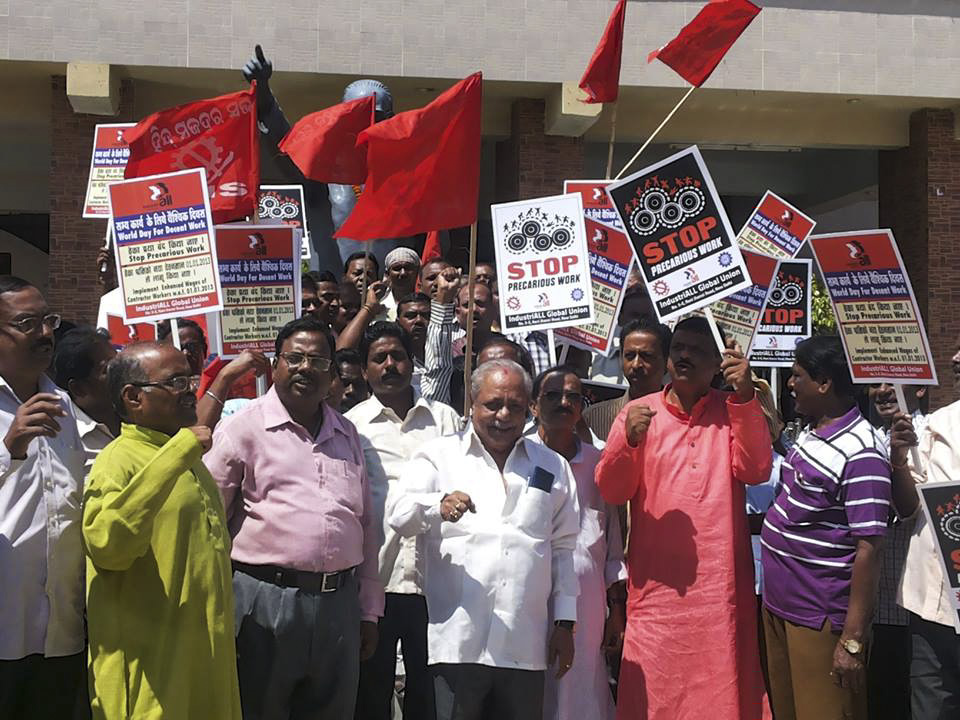
A workers' union protest against 'precarious work'; photo source - IndustriAll Global Union
Singhitarai and Edayar are not accidents. They are the predictable output of a system operating exactly as its designers intended – profitable, frictionless, deniable.
Until the definition of a factory once again includes every place where a worker can die in it, the factories of India will continue to function, quietly and efficiently, as graveyards for the men and women who built them.
(Views expressed in this report are the author's own.)
Follow us on WhatsApp
Follow us on Facebook
Follow us on X @vudmedia
Follow us on Substack
