
Pondicherry’s unique Franco-Tamil identity, shaped by centuries of French influence, bilingual traditions and a deeply rooted cultural synthesis, is facing growing anxiety under the National Education Policy’s language framework. The National Education Policy (NEP 2023) emphasis on compulsory regional language choices in CBSE schools has sparked widespread discontent among students, parents, teachers and cultural groups, who fear it could marginalise French — a language woven into the Union Territory’s social, historical and institutional fabric. Critics argue that the policy overlooks Pondicherry’s distinct political history, treaty obligations and cosmopolitan character, while narrowing educational and global opportunities for future generations.
Home page image: Three flags - of India, France and the Spiritual Flag of United India - adorn a government building in Pondicherry
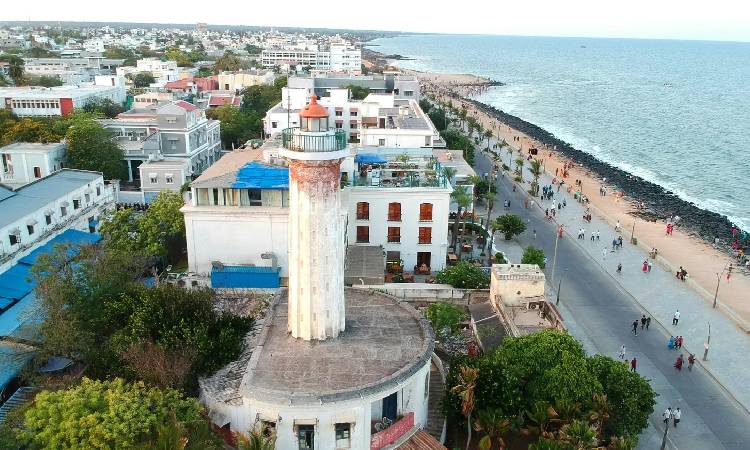
Text page image: The old lighthouse on Beach Road in White Town, Photo credit : Pondicherry Arun
Banner image: The Mahatma Gandhi statue on Beach Road, Pondicherry
Pondicherry (Pondichéry in French, and Puducherry in Tamil) – a name that conjures in the mind bright yellow buildings, quaint cafés, tourists sauntering along the beach promenade and a city that celebrates its Independence Day twice!
Behind Pondichéry’s streets and boulevards that have reinvented and changed themselves as a way of decolonisation, there exists a primal connection that goes far back into the families, generations and bloodlines of its denizens, who have called this place home since the time of the French conquest and governance of this south Indian territory.
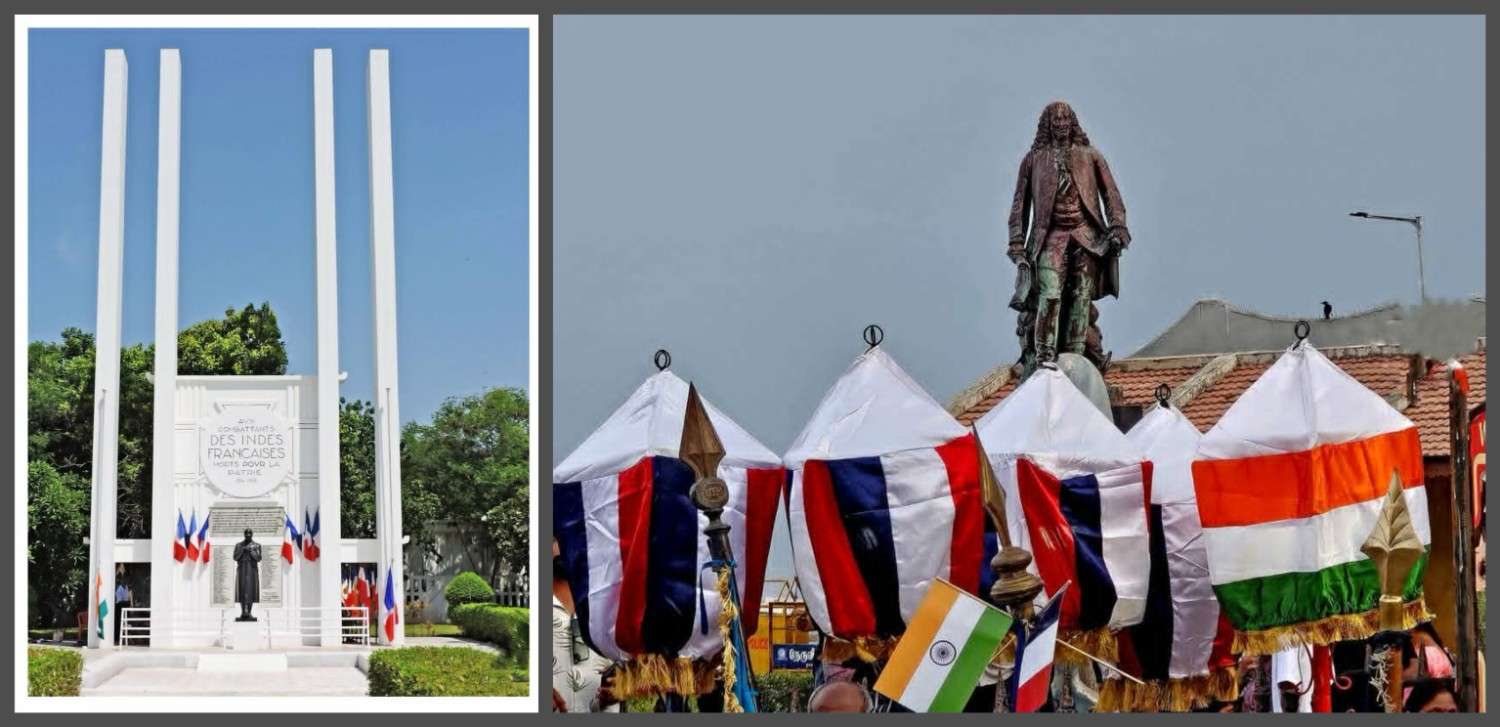
The French War Memorial (left), and the statue of French Governor General Joseph Marquis Dupleix (right)
‘La langue’- Tracing roots and reasons
Recently, Pondichéry has found itself in the limelight again, for a very different reason.
French, a language that has become intrinsic to the city and its people, is on the verge of erasure because of a new regulation that the Government of India has introduced in schools under its centralised education system.
Before we delve into the details of this aforementioned regulation and the ramifications that are to follow, a little history about why Pondicherrians have such a close affinity to this otherwise alien language.
Pondichéry was a major French colonial enclave in India from 1674 to 1954, developing from a small fishing village into a fortified port city. Established by the French East India Company under François Martin, it was briefly occupied by the Dutch and British before becoming a permanent French hub in 1814, finally merging with India in 1954.
After the transfer and cessation of Pondichéry by the French Government to the Indian Administration in 1954, and ‘de jure’ formal transfer of legal sovereignty along with the framing of laws in 1962, there were a large number of people who we refer to as ‘renonçants,’ who chose to retain French citizenship and abide by the French Civil Code rather than Indian personal laws, after the merger with India.
Existing socio-economic disparities, caste discrimination, bigotry, a poor quality of life and various other aspects affected these choices, which turned people to embrace this dual identity in the hope of a better future and greener pastures for themselves and the generations to come.
Pondichéry celebrates its Independence Day on August 15, and the formal day of independence, which is the ‘De Jure Transfer Day’ on August 16, each year.
This continues to hold true in all aspects of polity and economy, with tourism and the contributions of the French government, expatriates, and the Franco-Pondicherrian diaspora largely contributing to the growth, development, and unique identity and socio-cultural significance of this little ‘city.’
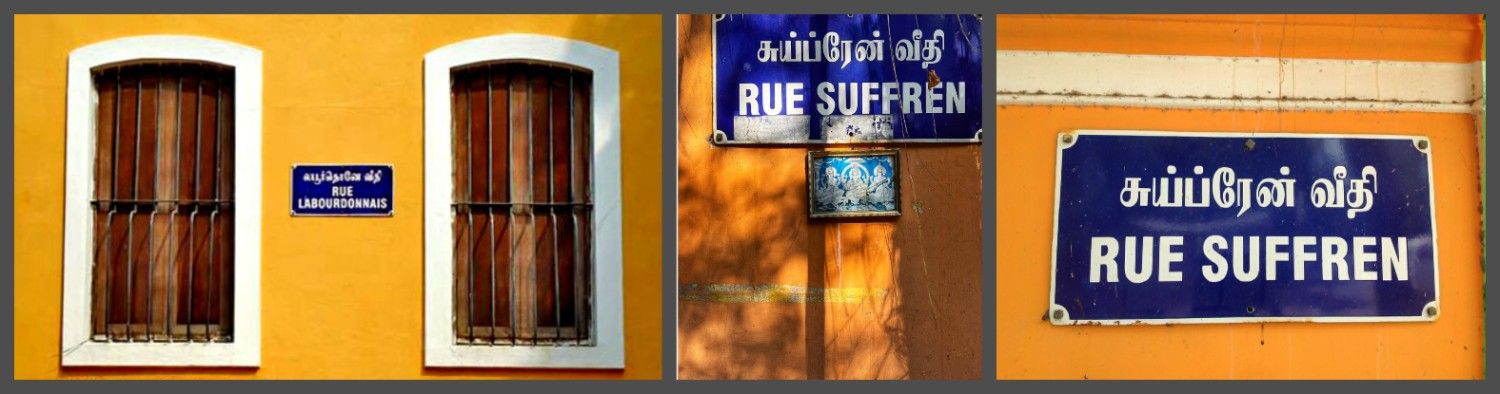
In co-existence: Name boards in French and Tamil are a common practice in Pondicherry
“Le Quotidien” - French and its place in the melting pot of Pondicherry’s culture
In Pondichéry, French is an integral part of official and gazetted communication, daily parlance, and tourism, with the Franco-Tamil diaspora and culture firmly woven into the social fabric.
Every little conversation here is interspersed with a word or two of French. The coffee shops are ‘cafés,’ the streets are ‘rues,’ documents are ‘papiers,’ and the local milk cooperative is ‘Ponlait.
All the while, Tamil and English find themselves comfortably dwelling in this cultural mélange where we spout a “Bonjour! Nalla irukeengala?” (Good day! How are you?) or a “Romba merci!” (Thank you so much!) with equal élan!
French and Tamil seamlessly segue into our routines, speech, practices and cuisine.
A vintage vin rouge, frites and poulet au citron is as popular a meal as a ‘ilai saapadu’ replete with rice and sambar, curd and pickles, rasam, kootu and poriyal.
Noël and Deepavali, Independence Day and Bastille Day, Balzac and Bharathi - they unequivocally find a place of importance in this sanctum that stands for unity in diversity.
The French influence does not end there. It pervades our very streets, our monuments, our architecture, our parks and schools.
And, the people of this city have embraced this duality NOT as vestigial symbols of the colonial past but as a testament to integration, harmony and peaceful coexistence.
The NEP 2023 and the implementation of the regional language policy
The Central Board of Secondary Education (CBSE), in its newly implemented National Education Policy (NEP) of 2023, has advocated a three-language policy as part of the curriculum for Grades 6 upwards, in all its affiliated schools.
In addition to other subjects, the language modules were to constitute three languages: the Medium of Instruction (R1), Language II (R2), and Language III (R3). Each being distinct, and of which two should be regional Indian languages, with English being considered a ‘foreign language.’
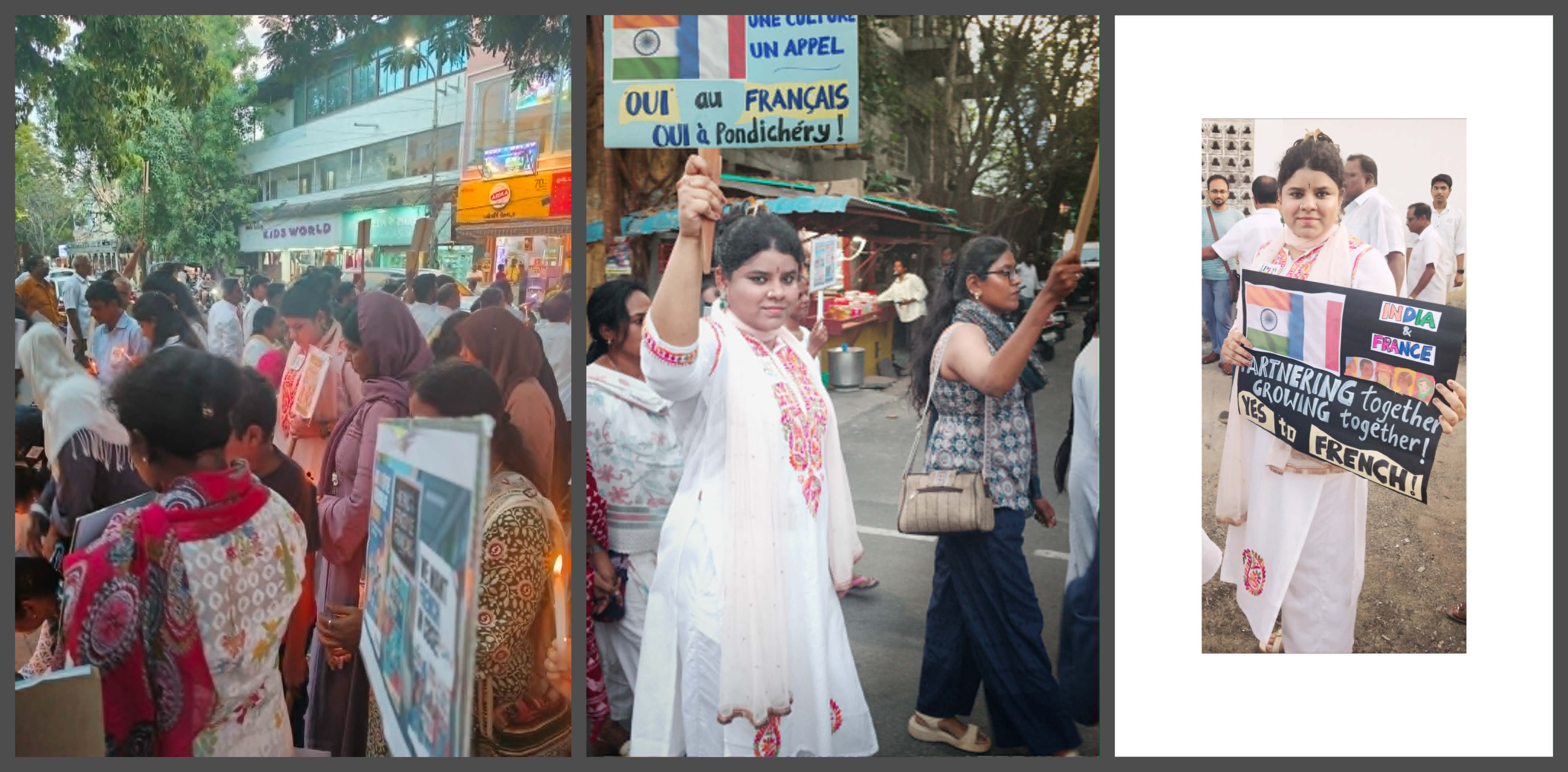 Protests against the NEP in Pondicherry; photo credit - author
The modified NEP rules state that CBSE schools that have English as the medium of instruction can no longer offer French to their students.
This will mean that a majority of schools in the city of Pondichéry are now deprived of the choice to offer foreign languages and would have to choose HINDI as the sole option, alongside Tamil as the regional vernacular.
This arbitrary and hasty implementation of the compulsory regional languages policy, beginning this academic year, has deprived so many schools and students of the opportunity to explore and learn foreign languages on any level.
Evidently, this is not directed towards equipping Indian students for global platforms and the imminent growth we will witness in educational technology.
The treaty of cession, existing laws and continuance of the French language
The Treaty of Cession (signed May 28, 1956 and ratified on August 16, 1962) formally transferred sovereignty of French establishments in India—Pondicherry, Karaikal, Mahé, and Yanam—from France to the Republic of India.
The Treaty finalised the de facto transfer of 1954, defining citizenship options, legal status of inhabitants, continuation of French education, property rights, choice of citizenship and a slew of other special rights and protection to the citizenry of the Union Territory of Pondichéry.
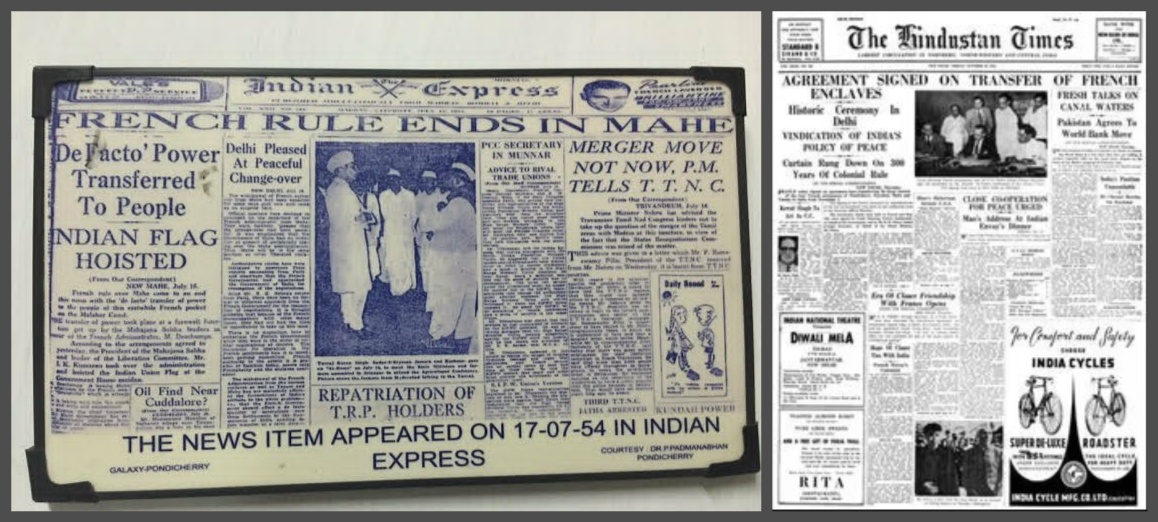
According to the official website of India’s Ministry of External Affairs (MEA), the following remains in place, since the Treaty of Cession and the Supplementary Agreement that came into place in the year 1963, jointly signed by the governments of India and France.
Treaty of Cession
SUPPLEMENTARY AGREEMENT BETWEEN THE GOVT. OF INDIA AND THE GOVT. OF FRANCE CONCERNING THE FORMER FRENCH TERRITORIES
(New Delhi, 16 March 1963)
(Section IV- CULTURAL QUESTIONS, EQUIVALENCE OF DIPLOMAS, etc.)
“The Indian delegation confirmed that teaching of French be maintained and encouraged in the educational institutions of Pondicherry and Chandernagore.”
Socio-cultural ramification of the regional language policy – voices of dissent
Something as new, fangled and sudden as a language policy, which overrules existing laws, and has made no accommodation for the readiness of students or teachers, nor any streamlined pedagogy or outcome seems to be in sight.
This new policy now pushes into oblivion a language and practice that has served to unite and uplift generations of individuals, thereby breaking community continuity and devaluing heritage. Evidently, it also seems to be a futile attempt at reframing history!
There has been a clear resonance of dissent and dissatisfaction among academicians, teachers, students and the parent body, many of whom have been looking with eagerness to adopt French as a preferred language of choice in addition to the primary subjects.
The Puducherry French Teachers’ Association has recently met under the aegis of Chevalier Dr Paneerselvame, Professor Emeritus of French, and the entire cohort of French language teachers of private and government institutions, to draw up a petition to the French Consulate, the Office of the Lieutenant Governor of Puducherry and the Office of the Chief Minister.
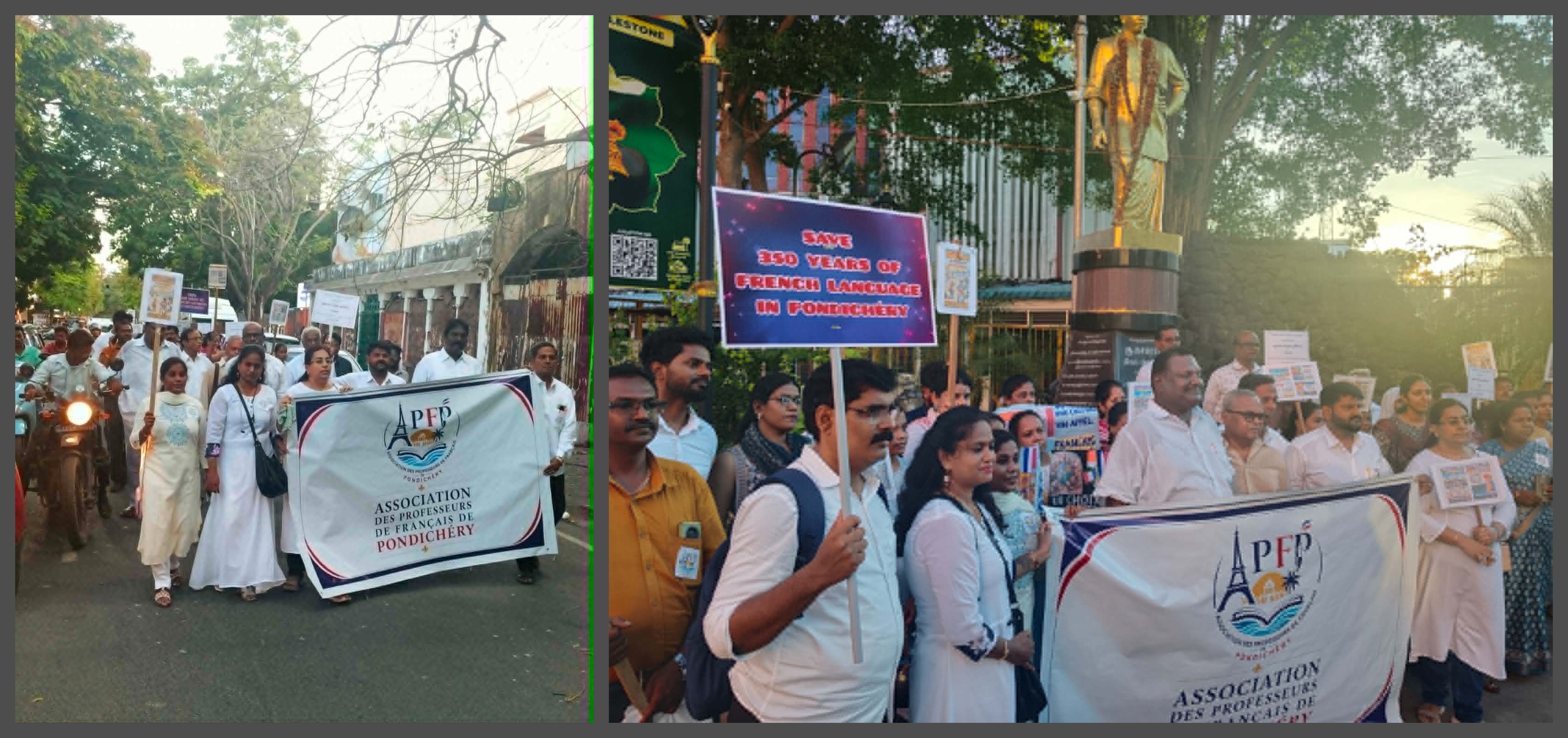
The protest by the Association of French Teachers in Pondicherry
Antoine Kalaipriyan, President of the Indian National Youth Front (France), has drafted a petition to the Ministère de l'Europe et des Affaires Étrangères (MEAE), Government of France, seeking their intervention in this regard.
The legislative opposition in Puducherry has also planned protests to raise awareness and collective support for the continuation of French in the Union Territory, given its unique place and cultural significance.
Pondichéry has chosen to speak up for the preservation of the language and memory as a crucial act of resilience and assertion.
To prevent any further attempts to erase its cultural and historical place in the annals of history, to keep open the choices for eager learners and students, and to ensure that students are offered an option to prepare themselves for global platforms.
Why should foreign languages have a place in central education?
While many argue that knowledge and learning of Indian languages is a more patriotic stance, and a way to promote them, there is the question of preparedness, availability of learning resources, trained resource persons, and choice of languages to be made available.
At present, the CBSE offers 22 regional languages, while in reality, there are over 143 indigenous languages that are still in use. Since the 1971 Census, the Indian government has stopped publishing detailed data on the ‘indigenous’ languages spoken by fewer than 10,000 people, treating them as non-scheduled or “minor languages.”
Also, the availability of resource persons and learning materials is strictly limited to regional demarcations.
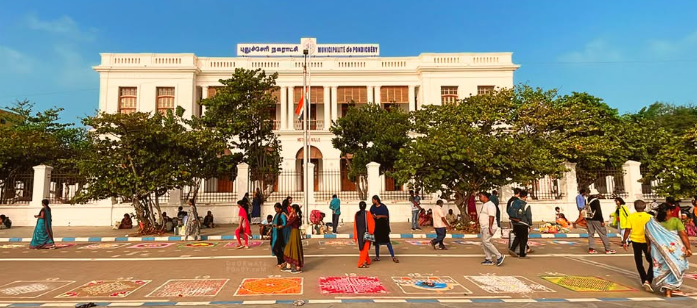
The Pondicherry Municipality office has name boards in both Tamil and French
In essence, should a student in the South choose Gujarati, Marathi, Beheliya or Bengali as a choice of the regional language, the school may not be able to provide for it. The options finally dwindle to Hindi and a regional vernacular.
Again, there arises an argument that one could choose to learn foreign languages privately. The chance of learning a foreign language privately, outside the realms of schooling, is a selective privilege and possibility only some children can avail themselves of.
However, to present the choice of a language to the student is the first step in equipping and preparing them towards a global narrative. Keeping open the possibility of foreign languages in school is an equaliser, leveller and a way of enlarging and broadening academic pathways to Indian children of all economic strata.
And, this is particularly relevant in Pondichéry, given how closely knit the language, créolisation and the Franco-Tamil diaspora are in this region.
The CBSE can instead concentrate on upgrading its largely unidirectional pedagogy that seems to increase the turnover of coaching centres and private tutorials that have already infiltrated school systems.
Education is the only tool that can enable society to discern and defeat injustice. A central education system should continue to be one that will enlarge and widen the prospects, opportunities and choices of eager learners and offer autonomous institutions under its fold.
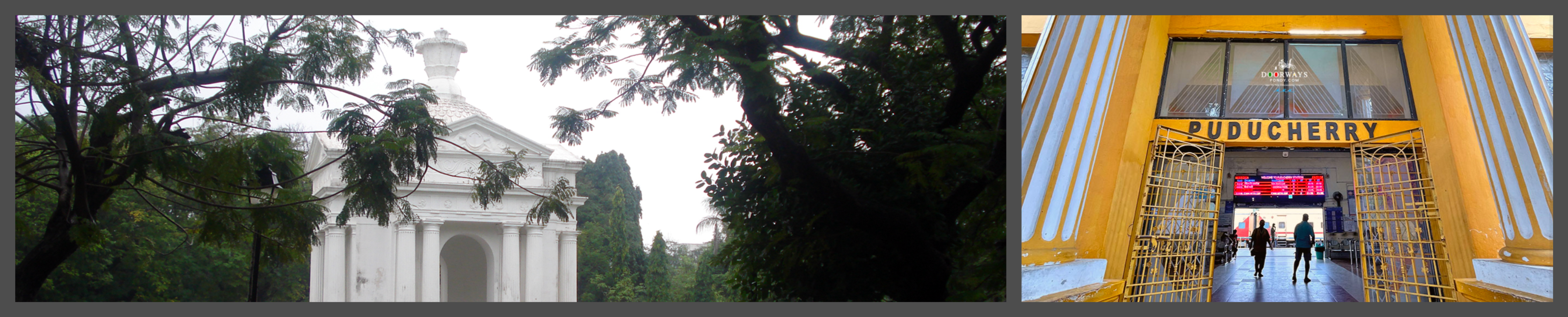
The old and the new: The Ayi Mandapam or Park Monument built during the reign of Napoleon III (left), and the Puducherry railway station (right)
Language, liberty and liaison
Language identity is a foundational pillar of India’s federal structure, deeply intertwined with the creation of states, political representation, and cultural autonomy. The reorganisation of states, primarily based on language, has reinforced regional identities while providing a framework for managing linguistic diversity within a unified, multilingual democratic system.
In Pondichéry, French functions not merely as a foreign language but as an internalised, créolised, and official component of the Union Territory's identity, bridging local Tamil culture with the Francophone world.
Pondichéry is currently a hub for fruitful scientific, technical and cultural collaboration between Indian and French research bodies and agencies, under the auspices of the French Government. These endeavours, which are facilitated by fluency in the French language among citizens, could weaken or even dissolve as a result of such an erasure.
French, here, is not an imposed language but a heritage, deeply intertwined with Tamil in a unique Indo-French cultural synthesis.
Preserving the language will be an integral factor in inspiring and preparing young minds towards a global narrative, welcoming cross-cultural tourism, employment and academia, all the while reiterating Pondichéry's identity as a unique confluence of strong Indian and global influences.
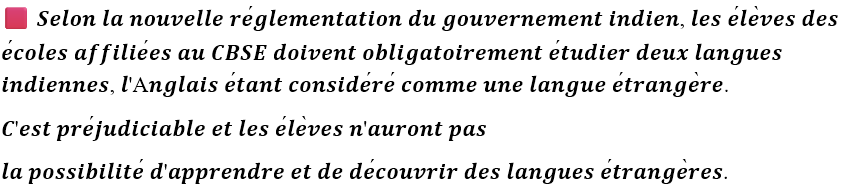
Translation: According to the new regulations of the Indian government, students in schools affiliated with the CBSE must compulsorily study two Indian languages, while English is considered a foreign language.
This is detrimental, and students will not have the opportunity to learn and discover foreign languages.
(Views expressed in this report are the author's own)
Follow us on WhatsApp
Follow us on Facebook
Follow us on X @vudmedia
Follow us on Substack
