
The denizens of UAE, or for that matter, Saudi Arabia, Bahrain and Kuwait, might not just be dreadfully looking up at the skies for the Iranian missiles, but also for the heavy rains that could upset their food security, which is heavily dependent on the supplies from India, the world’s foremost rice exporter, as much as India's reliance on the oil and fertiliser stocks that passes through the Strait of Hormuz. As the US-Israel war against Iran reaches a critical juncture, in question is not just the problem of energy supplies, but also of food security and remittances, which affect India as much as the Middle Eastern nations. This web of ‘complex interdependencies’ of economies and social life, involving a three-way exchange of food, fuel, and fertilisers, remains the largely overlooked fallout of the conflict, says Professor Swaran Singh in the 20th edition of Asia Watch.
Home page image: The Ras Laffan LNG refinery in Qatar, which was under attack in the ongoing conflict
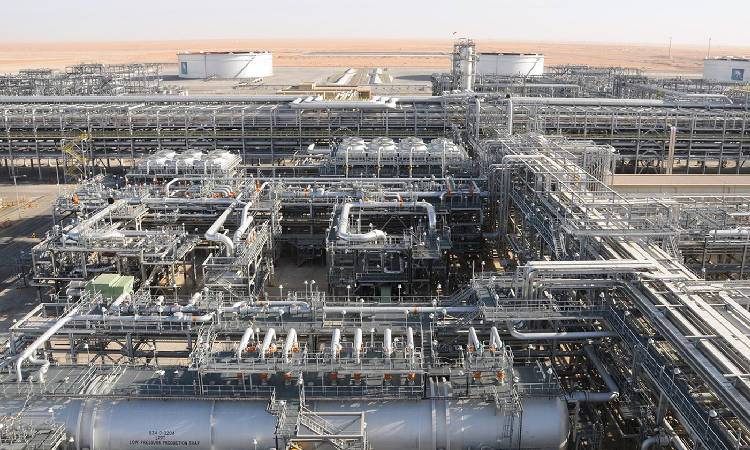
Text page image: Aramco's Khurais plant in Saudi Arabia, one of the world's largest oil and gas fields
Banner image: An unnamed oil storage depot in the Middle East
In the classical imagination of geopolitics, power flows from military bases, strategic alliances and oil fields. Yet, the 21st century is rewriting this script. Today, food, fuel, and fertilisers — that energise modern economies and make their structures and technologies deliver — are increasingly shaping international partnerships.
Nowhere is this more aptly visible than in the evolving ‘complex interdependence’ between emerging India and the dynamic economies of the Middle East (described so in the Western hemisphere for the West Asian region).
This relationship, however, has often been simplistically framed as India’s dependence on Gulf oil. Lately, India’s imports of fertilisers from some of these countries and agricultural technology from Israel have also attracted attention.
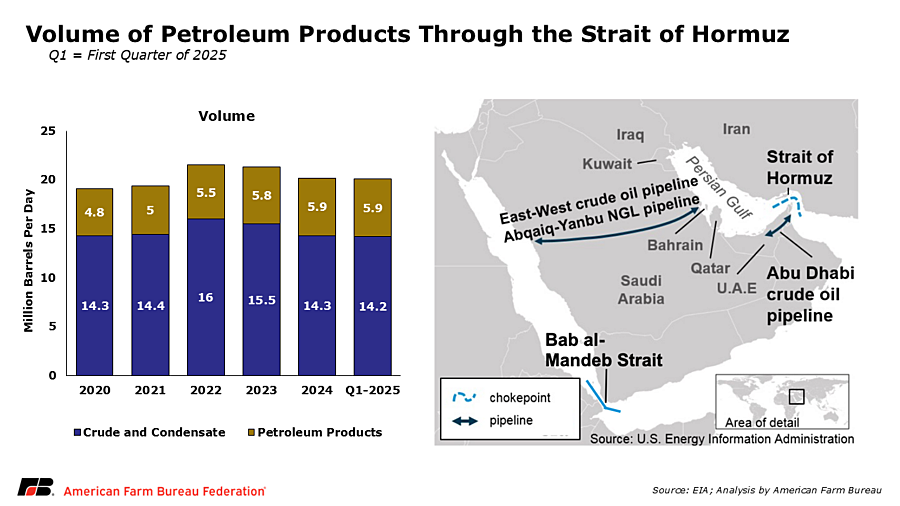
However, it is only half the story yet. The other half — less discussed but equally consequential — is the growing dependence of these Middle Eastern nations on India’s manpower and food exports, especially rice.
Bluntly put, India feeds these Middle East societies; these Middle East nations fuel and fertilise the Indian economy.
So, the relationship that is often imagined as oil flowing east and money flowing west, and geopolitics flowing from the barrels of oil, has become far too deeply intertwined, gradually calibrating a complex web, where neither side can easily coerce the other without incurring high costs.
This has ensured continuity in their connectivity for the benefit of all. This also explains how India was able to launch its India-Middle East-Europe Corridor in 2023 that cuts across traditional divides by connecting Saudi Arabia, UAE, Jordan and Israel. This new frame should enable them to stand against the headwinds of the ongoing crisis as well.
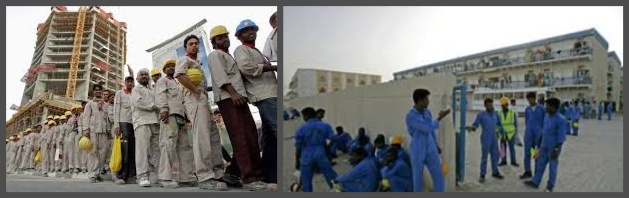
Between India and the Middle East, the presence of over 9.9 million Indian diaspora especially adds a unique “living-bridge” beyond their inter-State relations. For India, the diaspora is a major source of remittances. Of India’s total USD 138 billion remittances last year, over 38 per cent came from these Middle East nations.
Also, unlike India’s foreign direct investments that go to big industries, these remittances from the Middle East go largely to poor and lower middle class families, contributing to grassroots-level prosperity for India.
For the Middle East, other than low-skilled workers, the Indian diaspora has come to drive their modern infrastructure, healthcare and digital economies as well.
But last week, Goldman Sachs cautioned that these ongoing military strikes of US-Israel-Iran resulting in energy price hikes, slowing of exports, and a slide of remittances for India, will see India facing slower growth, higher inflation and a weaker currency over the coming year.
The forecasts are even worse for these economies of the Middle East, which are today at the very epicentre of this geopolitical storm. Their sole source of earning — energy exports and tourism — has been jeopardised, and food imports scuttled.
These last four weeks of US-Israel-Iran military strikes, since the 28th of February, have also cast doubts on this India-Middle East relationship, calling for a fresh scrutiny on its survivability and resilience.
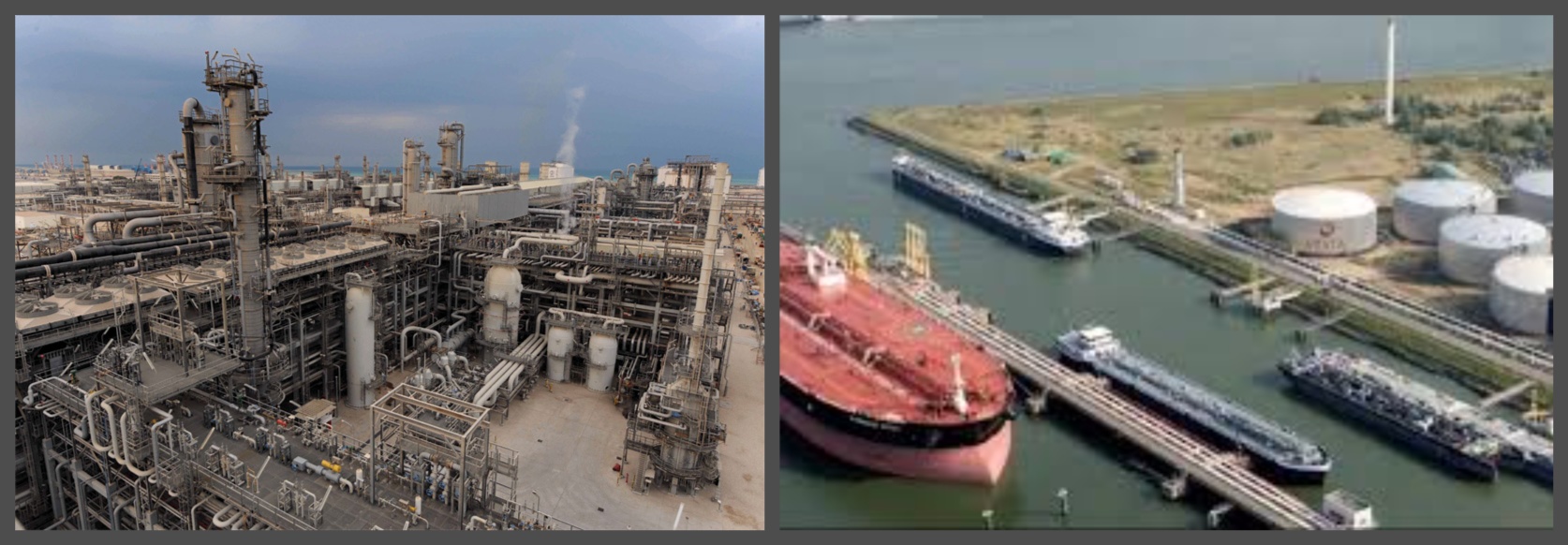
An LNG facility in Qatar and a oil tanker being loaded at an unnamed oil depot in the Middle East
India and the Middle East food security
Let us begin by exploring this lesser talked-of component of India’s exports to the Middle East and whether this provides Indian diplomacy with any leverage to facilitate an early end to this ongoing war.
To front-load India’s vantage point, among a whole lot of other commodities and services, India supplies over 40 per cent of globally traded rice to 172 countries, making it the world’s largest rice exporting country.
India’s dominance in rice exports (which, interestingly, is not how India sees it) is especially visible across the Middle East. Faced with demographic and ecological constraints — like water scarcity, desert climates, and limited arable land — food imports structurally are an indispensable necessity for all these nations, including Israel, which is known for intensive hi-tech agriculture.
In the midst of this ongoing conflict, severe weather forecasts for this year threaten to further disrupt the lives and livelihoods of these Middle East nations.
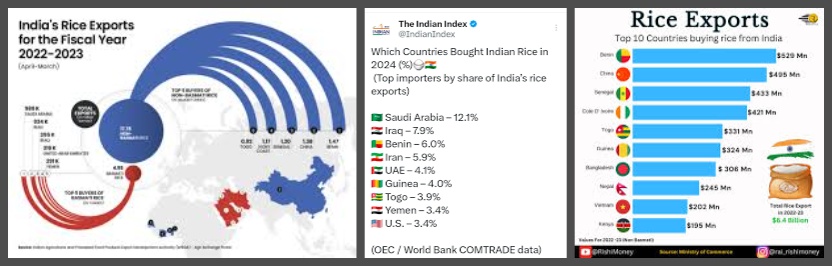
Also, amongst these nations of the Middle East, India’s food exports follow a clear hierarchy of sorts that often correlates to India’s energy imports. From this perspective, the dependence of Middle East nations on Indian rice exports can be categorised into dominant (50 to 80 per cent dependence), substantial (25 to 50 per cent), moderate (10 to 25 per cent) and low (less than 10 per cent dependence).
Conversely, these dependencies have a subtle correlation with India’s dependence on these nations for importing gas and oil.
To begin with, India’s rice exports play a dominant role in ensuring food security for the world’s second-largest oil exporter, Saudi Arabia. It is also the case for the world’s 8th largest exporter of Liquid Natural Gas (Oman) and even Yemen, which remain highly dependent on steady imports of India’s rice.
For long, underlining that correlation of food-energy swap, Saudi Arabia has been the largest market for India’s basmati rice exports. For several of these nations of the Middle East, India is often described as a critical source for their food security.
Likewise, the world’s second largest supplier of LNG (Qatar), and sixth, eighth, and tenth largest exporters of oil (respectively Iraq, UAE, and Kuwait) import between 25 and 50 per cent of their rice from India. This defines their food security’s moderate dependence on India.
Amongst these, the UAE has come to be India’s third largest trade partner (after the US and China) and second largest destination for India’s exports (after the United States). Likewise, India has been the UAE’s second-largest (sometimes largest) trading partner, undergirding strong bonhomie between their leadership.
Given their growing global connectivity and prosperity, these states have, no doubt, diversified their rice imports from Thailand, Vietnam and Pakistan. Yet, India supplies the Middle East more rice than Thailand, Vietnam, and Pakistan combined. The Middle East continues to rely heavily on India’s food exports, not just for volume but for quality as well.
Indeed, Dubai is today a critical re-export hub, extending India’s regional reach. Further down the spectrum, Jordon, Lebanon, and Libya also depend on rice imports from India that usually stand between 10 and 25 per cent of their annual imports.
Finally, the North African economies of Egypt, Morocco, Algeria, and Tunisia also import rice from India. But the fact that these are less than 10 per cent of their imports makes them commercial rather than strategic.
At the centre of ongoing destructive military strikes between the two sides, Iran and Israel both import food from India. Indian exports to Iran last year stood at over USD 1.2 billion. This included rice exports of over USD 757 million, as well as other agri-products like fruits, tea and coffee, which, driven by sanctions, remain less acknowledged or advertised.
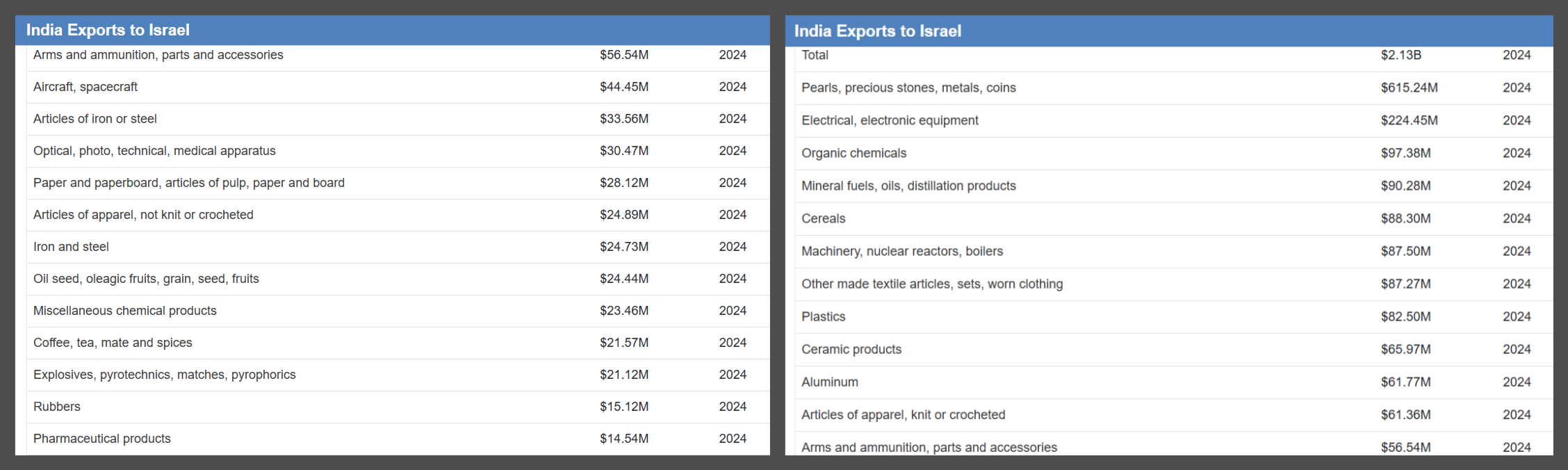
Likewise, Israel, despite being a leader in agricultural best practices and having emerged as a major partner for India’s quest for improving farm productivity, remains a diversified market for India’s agri-exports.
Of India’s total annual exports of over USD 2.1 billion to Israel last year, though, India’s rice exports to Israel constituted less than USD 100 million, along with a few other agri-products like oilseeds, spices and fresh fruits. The difference can be explained by the fact that the Iranian population is nearly ten times that of Israel.
The pattern, nevertheless, is clear: in much of the Middle East, India is not just a supplier — it is a food security anchor. But, the Middle East also remains an anchor for India’s energy and fertiliser imports, and Israel has come to be India’s major partner for the procurement of defence equipment and technologies as well.
India’s imports of fuel and fertilisers
If food gives India leverage vis-à-vis the Middle East, energy creates India’s dependency on these nations. It is a rather well-known fact that India depends on over 88 per cent of crude oil imports, and over 40 per cent of these crude oil imports come from the Middle East.
Saudi Arabia, Iraq, the UAE, and Kuwait remain India’s major suppliers from the Middle East region.
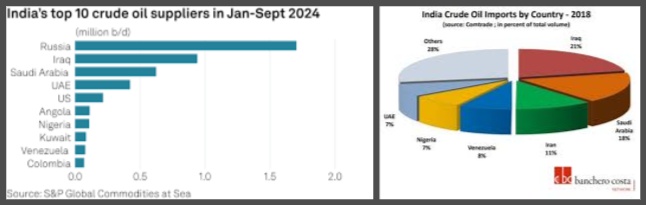
Additionally, as a critical energy mix, 80 per cent of India’s Liquid Petroleum Gas (LPG) comes from the Middle East, of which 60 per cent of imports come from Qatar, UAE, Saudi Arabia and Kuwait in that order. Specifically, 60 per cent of India’s Liquid Natural Gas (LNG) comes from the Middle East, with Qatar alone accounting for over 47 per cent of India’s imports.
This shows how India’s economic growth, industrial output, and even inflation dynamics are tightly linked to regular energy supplies from the Middle East region.
Fertilisers, on the other hand, have remained a hidden link. India imports over 30 per cent of its fertilisers, of which nearly 40 per cent come from these Middle East nations. Often overlooked in public discourse, fertilisers form the third pillar of this interdependence triangle.
India’s agricultural system — on which its food export capacity depends — relies substantially on the import of fertilisers from the Middle East. India, especially, depends on this region for Phosphates, Potash, Urea and Ammonia-based inputs.
In the case of urea, India imports 71 per cent of its consumption from the Middle East, which includes 45 per cent from Oman and a combined 26 per cent from Saudi Arabia, Qatar and the UAE as India’s key partners.
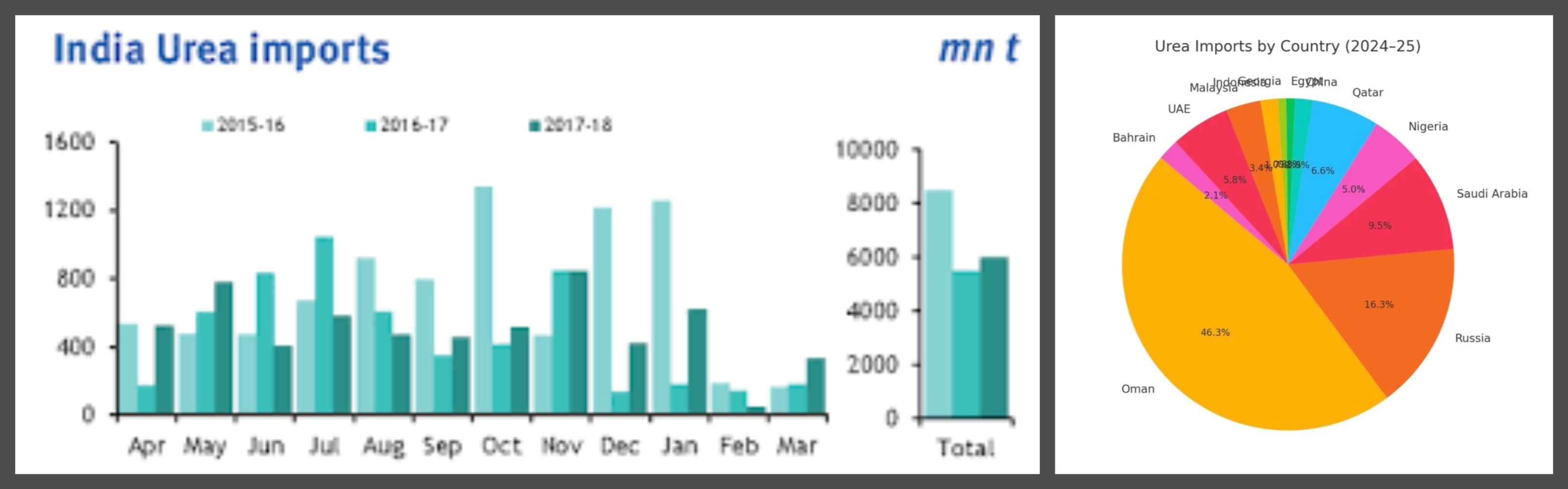
While gas and oil drive much of India’s rapidly growing economy, fertilisers remain crucial for sustaining India’s agricultural productivity, which, in turn, enables India’s food exports to the Middle East. This means that the Middle Eastern fertilisers indirectly also sustain India’s food exports back to that same region.
This circular loop of food, fuel, and fertilisers creates a powerful cycle of their complex interdependence. And the fact that this is not a unilinear but circular relationship makes it ill at ease with any disruptions.
The resource-rich Middle East has proved complementary with labour-rich and agrarian India. Since this relationship is balanced and not asymmetrical, neither side can visualise weaponising their exports howsoever critical they may be for the other side.
As a result, while the recent military strikes may have shrunk their bilateral trade volumes, India-Middle East trade has not collapsed altogether. This resilience is not incidental. Indeed, this striking circularity of their growing complex interdependence empowers them to contribute to resolving the current crisis and write a new script for Asia’s future.
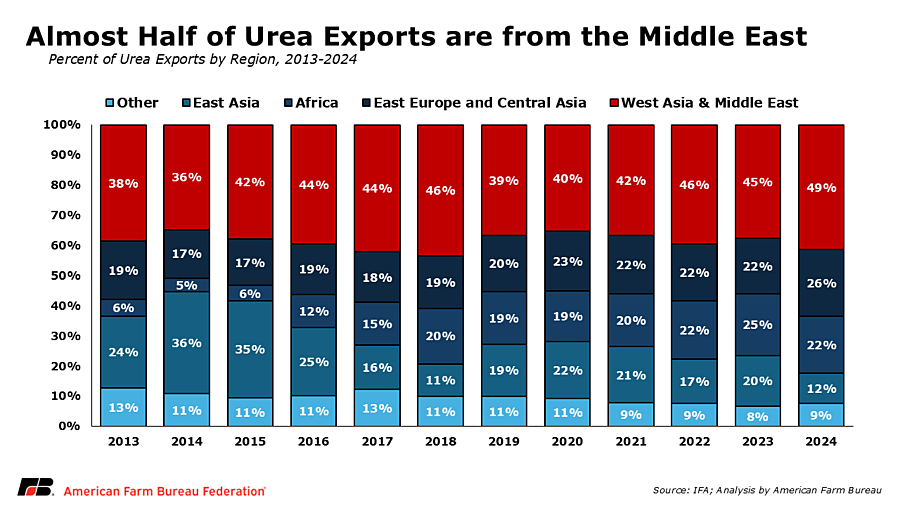
New grammar of geopolitics: Power without weaponisation
No doubt, the ongoing, selective closure of the Strait of Hormuz has unleashed serious stress and disruptions in the supplies for and from both sides. Global structural factors have resulted in shipping costs rising, with insurance premiums surging high. Food, fuel and fertiliser shipments have been delayed, and commodity markets have shown volatility.
Yet, the growing interdependence, as also the past records of India and the Middle East, lend some optimism for both sides contributing to a piecemeal rebound, and to a possible end to the US-Israel-Iran war.
During the post-pandemic year of 2023-24, brief export restrictions on rice exports by India had triggered global price hikes in food prices, including in the Middle East region. However, these restrictions were driven by concerns about India’s domestic food inflation and not on account of any geopolitical targeting.
Likewise, the American wars in this region during the early 1990s and during the first decade of this millennium had also triggered similar disruptions. But neither India nor its Middle East partners ever weaponised their exports, reflecting pragmatism and trust on both sides.
Not that there are no issues where they have had differences, yet their overall relations have played a stabilising role in such geopolitical disruptions. This is visible in the way India has, over decades, come to have friendly relations with almost all major nations of this otherwise deeply divided Middle East region.
What is promising is that the coming decades are likely to see their interdependence expanding even further. Irreversible climate changes, population growth and recasting of global supply chains with greater emphasis on trusted partners are expected to collectively strengthen a new grammar of geopolitics that transcends great powers’ geopolitical confrontations.
The fact that influence rather than crude power marks a key change in a patient and a piecemeal approach of their diplomacy puts them apart.
It is important, therefore, to appreciate the India-Middle East relations in the correct perspective; underline that the relationship is not defined solely by oil as it is often made out to be. It is increasingly being shaped by a three-way exchange of food, fuel, and fertilisers — each indispensable, and each reinforcing the other.
The cushion of the Indian diaspora has also gradually come to be a positive connect for their ever-intensifying inter-societal intertwining. This seems to be in step with emerging modern geopolitics of interdependence, not dominance, which remains the defining feature of India-Middle East relations.
Put together, this dense web of complex interdependence between India and the Middle East region — which is perhaps less visible beyond the pipelines and tankers threatened by US-Israeli-Iranian military strikes — is arguably far deeper and therefore enduring.
Since neither side seeks a relationship of either vulnerability or dominance, their pragmatism should guide mutual restraint for mutual benefit, with implications beyond their bilateral relations.
Follow us on WhatsApp
Follow us on Facebook
Follow us on X @vudmedia
Follow us on Substack
