

As Professor Kingshuk Chatterjee was finalising this comprehensive analysis on the Gaza Plan, its intricacies and durability, Israeli Prime Minister Benjamin Netanyahu had ordered military strikes on 29th October, which reportedly killed over 104 in Gaza. Hours after the strike, the Israeli government declared the resumption of the ceasefire. As these dramatic events show, the durability of the Gaza Plan – which President Donald Trump declared as the ‘final solution in 3000 years’ – is as tenuous as the provisions of the Plan, which are unlikely to fructify in realistic terms. As Professor Chatterjee explains in great detail, there are many factors in play, including the chimera of the ‘two-state solution,’ the Israeli desire for ‘One State, One Entity,’ the far-reaching demographic implications for the Israeli nation with the occupied-Palestine territory, and so on.
The guns have largely fallen silent over Gaza after two interminably long years. The sequence of events triggered by the outrage perpetrated by Hamas on 7 October 2023, and the disproportionate Israeli response (which would have qualified as genocide if perpetrated by any other country), causing the death of more than sixty-eight thousand Palestinians, is now gradually being wound down to a point that people affected by the conflict are able to breathe a bit.
US President Donald Trump has claimed the declaration of this particular ceasefire as the onset of a durable peace in the region, unlike any other. Despite intermittent breaches of the ceasefire over the last few days, the ceasefire appears to be holding for the while. Even as combatants on both sides lick their wounds, it is difficult to see how they would be able to indulge in this luxury for long.
There are too many moving parts in the Twenty-Point Plan for the ceasefire to last long enough to pave the way for a durable peace, but some reprieve from the conflict need not be ruled out.

Image: US President Donald Trump and Israeli Prime Minister Benjamin Netanyahu attend a presser (left), and President Trump displays his signature and comments on the visitors' book at the Knesset (right)
The 'Art of the Deal'
The conflict in Gaza began in October 2023, when Hamas militants breached Israeli security to raid an Israeli settlement, during which more than a thousand people were killed, and 251 were taken hostage. In the months that followed, Israel pummelled the Gaza Strip, in a bid to ‘eradicate’ the scourge of Hamas and bring back the hostages, extensively damaging Gaza’s residential areas and its built-up architecture in the process.
Israel claimed that hostages were being held in a large network of tunnels beneath Gaza, estimated at about 250 miles long in a territory just 26 miles long and 7 miles wide. In response, Israel destroyed much of Gaza’s city infrastructure.
However, it managed to rescue only 8 of the hostages through military action. Of the remaining 243 hostages, 160 were returned alive by the HAMAS – five were returned unilaterally, and 155 more were returned through the frameworks of three ceasefire deals negotiated by Qatar and Egypt – in batches of 105 (November 2023), 30 (January 2025) and 20 (October 2025), while the rest died in captivity.
As of 21 October 2025, the remains of 13 of the deceased Israeli hostages are yet to be returned. On the other hand, HAMAS was able to negotiate the release of 1,240 Palestinian prisoners and detainees (i.e., held without trial) from Israeli prisons during the November 2023 and January 2025 ceasefires, and another 2,000 in October 2025.
Both the November 2023 and January 2025 ceasefires collapsed on grounds of non-compliance – Hamas pulling out of the first one, Israel pulling out of the latter. The November 2023 Ceasefire did not address any of the pressing questions on either side – Israel resented the idea that it was required to swap Palestinian prisoners for hostages, and thus went on dragging its feet till Hamas pulled out.
Public pressure on neither side had come to a point where any breach of the ceasefire could prove counter-productive. The January 2025 Ceasefire, though, was negotiated during the Biden Presidency and was essentially forced on the two sides by the incoming team of President Trump, at a time when the Israeli government had no desire to relinquish its stranglehold on Hamas.
Thus, even though Hamas was desperate to let the ceasefire hold, Israel resumed its offensive once it had suitably appeased President Trump by letting the ceasefire run for a while. The other reason why the ceasefire fizzled out was that there was no serious thought about ‘the day after’ – Trump just wanted the ceasefire so that he could take the bow from a cheering world.
The October 2025 ceasefire, by contrast, is the first serious attempt by interlocutors on both sides to bring the destructive conflict to an end. While the immediate release of all hostages and their remains by Hamas has been insisted upon, conditions of the ceasefire have, for the first time, entailed that the Israeli Defence Forces (IDF) pull out of the main conurbations of the Gaza Strip, and retreat behind the Yellow Line in the first phase of the ceasefire.
Upon satisfactory and verifiable disarmament of Hamas, the IDF is required to pull out of the Gaza Strip altogether, subject to the deployment of an International Stabilisation Force (ISF). Projected to be manned by neighbouring Arab states, the ISF would function to provide a buffer between the two belligerent sides.
Unlike Trump’s first brush with the issue during the early weeks of his second term, when a naïve vision of Gaza Riviera was laid out (involving relocation of Gaza’s denizens elsewhere in the Arab world), the Twenty-Point Gaza Plan is better thought out. The Plan rules out relocation of the people of Gaza anywhere else, and, instead, proposes to rebuild the territory.
It also provides for reconstituting the political and administrative mechanism there in such a way that Hamas has no further role in its public sphere.
While Trump, the deal-maker, is happy to take credit for the Gaza Plan, it looks suspiciously similar to the Biden Plan (minus its forthright insistence on the Two State Solution), there is reason to think that the American ‘deep state’ has finally got through to him. To Trump’s credit, he used his leverage as “the greatest friend Israel has ever had in the White House” to coerce Prime Minister Netanyahu to agree to the ceasefire.
 Image: Two maps depicting the Gaza Strip - on the left showing the peace agreement details, and on the right, showing Hamas's presence in October 2023
This was, presumably, by threatening him with cutting off military and logistical support after Israel carried out air strikes illegally inside Qatar, one of Washington’s valuable allies in the Gulf, in a gesture of putting the leash on a state that had gone rogue.
The Art of the Deal, after all, is to make an offer that one cannot refuse.
Why the Ceasefire might just hold for a while
President Trump, true to form, began by claiming the Gaza Plan to be the foundation for everlasting peace in Palestine. In the unlikely event that his claim turns out to be true, he may actually look forward to the Nobel Peace Prize next year.
US Vice President J D Vance was more realistic during his visit to Israel, saying the hard work is set to begin, now that the first phase (launching the ceasefire and swapping hostages for prisoners) is over. The hard work Vance spoke about was to make the ceasefire hold long enough for Hamas to be disarmed, ISF to be deployed, Israel to pull out of Gaza altogether, and for reconstruction of Gaza to begin under a non-political technocratic administration.
There are a few reasons why the ceasefire might hold for a while.
First, after two years of continual and multi-front military operations, the IDF in particular, and the Israeli society in general, are completely exhausted. The Gaza conflict was the longest continuous military operation by Israeli forces since the country came into being. The engagement across multiple fronts (Gaza, Lebanon, Syria, Iran, Yemen) had put the IDF under quite a strain.
The fact that the clamour against the continuation of the conflict was not loud enough was because of the comparatively low body count for Israel as against the successes achieved, be it decimation of the leaderships of Hamas, Hizballah and the Iranian Revolutionary Guard Corps (IRGC), and degradation of their war-making capabilities, etc.
Additionally, the first-ever direct confrontation with Iran has made the Israelis realise their own vulnerabilities – they had exhausted nearly a third of their missile interceptors (Arrow, David’s Sling and Iron Dome) in the Twelve Day War with Iran. Additionally, the Gaza conflict and Israeli operations against Hizballah and Houthis have depleted their overall arsenal considerably.
This partially explains why, according to Moscow, Tel Aviv is messaging Tehran through Russia that it does not want any further conflict for the time being. Israel needs, further, to carry out a proper security and intelligence audit about its own lapses, which are supposed to have paved the way for the Hamas attack of 7th October 2023.
Furthermore, they have not even started calculating the financial costs of the war in terms of loss to the Israeli economy. If these were different times, not disfigured by the October 2023, wiser counsel would have been guaranteed to prevail in Tel Aviv.
 Image: The extent of destruction and devastation in Gaza as a result of Israeli military attacks and bombardment over the two years; photo credit: UNRWA
For the people of Gaza, it is still more imperative that the ceasefire holds. After two years of relentless bombing, shelling and Israeli ground offensive, the population of Gaza is completely devastated. The built-up architecture of the territory, civilian infrastructure (schools, hospitals, food and water supply, and other essential services) lie in ruins.
More than 92 per cent of the residential premises in the territory are estimated to have sustained extreme damage and are not in livable conditions. Parts of the territory are reported by agencies under the United Nations as either experiencing famine conditions or close to it.
With over 68,000 dead (nearly a third being women and children), the social fabric of Gaza lies in tatters. For the population to restore any sense of normalcy to their lives, it is imperative that the ceasefire holds for a time. It is reasonable to assume that there is no stomach for continued combat among the people of Gaza.
Even Hamas would not particularly mind if the ceasefire could hold for the time being. Its top leadership up to several levels has been decimated by relentless and targeted Israeli campaigns and assassinations over the last two years. Except for the current leader Khalil al-Hayya, no leader of any stature appears to be left standing (and virtually none in the territory itself).
The organisation’s military capabilities, developed over three decades with support from Iran and many other sympathisers from across the Muslim world, have been so badly degraded that it cannot stand on the ground against the IDF as before.
Moreover, in good measure, Hamas has lost control of much on the ground in Gaza in the last two years – food and aid distribution, to the extent Israel now allows, is being contested by armed gangs (such as those of the Doghmush and the Yasser al-Shabab clans, often with calculated support from Israel in order to subvert the position of Hamas).
 Image: The al-Qassam Brigades in Gaza City, January 2023 (left), photo credit: FARS Media Corporation; and Hamas fighters from a propaganda video
As a result, Hamas seems to prefer a ceasefire for the time being, while it deals with its challengers in the territory, and recoups its standing as the force to reckon with in Gaza.
The most important reason why this ceasefire might hold is the level of international involvement in the making of the ceasefire. Hamas has been persuaded to come to the negotiation table by Qatar and Egypt – two powers in the neighbourhood that have consistently tried to speak for Gaza and its people (with Qatar helping Hamas defray the administrative expense of functionaries of the Gaza administration for the last several years) – with international interlocutors.
Both countries resolutely opposed Trump’s half-baked Gaza Riviera plan in January 2025 and any further displacement of the population of Gaza. In a way, if Hamas survives as an organisation after this conflict, it would be in good measure owing to the ceasefire proposal (particularly the components dealing with the reconstruction of Gaza) that the deal’s Arab interlocutors have brought Washington DC to underwrite.
The possible let-off for Hamas was precisely why PM Netanyahu was reluctant to commit, which is where the Trump factor came in handy.
Both in his first term, and from the very beginning of his second, President Trump has consistently weighed in all the time in favour of Tel Aviv. So much so that Trump looked away when Netanyahu broke out of the January 2025 Ceasefire, for which Trump had taken credit. This gave Netanyahu virtually a free hand in Gaza, by ignoring human rights and the genocidal implications of Israel’s military misadventure, which could have been challenged had it been the Biden administration.
Under Trump, the US even went to the extent of bombing Iran’s nuclear installations, risking a major war. Thus, when Trump rammed through the ceasefire in October 2025, promising to return all the remaining hostages at one go, he achieved something that Bibi himself had failed to do by pushing for a military solution to the question.
A large section of the Israeli population today believes that the Netanyahu government prioritised the elimination of Hamas over the return of the hostages, in order to exculpate itself from charges of governance and intelligence failures which caused the debacle of 7th October 2023.
For the Israelis, the ceasefire and return of the hostages is the doing of Trump – they are grateful to him to that extent, and might start baying for accountability from Netanyahu.
Trump, indeed, could be in the running for the Nobel Peace Prize if the ceasefire graduates to its next phases.
And yet, may not hold for long
The scenario of the ceasefire moving onto the subsequent phases is, however, particularly grim. The most pressing precondition for the ceasefire to hold is the proposed disarmament of Hamas, without any particulars of what disarmament is to mean.
Is Hamas to give up all its weaponry, big and small, or merely its arsenal of rockets, mortars and missiles?
Hamas might still agree to negotiate over the latter (hoping to build it back later, once international scrutiny reduces). But the group is highly unlikely to accept complete disarming in a verifiable manner. This is simply because such disarming would involve losing its muscle in the Gaza Strip, and, in effect, its control over the population of Gaza.
 Image: An undated photo of a rocket fired from a civilian area in Gaza towards Southern Israel (left), photo credit: Wikipedia; and an interceptor fired from an Iron Dome system (right)
Total neutralisation of Gaza could work only if its resistance could be proven to be demonstrably unnecessary, i.e., if Israel agrees immediately to confer statehood and sovereignty to the Palestinians, which, however, is not on offer.
It could also theoretically work if the ISF is given sufficient muscle to not only forcibly disarm Hamas (the first step), but also succeed in keeping the IDF from returning to Gaza should it so choose (the second step).
For the first scenario, if the ISF fails to contain the battle-hardened Hamas, the entire Plan would collapse. Even if the ISF were able to contain Hamas, that would involve a colossal body count, which is unlikely to be popular. In such a situation, the Plan would lose its charm (as the IPKF did in Sri Lanka vis-à-vis the LTTE) for those countries deploying troops.
For the second scenario, if the ISF is to deploy soldiers from neighbouring states (viz. Egypt, Qatar, UAE, Saudi Arabia, or even Turkey and Pakistan), none of them are likely to have either the mandate or the teeth to prevent any Israeli incursion on a future date. That kind of muscle would require American boots on the ground in Gaza enforcing the ceasefire, which Trump is unlikely to sign up for.
But the most important factor with potential to undermine the Gaza Plan is that Israel has virtually no interest in the medium to long-term success of the plan.
The 7th of October 2023 has shifted the vortex of Israeli politics and society considerably more to the right. Israeli public opinion has shifted to a point where a large section of Israelis does not distinguish anymore between Hamas and the rest of the Palestinians, and does not seem to believe in the possibility of coexistence with a Palestinian state.
Pragmatists in Israel are no longer talking of the Two State Solution, but rather of One State [Israel], One Entity [Occupied Palestine, quasi-autonomous]. Chatter suggests that even though Trump’s Gaza Plan consisted of twenty-one points (not twenty), Netanyahu made his acceptance of the rest of the Plan conditional upon dropping the mention of the sovereign state of Palestine.
And here lies the problem. As early as the 1980s, Israel had come to realise that demographic dynamics of the state of Israel ensured that there could be no military solution to the Palestinian question. At that time, the state of Israel had a population of approximately 9.4 million, but a citizen body of only 6.3 million.
Of the citizens, 4.9 million were Jewish, and 1.4 million were Arab-Israelis (i.e., Israeli citizens of Arab descent), and 3.1 million Palestinians were spread across the occupied West Bank and Gaza. Thus, of the total population of Israel and occupied Palestine, there were 4.9 million Jews and nearly 4.5 million Arabs.
This prompted them to work on land-for-peace and the Two-State Solution – one for the Jews and one for the Arabs. To ensure that the Jews would not be outnumbered in the state of Israel, immigration was encouraged from the Soviet bloc of countries, which pushed the Jewish population in Israel up to 7.2 million by 2024.
This increased the requirement for more land for the new settlers, thus undermining the Two State Solution by the late 1990s, helped by Hamas’s refusal to honour the land-for-peace arrangement of the Oslo Accords. The new settler communities constitute the extreme right wing of Israeli politics today, represented by Bezalel Smotrich and Itamar Ben Gvir.
This hard right settler lobby prodded Bibi into the politics of establishing Israeli control over Gaza and the West Bank after October 2023.
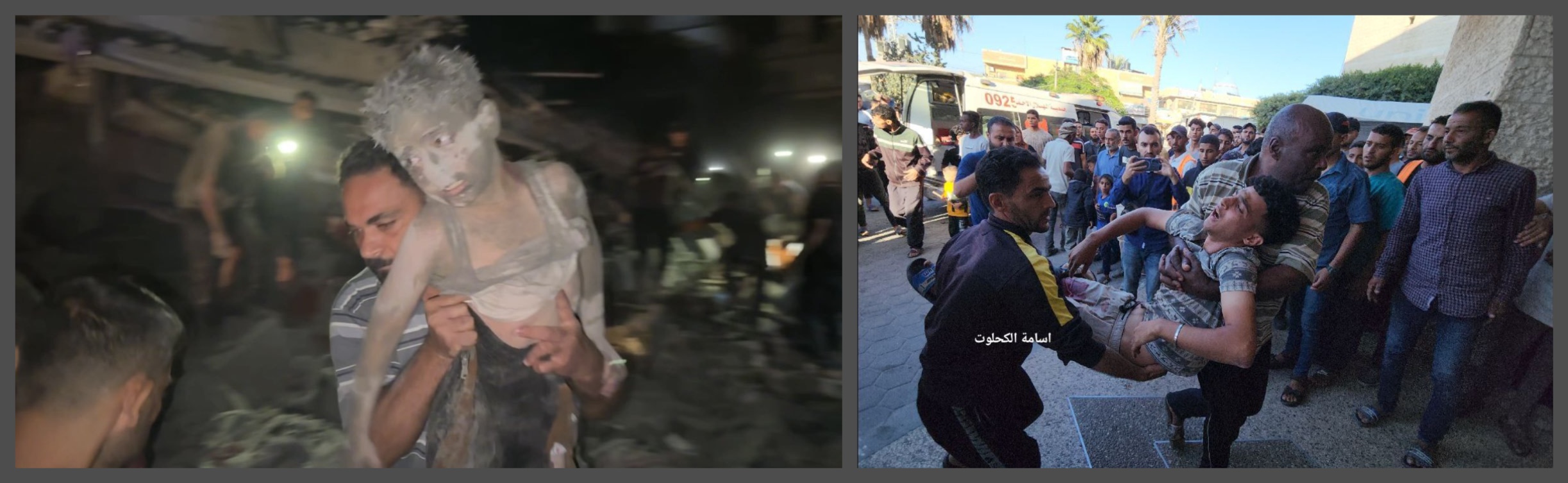
Image: Undated images of Palestinian children being taken to hospitals following Israelli air strikes, photo credit: UNRWA
During the two years of the Gaza conflict, Israel has been patiently encroaching upon land in the West Bank, which failed to even secure a serious mention in the plan. When this analysis was being readied, the Israeli Knesset had discussed a non-binding resolution to recommend annexation of the West Bank by Israel.
Should the Israeli government pursue this seriously, that would be the death knell of not only the Two State Solution, but also Trump’s Gaza Plan.
Just as these demographics are likely to have Israel press ahead with denying Palestinians their own state, it is equally certain to deny them an easy solution.
While Jewish population in Israel stands today at 7.2 million, apart from 2 million Arab-Israelis, occupied territories of West Bank and Gaza have over 3 million and 2 million Arabs respectively, plus nearly half a million other non-Jewish (Bedouins, Druze, etc) – making the total population tally of Israel and occupied Palestine chalk up to 7.2 million Jews and 7.5 million Arabs.
If Israel continues with its present policy of discrimination and ethnocracy (rule of one population group over another), denying the Palestinians freedom, sovereignty and dignity, with or without Hamas, another Intifada is virtually guaranteed in the scheme of things. Short of Tel Aviv performing a comprehensive rethink, the Gaza Plan may not have much of a shelf life.
 Image: Palestinians demonstrate during the First Intifada in Gaza Strip (left), 21 December 1987, photo credit: Efir Shahrir, Dan Hadani Collection; Israeli soliders frisking Palestinian men as school children pass by in November 1986 (right), photo credit: Wikipedia
How long before it falls apart?
The Israeli air strikes after the ceasefire came into being clearly signify the way Tel Aviv is approaching the question. The ceasefire would be observed when it suits Tel Aviv, and not when it does not. Tel Aviv may take a break from observing the ceasefire, only to return to it afterwards, and observe the ceasefire till the next breach.
Now that the hostages have all been returned, Bibi has little else to fear domestically by resuming an aggressive posture.
The ongoing discussions at the Israeli Knesset about annexation of the West Bank indicate the Israeli determination to preclude the possibility of the creation of a viable state of Palestine, lest the Gaza Plan continue to work with that objective.
That these discussions took place in Jerusalem when US Vice President J.D. Vance was visiting Israel signifies that Tel Aviv would persist in its opposition to the Two States solution, no matter what Washington, DC has to say on the matter.
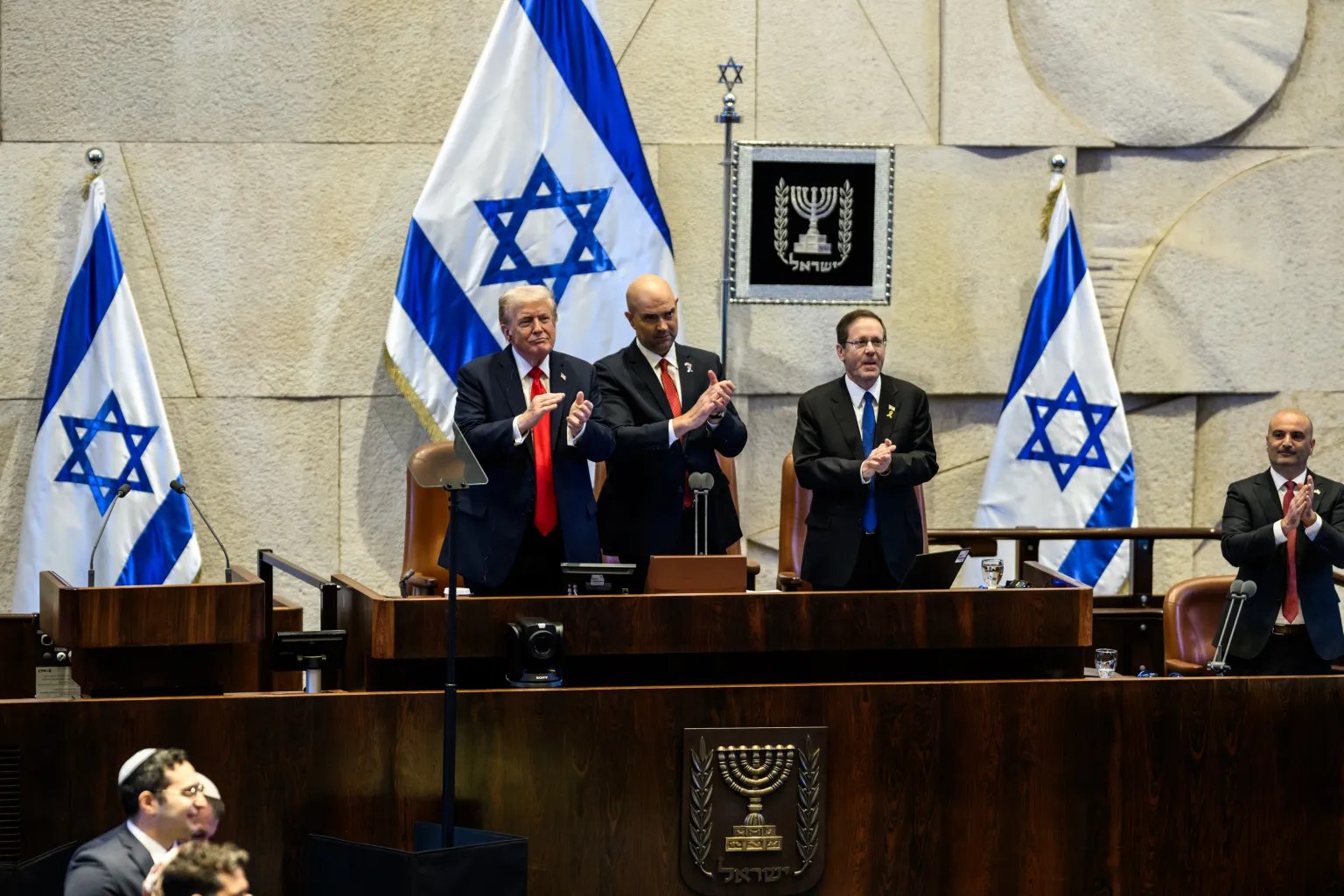
Images: US President Donald Trump at the Israeli Knesset, photo credit: White House
Unless the US and all the regional interlocutors show their determination in turn by means of speedy and definitive progress in rebuilding Gaza and insulating occupied Palestine from Israeli expansionism (an unlikely scenario), resumption of conflict and violence in Israel-Palestine is likely to prove a foregone conclusion in the medium to long term.
Let us not set about nominating President Trump for the Nobel just yet!
Follow us on WhatsApp
Follow us on Facebook
Follow us on X @vudmedia

.svg)
.jpg)

.jpg)
