
West Bengal today votes in the second and final phase of the election to choose its new legislature and government. Shaping this election immensely is the controversial Special Intensive Revision (SIR) through which the Election Commission has disenfranchised a whopping 90 lakhs, with over 27 lakhs being omitted, citing ‘logical discrepancies,’ a benchmark which remains challenged and inconclusive even in the Supreme Court-appointed Appellate Tribunals. The scale of deletions is such that in at least 89 assembly segments, the number of deletions exceeds the vote margin recorded in the 2024 Lok Sabha polls. It is thus a foregone conclusion that the SIR will significantly influence the electoral outcome. Yet, the Trinamool Congress, as the party ruling the state, is putting up a brave front, even as the BJP has pulled out all stops to capture the state. The surprising element, however, is the likely revival of the Left Front at the hustings, says Tapas Das, in this detailed analysis of the West Bengal electoral scene.
Home page image: TMC leader and West Bengal Chief Minister Mamta Banerjee addressing an election rally
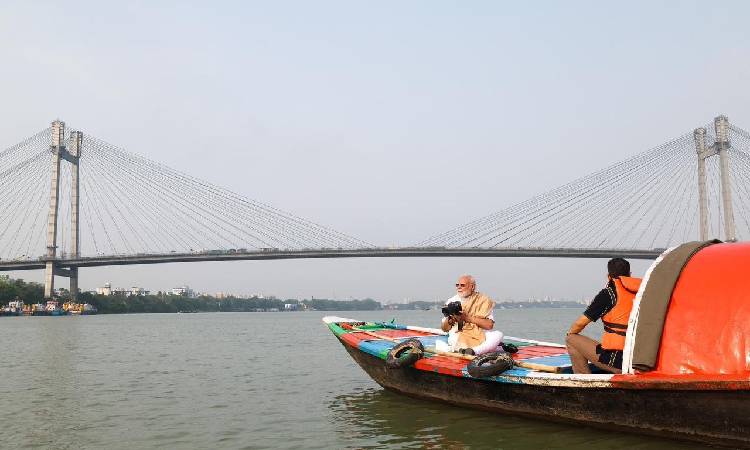
Text page image: Prime Minister Narendra Modi takes a boat ride near Howrah Bridge amid the election campaign in West Bengal
Banner image: Women voters display their voter identity cards at a polling booth during the first phase of the West Bengal election
The 2026 West Bengal Assembly election, held in two phases to elect the 294 members of the state legislature, saw its first phase, covering 152 constituencies, held on April 23rd. The voting for the remaining seats will be held in the second phase today (April 29th), with votes to be counted on May 4.
According to the Election Commission of India (ECI or EC), 2,926 candidates are contesting after withdrawals. Of these, 1,478 are running in Phase I and 1,448 in Phase II. This election stands out because the Commission has shortened the schedule to just two phases, a big change from the eight phases in 2021, even though West Bengal still faces complex political and security challenges.
The Chief Electoral Officer of West Bengal says there are 6,82,51,008 eligible voters this year. This includes about 3.49 crore men, 3.33 crore women, and over 1,200 third-gender voters. Of the 80,719 polling stations, more than 10,000 are run entirely by women, and several are specially designed for people with disabilities.
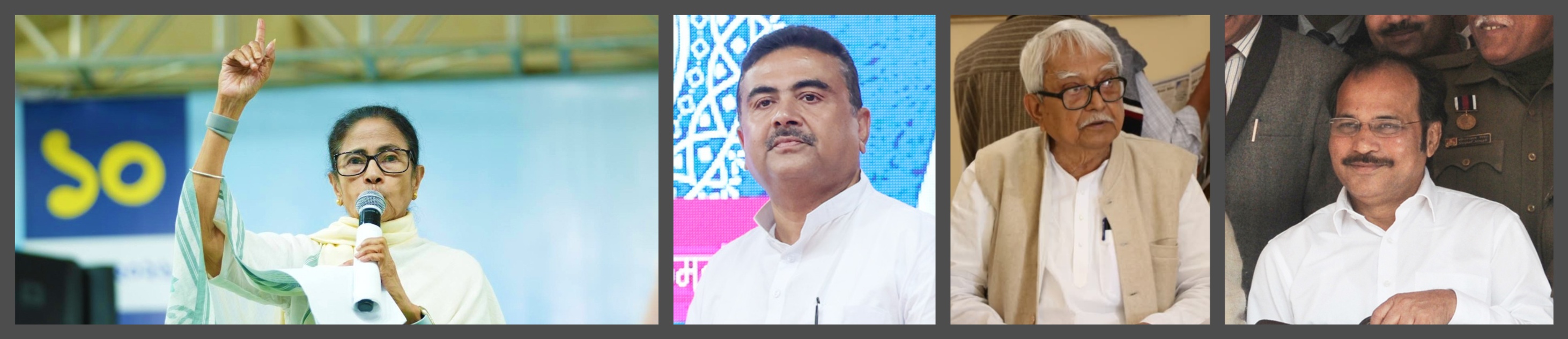
The contenders (from left to right): TMC leader Mamta Banerjee, BJP leader Suvendu Adhikari, CPI(M) leader Biman Bose, and Congress leader Adhir Ranjan Chowdhury
Security for this election is at a record high, with over 2,400 companies of the Central Armed Police Forces (CAPF), the largest deployment ever for a state election in India. Murshidabad, where this author is based, has been a key focus, with 316 CAPF companies assigned to the Jangipur and Murshidabad police districts, the highest number in the state.
A major issue in this election is the Special Intensive Revision (SIR) of the voter rolls. Nearly 90 lakh names, or about 12 per cent of voters, were removed, reportedly listed as deceased or absent. Of this, over 27 lakh voters were deleted by the EC, citing “logical discrepancy,” alleged to be a criterion used exclusively for the SIR in West Bengal.
The ECI says this was to remove fake entries, but almost all political parties, other than the Bharatiya Janata Party (BJP), have contended that the SIR has deprived people of their right to vote.
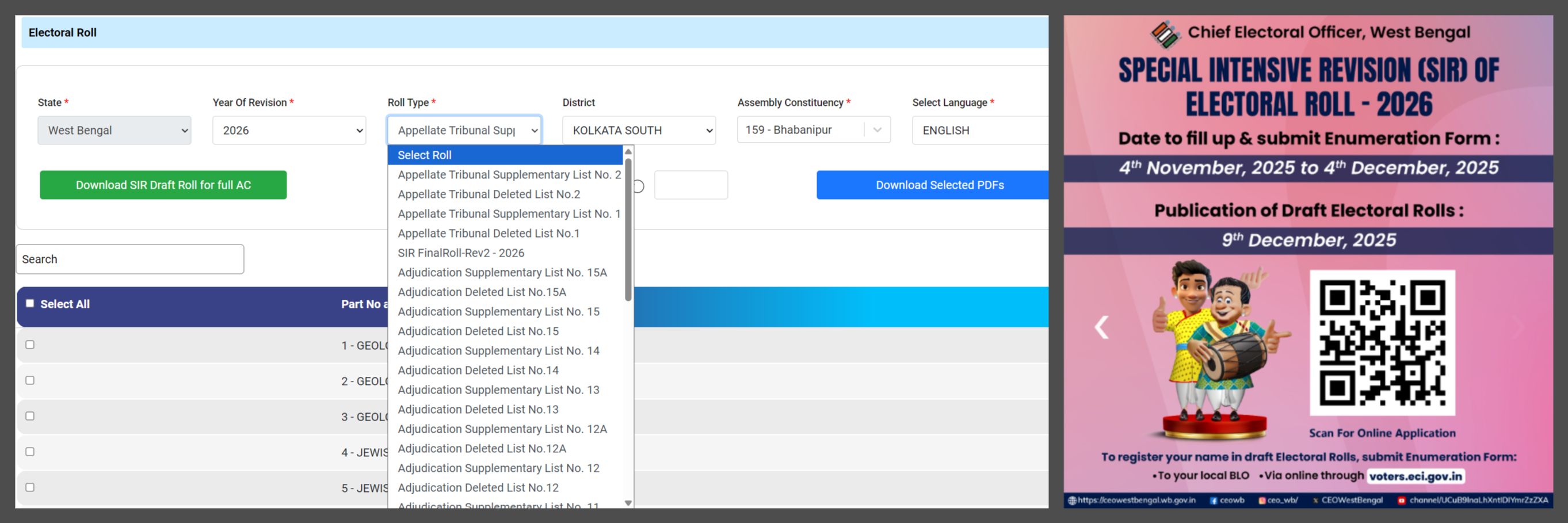
It is a foregone conclusion that the SIR would impact the election results in West Bengal. The All India Trinamool Congress (AITC or, popularly, the TMC) still leads the BJP in both vote share and seats in the Assembly and Lok Sabha.
However, in about 89 Assembly segments, more names were deleted than the margin of victory in the 2024 Lok Sabha election. This makes the revision an important political factor, though it is not the only thing that will decide the outcome.
This election will likely reveal many social and political divides. These include Hindu and Muslim mobilisation, Bengali identity versus non-Bengali voices, Joy Bangla versus Joy Shri Ram slogans, Hindi versus Bengali language issues, and Veg Versus Non-Veg foods.
For example, there are debates over the medium of instruction in schools and demands for government services in Bengali. Competing welfare promises also play a role. North Bengal often feels neglected compared to South Bengal. Additionally, there are tensions between bhadrolok and indigenous identities, along with urban versus rural concerns.
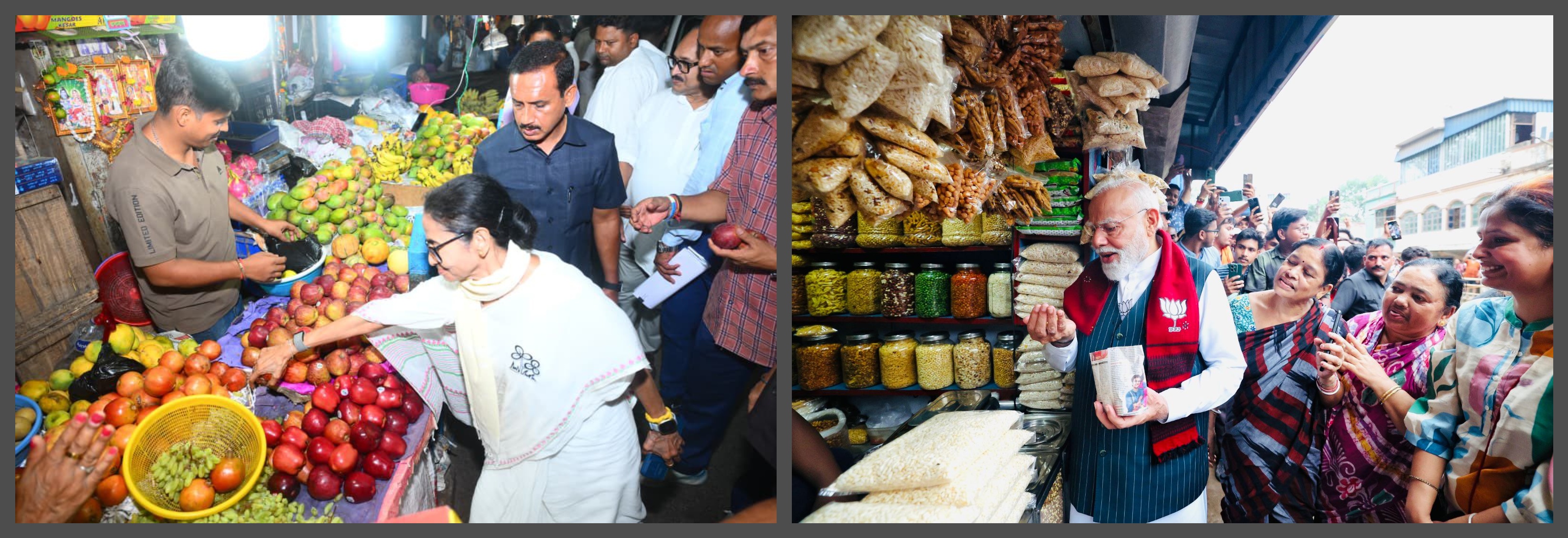 On the streets: CM Mamta Banerjee and PM Narendra Modi in their respective campaigns, connecting with ordinary people
SIR: Electoral cleansing or mass omission?
The Special Intensive Revision (SIR) of electoral rolls has fundamentally reshaped West Bengal's electoral landscape. Around 34 lakh voters have been reportedly denied the right to vote in the first phase of the election.
Of the over 90 lakh names struck off, more than 60 lakh were categorised as absentee or deceased voters. Of the remaining, 27.16 lakh were persons whose cases remained unresolved (Logical Discrepancy category) and were pushed before the 19 Appellate Tribunals, which were overburdened with petitions.
The Supreme Court has ordered that the electors purged from the voter list during the West Bengal Special Intensive Revision, but subsequently cleared by Appellate Tribunals by April 21 or April 27, must be allowed to vote in the Assembly election.
The geographic and demographic concentration of these deletions has become a focal point of political contention. Data indicate that the most deletions under adjudication occurred in Muslim-majority constituencies and in districts bordering Bangladesh, such as Murshidabad, where 4.55 lakh names were removed.
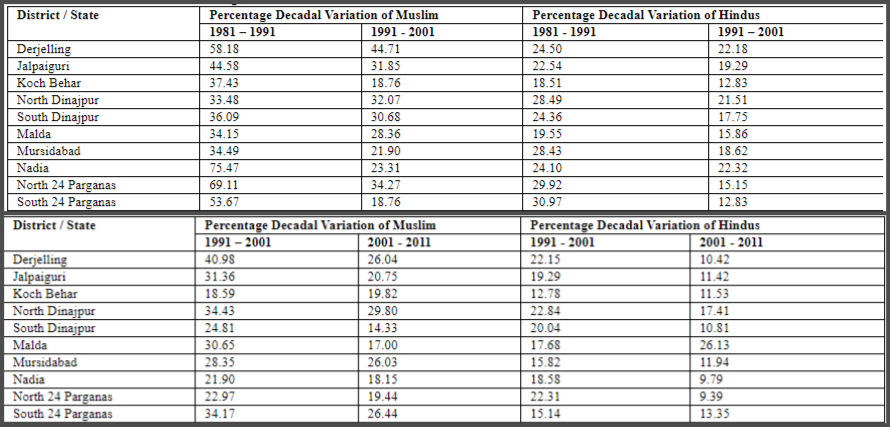
Of the 25 polling stations with the highest rates of “voters under scrutiny,” 11 are located in Malda, 8 in Murshidabad, 5 in North Dinajpur, and 1 in Birbhum. In other words, the statistics indicate that the phenomenon of “voters under scrutiny” is concentrated within specific geographical regions.
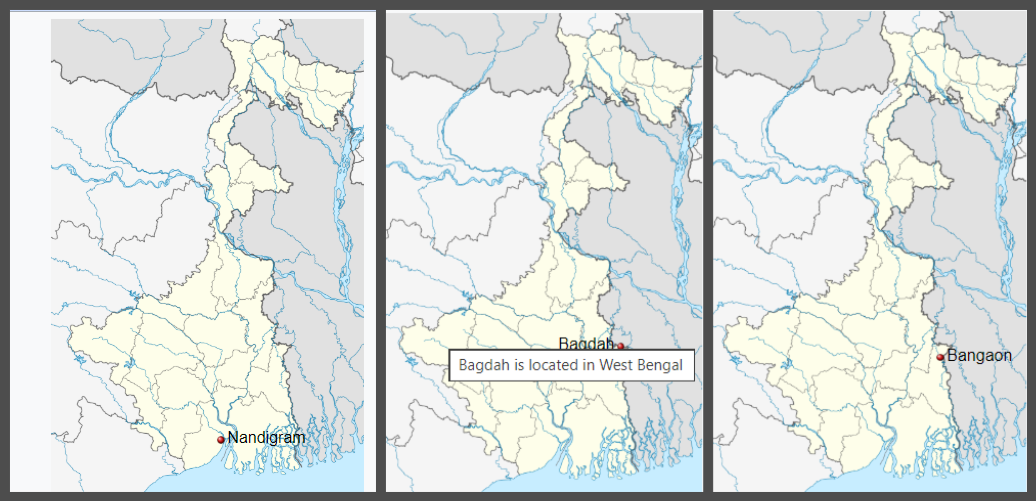
In high-stakes battles, like in Nandigram, the disparity is particularly sharp: Of the 2,826 voters excluded from this Assembly constituency, 2,700 were Muslims, accounting for approximately 95.5 per cent of the total, a figure significantly higher than their population share in that seat.
Similar is the case of Bhabanipur, the South Kolkata constituency where Chief Minister Mamata Banerjee is seeking the people’s mandate. In 2021, she won with a margin of 58,832 votes. Yet, the Trinamool could manage a lead of only 8,291 votes from this Assembly segment in the 2024 Lok Sabha election.
As many as 47000 names were deleted from the constituency in the SIR exercise. Over 14000 are under adjudication. The vast majority, 40 per cent, of the deleted voters are Muslims. Notably, the Muslim population in this constituency stands at approximately 20.1 per cent. Conversely, the number of non-Muslims removed from the voter list accounts for 59.9 per cent.
However, the effect is not limited to Muslims community alone. Across West Bengal, 63 per cent of the deleted voters are Hindus, especially in Matua-dominated border areas such as Bagda and Bongaon, where questions of citizenship and identity documents remain highly sensitive.
The scale of these deletions could have a major impact on the 2026 election. In at least 89 assembly segments, the number of deleted names exceeds the vote margin recorded in the 2024 Lok Sabha polls. In Howrah South, for instance, 83,267 names were deleted, far more than the TMC’s earlier winning margin of 50,569.
The gap is even sharper in places like Jorasanko, where 66,491 names were deleted against a margin of only 12,743, and Bidhannagar, where 54,064 deletions are far above a lead of just 7,997. With the electorate dropping from 7.66 crore to 6.75 crore, the outcome may depend as much on the Appellate Tribunals’ decisions as on the usual campaign battle on the ground.
The trend continues across central Kolkata. Chowringee saw 62,695 names deleted compared to the margin of 45,344, while Cossipore-Belgachhia recorded 62,047 deletions, nearly double its 2021 margin of 35,390. In Ballygunge, voter cuts of 55,406, and in constituencies such as Shyampukur, it was 51,918 deletions as opposed to the 22,520 margin of 2021, and 56,789 against 23,433 in Serampore.
Competing promises, not just ideology
The BJP manifesto for West Bengal, titled ‘Sankalp Patra,’ focused on national security and promised to end illegal infiltration, placed at the top of its 15 major promises. The party has committed to implementing the 7th Pay Commission, including clearing dearness allowance dues for government employees and pensioners, and introducing the Uniform Civil Code (UCC) within six months of coming to power.
The ruling party at the centre also promised to increase financial support for women to INR 3,000 per month, up from the current INR 1,500 under the Trinamool Congress’s Lakshmir Bhandar scheme, which benefits about 2.42 crore women. For unemployed youth, the BJP has announced a monthly aid of INR 3,000, similar to the TMC’s recently launched Banglar Yuva Sathi scheme, which offers INR 1,500.
Other key pledges include rejuvenation of old tea gardens, strengthening of the Darjeeling Tea brand, modernisation of the jute industry, and full implementation of the Ayushman Bharat Yojana and all Central Government schemes.
In contrast, the TMC’s manifesto centred on 10 commitments. These include expanding existing welfare initiatives, such as broadening ‘Duare Chikitsa’ doorstep medical care, continuing the Lakshmir Bhandar scheme (with a recent INR 500 increase in the state budget for 2.4 crore poor women), and rolling out the Banglar Yuva Sathi scheme for unemployed youth aged 21–40, which has already received 80 lakh applications.
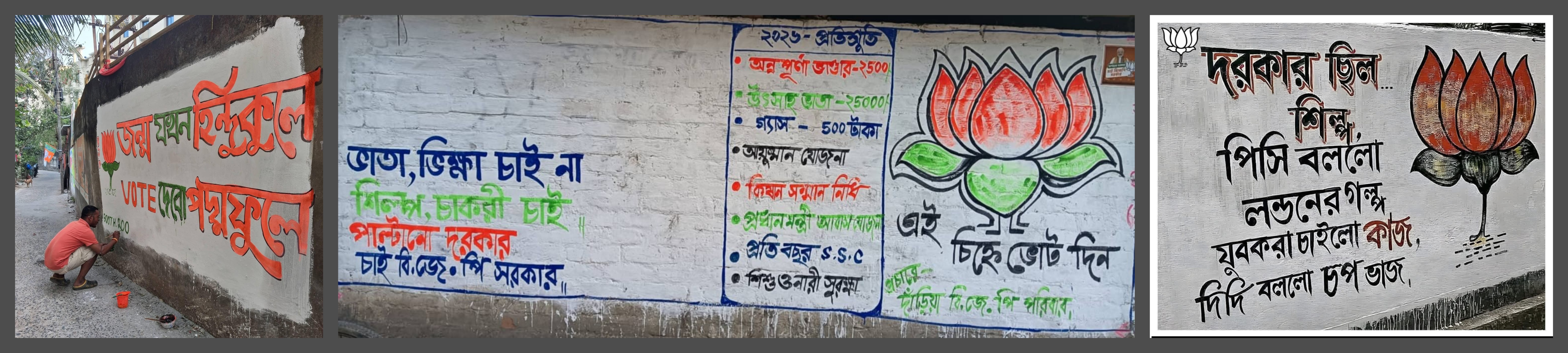
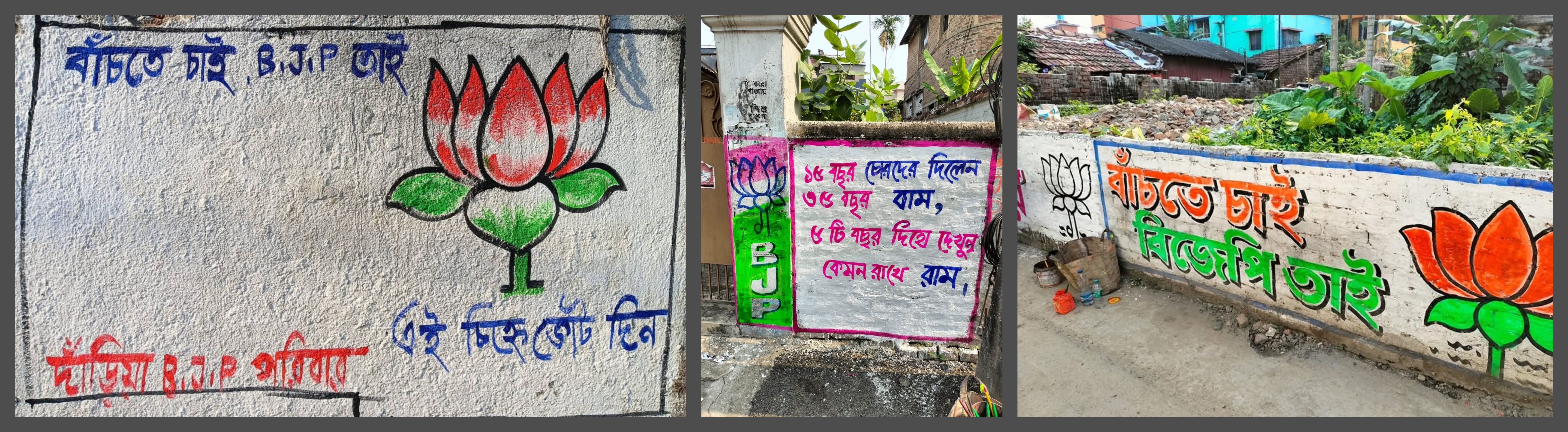
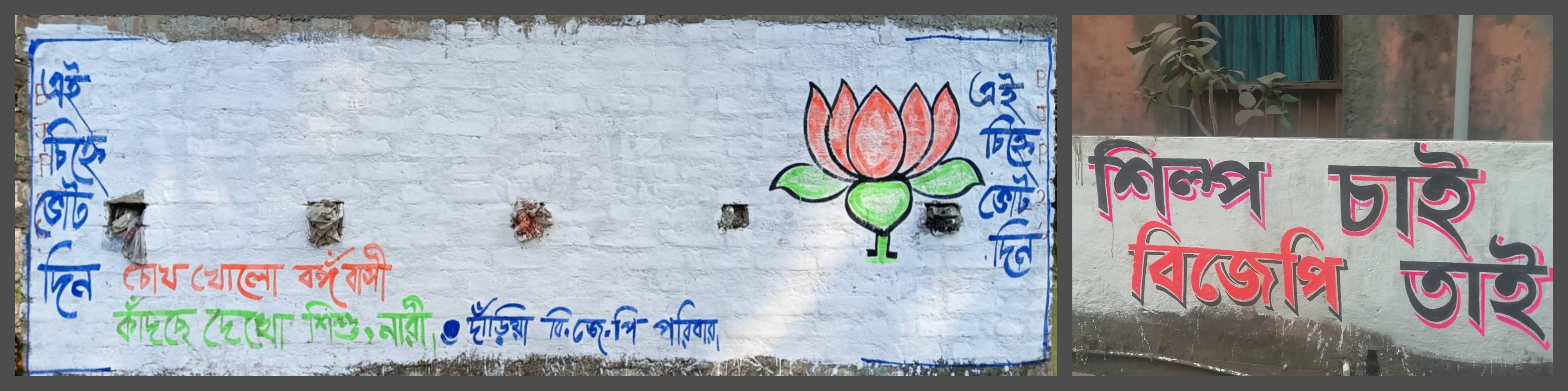
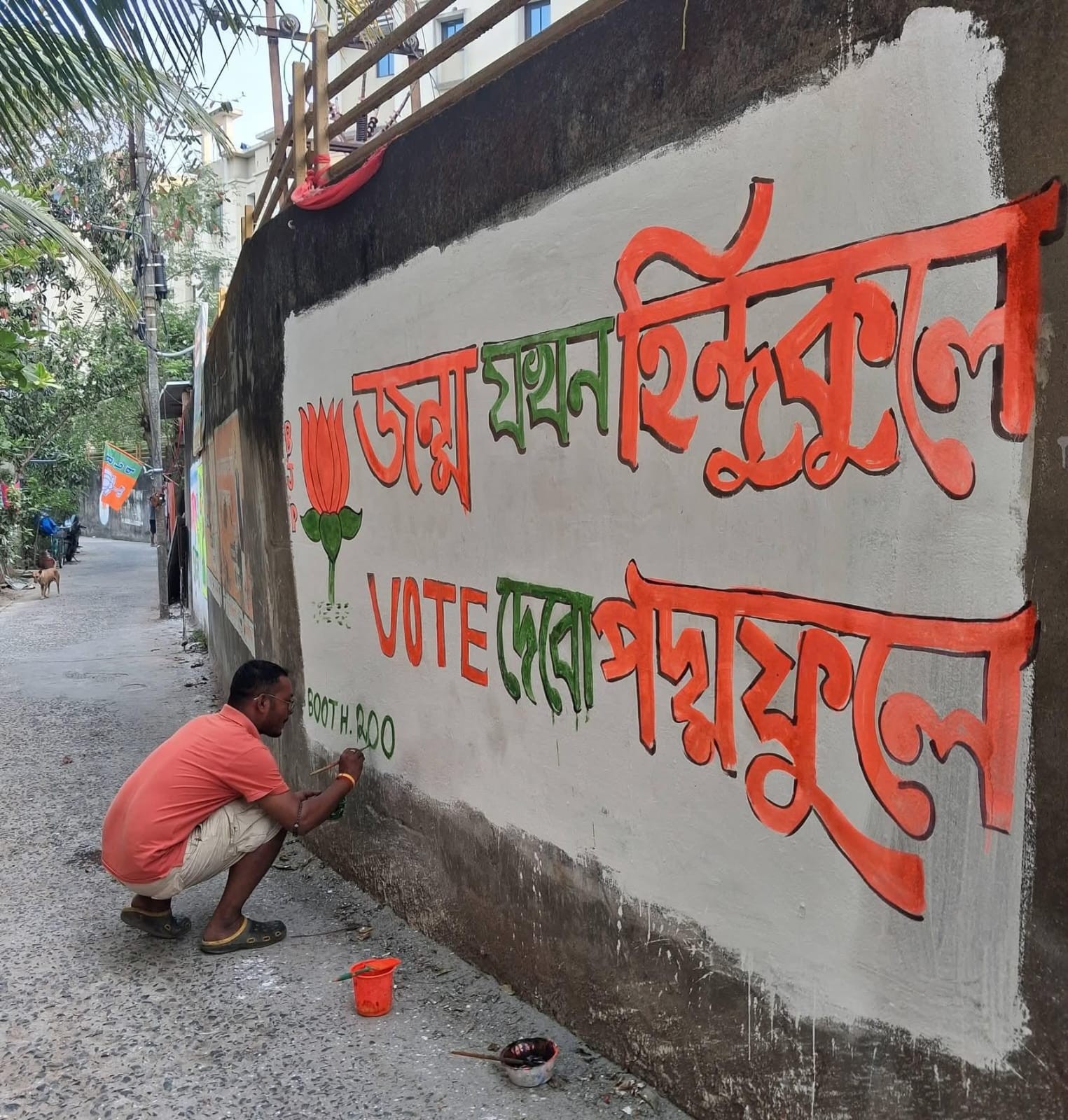
The writing on the wall: election posters; Photos by the author
The party has promised pucca houses for every family under “Nischit Abasan,” access to piped drinking water through “Ghore Ghore Nal”, and a INR 30,000 crore agriculture budget to support landless farmers.
Additional commitments include upgrading industrial infrastructure to make West Bengal a trade gateway for eastern India, holistic development of government schools, and highlighting the state’s growth in the cement, leather, and MSME sectors, which currently employ 1.5 crore people.
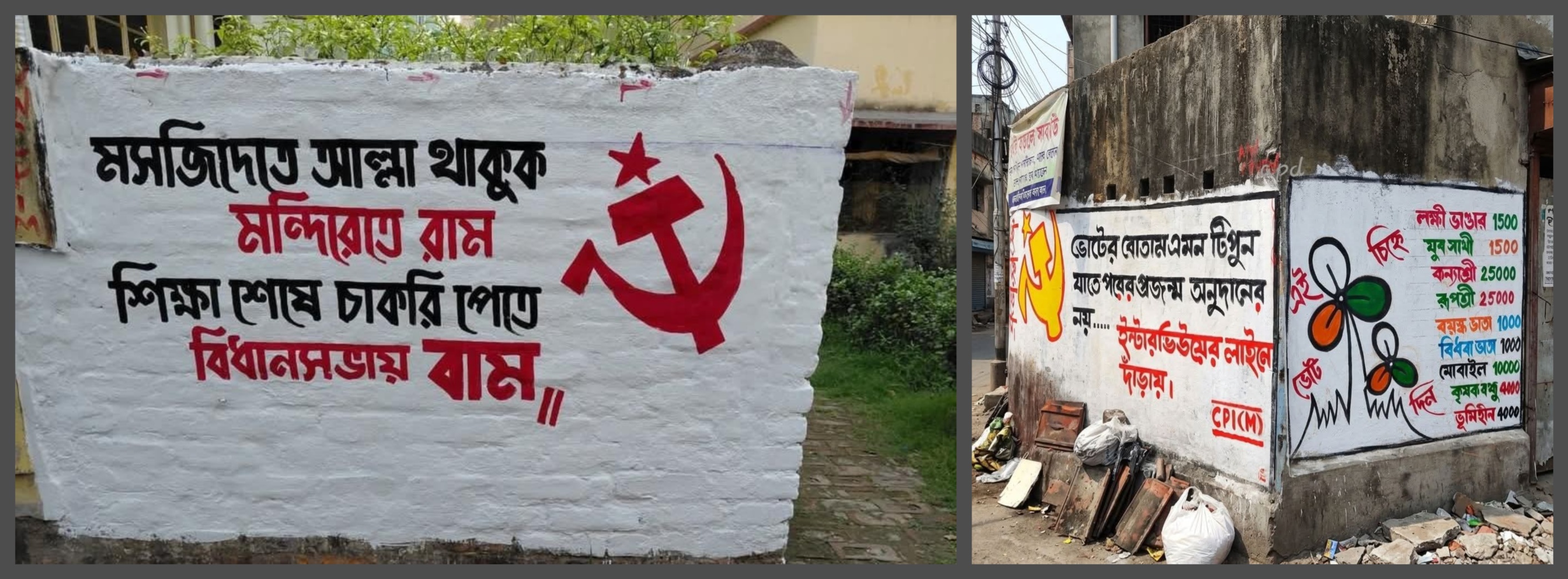
The Left Front, led by the Communist Party of India (Marxist) or the CPM, released its manifesto with the tagline ‘No Mandir-Masjid, Bengal needs Employment,’ positioning itself as a left, democratic, and secular alternative to the BJP and TMC.
Promising to prioritise livelihoods, the Left Front has promised one permanent job per family, at least two employment calls for every registered unemployed youth, a 100-day urban employment guarantee scheme, and extension of rural guaranteed work to 200 days.
It has also pledged to fill all vacant government posts within five years through transparent annual recruitments via the Public Service Commission, School Service Commission, and College Service Commission. On the industrial front, the manifesto emphasised the development of heavy and medium-scale industries, as well as the establishment of new software and hardware parks.
In the social sector, it proposes to provide free electricity up to 100 units and a 50 per cent subsidy for consumption up to 200 units. Additionally, it announced the creation of an ‘Abhoya Bahini,’ a women’s safety force under the state police.
The Left Front has voiced demands for justice in the RG Kar case and the killing of nine-year-old Tamanna in a bomb blast during TMC victory celebrations in Kaliaganj.
A war cry and intense campaign
The West Bengal election campaign reflected the intense political rivalry and ideological divide, especially between the BJP and the TMC. The BJP’s posters used a two-part strategy: appealing to religious identity and criticising the state’s industrial decline and welfare politics.
One controversial slogan, “Jonmo jokhon Hindu kule, Vote debo Poddo phule” (Born in a Hindu family, I will vote for the Lotus), directly calls for Hindu unity. It is often shown with “Banchte Chai, BJP Tai” (We want to live, so we want BJP), framing the election as a fight for survival. The posters also refer to Bengal’s political history, asking voters to give the BJP five years after 35 years of the Left and 15 years of what they call the “thieves” of the TMC, while suggesting that “Ram” will protect the state.
A significant portion of the BJP’s visual campaign targeted the youth and the lack of industrial employment. Using biting sarcasm, the posters mock the Chief Minister's suggestion of selling fried snacks as an alternative to formal jobs: “Yuvokra chailo kaaj, Didi bollo chop bhaaj” (The youth asked for work, Didi told them to fry chops).
By contrasting the promise of turning Kolkata into “London” with the reality of a lack of industry ("Shilpa"), the BJP positions itself as the party of development. Their messaging directly attacks the TMC’s flagship welfare schemes, alleging that while the government gave “Bhandar” (Lakshmir Bhandar), it took away the honour of women and the jobs of the youth.
To compete with the TMC’s popular social security schemes, the BJP has announced its own scheme, “Annapurna Bhandar,” which aims to offer even larger cash transfers.
The campaign of the Trinamool Congress, for its part, stressed on the Bengali identity and the protection of welfare benefits. Its principal slogan, “Jatoi koro hamla, abar jitbe Bangla” (No matter how much you attack, Bengal will win again), works as a defensive political symbol. The TMC portrayed investigations by central agencies as attacks on Bengal’s dignity rather than as purely legal action.
Another slogan, “Unnoyon Ghore Ghore, Ghorer Meye Bhabanipure” (Development in every home, the daughter of the house is in Bhabanipur), embedded Banerjee’s image as a local leader. By calling her the “daughter of the house,” the party sought to connect politics to the everyday lives of ordinary families.
The TMC also leaned heavily on its welfare schemes. One of its best-known slogans, “Lakshmir Bhandar dicche daak, birodhira nipat jaak” (Lakshmir Bhandar is calling, let the opposition perish), uses its popular cash-transfer program as a political instrument. The message is unmistakable: voting against the TMC may put women’s financial support at risk.
The party also used strong regional slogans such as “Janogoner gorjon, Bangla birodhider bisorjon” (The roar of the people, the immersion of anti-Bengal forces), portraying opponents as enemies of Bengal. The familiar “Khela Hobe, Abar Hobe” (The game is on, once more) has also returned, signalling confidence and reminding supporters of the 2021 victory.
The Left Front, for its part, presented itself as the secular and democratic choice in the 2026 Assembly elections. Its campaign focused on economic struggles and governance failures. The main slogan, “Mondir Noy, Masjid Noy, Banglay Ebar Chakri Chai” (Neither temple nor mosque, this time Bengal wants jobs), rejected communal politics, alleged to be promoted by the BJP and the TMC.
Another slogan, “Nei Kono Kaj, Nei Shilpo, Pishi-Bhaipo Dichhe Golpo” (No work, no industry; Aunt and Nephew are only telling stories), criticised the TMC leadership for talking rather than delivering real industrial growth. By using “Pishi-Bhaipo,” the Left aims to tap into frustration with dynastic politics and government inaction.
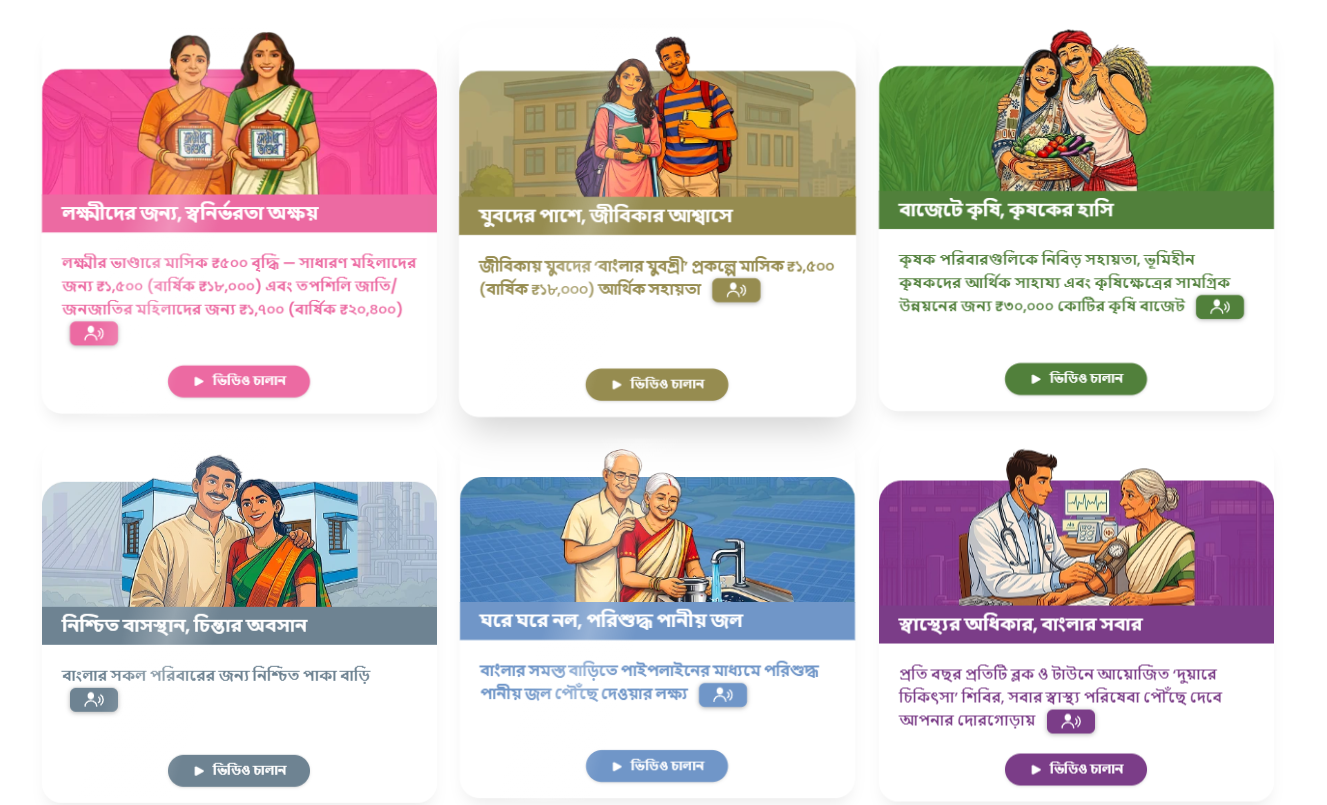
The manifesto page of the Trinamool Congress
To respond to the legal and ethical controversies surrounding the state government, the Left has adopted the slogan “Chor Dharo, Jel Bharo, Natun Bangla Gore Tolo” (Catch the thieves, fill the jails, build a new Bengal). It clearly points to the recruitment and ration scams and promises a broader political and administrative cleanup as the basis for rebuilding the state.
At the same time, the Left is trying to offer a more dignified alternative to the TMC’s welfare model through the slogan “Bhatar line-e noy, amra interview-er line-e darate chai” (Not in the dole line, we want to stand in the interview line). This message is aimed mainly at young people and the middle class, arguing that secure employment offers more dignity and long-term stability than monthly cash support.
Finally, with the slogan “Pahar hok ba samotol, bikalpo shudhu laal nishan” (Whether hills or plains, the only alternative is the Red Flag), the Left Front underlines its wider alliance with the ISF and CPI(ML) Liberation. The idea represents itself as a united Third Front that speaks for different regions and social groups across West Bengal.
The fierce electoral contest in West Bengal’s 2026, reflecting through the aggressive campaigning and cultural symbolism, saw the leading parties utilising lively campaign songs to draw voters.
The TMC’s official campaign song "Je Lorche Sobar Daake" portrays Chief Minister Mamata Banerjee as the sole guardian of the state’s interests, while the viral remix “Asbi Naki," created by youth leader Debangshu Bhattacharya, mocks the opposition.
The BJP countered with songs about “Parivartan” (Change) by blending folk with modern rap, targeting rural and urban young voters alike, framing the election as a struggle to “save" Bengal’s essence. The party’s main track, “Cholo Paltai Bangla,” advocates a leadership overhaul, featuring energetic beats and lyrics that address corruption and the SIR issue.
The Left Front made a dramatic impact with songs about unemployment and everyday struggles. Their viral song, “Neteo Achhi, Heteo Achhi” (We are on the internet, and we are on the streets), answers critics who say the Left is only active on social media.
Young leaders like Srijan Bhattacharya and Aratrika performed the song, using humour to highlight job losses and failures by both state and central governments. These songs have made the 2026 campaign a musical contest, with catchy tunes spreading faster than traditional manifestos.
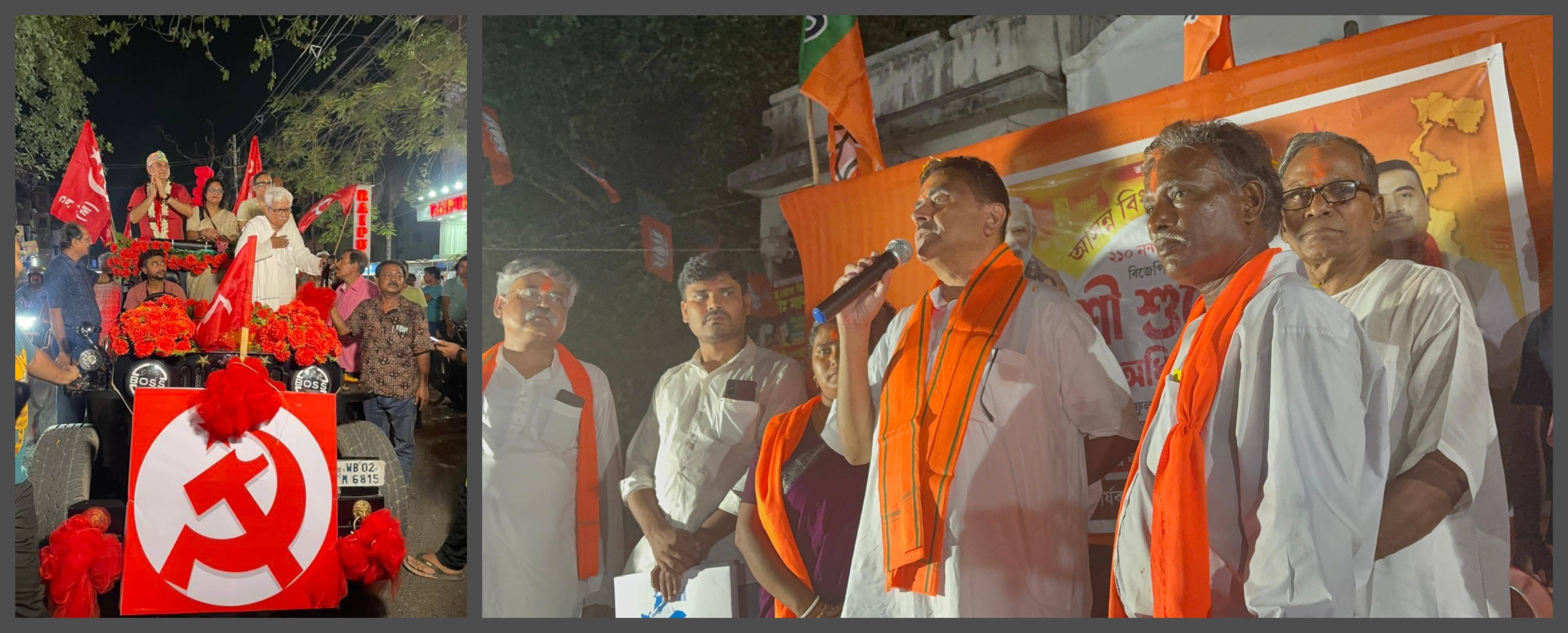
Left Front leader Biman Bose (left) and BJP leader Suvendu Adhikari (right) leading election rallies
The electoral scene: resurgence of the Left?
The BJP's main strength in the 2026 election lies in its ability to turn the narrow defeats of 2021 into victories by making gains out of the SIR-led revisions. In constituencies where the margins were very slim, the large-scale deletion of voters, described by the Centre as a process of “purification” but seen by the state government as disenfranchisement, could alter the electoral arithmetic in the BJP’s favour.
At the same time, the party has managed to consolidate its support base through religious polarisation and a growing “civil society” network.
Where the BJP seems to falter is the absence of a clear, homegrown chief ministerial face who can match Mamata Banerjee politically. Even with figures like Swapan Dasgupta contesting from Rashbehari, the BJP still appears heavily dependent on the Rashtriya Swayamsevak Sangh (RSS) for grassroots mobilisation, suggesting an enduring organisational gap.
There is also a real possibility that voters angered by the pain and uncertainty caused by the SIR, or disturbed by so-called “anti-Bengali” incidents in BJP-ruled states, may drift back toward the TMC or other parties. The Matua vote, too, remains uncertain, and that could become another obstacle to the BJP’s expansion. More importantly, in the Bengali mindset, the BJP has not become a Party for the Bengali.
The TMC, on the other hand, goes into this election with a formidable organisation and a loyal rural support base that continues to see Mamata Banerjee as its principal protector and provider. Banerjee has also effectively returned to her familiar style of street politics, turning the SIR into a larger political battle against central interference.
Still, the TMC is facing one of its most difficult elections in recent years. Corruption charges, the fallout from the Abhaya case, and deep frustration among young people over job prospects have all contributed to a visible anti-incumbency mood.
More importantly, the party’s long-held dominance over the Muslim vote no longer looks secure. The rise of independent Muslim voices such as Noushad Siddiqui (ISF) and Humayun Kabir (AJUP), along with the renewed presence of the Left, could divide the minority vote in ways that may seriously hurt the TMC in key districts.
After years on the margins, the Left Front appears to be finding its footing again by shifting its focus from abstract ideological language to everyday concerns such as employment, corruption, and the agrarian crisis. That change has helped it reconnect with younger voters and regain some of its older social base, especially in districts like Murshidabad.
The Left is likely to improve its tally in a meaningful way, with possible gains in seats such as Uttarpara, Kaliyaganj, Domkal, Uttar Dum Dum, Khargram, Karandighi, Pandua, Jalangi, Hariharpara, and Ballygunge. Its resurgence is also being strengthened by what may be called the “Adhir factor”: Adhir Ranjan Chowdhury’s direct entry into the Assembly contest from Berhampore adds intensity to the race and turns it into a genuinely competitive four-cornered battle.
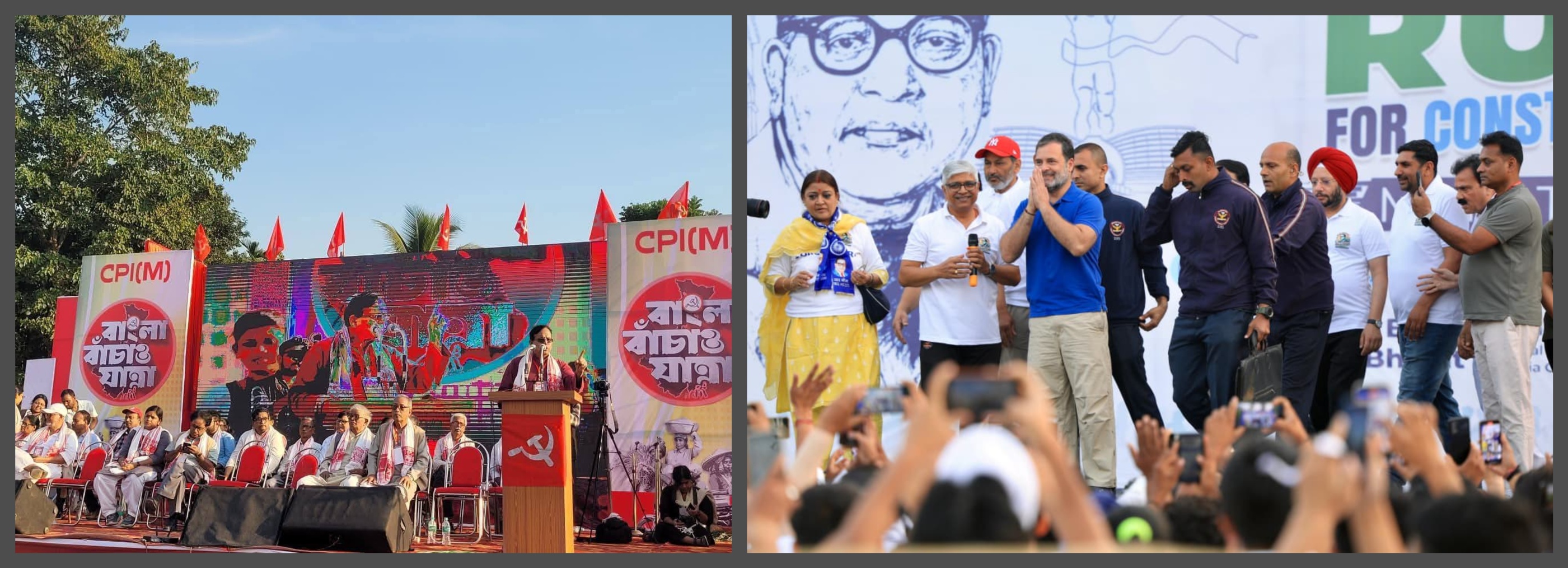
A CPM election meeting (left), and Rahul Gandhi (right) at a Congress campaign meeting
Even if Mamata Banerjee wins a fourth term as Chief Minister, her next spell in the Assembly could be the toughest of her political career. A more varied opposition, with leaders like Minakshi Mukherjee, Adhir Ranjan Chowdhury, and Noushad Siddiqui, may start to break the bipolar pattern that has shaped the assembly since 2021.
That could sharpen debates, put more pressure on government policy, and slow the easy passage of controversial bills. In that sense, greater negotiation and compromise may lead to a healthier, more accountable style of governance.
If the Left and Congress manage to win back a meaningful presence in the assembly, the TMC’s near-total control of the floor could give way to a far sharper and more layered opposition. Banerjee would then have to do more than just answer Suvendu Adhikari and the BJP’s aggressive attacks.
She could also face steady pressure from the Left on issues such as jobs and corruption, along with demands around identity and regional concerns raised by Humayun Kabir and the ISF.
Follow us on WhatsApp
Follow us on Facebook
Follow us on X @vudmedia
Follow us on Substack
