

The joint US-Israeli military assault on Iran, launched on February 28, 2026, happened amid active diplomatic negotiations over Iran’s nuclear programme. The spontaneous strikes, following weeks of US military mobilisation to the region, resulted in the targeted killing of Iran’s top leadership, including its Supreme Leader, as well as immense casualties, notably the killing of 165 school girls, besides extensive damage to civilian and economic infrastructure, which eventually triggered the Iranian retaliation across the West Asian region. Acting without a UN Security Council authorisation, or of the US Congress, the action led by the US President Donald Trump and Israeli PM Benjamin Netanyahu, invariably constitutes a ‘war of aggression’ violating Article 2(4) of the UN Charter, the Geneva Conventions, and multiple UN resolutions. In this comprehensive analysis of the legal dimensions of this conflict, Rejimon Kuttappan also lists the military operations, often spearheaded by UNSC members, that made a short shrift of international law. The lack of punitive actions against such recurring violations raises questions on the very concept of the ‘rules-based order.’
Home page image: The headquarters of Iran's Islamic Revolutionary Guards Corps in rubble; photo source - White House
Text page image: The body of a girl trapped under the debris at the Shajareh Tayyebeh school in Minab; photo source - Mehr News Agency
Banner image: An F-35 aircraft on the flight deck of an unnamed US aircraft carrier; photo source - US Department of War
On the night of February 28, 2026, two of the world’s most powerful military forces—the United States and Israel—launched a coordinated bombardment of Iran, a sovereign nation with which neither was at war.
Operation “Epic Fury,” as the Pentagon named it, and Israel’s “Roaring Lion” campaign targeted Tehran, Isfahan, Qom, Karaj, and Kermanshah, killing Iran’s Supreme Leader Ayatollah Ali Khamenei, its defence minister, its army chief of staff, and several commanders of the Islamic Revolutionary Guard Corps.
As of March 8, over 1,300 Iranian civilians are reported dead. Among them are more than 165 schoolgirls, aged seven to twelve, killed when a missile struck the Shajareh Tayyebeh girls’ elementary school in Minab, Hormozgan Province, on the very first day of the assault.

Funeral of the school children of Minab killed in the US-Israeli strike; photo source - Tasnim News Agency
This was not a response to an armed attack. It was not authorised by the United Nations Security Council (UNSC). It came just two days after the most intensive round of US-Iran nuclear negotiations in Geneva had concluded, with the Omani mediator publicly expressing confidence that a diplomatic breakthrough was imminent.
What it was—by every credible measure of international law—is an act of aggression, the most serious violation of the post-Second World War legal order that the founders of the United Nations sought to build.
Violation of the UN Charter: Articles 2(4) and 51
The bedrock of the modern international legal order is the prohibition on the use of force between states. Article 2(4) of the UN Charter states, in unequivocal terms, that all member states shall “refrain in their international relations from the threat or use of force against the territorial integrity or political independence of any state.”

This is not merely a guideline—it has crystallised as a jus cogens norm, a peremptory principle of international law from which no derogation is permitted.
The Charter provides only two exceptions to this prohibition. The first is authorisation by the UN Security Council under Chapter VII (Articles 39–42). The second is the inherent right of individual or collective self-defence under Article 51, which states: “Nothing in the present Charter shall impair the inherent right of individual or collective self-defence if an armed attack occurs against a Member of the United Nations.”
Neither exception applies to the February 28 strikes. The UNSC did not authorise any military action against Iran. The United States did not even request such authorisation. And no conclusive proof was provided of Iran attacking, about to attack, or planning to attack either the United States or Israel.
Even the more permissive doctrine of anticipatory self-defence—which some legal scholars argue allows a state to act against an imminent threat—cannot rescue the US-Israeli position. The Caroline Doctrine, the customary international law standard established in 1837, permits preemptive action only when the threat is “instant, overwhelming, and leaving no choice of means, and no moment for deliberation.”
A weeks-long military buildup, preceded by rounds of active diplomatic negotiations, is the antithesis of such urgency.
UN Secretary-General António Guterres condemned the strikes at an emergency session of the Security Council on February 28, describing them as “squandering” an opportunity for diplomacy. The UN Special Rapporteur on human rights and counterterrorism, Ben Saul, was more direct: “This is not lawful self-defence against an armed attack by Iran, and the UN Security Council has not authorised it. Preventive disarmament, counterterrorism and regime change constitute the international crime of aggression.”
The ‘Crime of Aggression’ under international law
The actions of the United States and Israel meet the textbook definition of aggression as established in UN General Assembly Resolution 3314 (XXIX), adopted on December 14, 1974. This resolution defines aggression as “the use of armed force by a State against the sovereignty, territorial integrity or political independence of another State, or in any other manner inconsistent with the Charter of the United Nations.”
Article 3 of Resolution 3314 specifies that the following acts qualify as aggression: (a) the invasion or attack by the armed forces of a State of the territory of another State; (b) bombardment by the armed forces of a State against the territory of another State or the use of any weapons by a State against the territory of another State. Both clauses describe precisely what occurred on February 28.
Article 2 further states that the first use of force in contravention of the Charter constitutes prima facie evidence of aggression. Article 5 declares: “A war of aggression is a crime against international peace. Aggression gives rise to international responsibility.” And critically: “No consideration of whatever nature, whether political, economic, military or otherwise, may serve as a justification for aggression.”
The ‘crime of aggression’ was codified in the Rome Statute of the International Criminal Court through the Kampala Amendments of 2010 (Article 8 bis). It defines the crime as “the planning, preparation, initiation or execution, by a person in a position effectively to exercise control over or to direct the political or military action of a State, of an act of aggression which, by its character, gravity and scale, constitutes a manifest violation of the Charter of the United Nations.”
While the ICC’s jurisdiction over aggression does not extend to the United States, Israel, or Iran—none being parties to the Rome Statute—the legal principle stands as a universal indictment.
 The Osirak reactor, before (left) and after (right) the Israeli attack; photo source - Wikimedia Commons
There is a historical precedent worth recalling. In 1981, when Israel conducted a preemptive strike on Iraq’s Osirak nuclear reactor, the UN Security Council unanimously adopted Resolution 487, condemning the attack and reaffirming Iraq’s right to develop nuclear energy for peaceful purposes.
The parallels with 2026 are unmistakable, except that the scale of destruction this time is exponentially greater.
Violations of international humanitarian law: The Geneva Conventions
Even if one were to accept—for the sake of argument—that the decision to go to war (jus ad bellum) could somehow be justified, the manner in which this war is being fought (jus in bello) constitutes a catalogue of violations of the Geneva Conventions of 1949 and their Additional Protocols.
The four cardinal principles of international humanitarian law are distinction, proportionality, military necessity, and precaution. The strike on the Shajareh Tayyebeh girls’ school in Minab, which killed at least 165 children on the first day of the assault, represents a potential violation of all four. Schools are civilian objects under Article 52 of Additional Protocol I. Children are expressly protected under the Fourth Geneva Convention and the Convention on the Rights of the Child.
The Iranian Red Crescent Society has reported that over 6,668 civilian units were targeted by US-Israeli strikes, including hospitals. Reports confirm strikes on Tehran’s Gandhi Hospital and Khatam al-Anbia Hospital.
The targeting of medical facilities is a grave breach of the Geneva Conventions—specifically Article 18 of the Fourth Geneva Convention, which states that “civilian hospitals organised to give care to the wounded and sick, the infirm and maternity cases, may in no circumstances be the object of attack.”
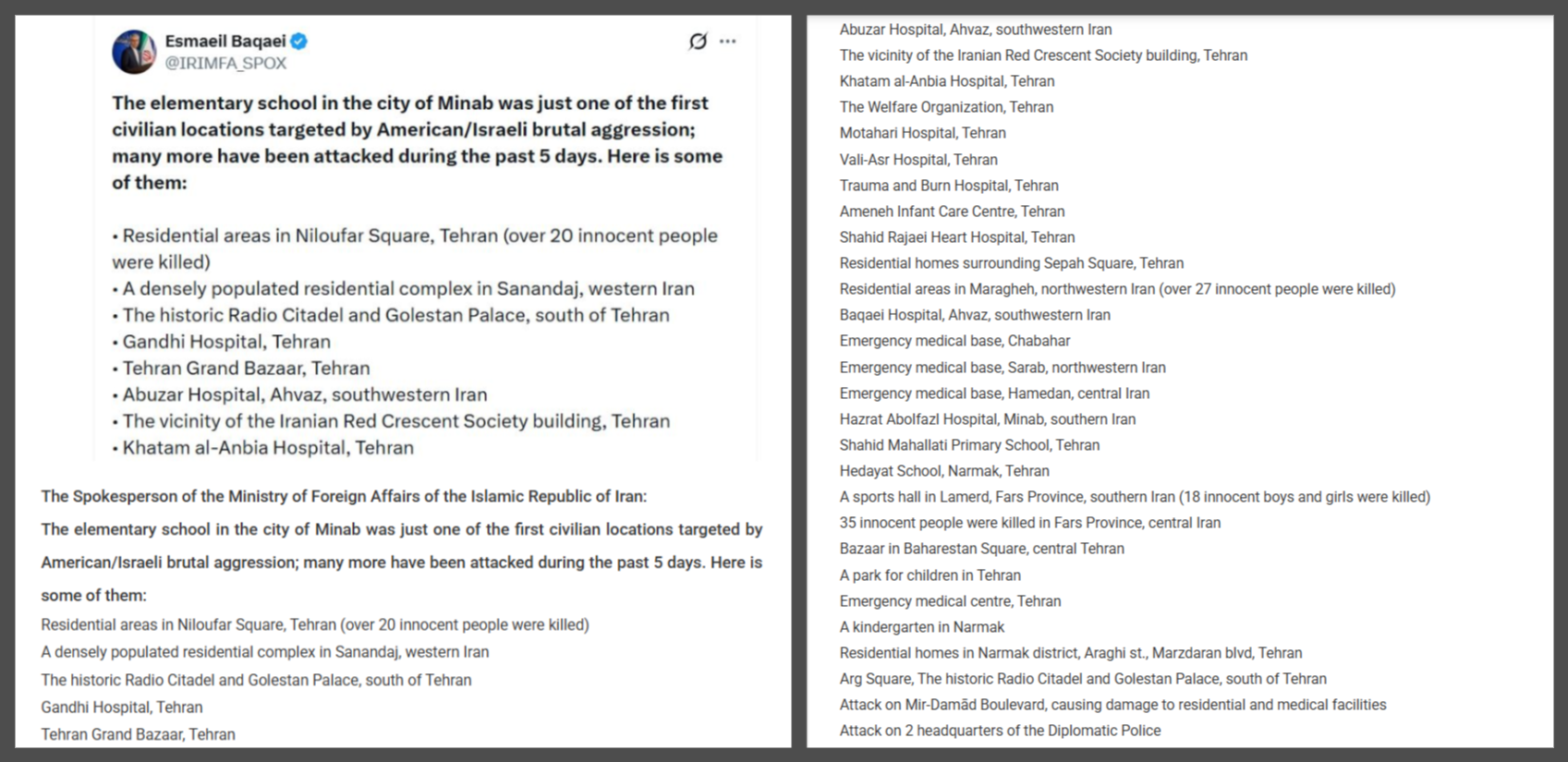
List of locations hit by the US-Israeli strikes as released by the Iranian government
Targeting of heads of state: The New York Convention
The deliberate killing of Ayatollah Ali Khamenei, Iran’s supreme leader, in the opening salvo of the assault raises an additional dimension of illegality. The 1973 Convention on the Prevention and Punishment of Crimes Against Internationally Protected Persons, including Diplomatic Agents (commonly known as the New York Convention), extends legal protection to heads of state, heads of government, and foreign ministers.
The targeted assassination of a sitting head of state contravenes this convention and long-standing international prohibitions against political assassinations.
Even under United States domestic law, successive executive orders—beginning with Executive Order 11905 signed by President Gerald Ford in 1976 and reaffirmed by Executive Order 12333 under President Ronald Reagan—explicitly ban political assassinations.
While past administrations have found ways to navigate these prohibitions, they remain a clear legal benchmark.
The deliberate targeting of Khamenei, Iran’s defence minister, and its army chief of staff goes beyond military targeting into the realm of decapitation strikes designed to achieve regime change—an objective that President Trump has openly acknowledged.

A photo of Ayatollah Khamenei at the Iranian embassy in Baku (left), and his home destroyed in the US-Israeli strike (right)
Bad faith in diplomacy
Perhaps the most morally damning aspect of these strikes is their timing. The bombardment commenced just two days after the most intensive round of US-Iran negotiations concluded. Oman’s Foreign Minister had stated publicly that he was “confident” a peace deal was “within reach” and that Iran had agreed to “never, ever have a nuclear material that will create a bomb.”
Article 2(2) of the UN Charter obliges member states to “fulfil in good faith the obligations assumed by them in accordance with the present Charter.” Launching military strikes during active negotiations makes a mockery of this principle.
The crisis itself is a consequence of the United States’ own actions. It was the first Trump administration that withdrew from the Joint Comprehensive Plan of Action (JCPOA) in 2018—the multilateral nuclear agreement that had placed verifiable constraints on Iran’s nuclear programme.
Iran, at that time, was in full compliance with the deal, as confirmed by the International Atomic Energy Agency (IAEA). The unilateral withdrawal set the stage for every escalation that followed: Iran’s incremental resumption of enrichment, the collapse of diplomatic trust, and ultimately this war.
Furthermore, both the 2025 US intelligence community assessment and the IAEA’s own reports concluded that Iran was not building a nuclear weapon. The IAEA Director General stated that there was no proof that Iran was constructing an atomic bomb.
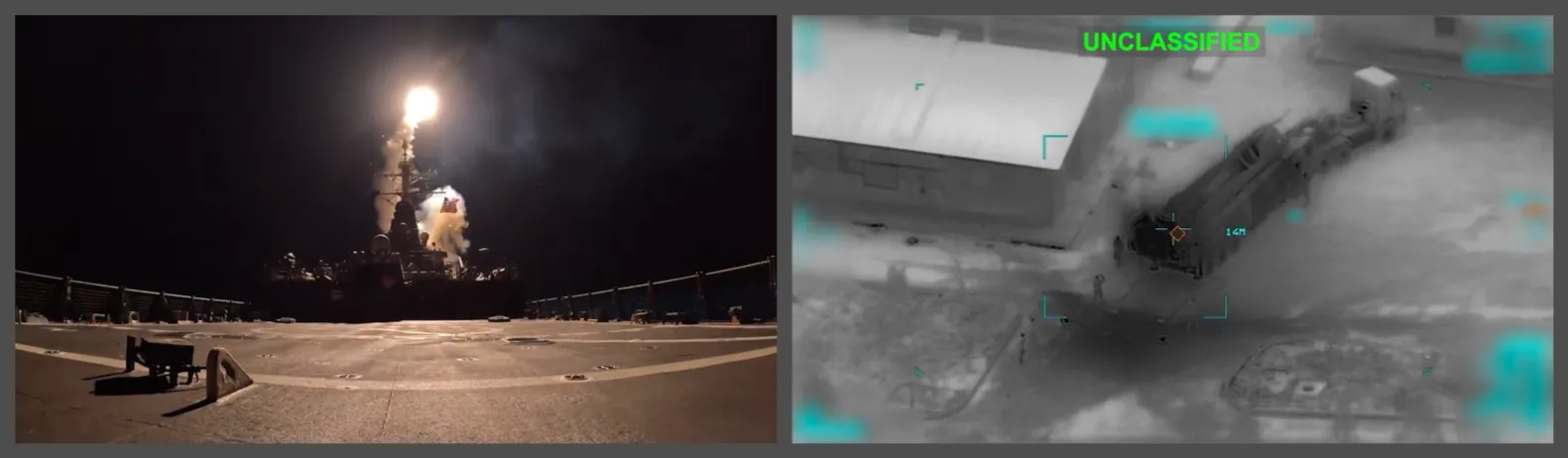 A Tomahawk missile launched from a US Navy destroyer (left), and an image of a mobile missile launcher of Iran destroyed in a strike (right)
Iran’s enrichment to 60 per cent purity, while alarming, was consistent with civilian purposes and not weapons-grade. The stated rationale for the strikes—preventing Iran from acquiring nuclear weapons—does not meet the legal threshold for the use of force.
A hypothetical future capability is not an “armed attack” under Article 51.
Regime change as the objective
President Trump told reporters that the goal was to bring about “freedom” for the Iranian people and stated his desire to be “involved in selecting the next leader of Iran.” Prime Minister Netanyahu declared the aim was to “remove the existential threat posed by the terrorist regime in Iran.”
These statements explicitly confirm what the legal analysis reveals: this is a war of regime change.
Forcible regime change violates the foundational principles of state sovereignty and non-intervention under the UN Charter. UN General Assembly Resolution 2625 (XXV) of 1970—the Declaration on Principles of International Law Concerning Friendly Relations and Co-operation Among States—declares that “No State or group of States has the right to intervene, directly or indirectly, for any reason whatever, in the internal or external affairs of any other State.”
It further states: “Every State has an inalienable right to choose its political, economic, social and cultural systems, without interference in any form by another State.”
The historical record of forced regime change—from Iraq in 2003 to Libya in 2011—offers a grim preview of what awaits Iran.
Violations of US domestic law
The illegality of this war extends to the very foundations of American constitutional law itself. Article I, Section 8 of the US Constitution grants the US Congress—not the President—the sole authority to declare war.
The War Powers Resolution of 1973 permits the President to commit forces without congressional authorisation only in three circumstances: pursuant to a formal declaration of war; pursuant to specific statutory authorisation; or in response to a national emergency created by an attack on the United States, its territories, or its armed forces.

None of these conditions was met on February 28, 2026.
Pentagon briefers reportedly acknowledged to congressional staff on March 1 that Iran was not planning to strike US forces or bases unless Israel attacked first—directly undermining the White House’s claim of an imminent threat.
The pattern of impunity
The US-Israeli assault on Iran does not occur in a vacuum. It is the latest in a decades-long pattern in which powerful states have violated the UN Charter, bypassed the Security Council, and waged wars of aggression with near-total impunity.
The legal architecture constructed after 1945 to prevent the recurrence of aggressive war has been breached so often by so many of the architects that the breach itself has become a defining feature of the system.
To understand why the strikes on Iran matter, it is necessary to confront the full record.
NATO - Yugoslavia, 1999: The seventy-eight-day NATO bombing campaign against the Federal Republic of Yugoslavia, launched on March 24, 1999, was conducted without Security Council authorisation. A draft resolution introduced by Russia, India, and Belarus described the bombing as “a flagrant violation of the United Nations Charter, in particular Articles 2(4), 24 and 53.”
The resolution was defeated, but the legal objection remained unanswered: no Chapter VII authorisation was sought or obtained, and no armed attack against a NATO member state had occurred. NATO bombed the Serbian state television headquarters in Belgrade, killing sixteen civilians.
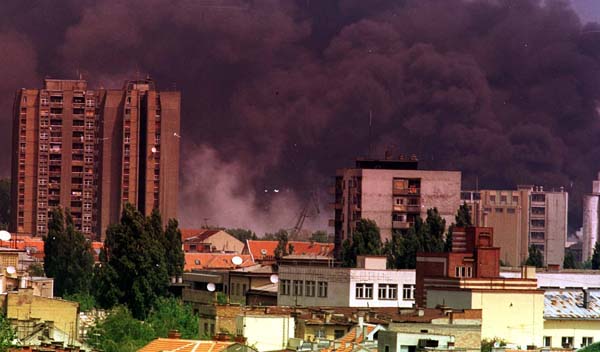 The Yugoslav city of Novi Sad on fire, following a NATO bombing; photo credit - Darko Dozet
Yugoslavia filed proceedings against ten NATO members before the International Court of Justice.
The Independent International Commission on Kosovo, established under UN auspices, famously described the intervention as “illegal but legitimate”—a formulation that, whatever its moral force, conceded the central legal point. Russian President Boris Yeltsin said at the time that NATO had “trampled upon the foundations of international law and the United Nations Charter.”
The United States - Iraq, 2003: The most direct precedent for the Iran strikes is the 2003 US-led invasion of Iraq—a war launched on the basis of intelligence claiming Iraq possessed weapons of mass destruction, intelligence that proved to be catastrophically wrong. The invasion was carried out without explicit Security Council authorisation.
An independent Dutch commission of inquiry, headed by former Netherlands Supreme Court president Willibrord Davids, concluded that the invasion violated international law and that UN Resolution 1441 “cannot reasonably be interpreted as authorising individual member states to use military force.”

American forces in their Humvees cruise through an Iraqi desert (left), and a statue of Saddam Hussein being pulled down (right); photo source - Wikimedia Commons
Former UN Secretary-General Kofi Annan was unequivocal, calling the invasion “not in conformity with the UN Charter” and, pressed further, “illegal.” Elizabeth Wilmshurst, the UK Foreign Office’s Deputy Legal Adviser, resigned over the war, describing it in her resignation letter as “a crime of aggression.”
The war killed hundreds of thousands of Iraqi civilians, destabilised the entire Middle East, and produced the conditions from which the Islamic State emerged. No head of state or government official was held legally accountable.
NATO - Libya, 2011: UN Security Council Resolution 1973 authorised a no-fly zone over Libya and “all necessary measures” to protect civilians. NATO interpreted this mandate as authorisation for a seven-month air campaign that systematically destroyed the Libyan government’s military capacity, directly assisted rebel forces, and culminated in the overthrow and extrajudicial killing of Muammar Gaddafi.
The operation far exceeded what the resolution authorised. Russia and China, which had abstained rather than veto Resolution 1973, accused NATO of distorting a humanitarian mandate into a licence for regime change.
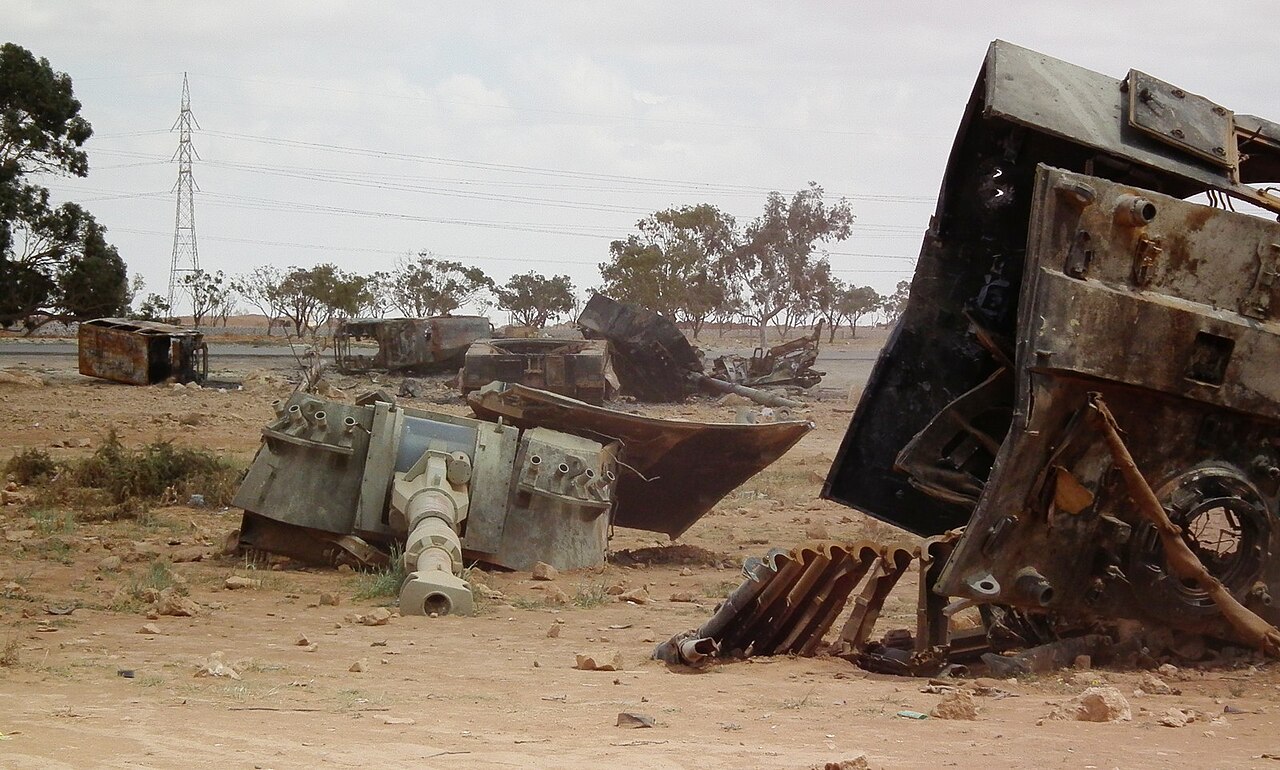 Destroyed fighting equipment of the Libyan Army lay in ruins after a bombing by the coalition forces; photo credit - Bernd Brincken
The experience poisoned the concept of “Responsibility to Protect” and ensured that Russia and China would subsequently veto humanitarian interventions—most consequentially in Syria, where hundreds of thousands died while the Security Council remained paralysed.
Libya itself descended into a failed state, a civil war, and a hub for human trafficking that persists to this day.
Saudi Arabia - Yemen, 2015–present: The Saudi-led coalition’s military intervention in Yemen, backed by US intelligence, logistics, and weapons sales, has produced what the United Nations has called the world’s worst humanitarian catastrophe. Coalition airstrikes have struck hospitals, schools, weddings, funerals, and school buses.
A UN Panel of Experts documented systematic violations of international humanitarian law, including indiscriminate attacks on civilian objects. The October 2016 airstrike on a funeral hall in Sanaa killed over 140 mourners. An August 2018 strike on a school bus killed forty children.
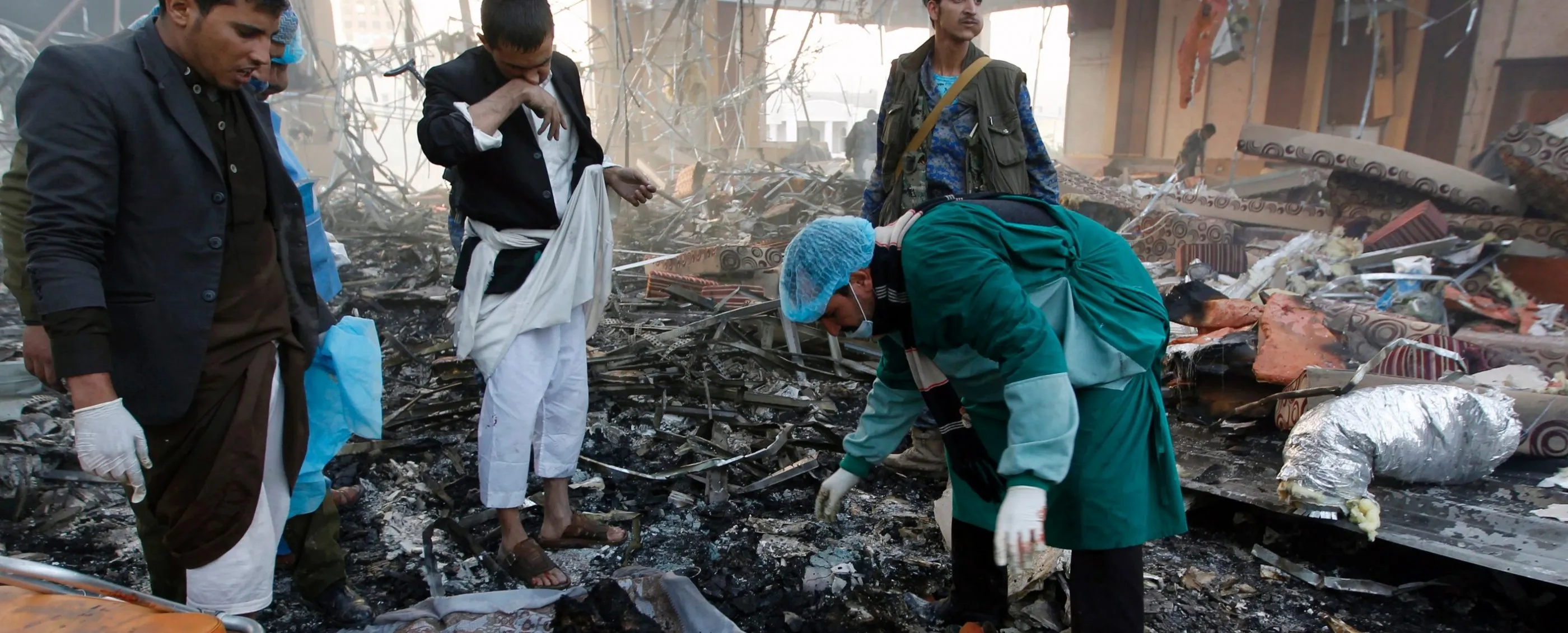
The severely damaged Kitaf Hospital in Northwest Yemen, following a Saudi-Emirati joint strike; photo source - Physicians for Human Rights
Despite repeated findings by UN investigative bodies, no meaningful accountability has followed. The United States and the United Kingdom, as principal arms suppliers to the Saudi coalition, bear direct legal responsibility under the Arms Trade Treaty for the foreseeable use of their weapons in violations of international humanitarian law.
Russia - Ukraine, 2022: Russia’s full-scale invasion of Ukraine on February 24, 2022, was among the most flagrant violations of Article 2(4) of the UN Charter by a permanent Security Council member since the founding of the United Nations.
Russia advanced legally incoherent justifications—“denazification,” the protection of Russian speakers in Donbas, and a distorted invocation of collective self-defence—none of which met any recognised threshold under international law.
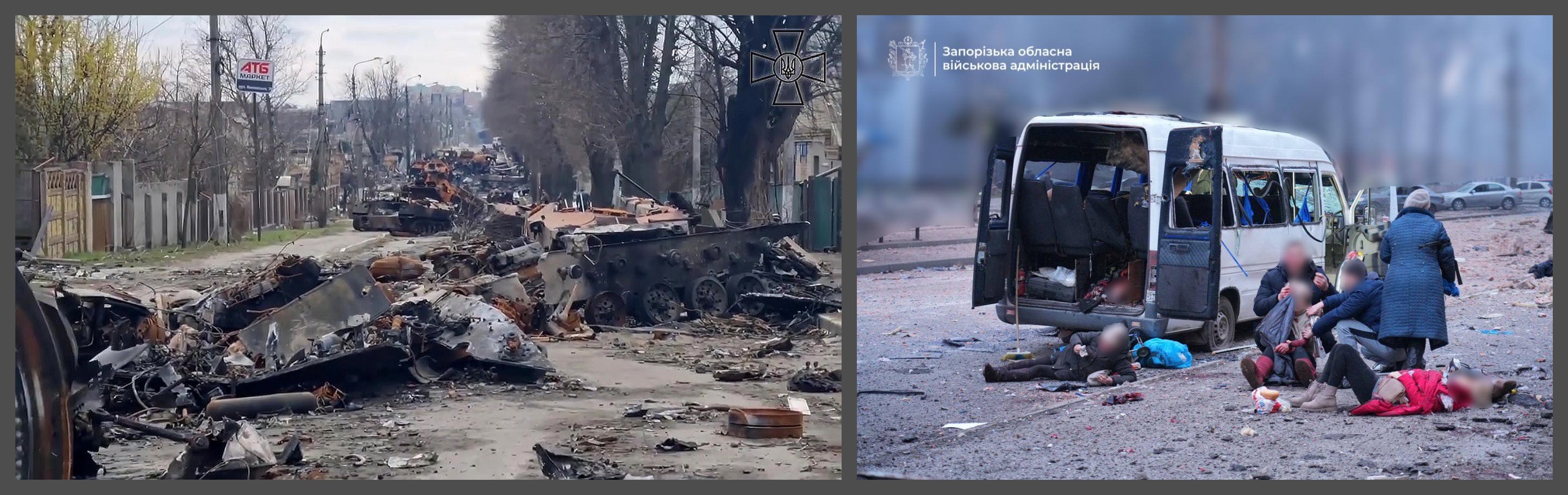
Destroyed military vehicles in a street in Bucha, Ukraine (left), and destruction in Zaporizhzhia after a Russian attack (right); photo source - Wikimedia Commons
The UN General Assembly voted 141–5 to condemn the invasion as a violation of the Charter. The International Court of Justice ordered Russia to immediately suspend military operations. Russia ignored both. UN Secretary-General António Guterres labelled Russia’s claims of peacekeeping “a perversion of the concept.”
The war has killed tens of thousands of civilians, displaced millions, and involved systematic attacks on civilian infrastructure, including hospitals, schools, and energy systems—acts documented by the UN Human Rights Monitoring Mission as potential war crimes.
Israel - Gaza, 2023–present: Israel’s military campaign in Gaza following the Hamas attacks of October 7, 2023, has been the subject of multiple findings by international legal bodies.
The International Court of Justice, in its January 2024 provisional measures order, in the case brought by South Africa under the Genocide Convention, found it plausible that Israel’s actions could constitute genocide and ordered Israel to take measures to prevent genocidal acts.
The ICJ, subsequently in July 2024, issued an advisory opinion declaring Israel’s prolonged occupation of Palestinian territories unlawful. The International Criminal Court’s Prosecutor sought arrest warrants for Israeli leaders.
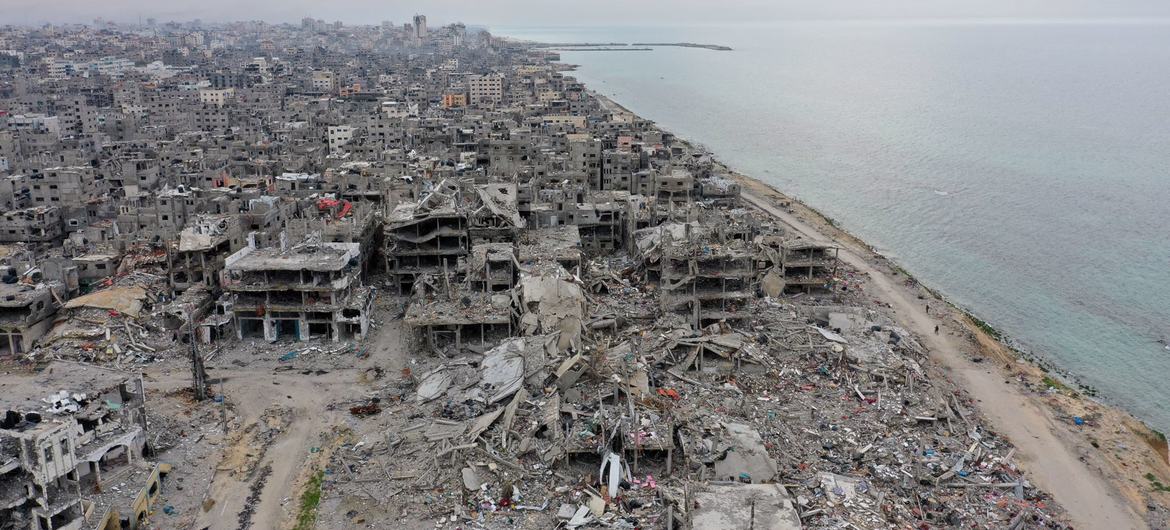 The extent of destruction in Northern Gaza; photo source - UNRWA
UN human rights experts described the campaign as involving the systematic destruction of civilian infrastructure, the use of starvation as a weapon, and the targeting of hospitals and schools sheltering displaced persons. As of early 2026, various estimates indicate the death toll in Gaza since October 2023 as between 67,000 and 78,000, the majority being women and children.
The pattern is unmistakable. From Belgrade to Baghdad, from Sanaa to Kyiv, from Gaza to Tehran, the post-1945 prohibition on the use of force has been violated not by the so-called “rogue states” at the margins of the international system but by its most powerful members—including, in several cases, the very permanent members of the Security Council entrusted with enforcing that prohibition.
In each case, the legal justifications offered have been found wanting by independent legal authorities: the Dutch Commission on Iraq, the Independent Kosovo Commission, the ICJ on Ukraine, UN Panels of Experts on Yemen, and the ICJ on Gaza. In each case, the human cost has been borne overwhelmingly by civilians.
And in each case, the perpetrators have faced no legal consequences, because the architecture of international justice—the Security Council veto, the ICC’s jurisdictional limits, the absence of enforcement mechanisms—was designed, whether by accident or intent, to exempt the powerful from the rules they impose on the weak.
The strikes on Iran are not an aberration. They are the logical culmination of a system in which impunity has become the operating principle.
The collapse of the rules-based order
What is unfolding in Iran is not merely a military operation. It is the most significant assault on the post-1945 rules-based international order since the invasion of Iraq in 2003—and in many respects, it surpasses it.
The strikes were launched during active negotiations, in the absence of any armed attack or imminent threat, without Security Council authorisation, with the explicit aim of regime change, and with devastating consequences for civilians, including the mass killing of schoolchildren.
The legal violations can be enumerated with precision:
Article 2(4) of the UN Charter (prohibition on the use of force); Article 51 (self-defence only after an armed attack); Article 2(2) (good faith obligations); UN General Assembly Resolution 3314 (definition of aggression); UN General Assembly Resolution 2625 (non-intervention and sovereign equality); the Geneva Conventions and Additional Protocol I (protection of civilians, schools, hospitals); UN Security Council Resolution 2601 (protection of education in armed conflict); UN Security Council Resolution 487 (precedent condemning preemptive strikes on nuclear facilities); the Convention on the Rights of the Child; the Rome Statute’s Article 8 bis (crime of aggression); the New York Convention (protection of heads of state); and the Caroline Doctrine (standard for anticipatory self-defence).
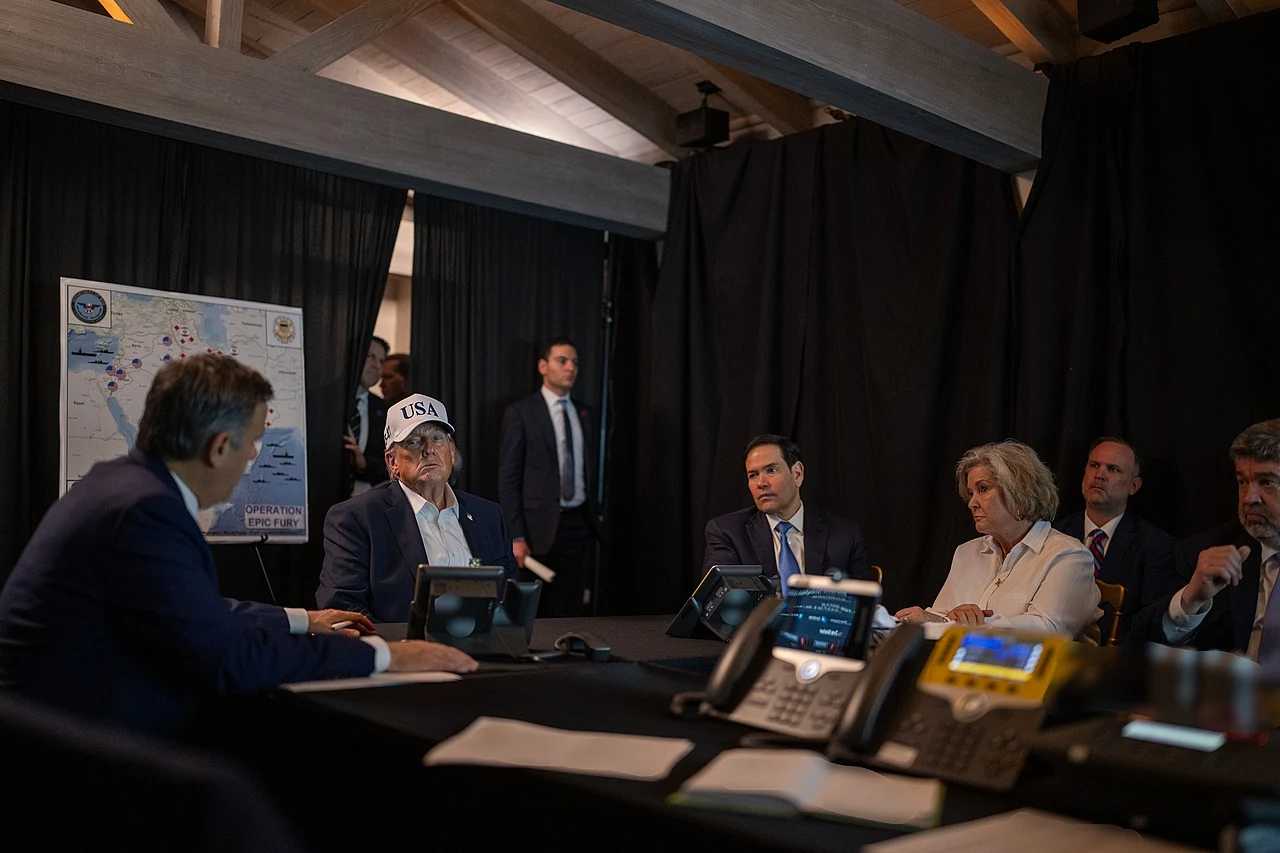 President Trump and his cabinet colleagues oversee Operation Epic Fury from his Mar-a-Lago resort
For decades, the United States and its allies have invoked the “rules-based international order” as the foundation of global governance. They have sanctioned nations, imposed embargoes, and justified interventions based on adherence to this order.
But when the most powerful nations on earth choose to disregard these rules whenever they become inconvenient, the order they claim to defend is revealed for what it has become: a system of selective enforcement, where international law applies to the weak but not to the powerful.
The rubble of a girls’ school in Minab. The silence of the Security Council. The bombs falling on a nation that was, hours earlier, negotiating in good faith. These are the images that will define this moment in history.
And they will be remembered not only as a catastrophe for Iran, but as the day the architects of the international legal order chose to burn it down.
(Views expressed in this report are the author's own.)
Follow us on WhatsApp
Follow us on Facebook
Follow us on X @vudmedia
Follow us on Substack

.jpg)

