
Hindi cinema has had many cliched identities: superstars, the Khans, filmi families, melodrama, big-budget blockbusters, and above all, fair-skinned, chocolate heroes. Then came Nana Patekar (and later, a few more in the pantheon), who did not fit any of these variables. Rough, rustic, ‘unconventional’ attributes, typically frustrated ‘, angry’ man, sore baritone – everything that fits the bill for the ‘anti-hero’ and villains. Yet, Nana Patekar broke out of these typecasts and stone-cast cinematic moulds to emerge as a hero, superstar and the matinee icon. In Nana, Hindi cinema saw the true ‘common man,’ an artist who could represent the lives of the ‘man on the street,’ galis and nukkads, dim-lit police chowkis, the political underbelly, and even the rough and tough of battlefields. Thus emerged Nana Patekar as the antithesis of Bollywood and carved out a space and cinematic journey for himself. Shilpee Bhardwaj looks back at the life and work of Nana Patekar, who passed away on 8 October 2026.
I was on my way home, waiting for an auto-rickshaw outside Infinity Mall in Mumbai. Traffic was heavy, and vehicles moved slowly. Then a black Mahindra Scorpio stopped right in front of me. The person who came out of the car looked very familiar. I couldn't recognise him at first, but I immediately matched his face to the character Anna from the film Parinda.
Amused at my confused look, he smiled at me instantly, almost with a childish demeanour.
That was the only time I ever saw Nana Patekar in person. It lasted only a few seconds, but it stayed with me. That smile was not a pretence at all. It came as an inner reaction of a man who followed his craft with sheer intensity.
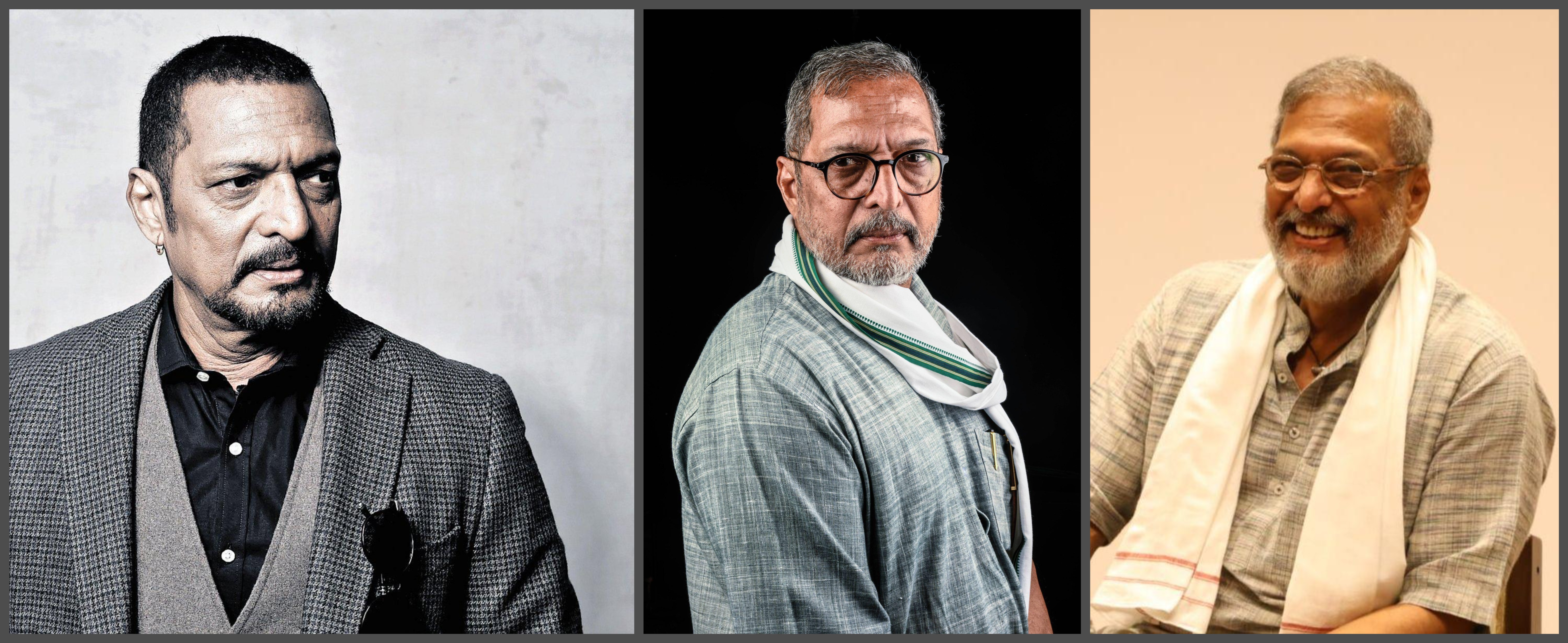
At the same time, I had been reading a lot about the sexual harassment allegation Tanushree Dutta made against him, and it was still on my mind. But his smile was so genuine that I found it hard to join the two images together: the actor whom I admire and the man named in the allegation.
Nana Patekar died at the age of 75, after a suspected cardiac arrest at his home in Goa. Undoubtedly, he was one of the most powerful actors in Indian cinema – the frustrated young man of Ankush, the dangerous Majid Khan of Angaar, the quiet father in Khamoshi, the intense officer of Ab Tak Chhappan.
Beyond these performances, one question kept returning: who was the person behind the artist?
Vishwanath (Nana) Patekar was born on 1 January 1951 in Murud-Janjira, Maharashtra, into a modest family. His father lost his business, and the young boy had to start earning while he was still in school. Years later, he recalled that he began working at thirteen.
In one interview, he remembered visiting friends around mealtimes, hoping someone would invite him to eat. He went on to study at the Sir J.J. Institute of Applied Art in Mumbai and worked as a commercial artist. Painting stayed with him all his life.
Acting came to him through theatre. His father loved plays and encouraged him to watch them, and that is how his own love for theatre began. Vijaya Mehta, one of the great figures of Marathi theatre, directed his first play.
Working with her, he performed in plays such as Purush, Mahasagar and Hamidabaichi Kothi, each very different in subject and character. In the early days, he worked for very little money. A play of his won an award at the Maharashtra State Drama Competition, and after that he decided to stay in acting.
It was on the stage that he also met his wife, Neelakanti Patekar. They met while working on a play, Jaat Na Poocho Sadhu Ki. She was an actress in both theatre and Marathi cinema, and she won a gold medal for best actress at a state drama competition and later a state award for a Marathi film.
In those early years, she was the steady earner of the household. By his own account, Nana was making about fifty rupees a show while she earned around two and a half thousand a month, and he credited her support for letting him keep going at a time when he did not know if acting would work.
Theatre also taught him something about his craft. In one interview, he explained how in Purush he played Gulab Rao, a crude and corrupt politician, and worked hard to give the character small touches that made him real.
Later, when he became a film star, he noticed that audiences started cheering at his dramatic entries, even in the most painful scenes of the play. Patekar is said to have walked out of one such performance because of this factor. He realised that the film star was getting in the way of the character, and he decided never to let that happen again.
The idea that the character matters more than the star explains how he chose his roles. Patekar rarely took the safe road. When Nana came to films, he did not look for heroes, but looked for people.
Ankush (1985) was a small-budget film about jobless young men in Mumbai after the mill strikes. The film became a surprise hit, and his performance as a frustrated young man gave him his first big recognition.
In the Marathi film Maaficha Sakshidar (1986), based on the real Joshi- Abhyankar murders in Pune, Patekar took on a dark and violent character. In Mohre (1987), he played Abdul, a truck driver fighting alcoholism and depression, a man very far from any hero.
Nana’s smaller, quieter films show the same instinct. In Giddh (1984), he played a pimp who took village girls to the brothels of Bombay. The film won a special award for its picture of people helpless against the Devadasi tradition.
In Disha (1990), he was Vasant, a farm labourer who leaves his drought-hit village for the mills of Bombay to pay off his debts. In Diksha (1991), he played Koga, a low-born boy who dreams of learning the scriptures and, in the end, refuses the promise of heaven and salvation to keep his dignity. In each of these, he played someone at the edge of the story, and he gave that person a face.
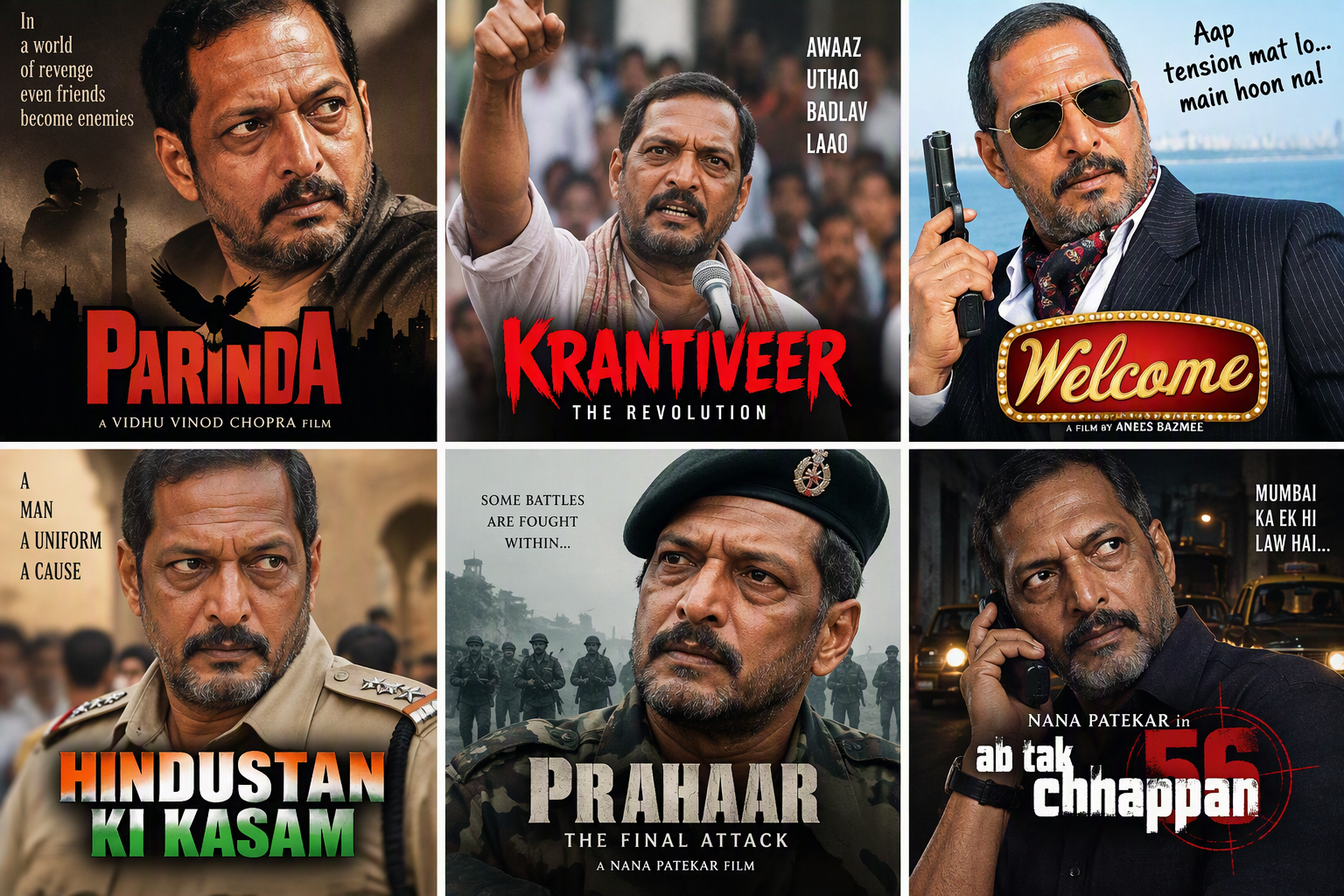
Then came the roles that made him a star. For Parinda (1990), he is said to have agreed to the film on the condition that he would have a say in shaping his character, and the film made him a force in Hindi cinema. As Anna, he put menace beneath an almost ordinary face.
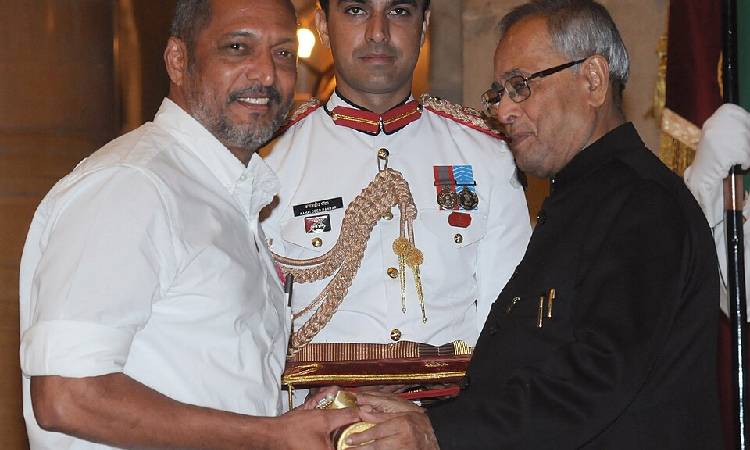
In Angaar, as Majid Khan, a powerful builder and the head of a dangerous family, he won the Filmfare Award for Best Villain. As Pratap Narayan Tilak in Krantiveer, his anger felt like the frustration of a man who could not accept the injustice around him. He went on to win three National Film Awards and received the Padma Shri.
Patekar also took his craft seriously. For Prahaar (1991), which he wrote and directed, Patekar is reported to have gone through army training. He reprised the army officer roles later, in Tirangaa (1993) and Kohram (1999). Possibly inspired by these roles, Patekar later joined the Territorial Army.
Nana Patekar’s co-stars are quoted as stating that he wrote out his dialogues by hand before a shoot, until the lines were no longer someone else’s words but his own.
In Khamoshi (1996), as Joseph Braganza, a deaf father, he showed a tender side that surprised audiences used to his anger. In Ab Tak Chhappan (2004), a controversial movie that portrayed ‘encounter specialists’ in Mumbai Police, Patekar donned the role of encounter specialist Sadhu Agashe, but in a meaningful role portraying what a life of violence costs a person.
And in Welcome (2007), Patekar revealed his comical prowess. As the proud and short- tempered gangster Uday Shetty, Patekar dived into comedy without ever appearing to chase a laugh. He did not simply play an emotion but made the audience look at the person feeling it. For someone known for his serious demeanour, Nana excelled in his comic roles.
Nana Patekar never needed the conventional hero’s face to command a screen. For decades, Bombay cinema held on to a quiet assumption that a protagonist had to be fair-skinned and good-looking, a face the audience could admire from a distance. Nana broke that myth, not by arguing with it but by making it irrelevant.
What made him different was that he never played a conventional hero. His characters were angry, bitter and flawed, and refused to follow the familiar line between good and bad. There was something democratic about his cinema. His characters were often for the people, but they were also, in a sense, by the people.
He came from a modest background and rose through the stage rather than film glamour, so his anger never looked borrowed from a studio. It looked like it belonged to someone who had lived it. That may be why audiences trusted him even in his harshest roles.
Yet his range went well beyond rage. In Thodasa Roomani Ho Jaayen (1990), he plays Baawe, a schoolteacher who uses poetry and storytelling to bring hope to a town worn down by despair.
Here he sets aside the intensity we later came to associate him with, and plays the role with gentleness and a touch of mischief. Through Baawe, he shows that change does not always begin with power or protest; sometimes it begins when someone helps us imagine a different world.
That is what makes him a milestone-maker. He did not wait for the industry to widen its idea of a hero. He widened it himself, one performance at a time, and proved that what audiences truly remember is conviction, not polish.
Nowhere did the stage and the screen meet more than in Natsamrat (2016), where he played Ganpatrao Belwalkar, an ageing stage actor whose grand gestures slowly gave way to a wounded man facing loneliness and the loss of who he was. The actor who played a performer at the end of his journey was, in his own way, still defending the stage.
Patekar’s concern for ordinary people was never confined to the screen. When drought and debt pushed farmers in Maharashtra into crisis, he gave INR 15,000 each to dozens of families who had lost a loved one.
He then co-founded the Naam Foundation with the actor Makarand Anaspure, which worked on water conservation, reviving rivers and supporting the widows of farmers who had died by suicide. Those who followed his work say he went to the fields himself and asked struggling farmers to call him or the foundation at least once before taking any extreme step.
Yet an honest tribute cannot ignore the other chapter. Tanushree Dutta accused Patekar of sexually harassing her on the set of the film Horn ‘Ok’ Pleassss. A complaint she made to the actors’ association at the time led to no action.
Ten years after the shoot, her renewed allegation came as India’s #MeToo movement was gathering force. Patekar denied it. “What is a lie is a lie,” he told reporters.
Some months later, the Mumbai Police filed a B-Summary report, concluding they lacked enough evidence to prosecute him. Dutta rejected the finding and claimed her witnesses had been intimidated, the investigation was rushed, and her lawyer said they would oppose it in court.
The allegation still stands, and I cannot claim to know what happened on that set, but it also raises questions bigger than one man, as to why a complaint went nowhere for ten years, and whether women on film sets now have safe ways to be heard. Patekar’s demise does not close those questions.
But when I look at his life as a whole, I see a person far larger than any single headline. I see a boy who started working while still in school, a young actor who took a dream to the stage for fifty rupees a show, a performer who refused to let his stardom crush the character and a man who went into the fields to sit with grieving farmers.
A smile cannot prove innocence, just as an angry face cannot prove cruelty, and I do not offer it as evidence of anything. But now I understand why it stayed with me. It belonged to a person who was far more complicated and far more alive, not as a headline but as a human being.
(Views expressed in this report are the author's own.)
Follow us on WhatsApp
Follow us on Facebook
Follow us on X @vudmedia
Follow us on Substack
