
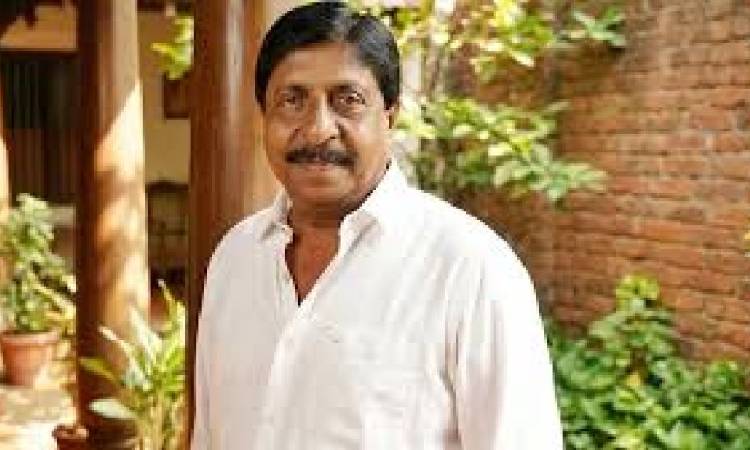
Sreenivasan, who passed away earlier this month, was a stalwart of Malayalam cinema, who etched his place in the hall of fame not just with exceptional acting skills but with a pantheon of cinematic writing and filmmaking that echoed the voices of the ordinary man, the underdog and the marginalised, even if not in the conventional political and sociological sense. The Sreenivasan cinematic language, interestingly, was not of parallel or middle cinema, but of a brand of mainstream cinema that blended extensive humour with touching storytelling and grounded social messaging.
Hours after the results of the Kerala local bodies election began showing on the television screen on the 13th of December, the social media handles of Malayalees worldwide were beaming one movie scene – where a local communist leader is trying to explain to his cadre the reasons for his party’s defeat in a recent election.
The scene from the movie Sandesham (1991) shows veteran actor Sankaradi attempting a conceptual explanation of the party’s loss. Secessionists and reactionaries, though seeming to be at odds, had a bridge between them, and the bourgeoisie were waiting for an opportunity, says Sankaradi, explaining the setback. When pressed further by a confused party worker, Sankaradi explains, “class dominance and colonial strands of thought,” underlining that it was not a radical change.
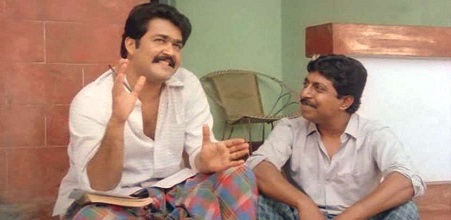
Image: Dasan (Mohanlal) and Vijayan (Sreenivasan) were iconic characters of Malayalam cinema, in this still from Nadodikaatu
As incomprehensible it may read, this scene has been a leitmotif when the communist front in Kerala loses at the hustings, representing how the Left leadership in the state seek refuge behind ideological abstraction to explain the electoral scenario other than its own failings.
It might be sheer coincidence or a twist of fate that exactly a week later, the scenarist who conceived this scene breathed his last.
Describing Sreenivasan as a ‘scenarist’ will be a huge understatement. For Sreenivasan was a multi-faceted talent who occupied a pride of place in Malayalam cinema as actor, screenwriter, director and producer. Yet, such a multi-role characteristic is not an uncommon feature in Indian cinema. The pantheon of actors turning to filmmaking or vice versa is a versatile lot in Indian cinema.
Hindi cinema, for instance, had legendary figures from Guru Dutt, Raj Kapoor, Dev Anand, Rakesh Roshan, who wrote, directed and acted in their own produced movies. That legacy was replicated in contemporary times by the likes of Anurag Kashyap, Farhan Akthar, Zoya Akthar, among others, even as frontline stars like Aamir Khan, Ajay Devgn, Arbaaz Khan, Pooja Bhatt and Konkana Sen Sharma also graduated in directing movies, along with their acting careers.
South Indian cinema, particularly in Tamil and Malayalam, also hosted a creative multiverse with figures like NTR, Bhagyaraj, Ramarajan, Krishna, Manivannan and Balachandra Menon, among others, establishing this trend in the 1980s, before a whole creed of actor-filmmakers emerged in the Southern scene in the later years – be it Parthiban, Samuthirakani, Sundar C, Cheran, Sasikumar, Ram, Upendra and Rishab Shetty, among others, establishing the spectrum of actors who scripted and directed movies with them handling the chief protagonist or major supporting roles in most cases.
Lately, even leading actors like Prithviraj have ventured into direction while new generation directors like Pradeep Ranganathan have moved into acting roles, halting their directing careers. So too a range of other directors/screenwriters who have turned to full-time acting, be it Santhana Bharati, Crazy Mohan, Ranji Panicker, Johny Antony, Samuthirakani
Notwithstanding such a rich tradition of craft blending – as actor and storyteller-creator – in Indian cinema, Sreenivasan’s cinema, especially one he wrote or created, was a world of its own.
A cinematic genre of his own
By his own admission, Sreenivasan was an accidental screenwriter when ace director Priyadarshan forced him to write the script and dialogue for the 1984 comedy flick, Odarthuammava Aalariyam.
The movie was a milestone in many respects – launching Srinavasan as a screenwriter, beginning of a new trend of slapstick comedy that catapulted not just Priyadarshan into the big league but also fast-forwarded the careers of a handful of actors including Mohanlal, Mukesh, Maniyanpillai Raju, Jagadeesh, and Srinavasan himself, with a string of mass-selling comedies before most of these actors moved into the mainstream masala fare.
Sreenivasan established himself as a leading screenwriter when he teamed up with contemporaries of the 1980s, including Priyadarshan and Sathyan Anthikad, the latter graduating from a lyricist to a director of family dramas, both backed by Sreenivasan's entrenchment in Malayalam cinemas as among the most dependable storytellers.
The 1980s coming of age of the actor and the storyteller went as a parallel journey and marked the emergence of a brand of cinema that was distinct from the then melodramatic mainstream, the other extreme of parallel ‘art’ cinema, as well as the ‘middle cinema’ that formed the new wave in Malayalam. In other words, Sreenivasan’s screenwriting from the late 1980s was neither of the I.V. Sasi-Joshi-P.G. Vishwambaran brand, nor of Adoor Gopalakrishnan-Aravindan kind, nor the Padmarajan-Bharathan variety.
Rather, Sreenivasan mainstreamed the satire, inspired by the Panchavadi Palam template, but adding comedy and drama elements from the masala fare, without much action but with immense societal undercurrents. Starting from slapsticks of the Odarathammava Aalariyam, Mazha Peyunnu Madalam Kottunnu and Aram+Aram=Kinnaram kind, Sreenivasan moved towards populist interrogations by weaving comedy and realism to narrate deeper social issues.
If Varavelpu (1989) exposed the militant extremes of trade unionism in Kerala, a handful of Sreenivasan's writings, like Nadodikaatu (1987) and Gandhi Nagar 2nd Street (1986) picturised the helplessness of unemployed youth, couched in everyday humour short of darkness. Many years later, Sreenivasan also portrayed the lazy youth being wasted in Njan Prakashan (2018). In Sanmanasu Ullavarku Samadaham (1986), Sreenivasan explored the intricacies of the tenant-landlord relationship, a plot which was remade in Hindi as well.
Though a thorough family drama in an archetypal Kerala rural setting with immense comic intersperse, Ponmutta Idunna Tharava explored casteist interactions without any element of politicisation or social violence. Through Artham and Vellanakallude Nadu (1988), Sreenivasan took on the corrupt political and bureaucratic establishment.
While political subplots figured in some of his works, Sandesh was Sreenivasan’s direct and all-out engagement with the political realities of the time. As mentioned in the outset, the movie was a sardonic political satire that lampooned the politics of the Communist Party and the Congress in Kerala, with electoral victories alternating between the two fronts for many decades.
The Hindu right and the Bharatiya Janata Party (BJP), not even a nominal force in the early 1990s, hardly figured in these narratives then.
Yet, years down the line, Leftist social media handles used to counter the electoral setback scenes by claiming Sreenivasan to be a ‘Sanghi.’ Interestingly, it had amused many during Sreenivasan’s funeral that his younger son, Dhyan Sreenivasan, himself a popular actor, raised a ‘Communist’ salute to his father’s body, followed by similar gestures by leading Communist leaders in Kerala.
At least one video showing Sreenivasan in conversation with Kerala Chief Minister Pinarayi Vijayan shows the latter telling the former about his father’s Communist connections. In Arabikatha (2007), though not of his writing, Sreenivasan portrayed the immaculate Communist who fought against the corrupt elements in his party and found resonance with the cadre.
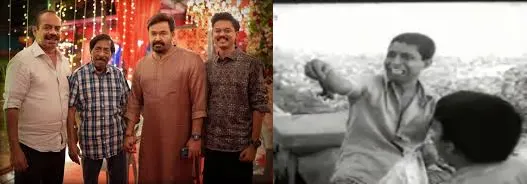
Image: One of the last pictures taken of Sreenivasan (left), with Sathyan Anthikad and Mohanlal on the set of Hridayapoorvam, and a still from his first movie, Manimuzhakam (right)
By the time Sreenivasan gained the confidence to venture into directing, he had attained the ability to engage Freudian elements in his craft of storytelling. In Vadakunokiyanthram (1989), his first directorial venture, Sreenivasan presented a complex human mind in the lead protagonist – Thallathil Dineshan – played by himself. Dineshan, who suffers from an ingrained inferiority complex, advances into extreme psychological disorders and Othello’s Syndrome following his marriage to a beautiful woman, with his nights turning into an ordeal driven by suspicion and distrust.
The very next year, he wrote Thalayanamanthram, portraying a semi-literate housewife’s jealousy leading to a family break-up and metaphorically representing one of the underlying causes of joint families splitting up in what was among the most literate societies. Years later, through Azhagiya Ravanan (1996), Sreenivasan also brought on screen the travails of an absolute narcissist whose personality was moulded by the setbacks and poverty of childhood.
Similarly, through Chinthavishtayaya Shyamala (1998), Sreenivasan’s second and final directorial outing, he brought out the trauma of a semi-literate and unemployed housewife being forced to fend for herself and her two little daughters when her wayward husband (played by Sreenivasan) abandons the family in the guise of spirituality.
Like politics, Sreenivasan also tormented his own domain, the film industry, through this satiric dissection. Through Udyananu Tharam (2005), he caricatured the superstar culture in cinema through abject lampooning and ridiculing stardom. Interestingly, while he himself enacted the despicable superstar in this movie, the reigning superstar of Malayalam cinema, Mohanlal, was cast in the role of a struggling actor at the receiving end of the former.
The second coming of Sreenivasan’s ‘superstar’ character in Padmasree Bharat Dr Saroj Kumar (2012) led to controversies, as many felt the depiction was of Mohanlal himself, through Sreenivasan himself confirmed that the character had shades of even Mammooty’s actions being depicted in equal measure. The movie and subsequent outbursts even led to a period of estrangement between Sreenivasan and Mohanlal – an enviable pair which brought to life many Sreenivasan writings in the 1980s.
While both his directorial ventures fetched state and national awards for highlighting social issues, they meant recognition for a mainstream filmmaker’s ability to interrogate and picturise serious social and common man issues of day-to-day lives without the fuss of artistic excellence matching parallel cinema nor having to depend of mass masala entertainment fare.
The Sreenivasan cinematic universe, formed in the 1980s and flourishing through the 1990s, therefore could be invariably classified as a different genre of Malayalam cinema that did not strictly adhere to the formula and character of the three main segments of the time – mass, middle or the mesmerising ones. In mainstreaming the average individual and society’s travails and daily struggles through deeply engaging humour and familial narratives, his cinematic universe certainly stands out in the pantheon of Indian cinema.
Voice of the underdog
As a product of the Adyar Film Institute, where he rubbed shoulders with the likes of Rajnikant and Chiranjeevi, Sreenivasan’s quest was to be an actor at a time when Indian cinema, including Malayalam cinema, had set ideas about physique, looks and persona irrespective of the characterisation.
From the role of ‘Vayaran Michael’ in Manimuzhakam (1976), his first leading role in Sanghaganam (1979), Mela (1980), Panchavadi Palam (1984), Chidambaram (1985), and all the way up to the commercial fare, Oru Maravathoor Kanavu, Sreenivasan could harness his ‘unconventional’ typecasting to essay roles in the parallel cinema universe before drawing similar dimensions of portrayal into mainstream cinema.
It could be this self-identification of physique and appearance with its inherent potential to depict ‘ordinary’ characters of daily life – be it of the common man, a marginalised group member or the archetypal social underdog – that could have inspired Sreenivasan to pen stories of ordinary human lives when he shifted to screenwriting, after the initial acting forays.
Sreenivasan’s evolution from a wannabe to a trained professional and a successful actor is a social revolution in Malayalam cinema where the spectrum of acting was dominated not just by the conventional ‘good-looking’ and ‘fair-skin’ crowd but also with evident ‘Savarna’ (upper caste) lineage. If seen from a casteist paradigm, Sreenivasan, along with Mukesh, were among the very few actors who broke the ‘Savarna’ domination and reached the top of the star cast in Malayalam cinema’s lineup.
Before advancing into ‘hero’ or character roles in the 1990s, and carrying through the subsequent years, Sreenivasan played in classic underdog including in movies that he wrote – be it the physically-challenged vagabond in Panchavadi Palam, the goldsmith in Ponmutta Idunna Tharavu, the unsuccessful tailor-cum-novelist in Azhakiya Ravanan, the barber in Katha Ezhuthumbol or the repressed peasant in Oru Maravathoor Kanavu.
What Sreenivasan could not compensate for through his acting roles in representing the voice of the underdog and the marginalised – not necessarily the socially repressed sections – he made up for through his screenplays by bringing on screen the voices of the common man, his travails and cries of desperation.
If illness had not slowed him down in recent years, there could have been many more works of social, political and cultural relevance that could have come out of Sreenivasan’s pen.
Follow us on WhatsApp
Follow us on Facebook
Follow us on X @vudmedia
Follow us on Substack
