
By the time dusk settled over the manicured lawns of the All-England Club, Centre Court at Wimbledon had once again crowned a champion. Yet the applause that echoed through Wimbledon was not merely for another Grand Slam winner. It was an acknowledgement that men's tennis, after years in the shadows of immortal champions, may finally have found the man capable of writing its next enduring chapter. Yet, considering that Jannik Sinner’s closest rival, Carlos Alcaraz, continues to hold the edge in the ATP majors indicates that their rivalry could drive this new era, which will remain delicately balanced rather than one-sided. This tension is precisely what gives the sport’s next chapter its shape, says Prasad Nair.
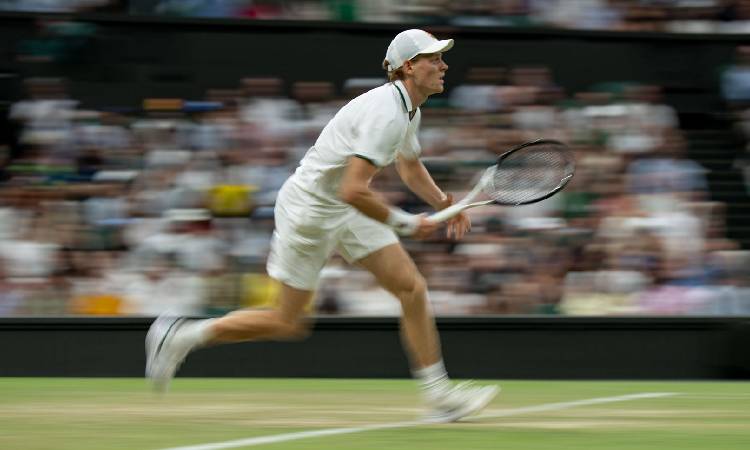
Home page image: A glazy image of the Wimbledon gentlemen's singles final at the Centre Court
Text page image: Jannik Sinner paces during the final gentlemen's singles match with Alexander Zverev at the 2026 Wimbledon
Banner image: Sinner holds up the Wimbledon Gentlemen's trophy from the Club House balcony to the cheering crowd
For more than two decades, Wimbledon belonged to the Big Three – Roger Federer’s unparalleled elegance, Rafael Nadal’s indomitable spirit, and Novak Djokovic’s astonishing resilience combined to win 17 titles between 2003 and 2022. That run ended when Carlos Alcaraz defeated Djokovic in 2023.
Together, the ‘three musketeers’ had transformed the grandest Grand Slam into a theatre where sporting excellence reached mythical proportions. Early this month, the Centre Court became less a tennis arena and more a cathedral of greatness, where records fell with astonishing regularity and history seemed to be in a permanent state of construction.
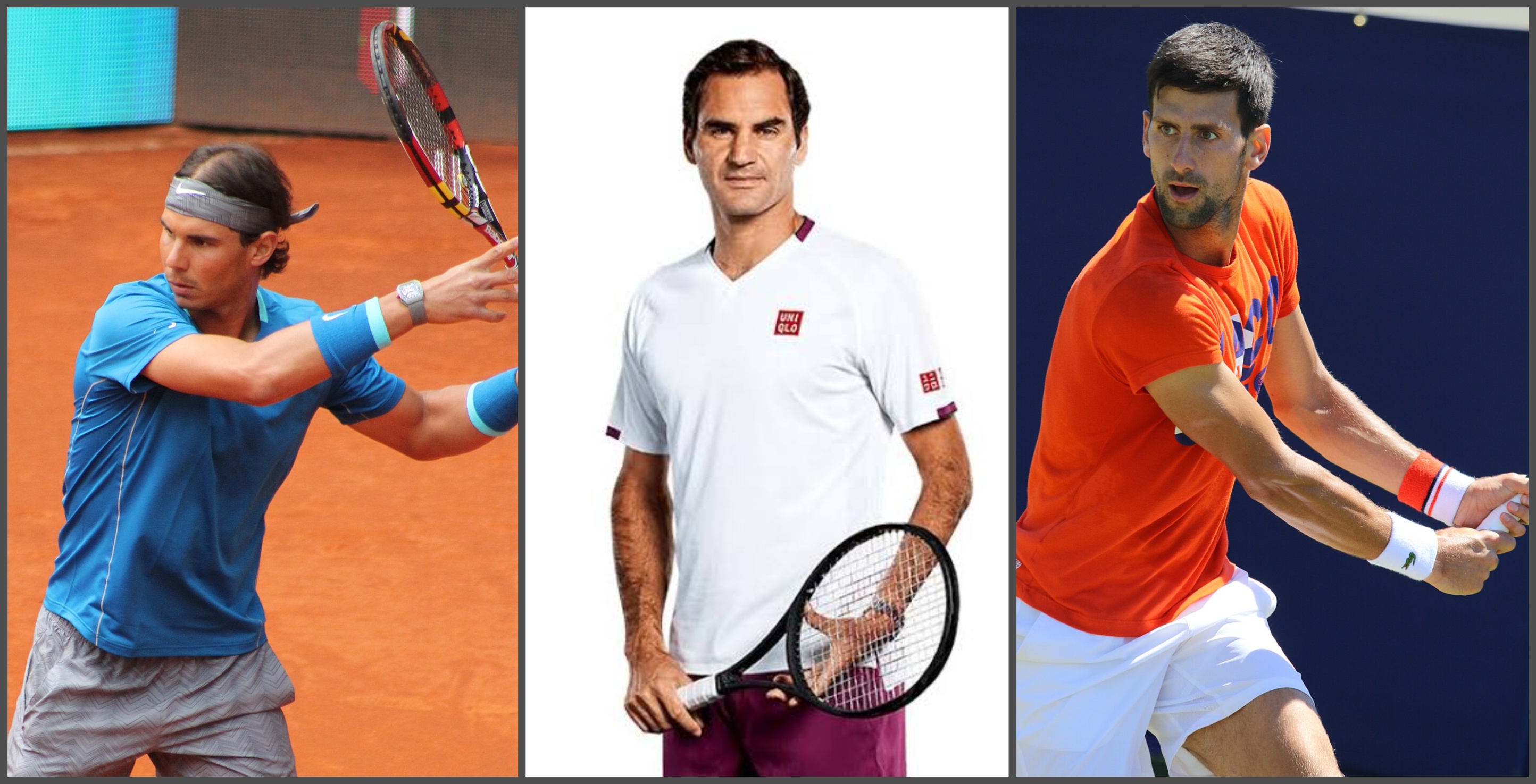
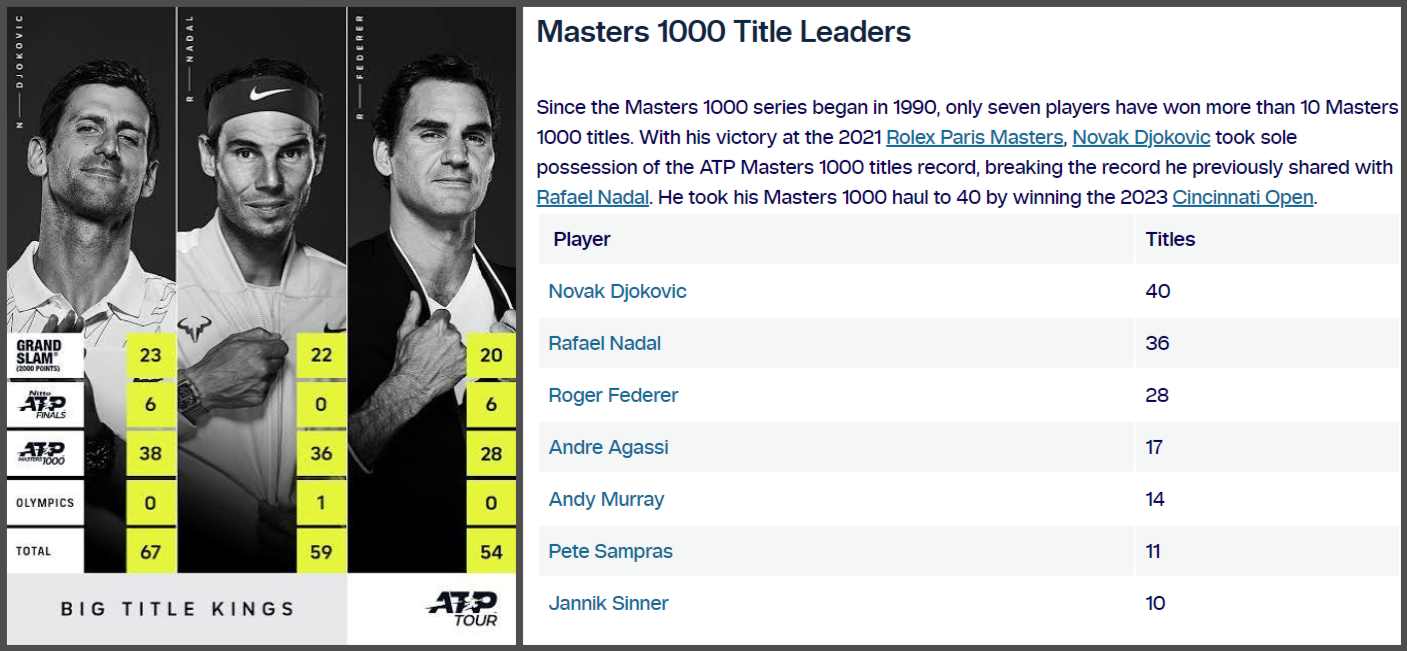
The Big 3: Rafael Nadal (left), Roger Federer (centre), and Novak Djokovic (right)
When Federer hung up his racket in 2022 after winning 20 grand slams, Nadal’s muscular body yielded to the toll of years of relentless warfare he waged to win 22 grand slams. Djokovic, having bagged 24 grand slams, aged like fine wine, entered the twilight of an extraordinary career – a question mark then lingered over men’s tennis.
Who will inherit the throne once held by perhaps the greatest players in tennis history? Importantly, would anyone in the near future command the reverence that Wimbledon reserves only for champions who transcend victories and become part of its folklore?
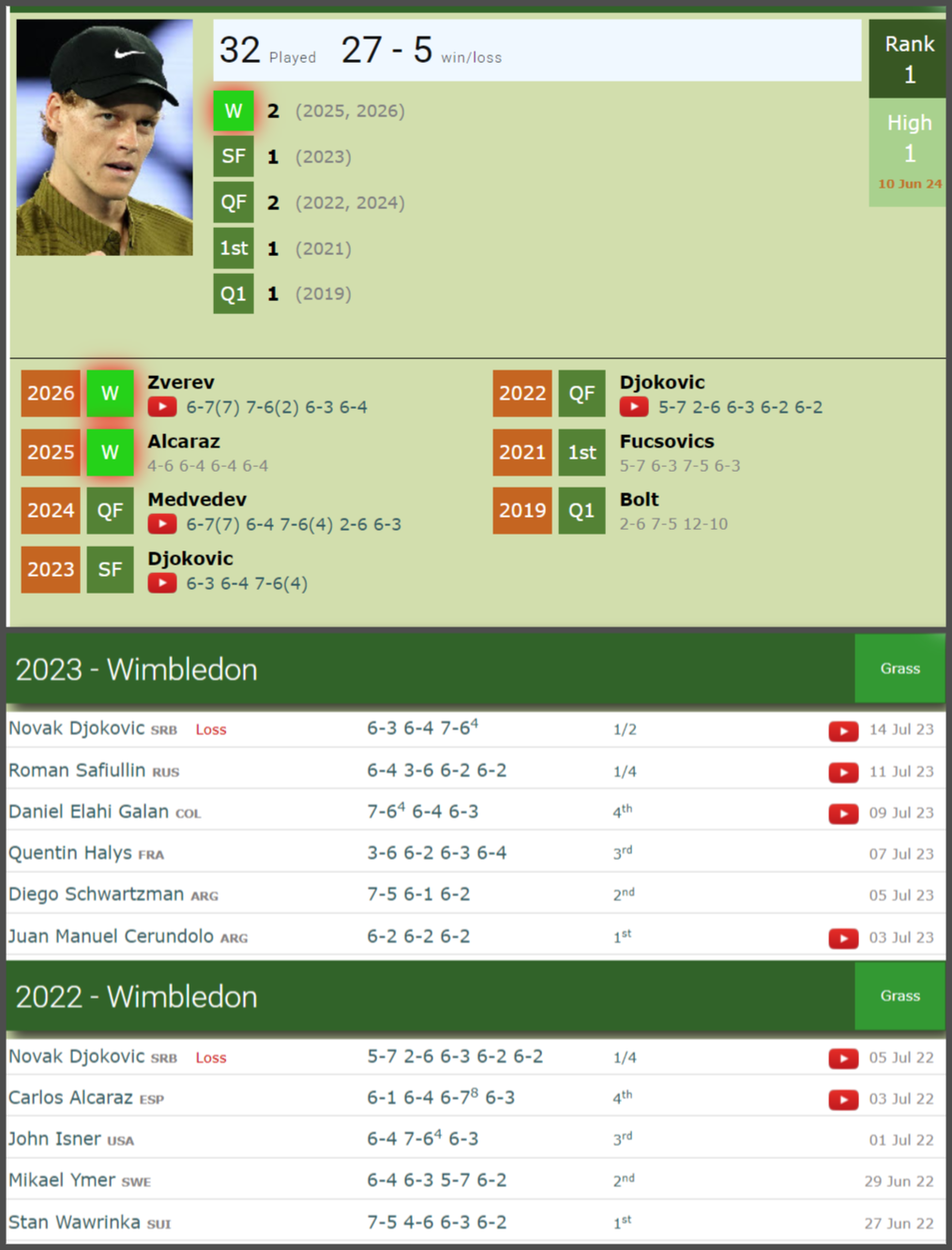
On July 12, 2026, Jannik Sinner, with his proven talent, offered perhaps the clearest answer yet to tennis fans and critics alike. Sinner’s 6-7, 7-6, 6-3, 6-4 triumph over French Open champion Alexander Zverev was not just another addition to his growing collection of Grand Slam trophies.
His win encapsulated everything modern tennis demands: technical excellence, tactical brilliance, emotional composure, and an unnerving ability to perform at the highest level without letting pressure cloud judgement.
The 24-year-old Italian, in his title defence, reaffirmed his status as the world’s finest player and reinforced the view that tennis has entered the Jannik Sinner era. Sinner will undoubtedly be tested by his greatest rival, Carlos Alcaraz, once the Spaniard recovers from his injury.
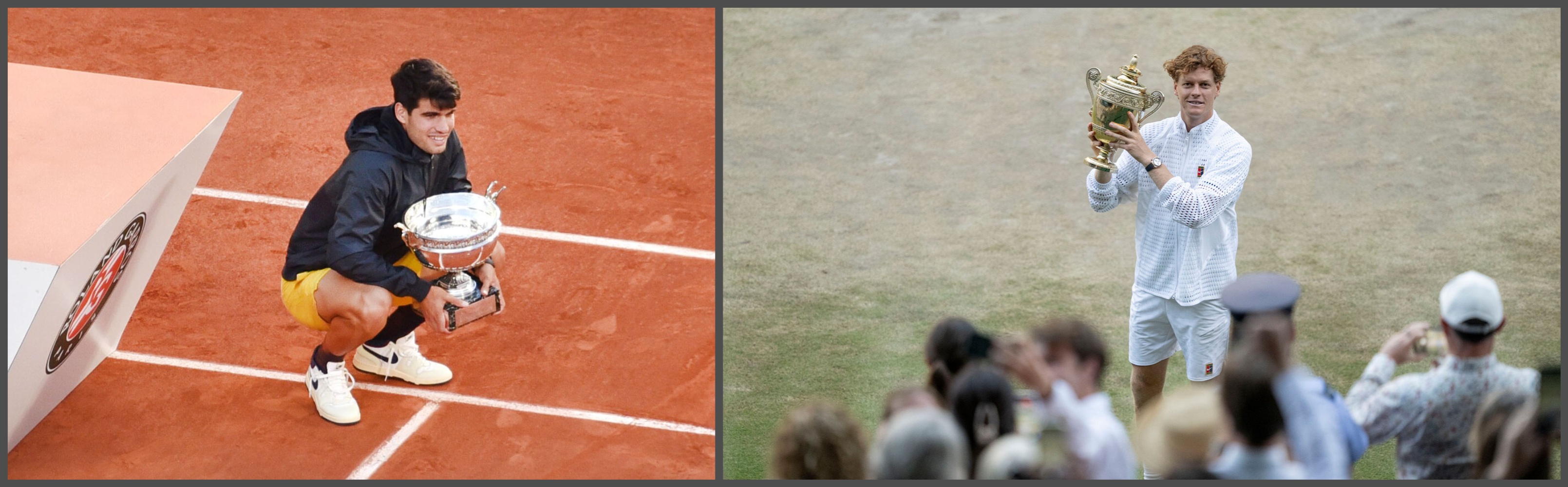
Carlos Alcaraz after winning the men's singles final at the 2024 French Open, at Roland Garros (left), and Sinner with the Wimbledon Gentlemen's singles trophy, 2026 (right)
Yet, the duo’s monopoly appears destined to shape the sport for at least another decade.
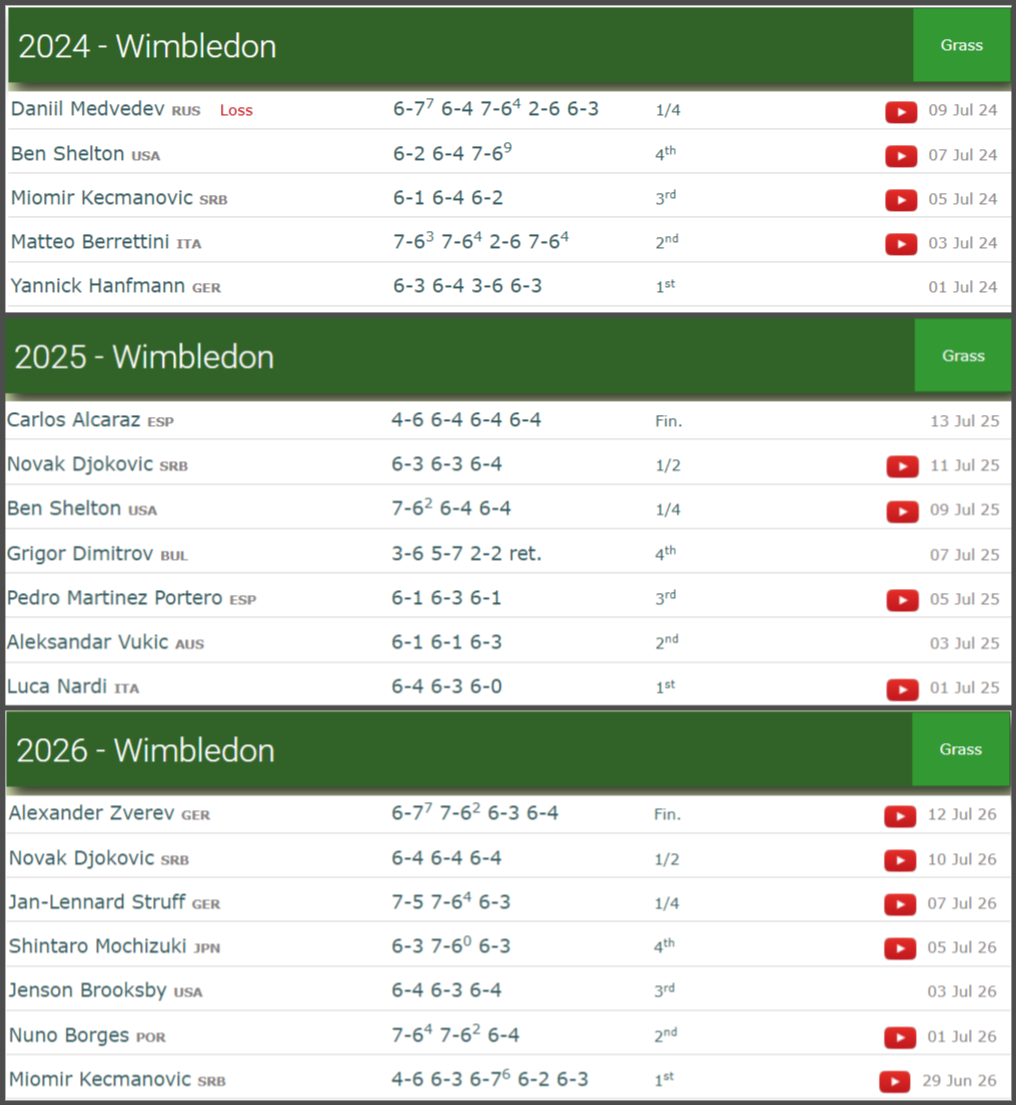
A fortnight tested Sinner’s resolve before it even began. The scoreline, though competitive, tells only part of the story. What made Sinner’s triumph especially remarkable was the path that led to it. Six weeks earlier, he had suffered a shocking second-round exit at Roland Garros, undone in five gruelling sets by Juan Manuel Cerundolo in conditions that never suited his game.
For a lesser competitor, the result might have lingered as a psychological scar heading into the grass season. Zverev, by contrast, capitalised fully on that early Parisian exit, going on to claim his maiden Grand Slam title on Roland Garros clay.
The contrast in fortunes set up a final chapter full of subplots. Zverev arrived at SW19 with an opportunity to do something that no man had managed in the Open Era since 1968: win his first major and follow it immediately with a second at the very next Grand Slam.
He had also never previously progressed beyond the fourth round in the nine prior Wimbledon appearances, yet played the tournament of his life, dropping only two sets across the fortnight and looking, for the first time, entirely at home on grass.
From Germany, only Boris Becker and Michael Stich have won Wimbledon men’s singles – with Steffi Graf (7-time winner), Angelique Kerber (2018) and Cilly Aussem (1931) being women's singles winners from the country – and Zverev came within one match of emulating his male compatriots.
However, Sinner, who was at his peak and playing perhaps the best tennis of his life, ensured that history would have to wait. In doing so, he became the tenth man in the tournament’s history to successfully defend the Wimbledon men’s singles title.
This list is a hall of fame that includes Federer, Nadal, Djokovic, Pete Sampras and Björn Borg. Sinner’s Wimbledon feat firmly placed him in an elite category.
The anatomy of a champion’s composure
Wimbledon finals are seldom remembered for numbers. They are remembered for subtle shifts in momentum, the moments when belief changes hands, and the occasions when champions reveal qualities invisible to statistics. Sinner’s latest triumph firmly belongs in that category.
The opening exchanges suggested Centre Court was about to witness an epic. Zverev, still riding the confidence of his breakthrough in Paris, looked every bit the player who had finally broken through the psychological barrier that had long kept him from Grand Slam immortality.
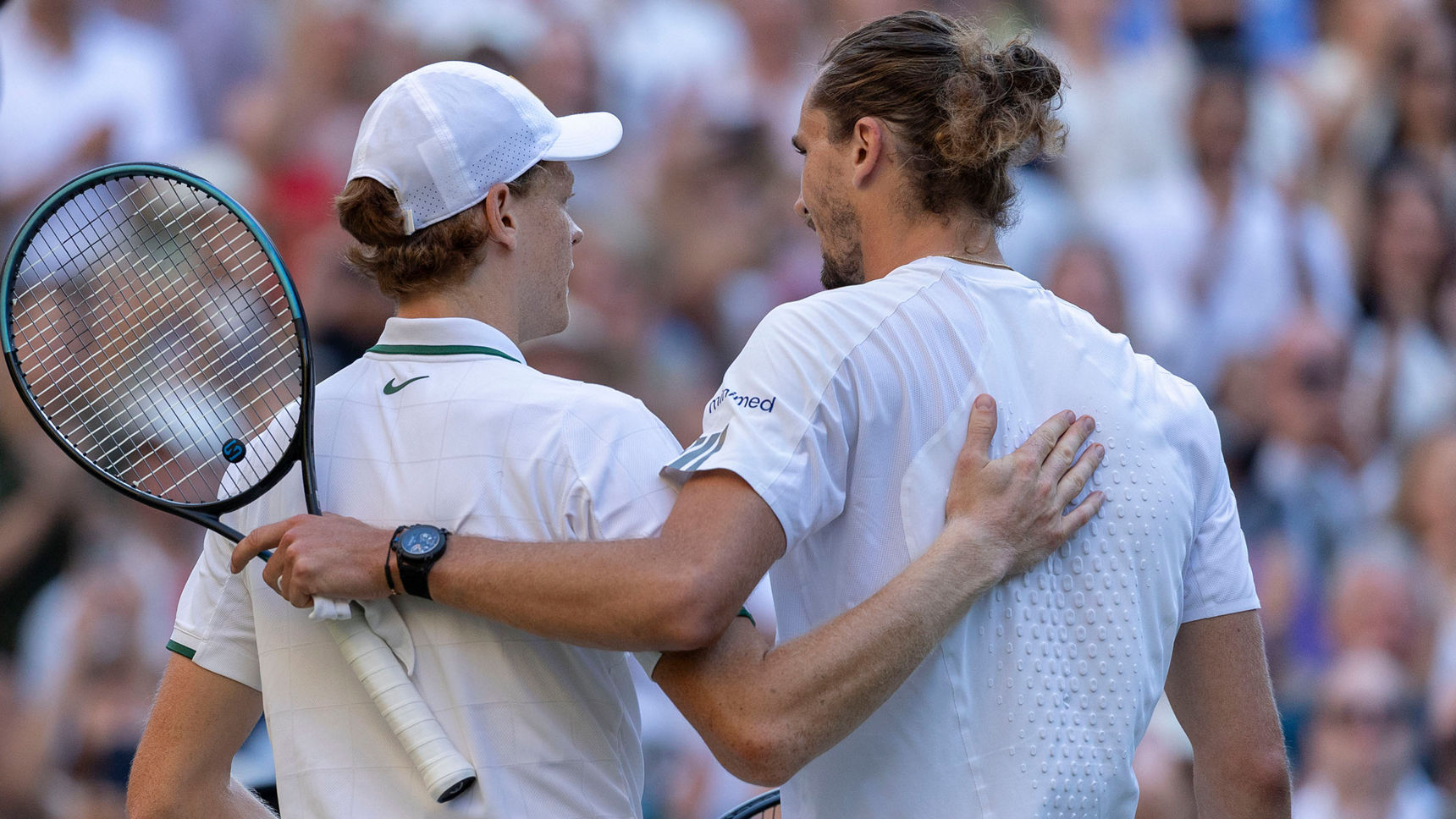
Sinner and Zverev greet each other after the Wimbledon Gentlemen's Singles Final
His serve exploded off the grass with intimidating pace, his backhand sliced through the court with remarkable precision, and perhaps most importantly, he carried himself with the confidence of a man who no longer doubted his place among the elite.
Sinner, however, appeared almost detached from the occasion. There is a curious calm about the Italian that has become one of his defining traits. He rarely celebrates spectacular winners with extravagant emotion. He seldom shows visible frustration.
His face, often expressionless, conceals an extraordinary competitive fire. It is not indifference but discipline — a refusal to let emotion interfere with execution. In an era increasingly shaped by intensity and theatre, Sinner’s composure has become his greatest psychological weapon.
The first set unfolded like an elaborate game of chess disguised as a power contest. Both players served with authority, denying each other meaningful opportunities to seize control. Rallies were punctuated by blistering groundstrokes, yet beneath the apparent aggression lay intricate tactical calculations.
Zverev sought to pin Sinner deep behind the baseline, using the width of the court to open space for decisive forehand strikes. Sinner, by contrast, remained content to absorb pressure, redirecting pace with remarkable economy of movement before gradually assuming command of exchanges.
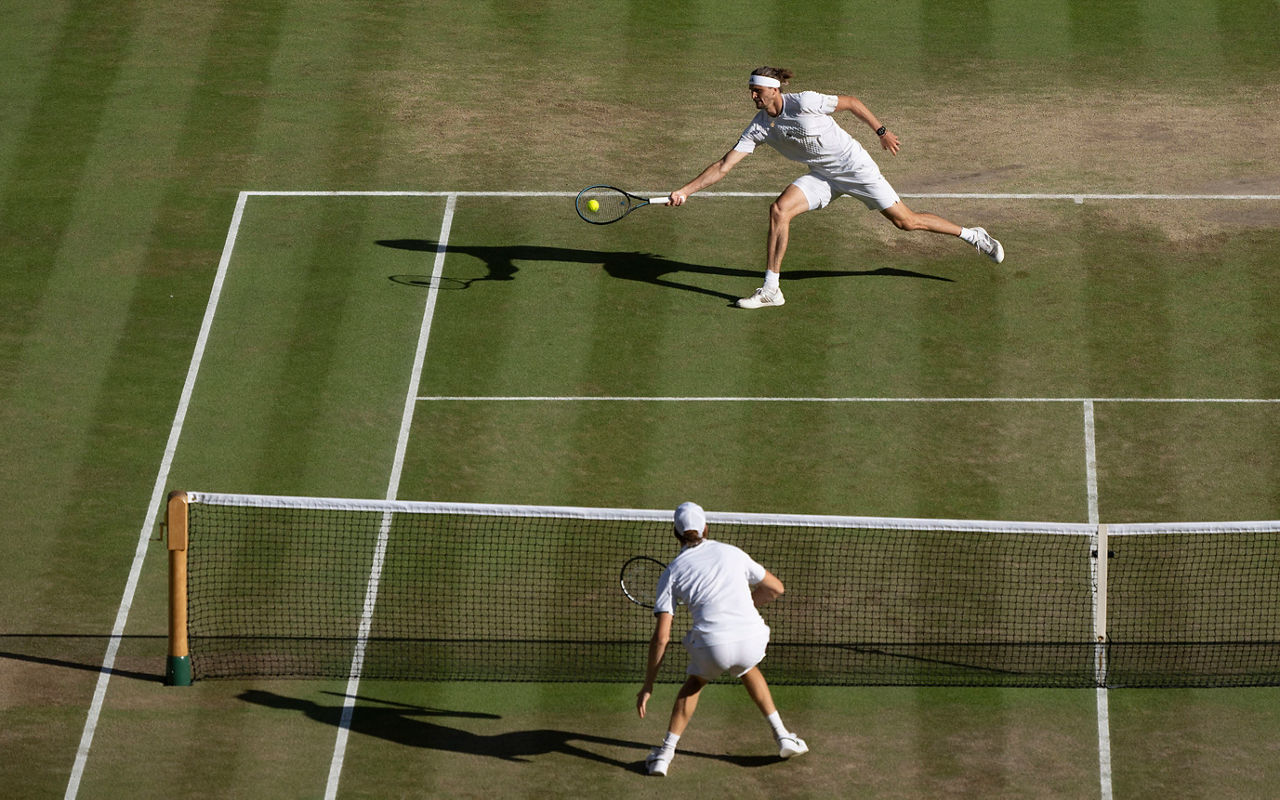
Zverev leaps to return a shot to Sinner at the 2026 Wimbledon gentlemen's final
When the set inevitably drifted towards a tie-break, there was little to separate them. Zverev edged the crucial moments 9-7, claiming the opener after nearly an hour of absorbing tennis. For many players, surrendering such a closely contested first set on Centre Court would have planted seeds of doubt.
Then it becomes extremely difficult to compete effectively against an opponent playing with such supreme confidence, and overcoming the psychological burden can feel overwhelming. Champions are not often distinguished by the matches they dominate but by those they rescue from adversity.
How the second set decided the championship
Although Zverev won the first set and steamed ahead, the second set would become the defining passage of the championship. Here, Sinner demonstrated the quality that increasingly separates him from almost every other player on the ATP Tour — not the sheer power of his strokes or the elegance of his movement, but his extraordinary clarity under pressure.
While others begin calculating consequences, Sinner simplifies the game. Every point becomes an isolated challenge. Every decision is stripped of unnecessary emotion. This trait was once associated with Federer in his prime and later perfected by Djokovic during his remarkable reign. Sinner has now made it his own.
As the second-set tie-break unfolded, momentum shifted almost imperceptibly before gathering irresistible force. Sinner attacked second serves with conviction, trusted his forehand when opportunities arose, and defended with astonishing elasticity whenever Zverev tried to dictate play.
By the time he levelled the contest, the Centre Court sensed what seasoned tennis observers have often recognised over the past two seasons: once Sinner establishes emotional equilibrium, dislodging him becomes almost impossible.
The remaining sets reflected that reality. Zverev continued to produce moments of brilliance, striking winners that drew appreciative applause from every corner of the stadium. Yet brilliance, however spectacular, could not match relentless excellence.
Sinner's baseline precision grew increasingly suffocating. His serve, often overshadowed by the more flamboyant elements of his game, delivered under pressure. His court coverage transformed defence into attack with astonishing efficiency.
The closing stages had their own theatre. As evening sunlight faded and his foot firmly on the grass, Sinner earned the decisive break in the seventh game of the fourth set, striking a forehand beyond Zverev's reach on his third break point.
He then closed out the match in an entertaining final service game, featuring a diving volley and a delicately disguised drop shot — small flourishes of showmanship from a player who otherwise deals almost exclusively in efficiency. Point by point, game by game, he had tightened his grip on the final until resistance finally yielded to inevitability.
There was no theatrical collapse from Zverev, nor any dramatic flourish from Sinner beyond that closing game. Instead, the contest ended in the quiet manner that has increasingly become the hallmark of the Italian's victories.
The handshake at the net carried mutual respect rather than bitterness. The celebrations remained measured rather than extravagant. Yet beneath that understated conclusion lay a profound truth. Wimbledon had not merely witnessed another champion defending his title.
It had seen a player whose authority over the sport continues to grow with every passing major.
The numbers behind the throne
Strip away the narrative, and the underlying statistics make an equally compelling case for Sinner's ascendancy. The win was his fifth Grand Slam title overall and his hundredth match victory at majors — a milestone reached faster than nearly anyone in the sport’s recent history.
It was also his sixth title of the season, a haul that already includes the completion of the career Golden Masters in Rome earlier in the year.
With the GBP 3.6 million winner’s cheque added to his tally, Sinner extended his lead over Alcaraz in the ATP’s “Big Titles” count — a combined measure of majors, ATP Finals crowns, Masters 1000 trophies and Olympic gold medals — to seventeen against his rival’s fifteen.
Alcaraz, tellingly, still holds the edge in majors themselves, seven to five, a reminder that the rivalry driving this new era remains delicately balanced rather than one-sided.
That tension is precisely what gives the sport’s next chapter its shape. Sinner’s game, built on redirection, depth and clinical shot selection, and Alcaraz’s, built on flair, touch and improvisational brilliance, represent two contrasting philosophies for playing modern tennis at the very highest level.
Wimbledon 2026 belonged to the former. Few would bet against the latter reasserting itself before the year is out.
A champion built through refinement, not reinvention
Great champions rarely announce themselves through a single spectacular performance. They reveal themselves gradually, replacing occasional brilliance with unwavering consistency until success begins to feel almost inevitable.
Federer did it during the early years of the new millennium. Nadal followed through sheer force of will. Djokovic completed the triumvirate by redefining resilience itself.
Sinner’s path appears different, yet no less compelling. His ascent has been built not on flamboyance but on refinement; not on overwhelming charisma but on relentless improvement. Each season has seen another weakness quietly disappear from his game, while another dimension has been sharpened to near perfection.
The player who once relied primarily on explosive ball-striking has evolved into perhaps the most complete competitor in contemporary tennis — one capable of absorbing a shock exit in Paris and, six weeks later, closing out the sport's most storied tournament as though the setback had never happened.
That evolution, more than the trophy itself, may prove to be the defining story of this Wimbledon.
As Centre Court emptied and the covers were rolled out over the hallowed grass for another year, the lingering question was no longer whether men’s tennis had found an heir to its golden generation.
It was simply how long his reign might last.
Follow us on WhatsApp
Follow us on Facebook
Follow us on X @vudmedia
Follow us on Substack
