
In his analysis of February 2024, Prasad Nair had reported about how Carlos Alcaraz and Jannik Sinner, as the new kids on the block, are redefining the world of tennis with their superlative game and giving the veterans a tough time, both on grass and clay. A few years down the line, Alcaraz and Sinner are touted as the Big Two slated to replace the Big Three – Novak Djokovic, Roger Federer and Rafael Nadal – though the debate is not yet sealed on whether the younger lot will emerge as the ‘greatest’ of the game. By defeating Djokovic in the Australian Open, Alcaraz has become the youngest Grand Slam winner at 22. While Sinner will have a lot of catching up to do, it is a foregone conclusion that the generational shift has happened in world Tennis.
Home page image: Carlos Alcaraz (left) and Jannik Sinner (right) pose after a match; photo source - ATP
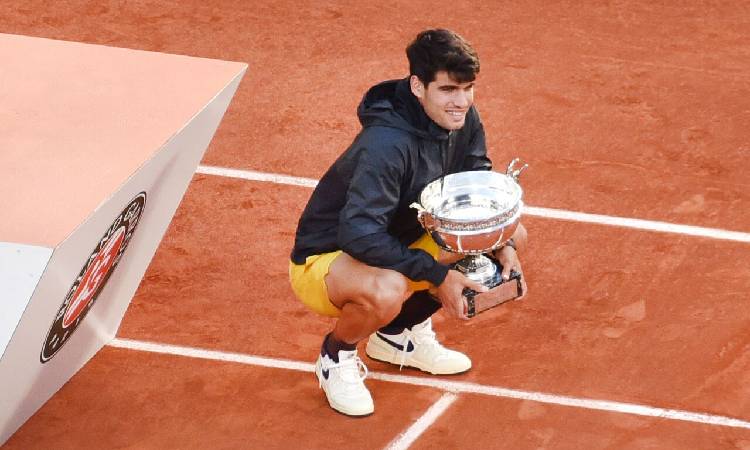
Text page image: Alcaraz holding the Coupe des Mousquetaires at the French Open 2024; photo source - Wikimedia Commons
Banner image: A panoramic view of the Rod Laver Arena at the 2020 Australian Open; photo source - Wikimedia Commons
Carlos Alcaraz defeated Novak Djokovic 2-6, 6-2, 6-3, 7-5 to win the men's singles title at the Australian Open and become the youngest male tennis player ever to win Grand Slams on all surfaces.
At 22, Alcaraz achieved a career Grand Slam – winning all four major championships, namely Australian Open, US Open, French Open and Wimbledon – something that eluded the Goliaths of tennis yesterday.
Alcaraz is also the youngest man in the Open Era (from 1968, when professional players were allowed to compete with amateurs at the Grand Slams) to reach the singles finals of all four major Grand Slams. With this win, Alcaraz ended Djokovic's unbroken 10-0 record in the Australian Open finals.

Novak Djokovic had entered the final with great hopes, gunning for his unprecedented 25th Grand Slam, boosted by his semi-final win over two-time defending champion Jannik Sinner. Instead, the 38-year-old former world champion came up short after the first set in the final.
Alcaraz’s win over Djokovic, the oldest-ever to reach the Australian Open final and the oldest major finalist overall since Ken Rosewall at the US Open in 1974, could, hence, be seen as a ‘passing of the torch’ moment.
For the unversed, this was similar to the 2023 Wimbledon final, when on the grass courts, Alcaraz defeated Djokovic 1-6, 7-6 (8-6), 6-1, 3-6, 6-4. Back then, too, Djokovic was chasing history, attempting to become the third man in the Open Era to win five consecutive Wimbledon titles and only the second man since Roger Federer to win 8 Wimbledon titles.
Alcaraz stopped him from drawing level with Margaret Court at the top of the Grand Slam leaderboard. Djokovic, who had established a firm hold on the championships, winning seven titles since 2011, had pushed Alcaraz to his limits.
Even though Djokovic dominated at Wimbledon, he had his moments of defeat, losing the 2013 final to Andy Murray 6–4, 7–5, 6–4 and battling a championship point against Roger Federer in the 2019 final, which he won 7–6 (7–5), 1–6, 7–6 (7–4), 4–6, 13–12 (7–3) after a herculean effort.
But the Australian Open was an even stronger backyard for him, winning all 10 finals and defeating even his biggest rivals, Roger Federer and Rafael Nadal, in the process. Djokovic’s hold at the Australian Open was similar to Rafael Nadal’s sway at the French Open in Paris. Yet Alcaraz stripped him of his record of never losing an Australian Open final.
The key factor about Alcaraz, according to observers of the game, is that he tends to play crunch points – most critical, high-pressure, and decisive moments in a match where the outcome of a game, set, or match is on the line – better than anyone else, including the Big Three: Federer, Nadal, and Djokovic. He can play disguised forehand and backhand drop shots from the baseline that are difficult to read.
Federer, on the other hand, was known for his drop shots (an offensive finesse shot designed to land just over the net, forcing the opponent to run forward and often resulting in a winner or a weak return). However, such tactics were seen as more of pure instinct than as one he would use when the opponent was perched on the baseline.
Federer’s strongest footing is his legendary hard shots, which often deter his opponents from playing back. Alcaraz’s drop shots are more frequent, gamed with a definite tactic when the opponent is off-balance or far back on the baseline, enabling him to win points easily.
Where Federer would hit fewer drop shots, Alcaraz would hit more, especially when opponents are in a bad position to deal with them. The success rate may be similar, but Alcaraz uses them more than Federer, perhaps ever did, to win.
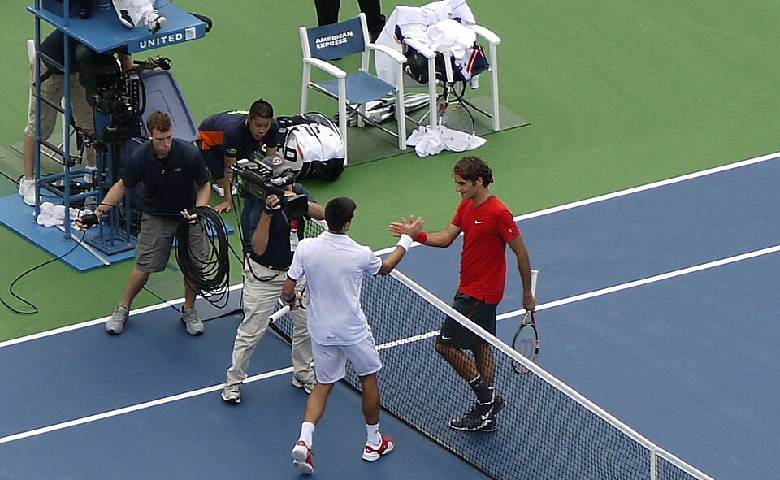
Djokovic and Federer at the US Open 2011; photo source - White House
However, tennis analysts point out that Federer’s slice and chip were like invisible threads, pulling opponents exactly where he wanted them. He understood how to stretch the court vertically, using depth and height in ways Alcaraz has not mastered yet.
With that soft, angled chip, Federer would lure opponents forward and then glide a passing shot ruthlessly to win the point. The slice is a low-skidding, biting shot that wasn’t just defensive; it was a weapon with teeth.
Further, he had drop volleys and stop volleys that were played with a delicacy no one else on tour could match. The drop shot he deployed was pure feel, a whisper off the strings, and when it came to touch, it was hard to argue that anyone could surpass Federer, including Carlos Alcaraz.
According to statistics, at age 22, Carlos Alcaraz is at the top, having won seven Grand Slams across all surfaces — two US Opens, two Wimbledon titles, one French Open and one Australian Open. Rafael Nadal had won six Grand Slams, including four French Opens, one Wimbledon and one Australian Open.
Roger Federer had won three, including one Australian Open and two Wimbledon titles. Novak Djokovic had won only one Grand Slam title, the Australian Open, by that age. Jannik Sinner, Carlos Alcaraz’s current biggest rival, had not won a major title at 22.
For Djokovic to win his 25th Grand Slam is becoming a mounting challenge, as he needs to make a deep run in major championships and defeat both Alcaraz and Sinner, who will be waiting for him in the semi-final and final.
Alcaraz and Sinner have established a firm duopoly, largely since 2024, splitting 4 major championships each, with Sinner winning two Australian Opens, one Wimbledon and one US Open. Alcaraz won two French Opens, one Wimbledon and one US Open.
Djokovic finally broke the duopoly when he defeated Sinner in a five-set classic, 3-6, 6-3, 4-6, 6-4, 6-4, in an enthralling semi-final at the Australian Open. Although the epic victory took Djokovic back to 2012, when he won the marathon final against Rafael Nadal, he perhaps ran out of gas against Alcaraz.
Returning to the two-horse race witnessed in 2024 and 2025, which cemented a generational shift at the sport’s pinnacle, the modern duopoly was evident at last year’s French Open, when Alcaraz edged Sinner 4-6, 6-7, 6-4, 7-6, 7-6 to win the final.
Tennis has evolved, with Alcaraz and Sinner setting a new standard: faster rallies, heavier shots, more athletic movement, and relentless pressure from the baseline. Leading former players disagree on whether Alcaraz and Sinner are better than Federer, Nadal and Djokovic.
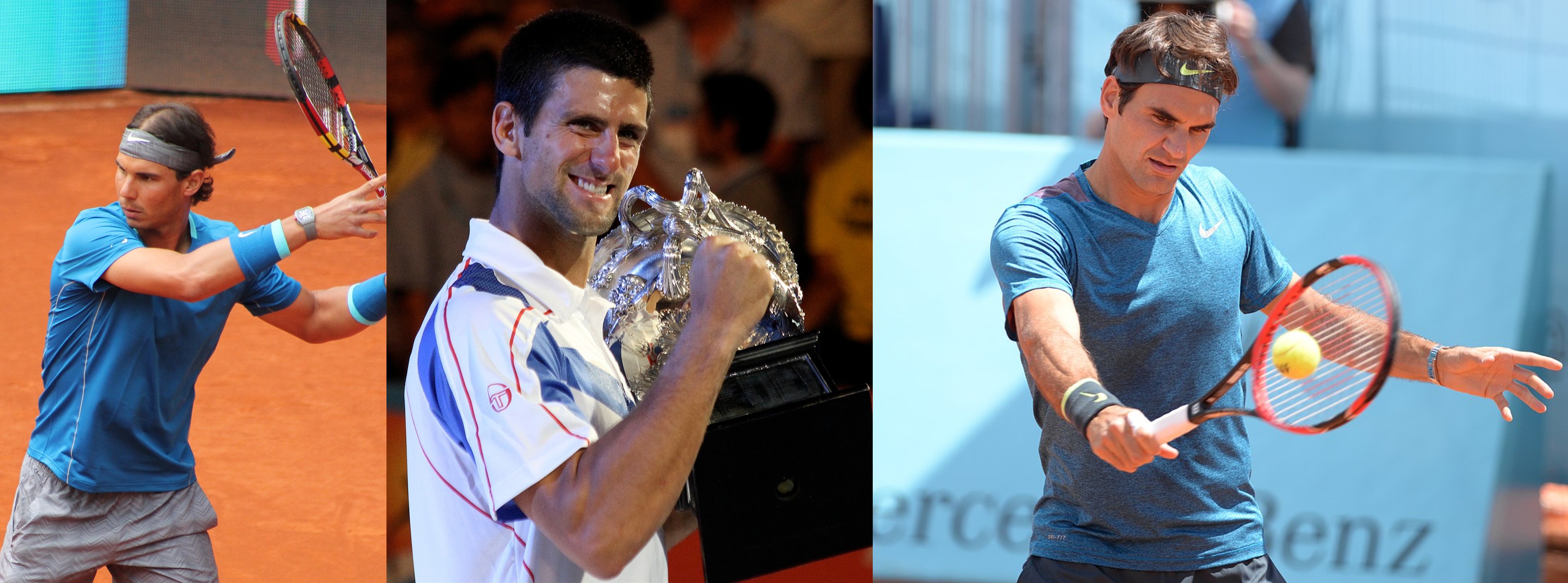
The Big Three - Rafael Nadal (left), Novak Djokovic (centre), and Roger Federer (right); photo source - Wikimedia Commons
Many of the veterans feel that the Big 3 – Federer, Djokovic and Nadal – dominated tennis for two decades, winning all the biggest titles year after year, while the duopoly reign is just two to three years old, and will need to maintain this dominance for another 10 years. Such a long journey and mental toughness will be the key in deciding who is greater in tennis history.
In the quarter finals of the Australian Open last year, the 37-year-old Djokovic had beaten Alcaraz 4-6, 6-4, 6-3, 6-4. Considering the head-to-head record, Djokovic and Alcaraz are even at 5-5, while Alcaraz has a 6-5 margin in head-to-head encounters.
Critics point out that if a 37-year-old Djokovic can beat Alcaraz, a 38-year-old Djokovic can beat Sinner, making it even more challenging for Alcaraz and Sinner to defeat a much younger version of Djokovic, Nadal or Federer, who have won 66 Grand Slams over two decades.
Sports commentators say it is unfair to compare generations. The evolution of tennis racquets from wooden frames used in the Bjorn Borg era to today’s powerful graphite-and-composite designs has reshaped the sport in dramatic ways.
Early wooden racquets had tiny sweet spots and demanded precision and touch, favouring serve-and-volley players and finesse at the net. The shift to metal and then graphite frames in the late twentieth century made racquets lighter, stiffer, and more durable, allowing players to swing faster and generate far more power and topspin.

The Big Two - Carlos Alcaraz (left) and Jannik Sinner (right); photo source - Wikimedia Commons
Larger head sizes and advanced string materials further enhanced control and spin, helping baseline rallies become longer, heavier, and more physical. As a result, modern tennis is played from deeper positions with explosive groundstrokes, extreme angles, and athletic defence that would have been nearly impossible with wooden equipment.
Racquet technology did not just improve performance; it fundamentally changed the tactics and movement patterns of elite players.
The Australian Open was one of the biggest bets for Novak Djokovic to win a historic 25th Grand Slam, and he had the full momentum after getting past Sinner in the semi-final.
Notwithstanding the loss to Alcaraz, not many feel that the sun has set on Djokovic’s career yet, although the French Open may be more challenging. It is commendable that, at age 38, Djokovic is still vying for the top prizes and making deep runs in Grand Slams.
Yet, it is beyond doubt that the new generation has dawned in the tennis world and that the veterans will have to give way. Alcaraz’s achievements at 22 are not just inspiring for his contemporaries but also to the younger generations with a passion for the game.
Similarly, the game also must go beyond the Alcaraz-Sinner binary with more champions needed to be produced in order to ensure greater sporting depth to the game as well as its Grand Slam tourneys.
Follow us on WhatsApp
Follow us on Facebook
Follow us on X @vudmedia
Follow us on Substack


