
Note from Team-The Polity: During the 2018 floods that swept Kerala, a woman from Gujarat made a controversial tweet stating, “let the beef-eating people suffer.” There were other conversations of a similar nature beaming across the social media space. Beyond the essential question of respecting the culinary traditions or cultural practices of other regions, such pronouncements not only reinforced the hate-culture already spreading across the nation but also illustrated the attempts of a dominant section to dictate the nation’s cultural definitions and impose a unitary identity.
Kerala Story-2, a movie sequel to the first edition of the same name, comes in this list of targeted attacks aimed at what could be described as the ‘Idea of Kerala’ – as the syncretic cradle of religious traditions, be it Christianity, peaceful Islam or Advaita Hinduism. In the post-Babri Masjid churning, the state too saw the surge of Islamist fundamentalism, which culminated in fringe groups attempting to brainwash and recruit youth for domestic and global terror campaigns. While a case of around two dozen youths being recruited/indoctrinated to join a foreign terrorist group, along with the suspicious activities of an Islamist NGO, were blown out of proportion as a 30,000 count in the first part of the movie, the sequel’s trailer came with an atrocious claim of meat being force-fed on allegedly ‘converted’ women.
The disconcerting aspect was not just the outright approval for this evidently propaganda movie by the Central Board of Film Certification, but the High Court's failure to consider the inherent malice in the theme and apparent political agenda behind this venture. The larger concern is about the ruling regime and its political affiliates treating such creative platforms as means to create polarisation in the Kerala society, in order to make political inroads, which, in turn, could create a hate campaign against the people of the state. Equally unsettling is the alleged collusive approach of the ruling Left Front, with its supposed resistance to Fascism clouded by an apparent ‘soft Hindutva’ push.
While the BJP, as a national party, has all the merits to carve a political space in Kerala, such efforts cannot ride on the tentacles of a saffronisation campaign that relies on the tools of hate and building discord within and against the populace and communities of the state. Here is a detailed report by Rejimon Kuttapan.
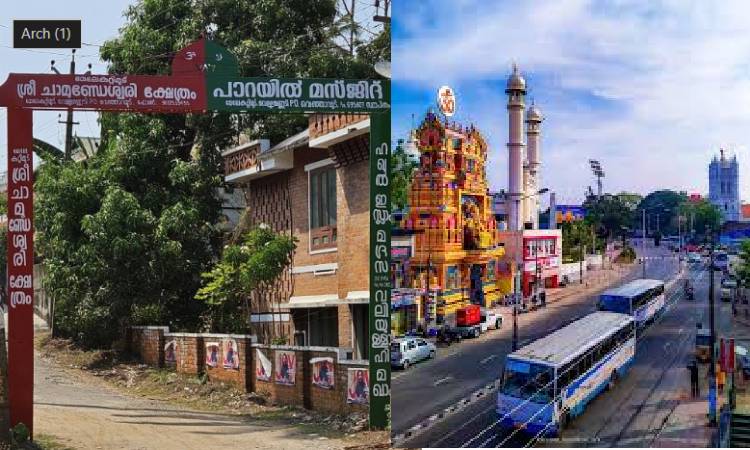
Text page image: A temple and masjid in Thiruvananthapuram share a common archway (left), and the Palayam area in Thiruvananthapuram city, where a temple, mosque and church remain side-by-side; photo source 1- Rajib Chaudhury
Banner image: Glimpses of harmony - A Sabarimala pilgrim greeted by a Muslim cleric, a woman in Hijab relishing Onam feast, a Christian nun preparing the flower spread for Onam, and a Christian nun guiding students performing an Islamic art form; photo source 1- Sabrang India
In India’s increasingly fractured democracy, cinema has transcended its role as entertainment to become a calculated instrument of ideological warfare. Narratives are no longer crafted merely for artistic merit or box-office success; they are engineered to consolidate majoritarian power, exploit societal anxieties, and vilify minorities as well as their cultural traditions.
The Kerala Story franchise stands as a textbook case of this weaponisation, peddling Hindutva conspiracy theories under the thin veneer of a patriotic exposé. Yet, the tragedy of this cinematic assault is matched by a political one: the creeping ideological capitulation of Kerala’s ruling Left Democratic Front (LDF) in the face of a rising saffron tide.
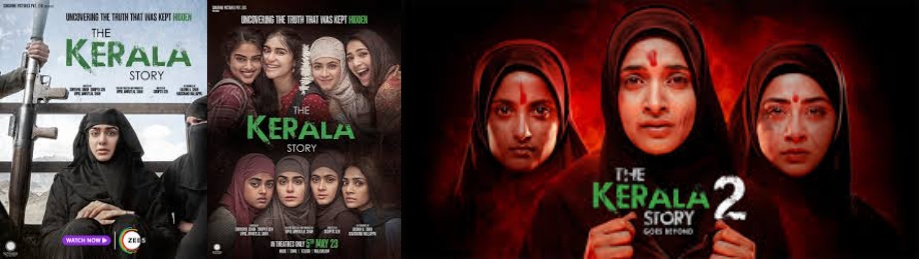
Posters of the Kerala Story franchise, photo source - Wikimedia Commons
The propaganda machinery
The 2023 original, directed by Sudipto Sen and produced by Vipul Amrutlal Shah, aggressively amplified the “love jihad” myth—the discredited notion of orchestrated seduction, conversion, and radicalisation of non-Muslim women, initially as an alleged campaign originating in Kerala to join the ranks Islamic State of Iraq and the Levant (ISIS), and, later, propagated as a concerted conversion campaign pursued across the country.
The teaser of the first Kerala Story movie peddled the outright fabrication that 32,000 Kerala women were victims. Though this claim was debunked and withdrawn after judicial scrutiny and public outcry, the damage was already done with the propaganda machinery portraying the fabricated theory as a truism among major sections of the populace.
Bolstered by tax exemptions in the states ruled by the Bharatiya Janata Party (BJP), and an endorsement from Prime Minister Narendra Modi—who labelled the film as a revelation of “a new form of terrorism”—the controversy translated into electoral fuel and a commercial windfall of over INR 300 crore.
The sequel, The Kerala Story 2: Goes Beyond, directed by Kamakhya Narayan Singh and released on February 27, 2026, intensifies this smear campaign. Despite expanding its plot to cities like Jodhpur and Gwalior, the franchise stubbornly retains “Kerala” in its title, sustaining the targeted vilification of the state.
The sequel follows three women—Surekha from Kochi, Divya from Jodhpur, and Neha from Gwalior—who are manipulated by Muslim men into religious conversion and captivity.
The film eschews nuance for megaphone propaganda. It introduces the inflammatory trope of “Ghazwa-e-Hind 2047,” features extrajudicial “bulldozer justice” as a cathartic resolution, and employs strident background poetry invoking “Babur and Aurangzeb” to target a single community.
The legal battle surrounding its release was fierce. On February 26, 2026 (adjusted for the timeline), a single-judge Kerala High Court bench, led by Justice Bechu Kurian Thomas, imposed an interim stay of 15 days on its release, flagging prima facie risks of communal disharmony and questions over the Central Board of Film Certification's (CBFC) U/A certificate.
However, a division bench comprising Justices Sushrut Arvind Dharmadhikari and P.V. Balakrishnan swiftly vacated the stay on February 27, permitting a nationwide release on grounds of avoiding pre-censorship and citing precedents like Padmaavat and Aarakshan on free expression.
Notably, Justice Sushrut Arvind Dharmadhikari, who was part of the division bench that cleared the film, was recommended by the Supreme Court Collegium shortly after (around February 26-27, 2026) for elevation as Chief Justice of the Madras High Court, to assume charge around March 6, 2026.
This rapid sequence has fueled perceptions among critics that the film functions as part of a broader political strategy, potentially enabled by judicial insensitivity or alignment in high-stakes ideological cases.
While Day 1 box office figures were muted at around INR 0.75 crore (due to limited evening shows and initial disruptions), controversy-driven momentum sparked a sharp 520 per cent surge on Day 2, raking in approximately INR 4.65 crore domestically (total ~INR 5.4 crore over two days).

The broader ecosystem
The Kerala Story franchise does not exist in a vacuum; its trajectory aligns seamlessly with a broader, deliberate ecosystem of Hindutva-aligned cinema designed to fuse hyper-nationalism with sectarian framing for electoral dividends.
Over the past few years, the silver screen has been systematically transformed into an ideological battleground. Films like The Kashmir Files (2022) weaponised the undeniable trauma of the exodus of Kashmiri Pandits to foster the contemporary anti-Muslim animus, setting a polarising template that others eagerly followed.
This cinematic machinery routinely flattens complex geopolitics into state-sanctioned triumphalism, as seen in Article 370 (2024), and violently silences marginalised indigenous voices by reducing tribal struggles to a purely security-state perspective in Bastar: The Naxal Story (2024). Simultaneously, it mainstreams right-wing historical revisionism through biographical glorifications like Swatantrya Veer Savarkar (2024).
Even high-octane military spectacles such as Uri and Fighter have been drafted into this cultural project, seamlessly blending legitimate armed forces' valour with muscular majoritarian rhetoric. Together, these films do not merely reflect the current political climate—they actively manufacture the cultural consent required to sustain it.
In the lead-up to the 2026 Assembly elections in Kerala, this cinematic ecosystem persists, receiving immense state patronage and amplifying the narrative that the Hindu majority is under constant, existential siege.

The saffron surge
Kerala has long prided itself as an impenetrable fortress against majoritarianism, but beneath this secular veneer, Hindutva’s organisational inroads have accelerated at an alarming pace.
Over the years, the Rashtriya Swayamsevak Sangh (RSS) has methodically deepened its footprint through grassroots welfare programmes, temple-centric mobilisation, and relentless local propaganda, laying the groundwork for a political shift that is now impossible to ignore.
The first undeniable crack in the fortress appeared during the 2024 Lok Sabha elections, when actor-turned-politician Suresh Gopi’s historic victory in Thrissur elevated the BJP’s state vote share to a formidable 16.68 per cent.
Yet, it was the December 2025 local body polls that delivered a seismic shock to the state’s political establishment: the NDA captured the Thiruvananthapuram Municipal Corporation, securing 50 out of 101 seats and effectively dismantling over four decades of the Left Democratic Front (LDF) dominance in the state’s capital city.
The subsequent election of BJP’s V.V. Rajesh as Mayor signals a massive urban consolidation for the right wing, but perhaps more concerning for the traditional fronts are the shifting demographic loyalties.
By tactically exploiting localised grievances—such as the Munambam Waqf dispute in Christian-majority pockets of Ernakulam—and penetrating Muslim-majority wards in Thrissur, the BJP has shattered the myth of an exclusionary Hindu-only appeal.
As the critical April 2026 Assembly elections loom, the BJP has not merely arrived; it has cemented itself as a highly credible third force, capitalising on severe LDF anti-incumbency to position the NDA as a viable, formidable alternative in a state that once thought itself immune to the saffron tide.
The Left's ideological capitulation
How has Kerala’s ruling Left responded to this existential threat? The LDF's approach to The Kerala Story 2 epitomises a disturbing pattern of ideological capitulation disguised as electoral pragmatism.
Initially, Chief Minister Pinarayi Vijayan issued sharp pre-release condemnations, denouncing the sequel’s teaser as a deliberate hate campaign designed to spread division, but, noticeably, preferring not to mount a legal challenge to the movie.
Once the judiciary cleared the film, the LDF’s fiery anti-fascist rhetoric faded into a tactical silence. There were no mass mobilisations, no sustained protests, and no administrative interventions. The Left is acutely aware that the BJP’s vote share has tripled since 2009.
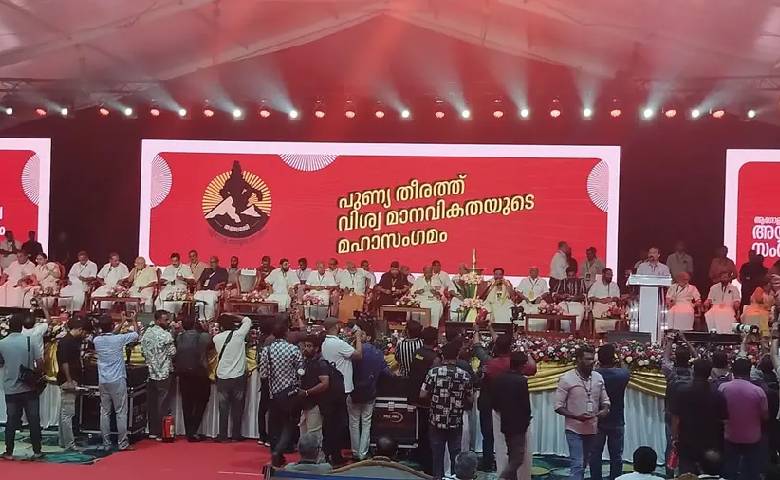 The Global Ayyappa Sanghamam, supported by the Kerala Government; photo source - Deshabhimani
Confrontation risks entrenching the “anti-Hindu” label that the RSS has tried to paste on the LDF ever since the 2018 Sabarimala protests—a crisis where the Left initially championed women’s entry, only to disastrously retreat under right-wing pressure.
This ideological surrender extends beyond cinema. In September 2025, the government endorsed the Global Ayyappa Sangamam, a massive mobilisation involving influential caste organisations like the Nair Service Society (NSS) and Sree Narayana Dharma Paripalana (SNDP) Yogam.
The event even featured a supportive message from Uttar Pradesh Chief Minister Yogi Adityanath, fueling Opposition claims of a tacit understanding between the LDF and BJP aimed at marginalising the Congress-led UDF.
A more glaring compromise occurred in October 2025 regarding the education sector, wherein Kerala has consistently resisted the alleged “saffronisation of education” and rewriting of history books. Faced with a severe financial crunch, the Kerala government signed a Memorandum of Understanding (MoU) with the Union government to implement the PM SHRI schools scheme. By signing, the state secured INR 1,476 crore in blocked funds, but at a massive ideological cost.
Allies, including State Secretary of the Communist Party of India (CPI) Binoy Viswom, publicly blasted the CPI(M) for unilateral decision-making, deriding the move as the implementation of a “Nagpur education policy” that facilitates the saffronisation of secular education.
General Education Minister V. Sivankutty defended it as a “tactical” move to reclaim rightful funds, but to the electorate, it looks remarkably like fiscal submission.
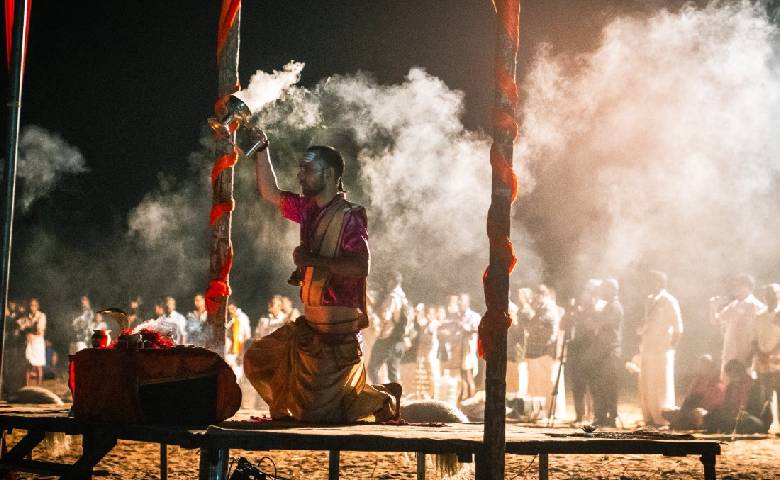
The Nila Arati during the Kerala Kumbh Mela; photo source - Mahamagam
With evident mobilisation from Sangh Parivar affiliates, topped up by endorsements from the Prime Minister and the Kerala BJP chief, the Mela’s highlights included ritualistic dip in the Nila River and Aarti, resembling the rituals along the Ganges.
However, the political undertone of the Kerala Kumbh revolved around the CPM’s tacit approval to cultural extravaganza that many saw not just as adopting the religious symbolism of North India but also carrying clear Hindutva imprints. With the state’s Devasom (Hindu religious affairs) minister, V.N. Vasavan, being an official patron of the Kumbh Mela, the Opposition saw it as evidence of a ‘soft Hindutva’ push by the CPM, on the lines of the Global Ayyappa Sanghamam.
The expanding threat
On the other hand, the Kerala Story franchise’s narrative risks spilling beyond Kerala's borders over into real-world targeting of Malayalis (non-resident Keralites) in other parts of India. Kerala’s cultural acceptance of beef consumption—rooted in diverse culinary traditions across communities—has long been stereotyped in majoritarian discourses as emblematic of “anti-Hindu” practices.
In a climate where cow vigilante violence has disproportionately targeted Muslims and Dalits over suspicions of beef-related activities (with documented lynchings, assaults, and harassment in states like Uttar Pradesh, Haryana, and Rajasthan), a similar pattern could emerge against Malayalis.
Narratives portraying Keralites as habitual “beef-eaters” are gaining traction in certain online and political circles, potentially framing them as threats in the same vein as minorities accused of cow slaughter or related offences.
Given existing precedents—where individuals have been waylaid, attacked, or worse on mere allegations of beef involvement—it is not difficult to envision non-resident Keralites facing confrontations, mob violence, or vigilante harassment in northern or central India.
Such targeting would amount to an indirect assault on Kerala’s people and identity, extending the film’s divisive propaganda into physical peril for migrants and travellers.
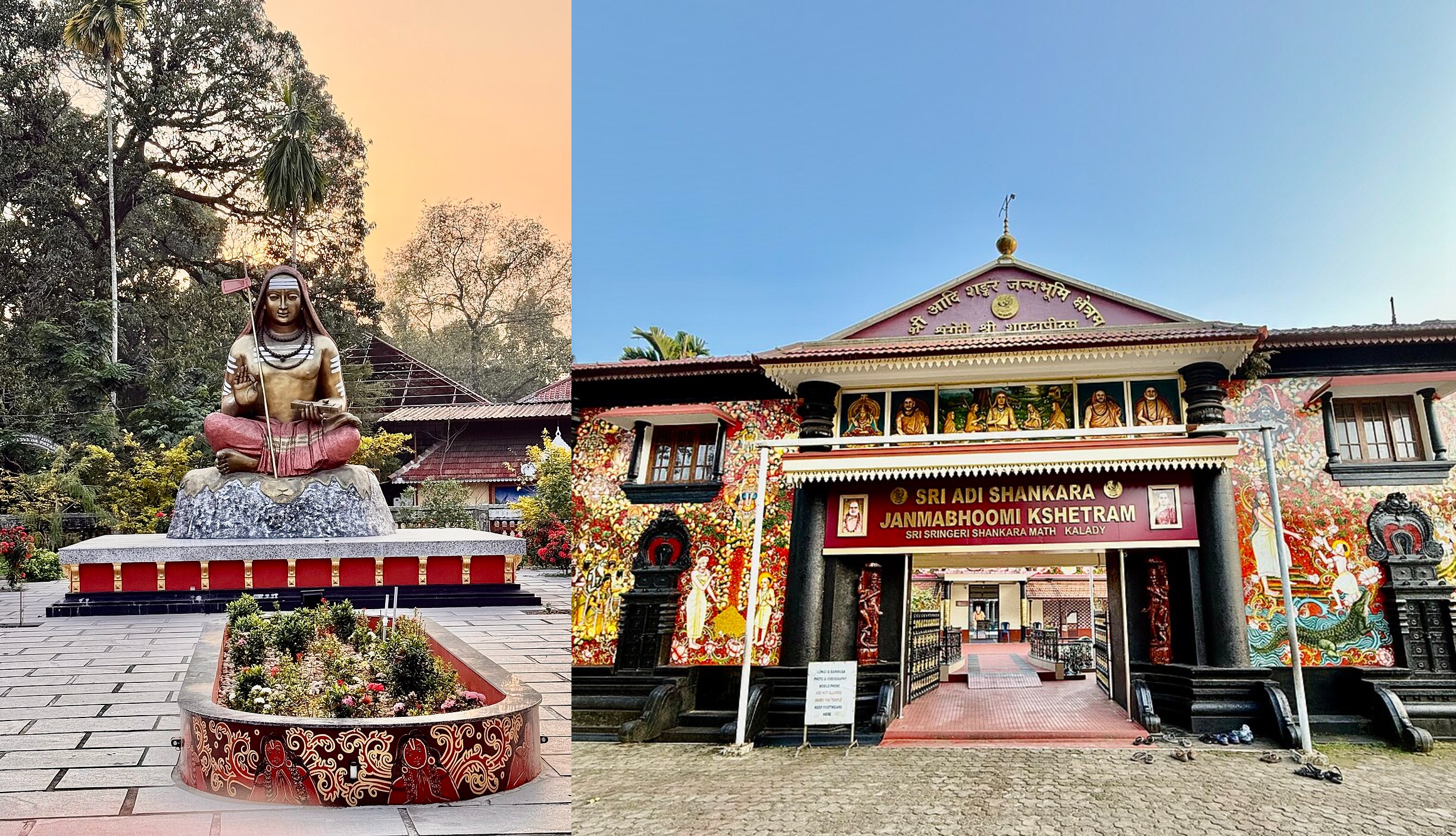
A statue of Adi Shankara (left) and the Sri Adi Shankara Janmabhoomi Kshetram (right), both in Kalady, Kerala; photo source - Wikimedia Commons
The ‘idea’ of Kerala
Despite aggressive political narratives attempting to fracture its identity, Kerala’s lived reality remains a powerful testament to an enduring, organic secular harmony. Long before modern constitutions codified religious pluralism, this coastal state served as a maritime crucible of coexistence.
It is the birthplace of the great philosopher Adi Shankara, whose profound Hindu tradition of non-dualism emerged from the very same soil that welcomed Saint Thomas the Apostle in 52 CE, planting the roots of Christianity centuries before it reached parts of Europe.
Kerala is also the land of Cheraman Perumal, the legendary Chera king whose storied embrace of Islam facilitated the construction of the historic Cheraman Juma Masjid in 629 CE. Here, Abrahamic faiths took root not through the sword of conquest, but through the vibrant trade of the Spice Route and the willing patronage of local Hindu rulers.
This ancient syncretism is not just historical trivia; it is a living, breathing practice etched into the state’s cultural fabric and spiritual geography. Perhaps nowhere is this unity more striking than in the pilgrimage to Sabarimala, where millions of Hindu devotees of Lord Ayyappa traditionally first seek the blessings of his legendary Muslim comrade, Vavar Swami, at the Erumely mosque.
This shared devotion is mirrored in the state’s architecture and neighbourhoods, where early Syrian churches seamlessly adopted traditional Hindu temple aesthetics, and where diverse places of worship stand shoulder-to-shoulder in areas like Palayam in the capital city, Thiruvananthapuram.
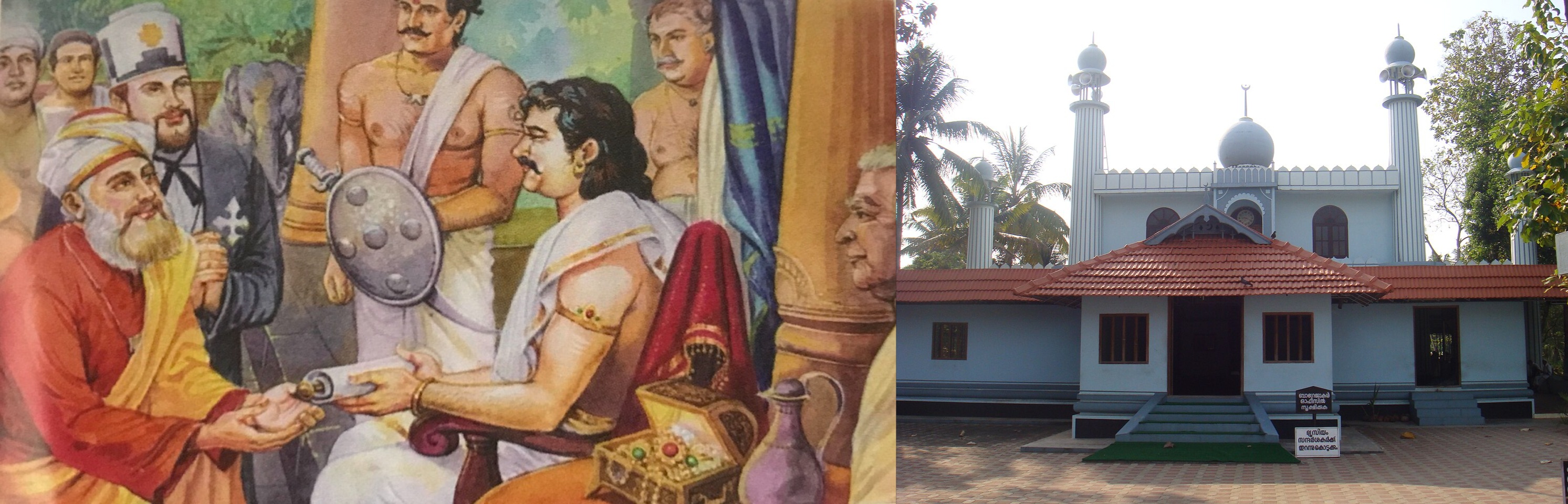
Thomas of Cana receives privileges from Cheraman Perumal (left), and the Cheraman Masjid (right); photo source - Kerala Tourism and Wikimedia Commons
Ultimately, Kerala proves that true secularism is not a fragile political construct but a resilient daily practice—a shared inheritance lived out organically every day in the bustling chayakadas (tea shops) and vibrant streets of the state.
A striking illustration of this organic coexistence emerged ahead of the Attukal Pongala on March 3, 2026. Often dubbed the “Women's Sabarimala,” this massive Hindu gathering coincided with the Islamic holy month of Ramadan.
During his Friday sermon, Palayam Juma Masjid Imam Dr V.P. Suhaib Moulavi made a passionate, viral appeal to the Muslim community. He urged them to serve as the “best hosts” to the lakhs of Hindu women and children arriving in the capital, calling on Muslims to open their mosques and homes to provide food, drinking water, and resting facilities.
"We are in Ramadan and observing fast," Moulavi stated. "But those who come for Pongala will be tired and thirsty... This is an occasion to openly demonstrate our love and brotherhood. It is only through love and fraternity that we can resist Islamophobia and hatred."
This was not an isolated gesture. It builds on decades of tradition, such as the historic Valiyapalli Muslim Jamath mosque in Manacaud, which routinely opens its expansive grounds to provide succour, water, and emergency medical space for Pongala devotees.
Such reciprocal acts—rooted deeply in civic service and mutual respect—vividly expose the chasm between the cinematic inventions of communal threat and Kerala's authentic interfaith bonds.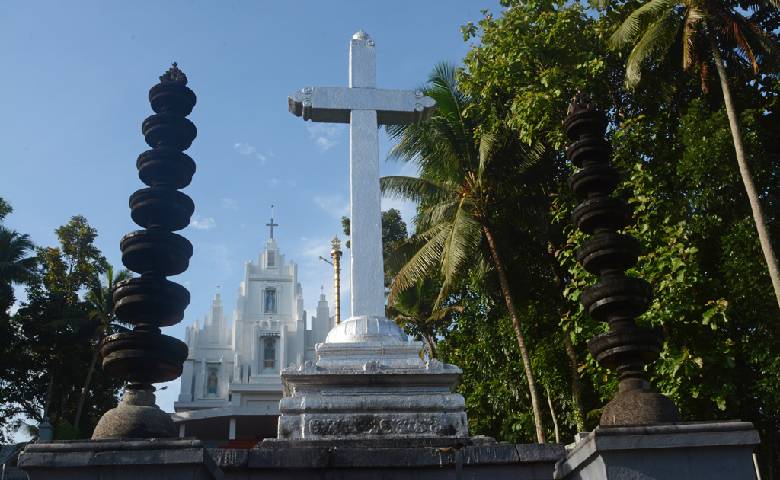 The Holy Magi Forane Church in Manimala. Notice the stone lamps, which are used in Kerala's Hindu temples as well
The road ahead
As the 2026 Assembly polls loom, the Kerala Story saga crystallises an existential battle: cinematic majoritarianism versus lived pluralism. The Hindutva brigade’s objective might be evident: fragmentation. Through films, welfare politics, and wedge issues—including potential spillover violence against Keralites elsewhere—the larger strategy could be to dismantle the social fabric and polarise communities.
The LDF’s current pattern—delivering fiery anti-fascist rhetoric on paper while executing tactical, right-leaning accommodations in practice—breeds incoherence and actively cedes ideological terrain. Yielding to organised propaganda and political opportunism will only impoverish the state.
Ultimately, the defence of Kerala’s secular ethos will not come from pragmatic politicians or court rulings, but from civil society. The authentic Kerala story thrives in interfaith hospitality, fact-based resistance, and civic solidarity—proving that lived truth is always far stronger than divisive fiction.
Follow us on WhatsApp
Follow us on Facebook
Follow us on X @vudmedia
Follow us on Substack

.jpg)
