
Eventually, the much-touted ‘inner-party democracy’ in India’s grand old party, the Indian National Congress (INC), turned out to be a fallacy and the imprimatur for free and fair elections to the presidency of the party promising to be an incredulous affair.
The party’s high command, spearheaded by the Gandhi family, has pre-emptively plotted the outcome of the election by orchestrating the entry of an establishmentarian and family loyalist into the fray as an unofficial nominee. While the country is made to believe that a legitimate contest is in the offing to elect a president, the first time since 1997 when even a meaningful contest looked possible, the Gandhis' have already signaled to the cadre and the electorate of the party on who their choice is.
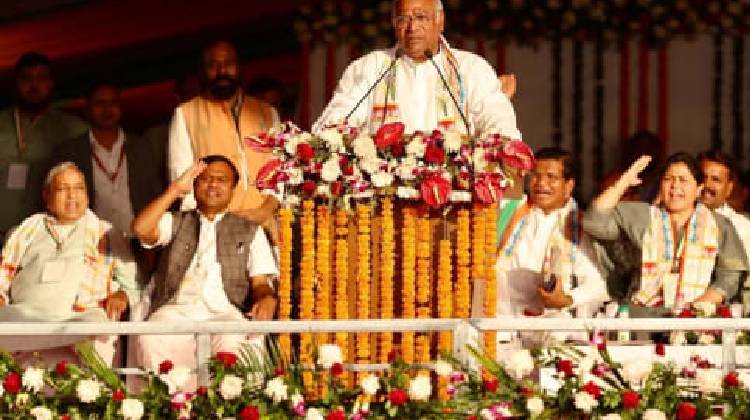
The decision to prop up the 80-year-old veteran, Malikarjun Kharge, to take on the Modi juggernaut and the cash-rich BJP machinery surely exposes the Gandhi family’s disinclination to shed control over the party even when exuding a grand renunciation posturing.
The question, though, remains moot on what the Gandhi family intends to achieve through this back-room manoeuvring. Is it sustenance of the status quo through a puppet presidency and another half-hearted shy at organizational revamp, in order to silence in-house critics like G-23? If so, are the Gandhis' laying the ground for another rout in 2024?
Rather, the strategy seems to be laid bare: the party will fight the 2024 Lok Sabha elections with Rahul Gandhi as the mascot who could take on Narendra Modi as the prime ministerial contender. This is despite the repeated rejections that the Gandhi scion has been facing at the hustings since 2014. The high command hopes to reverse this trend with the ongoing Bharat Jodo yatra, whose key objective seems to be the resurrection of Rahul Gandhi. The presidential choice had to be someone who fits well into this agenda.
The aborted attempt to foist Ashok Gehlot at the helm was seemingly driven by the calculation that as a street-smart politician, he could revive the party’s fortunes in the Hindi belt, even if in limited terms, and yet at the same time play second fiddle to Rahul Gandhi in the 2024 campaign. Sashi Tharoor, on the other hand, seeking to retain his individualism and autonomous identity within the party, has far greater appeal and sway among the youth and the middle class, the same constituencies that Rahul Gandhi wants to woo in the run-up to 2024.
With the rebellion in the Rajasthan Congress putting a spanner in the Gehlot plan, the Gandhis' had to eventually scramble to find a worthy choice, with the sole pre-requisite being a person who could toe the family’s line irrespective of whether he or she is capable of reviving the fortunes of the ailing party, particularly in the Hindi belt.
Needless to say, the eventual choice comes across as a grave disappointment. At 80, Kharge has long crossed the threshold that Narendra Modi has already set as a benchmark for leaders in India to retire from active politics. The sulking middle class reeling under the perennial burden of inflation and the restless youth brigade who find their job avenues being increasingly eaten up in the name of systemic reforms can see little in terms of hope from Kharge as someone who could galvanise the party to take on the might of the BJP.
Kharge’s rise on the national scene and subsequent ascent among the oligarchic veterans came only after Sonia Gandhi decided to deny Kamal Nath the leadership of the party in the Lok Sabha following the 2014 debacle despite the latter being the senior-most party member in the house. Despite losing his seat in the 2019 Lok Sabha elections by a huge margin, it was only his loyalty to 10 Janpath that ensured Kharge’s return to the Parliament as a Rajya Sabha member.
The eventual election of Kharge as INC president will signal to the nation that the Gandhis' continue to reward loyalty over merit. Worse this could prove for the party at a time when attacks on political dynasties remain the bulwark of top BJP leadership’s campaign against the opposition. Kharge’s victory will merely reinforce the perception that the Gandhis' solely seek to preserve their own interests rather than preparing the party to provide a formidable alternative to the BJP in 2024.
Tharoor was a welcome change the party needed
When Tharoor faced his first parliamentary elections in 2009, it was widely speculated that his performance and anticipated success will be a litmus test for professionals of various hues who aspire for lateral entry into politics. Over a decade later, few in the country will dispute the fact that Tharoor has passed the test with flying colours.
Even while straddling multiple roles of a public intellectual and an erudite author who continues to churn out best-selling books by the dozens, Tharoor had effectively managed to remain a 24x7 parliamentarian who could retain the loyalty of his voters despite changing political tides and at the same time also excelling as an influential voice on the national scene.
Having scored three consecutive victories from Thiruvananthapuram, the second one coming months after the infamy caused by Sunanda Tharoor’s death, an event which propelled quite a few political obituaries, Tharoor’s evolution as a seasoned politician with well-articulated, and often bipartisan, positions on major policy and political issues not just sweetened his success story but also represented a contrarian narrative to the conventional political culture.
If Modi had changed the character of politics in the country, Tharoor redefined how politicians had to engage with the polity.
No wonder then that his potent detractors are now from his own party, and significantly from his own state where his party colleagues regularly feel intimidated by his intellectualism and mass appeal. The disdain for his candidature, though coming on expected lines following the general trend of endorsing the ‘family’ nominee, has veered towards iterating Tharoor’s exogenetic political existence despite his stellar contributions to the nation for over a decade.
Yet, it stuns the party cadre in his home state that the local leadership has effectively scuttled the historic chance of facilitating the first Keralite president of the Indian National Congress in 125 years. The only such instance in the history of the party was the elevation of C Sankaran Nair to the post at the Amaravati session in 1897 for a one-year tenure. While a section of the party cadre in Kerala has already made their disapproval of the local leadership’s position clear, the arguments made against Tharoor by the Kerala leaders only add to their chagrin.
A foremost contention is that Tharoor has weak connections with the grassroots and ordinary citizens. This, incidentally, is being said about a leader who, besides introducing Indians to the ‘tweet’ revolution, has most effectively used social media and other public platforms in directly conversing with the people beyond the confines of party and ideologies affinities. Similarly, another senior Kerala leader lamented that Tharoor has little organizational basing though without explaining where Tharoor had failed on the trifle few organizational responsibilities ever entrusted to him or where, in turn, Kharge has made radical contributions to organizational building.
Such incongruities apart, the emergent trend that is evident in the run-up to the presidential election is the increasing gap between the aspirations of the cadre, who overwhelmingly desire a strengthened party with a visionary president at the helm, and the party’s in-house electorate which will eventually elect the president and evidently one that the Gandhis' have already chosen.
As Kharge is being ushered into the shoes of a national leader and the organizational machinery systematically mobilized to facilitate his victory, the outcome seems fait accompli. The Gandhis' will win, but the party stands to lose!
