

The River of Grey Flowers by Rejimon Kuttappan is a powerful work of faction—fiction that follows five young men trafficked into cyber-scam compounds in Myanmar. The novel traces their journey from marginalised lives in Tamil Nadu to brutal captivity, forced digital fraud, and a perilous escape. Through John’s story, it weaves together love, migration, and systemic exploitation, exposing the indifference that surrounds such disappearances. Blending journalistic precision with lyrical storytelling, the book becomes a haunting exploration of survival, memory, and resistance in a world where the powerless are easily erased.
Felt the river wind cold against my skin. Felt Senthil's voice echo like a heartbeat: 'Everything is possible…when the alternative is death.'
The leader raised his rifle. 'This ends now.'
Before he could fire — a sharp whistle cut through the air. Everyone turned. Downriver, from behind a clump of fallen bamboo, a long wooden boat shot forward — engine roaring, slicing water. A man stood at the bow, waving frantically.
A Burmese smuggler. Or Kathavarayan…
'Run!' he shouted. 'Run to the boat! Now! Quick!'
The militia men stumbled in surprise. The leader snarled, 'Shoot!' Gunfire cracked. Sand exploded around us. I grabbed Bhaskar by the arm. 'Move!' We sprinted towards the speeding boat. Our feet splashed through shallow water as bullets tore into the river surface. Govind slipped. Kumaresan hauled him up. Jyothika staggered, clutching her ribs, but kept running. I grabbed her hand, pulling her faster. 'Don't stop!'
The boatman shouted, 'Jump! Jump!'
Just as I pushed Jyothika towards the boat — a rifle butt slammed into my back. I hit the sand hard. The leader was on me instantly, pressing a boot into my spine, forcing me down. 'You first,' he hissed. 'You die first.'
I gasped, sand filling my mouth. Another guard grabbed Jyothika by the hair. She screamed and kicked, fighting with the last shreds of strength. Govind, trembling, picked up a piece of driftwood and swung at the guard's arm. The blow barely moved him — but it was enough to make him loosen his grip. Jyothika tore herself free, stumbling towards the water.
The boatman fired a warning shot in the air. The militia ducked instinctively. I seized the moment. I rolled to my knees and threw myself into the leader's legs. We both toppled. The rifle fired into the sand, inches from Govind's foot.
Then a sharp cry split the riverbank: 'John!'
Jyothika had turned back. She grabbed a fistful of sand and hurled it into the leader's eyes. He screamed, clutching his face. I surged up and punched him — hard — right across the jaw.
'Go!' I yelled. 'Now!'
Militia reinforcements crashed through the trees. Too many. Far too many. I shoved Jyothika towards the boat. Govind and Bhaskar were already being pulled aboard by the boatman. Kumaresan extended his arm. 'John! Fast!'
Rifle fire erupted. I felt a bullet graze my shoulder — hot, slicing — but I kept running. Kumaresan screamed, 'Jump!'
I sprinted the last few metres, lungs on fire. Behind me, the leader wiped sand from his eyes, raised his rifle, and fired. The bullet streaked past my leg, spinning into the water.
I leapt — and hit the edge of the boat with both hands. Kumaresan and Govind pulled me in. The boatman gunned the engine. The boat surged forward. Bullets chased us across the water, splashing in violent arcs. The river bent. Mist swallowed the boat. The guards disappeared behind the trees.
And we collapsed onto the wooden planks — soaked, shaking, alive. Barely alive.
My hands trembled as I looked back at the vanishing shore. Senthil's blood was still on my shirt. The Moei River carried us away. Toward Thailand. Toward danger. Toward hope. I had my Kathavarayan motif in my hand
—from River of Grey Flowers by Rejimon Kuttappan (Speaking Tiger, 2026)
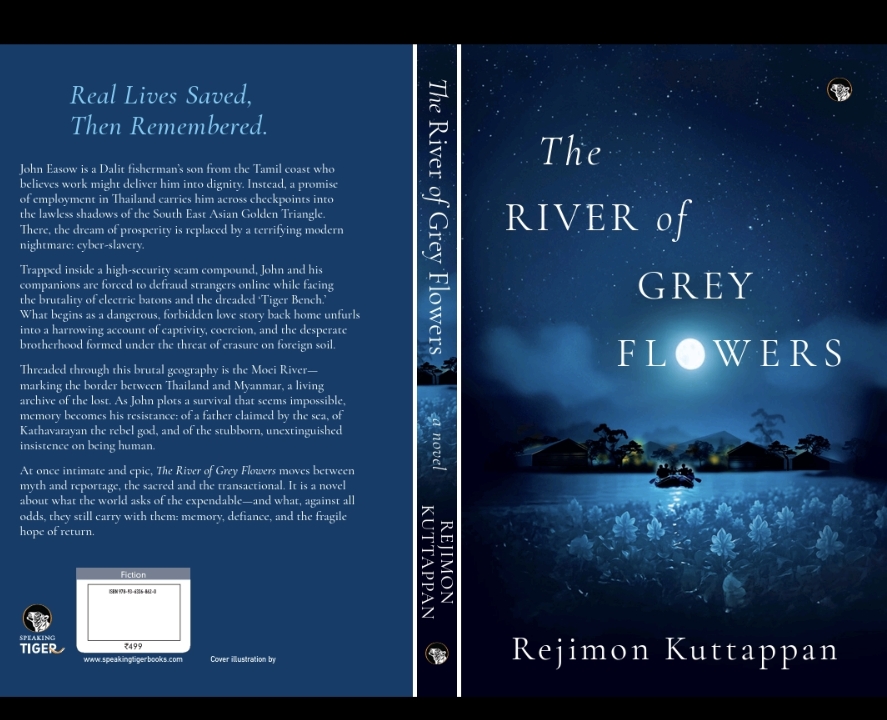
There is a moment early in River of Grey Flowers when five young Tamil men—crammed into the back of a van being driven to a destination they do not yet know is a scam compound in Myanmar—discover, almost by accident, that they are all Dalit.
The revelation arrives not with fanfare but with a quiet, devastating arithmetic: none of them owns land. One had his house burned down in caste riots that never made the news. Another worships Kathavarayan, the protector deity of the dispossessed.
The narrator, John, carries a hand-carved idol of Kathavarayan—the rebel god who loved an upper-caste woman and was beheaded for it. In that moment, caste ceases to be background.
It becomes the engine of the entire novel: the reason these men are in that van, the reason the world does not look for them, and the reason their survival will matter to no one except themselves and the women they left behind.
Rejimon Kuttappan’s debut novel is a work of faction—fiction constructed on the scaffolding of real events.
Kuttappan, an independent journalist and columnist for The Polity, who has spent over fifteen years reporting on labour migration across South East Asia and the Gulf, has since 2022 been directly involved in rescuing people from cyber-fraud compounds in Myanmar, Cambodia, and Laos. He has sat with survivors, heard their testimonies, tracked their ordeals through embassy corridors and family WhatsApp groups.
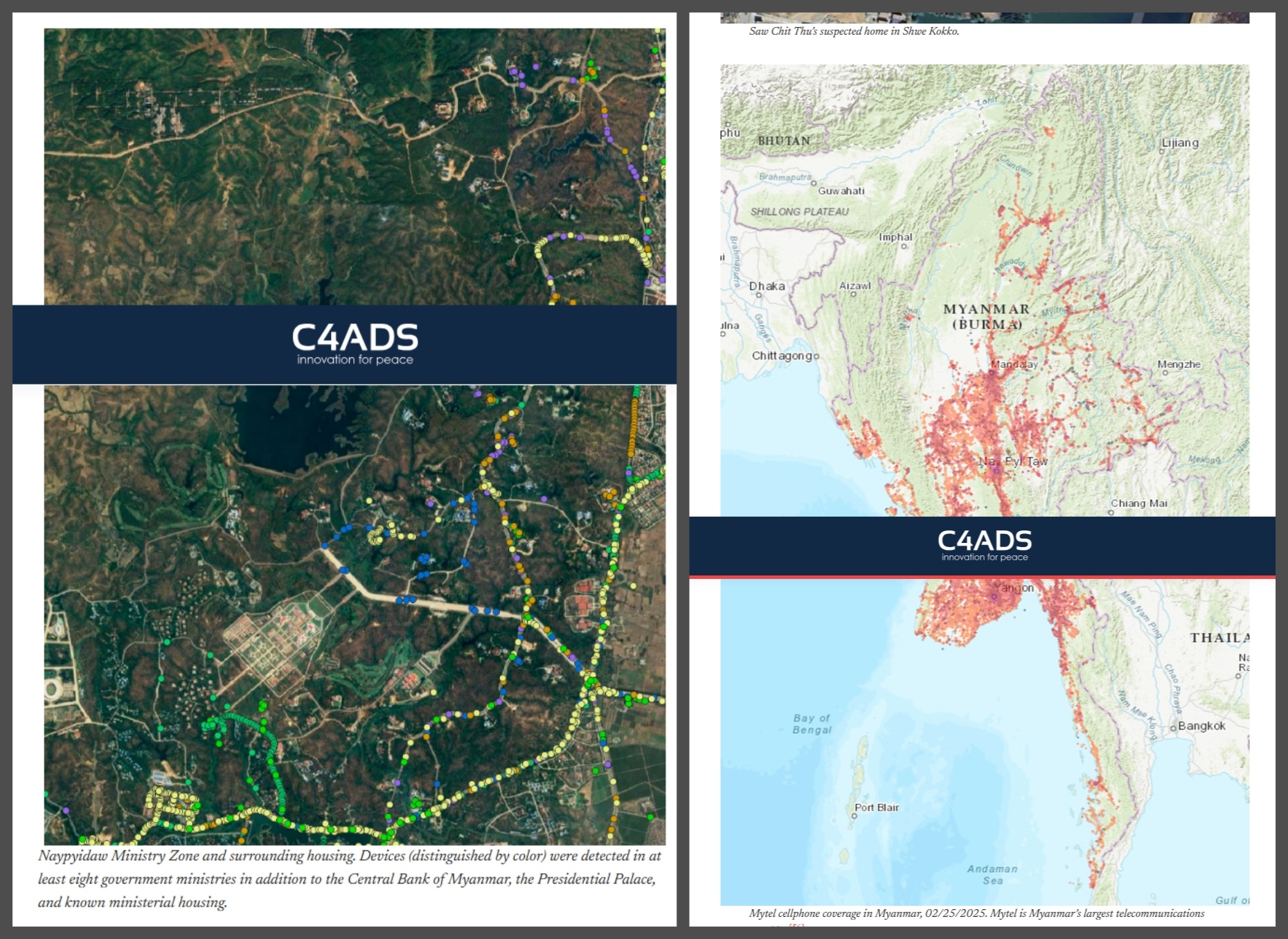
River of Grey Flowers is the novelistic distillation of that work. Every tiger bench in this book has a real counterpart. Everybody who disappears into the Moei River stands for someone whose name was never recorded.
The plot is deceptively simple. John, a young man from Ramanathapuram on the Tamil Nadu coast, lives three lives: graphic designer by day, horse racer on moonless highways by night, turmeric smuggler to Sri Lanka on certain tides.
He falls in love with Thenmozhi, an upper-caste woman—an act of transgression that mirrors his deity Kathavarayan’s doomed love for Aryamala. They elope to Katchatheevu, the disputed island, and barter a boat for their survival.
When caste shuts every door, and his father dies in a Sri Lankan naval prison, John accepts a graphic design job in Dubai. The interview is real. What follows is not. He is routed through Bangkok, driven to Mae Sot, and trafficked across the border into a fortified compound in Myanmar’s Myawaddy.
What Kuttappan does with this premise is extraordinary. He refuses to let the scam compound become a generic site of suffering. Instead, he fills it with the dense, particular textures of lives lived at the margins.
John and his friends—Rajesh, Kumaresan, Govind, Bhaskar—are forced to operate online romance scams, typing manufactured endearments to strangers on the other side of the world.
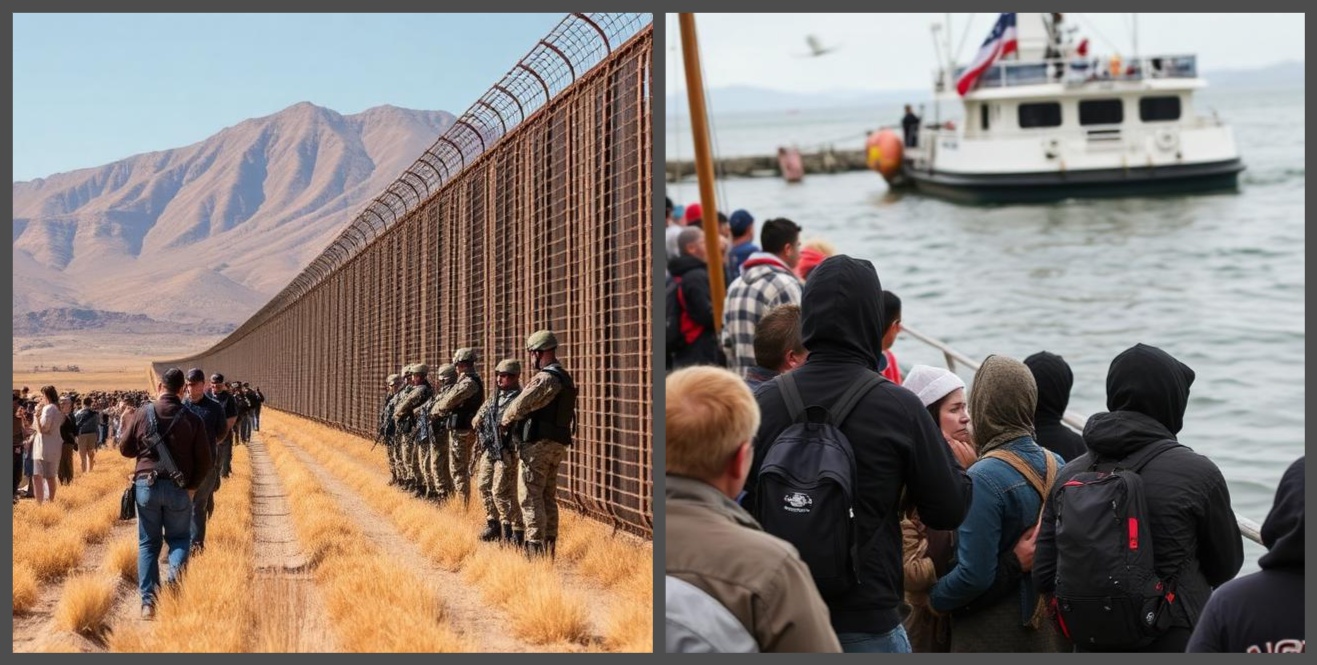
The cruel irony is exquisite: Dalit men who could not love freely in their own villages are now compelled to simulate love as forced labour. They type emojis—hearts, winks, fire—while colleagues scream on torture podiums a few rooms away. The juxtaposition is one of the most unsettling passages in recent Indian fiction.
The novel’s structure mirrors the experience of captivity. Part One opens on the Moei River—John and his friends are already escaping, Senthil bleeding beside him—and then spirals backward through memory. This is not a gimmick. It is how trauma works: the present is always contaminated by the past, and escape never arrives in a straight line.
By the time we reach the tiger bench scene in Part Five, we have already seen its shadow fall across every earlier chapter. The tiger bench itself—an iron-and-wood restraint device in which bricks are progressively stacked under the victim’s feet, hyper-extending the knees until tendons tear—is described with the controlled precision of a journalist who knows that the horror lies in the mechanism, not the adjective. Kuttappan does not sensationalise. He simply describes. That restraint is what makes the scene unbearable.
Rajesh’s death is the novel’s turning point. Found dead near the compound fence, a note in his pocket addressed to John—“There is no escape from this hell”—his killing is initially disguised as a suicide. But the truth, when it arrives through the voice of Bhaskar, is worse: he was beaten to death. His body may already be in the Moei River. Weighted down. Gone.
The African workers’ riot that follows is narrated through Shafeer’s fragmented testimony—a passage of sustained, visceral power that reads like an eyewitness dispatch rather than fiction. Iron rods wrenched from bunks. Monitors exploding. Gunfire punching through mattresses. And then silence, broken only by someone crying softly behind a wall.
Against this darkness, Kuttappan positions two counterweights. The first is Thenmozhi. While John is being tortured, his wife is fighting from Chennai with Sister Valarmathi, filing petitions, pressuring the Tamil Nadu government, and calling the Indian embassy in Yangon.
Her phone call to John—intercepted on a single bar of Burmese network signal through a flapping tarp on a moving truck—is one of the most emotionally devastating scenes in the book.
She tells him the government knows. The petitions worked. But the company is scattering the workers before officials can reach them. ‘Stay alive,’ she says. ‘We’re fighting for you. Hard.’ The scene works because Kuttappan has earned it: Thenmozhi is not a device. She is a woman who once chose John over her entire caste structure, and her stubbornness in Chennai mirrors the stubbornness with which she first chose to love him.
The second counterweight is the novel’s deep Tamil rootedness. Katchatheevu is not just a setting—it is a metaphor for every border that traps the powerless while the powerful negotiate above their heads. The Thoothukudi police firing haunts the novel’s political consciousness the way a drumbeat haunts a procession.
Karunanidhi appears not as a politician but as a face John paints on village walls—the black of justice, the red of revolution. MGR’s song plays on a radio while John’s father rots in a Sri Lankan prison. These are not decorations. They are the coordinates of a world in which Dalit lives are simultaneously celebrated in rhetoric and abandoned in practice.
Kuttappan understands that the men in those Myanmar compounds did not arrive by accident. They arrived because every other road had already been closed.
The prose is muscular and lyrical in turns, with a journalist’s instinct for the telling detail. A correction fluid white for the eyes of a carved deity. A cheap Samsonite knock-off carried across three countries. Noodles and dumplings are described as ‘the same lie served hot.’
Kuttappan writes with the compressed energy of someone who has spent years reducing complex human suffering to 800-word dispatches and has now, finally, been given the room to expand. The expansion suits him. When he describes the Moei River, he writes it as a character—indifferent, ancient, carrying everyone’s secrets and no one’s loyalties.
If the novel has a weakness, it is in its middle sections, where the compound’s daily routines—the scam scripts, the canteen food, the shift patterns—occasionally flatten into repetition. But even this serves a narrative purpose: captivity is monotony punctuated by terror, and Kuttappan replicates that rhythm faithfully.
By the time the escape begins—through transit camps, militia-controlled jungle, a broken truck, and finally the Moei River in darkness—the accumulated weight of those repetitions makes freedom feel as precarious as it actually is.
What elevates River of Grey Flowers above the growing shelf of trafficking narratives is its refusal to separate caste from capital, love from politics, or fiction from testimony.
This is a novel that knows exactly why its characters are poor, why they migrate, why they are targeted, and why no one comes to find them. It names systems—the kafala framework, the recruitment agent pipeline, the diplomatic indifference—without ever becoming a polemic. The anger is there, but it lives inside the characters, not in the author’s voice.
Kuttappan belongs to the Panan community, a Dalit group in Kerala traditionally known as ballad singers—oral historians who preserved memory, resistance, and survival through song.
River of Grey Flowers is, in the deepest sense, an extension of that inheritance. It is a ballad for people the world chose not to remember. It sings their names back into the record. And it does so with a craft, a fury, and a tenderness that marks the arrival of a significant new voice in Indian fiction.
—
River of Grey Flowers by Rejimon Kuttappan is published by Speaking Tiger Books, 2026. Available in bookstores and online.
Follow us on WhatsApp
Follow us on Facebook
Follow us on X @vudmedia
Follow us on Substack
