

In 1972, Herbert Feldman published a book called From Crisis to Crisis: Pakistan 1962-1969. I remember wondering at the time how it would be to live in a country experiencing back-to-back crises. Now, half a century later, I know from my own country, Denmark, how it feels, when things that could “never” happen here, happen repeatedly.
In India, the recent explosions in Delhi and Srinagar were major news stories. In Europe, particularly in Denmark, the explosions were duly registered by the media. But unlike the spotlight placed by the Indian media on the Kashmiri doctors involved, the Danish media paid no attention to this “white-collar terror ecosystem.” With alarm bells ringing loudly at home, the distant blasts in Delhi and Srinagar quickly disappeared from the news.
Stig Toft Madsen writes from Copenhagen about what makes it to the news in our interconnected world
Home image: People mourning victims of a terror attack in a European city, photo credit - WikiCommons
Text page image: Terror attacks and arrests in Europe in 2023, photo source - Europol
Banner image: The train bombed in Madrid terror attack of 2004, photo source - WikiCommons
The car explosion at Netaji Subhash Marg near Chandni Chowk and Red Fort happened in the evening of November 10th. Though the details were unclear, Danish news media reported the explosion the same evening.

Image: Bil er eksploderet nær stor turistattraktion i Indien - mindst otte døde (Car exploded near major tourist attraction in India – at least eight dead), DR.DK (Danish Broadcasting Corporation) reporting on November 10th at 20.12 IST
The driver of the car loaded with explosive material was identified as a Kashmiri medical doctor named Dr Umar un-Nabi, or Umar Nabi, practising and teaching at the Al Falah Hospital in Haryana. After having parked for some time in the Red Fort area, he – wilfully, accidentally or for want of a better target - brought the car to an explosion.
Umar may have acted in a hurry, knowing that two other Kashmiri doctors had already been arrested earlier in the day, reportedly with a major arms cache. These were Dr Mujammil Shakeel (or Muzammil Ganai), who also worked at Al Falah Hospital, and Dr Adil Rather, who worked at a hospital in Saharanpur, Uttar Pradesh.
Shakeel had apparently rented a house near his place of work in a village called Dhauj to store explosive material, a large quantity of which had already been recovered by the police.
Dr Shaheen Sayeed, a female doctor working in the Al Falah hospital, was also in the news. Unlike the other three, she was not a Kashmiri but came from Lucknow in Uttar Pradesh. It was speculated that the car, which had exploded, belonged to her.
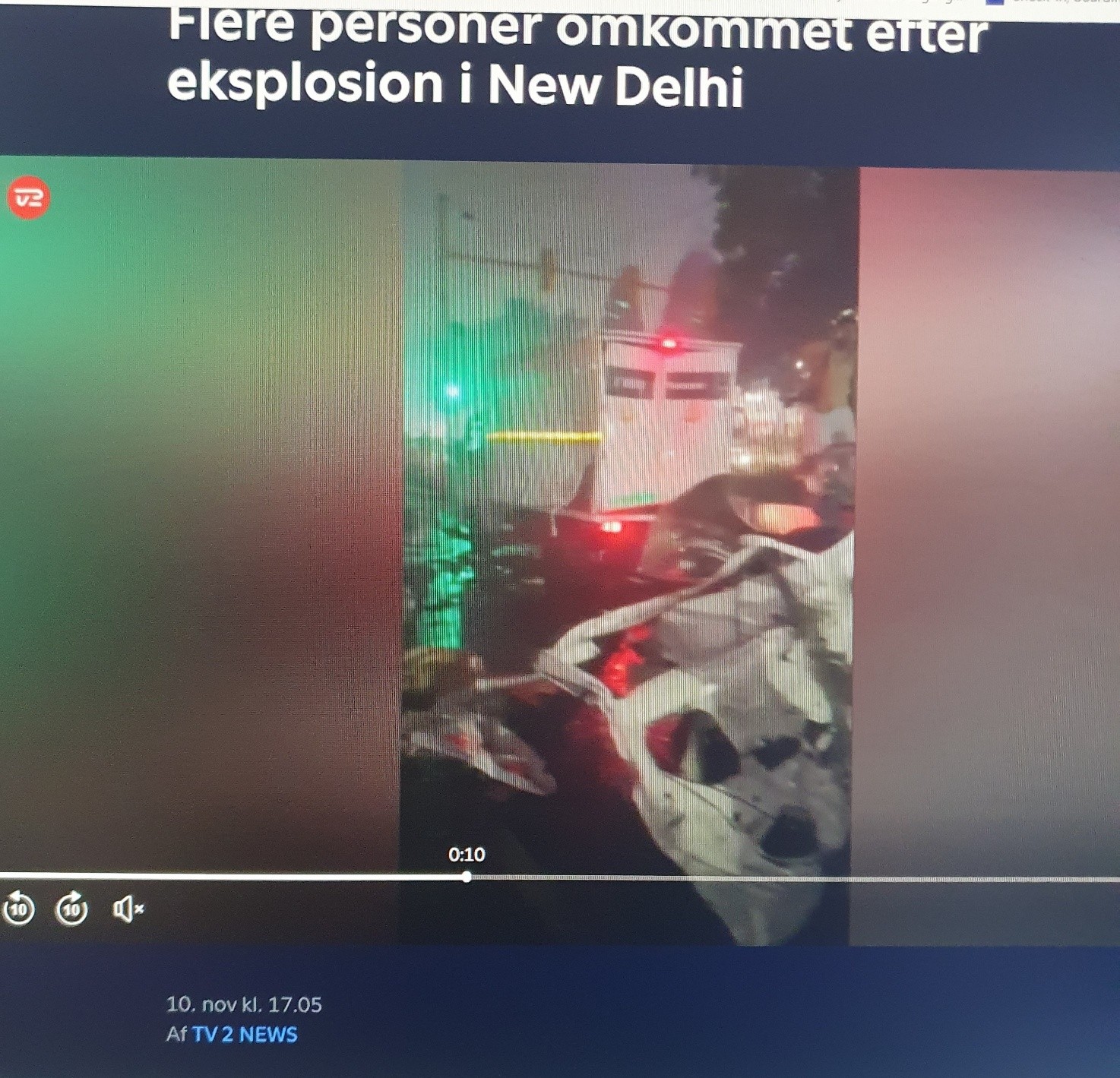 Image: Flere personer omkommet efter eksplosion i New Delhi (Several killed after explosion in New Delhi), TV2 reporting on November 10th at 21.35 IST
Ten family members of the JeM leader, Masood Azhar, were reportedly killed in that operation. Bent on revenge, the Jaish had activated its network in India, the NDTV surmised on November 11th.
By contrast, neither of the two main Danish TV channels (DR and TV2) nor Danish newspapers such as Politiken and Berlingske Tidende reported on the Kashmiri connection on November 11th. More surprisingly, the BBC was also very slow to link the explosion to the Kashmiri doctors.
When reporting at 17.47 IST from Red Fort, the BBC’s Delhi Correspondent did not refer to the Kashmir connection. Instead, she stressed that there was no official conclusion to the investigations: “…. as of now, we had been told that we need to wait for these answers as the investigation is underway” was about all she could report. For the remainder, she focused on the victims of the blast.
I fully understand that one should be careful about making guesses in situations of great fear, grief, and uncertainty. However, in this case, there was a striking gap between what the Indian media could plausibly report and the abeyance in which Western media held its viewers and listeners.
Globalisation is supposed to make the world “flat” and interconnected. It did not do so in this case.
The New York Times was an exception. Here, the NYT’s South Asia Bureau Chief could report by 7.10 am ET (17.40 IST) that the Indian police had disbanded an “interstate and transnational terror module” before the explosion, confiscating weapons and bombmaking material. Moreover, the Kashmir police had said that it had followed leads to towns outside Delhi, and that the driver of the car with the explosives was linked to that group.
Al Jazeera was also quick to report from Delhi. The channel spelt out the trail that the Indian police were following. But, seeming to be running with the hares and hunting with the hounds, it was also quick to point out that some Indian media had blamed Muslims more broadly for the attack even before the security agencies had commented on the explosion.
Al Jazeera tried to meet the obvious with opprobrium by chastising “a consulting editor with one of India’s largest media networks on X for writing that 'Terror has a religion,' and for having 'called the recent arrests of Muslim doctors for allegedly possessing explosives as an example of ‘radicalisation.’”
The pattern that emerged in the first two days was repeated in the following days. The news of the explosion at the police station in Srinagar was reported on November 15th by many Danish news outlets, relying on e.g. Reuters and NDTV.
It was made clear that the explosives that accidentally went off were in the custody of the police. The explosion in Srinagar was linked to the explosion at Red Fort, but the Kashmiri doctors were left out. The main radio and TV programmes carrying foreign news and analysis also did not dig into the story.

Even in the absence of such connections, the Danish media could have tried to analyse the events in some detail, but newspaper journalists are getting fewer in numbers in today’s Denmark.
On November 11th itself, the daily newspaper Jyllands-Posten, which has enjoyed a longstanding reputation for groundbreaking journalism, announced a round of firing including some of its investigative journalists. The economic crisis in the newspaper world is reflected in a decrease in the number of students who want to study journalism.
In terms of press freedom, Denmark now ranks at 6, whereas it was ranked second a few years ago. India ranks at an unflattering 151. However, in the case of the Red Fort explosion, the Indian media went ahead with some gusto, while the Danish media preferred to wait and see.
Of course, Danish media had less of an incentive to follow this story than Indian media, but it is noteworthy that the Danish media reported the blast and the victims, but not the news about the possible offenders.
The BBC also waited and watched. One of the BBC’s own investigative journalists concentrated on verifying some of the photos that were posted on social media. While some of these photos turned out to be false, the correction did not make much of a difference, as the actual pictures were easily available.
To be fair, I must add that in the days around November 11th, the BBC had found itself in an existential crisis. The US President, Donald Trump, had threatened to sue it over its broadcast of a Panorama episode in which two parts of Trump’s speech leading up to the attack on Capitol Hill on 6 January 2021 had been spliced together. BBC staff would probably find it difficult to ignore this development and equally difficult to concentrate on Delhi affairs.
Thus, it fell to Indian journalists to splice together the story.
What is newsworthy in times of crises?
What is the relevance of the Red Fort explosion, particularly in the international context? As forcefully conveyed by the Indian media, the explosion was ‘interesting’ because it involved Kashmiri medical practitioners. In other words, an elite education and a good job in a well-regarded institutional environment had been used as a resource to wage war against the existing order.
In April, the Danish MP Frederik Vad made a similar argument in a Danish context – that immigrants in Denmark may have command over the language and hold good jobs, but some use their position to undermine the society in which they live. His speech was roundly criticised. But events later in the year offered several examples of what he was talking about.
In this perspective, Denmark and India were readily comparable, and the Red Fort blast relevant in a Danish context.
In a video recovered by the police, Umar un-Nabi is seen trying to convince himself and his viewers that jihad through a suicide mission is theologically justified in an Indian context. According to Praveen Swamy and Sajid Farid Shapoo, this idea has been circulating among Muslims in different parts of the Indian subcontinent. In particular, the Islamic scholar Maulana Abdul Aleem Islami has contributed to an updated and radicalised version of the doctrine of jihad.
One may, no doubt, find similar exegesis in Denmark and Sweden, predictably concluding that it is the individual duty of Muslims to wage jihad against their ‘oppressors,’ whether uniformed or not. But what stands out in Denmark and Sweden is not the sophisticated theological argument that may convince believers to engage in violence at the risk of their own lives.
Rather, 2025 has been the year in which criminal networks controlled by Swedish Muslims, hiding in countries like Turkey, have hired Muslim and non-Muslim youth to carry out crime, including murder, in Denmark or Sweden. These hitmen have been hired on Internet chatrooms and promised large sums of money for attacking members of opposing gangs, etc.
Several of these hired gunmen reportedly are only 12-15 years old. Most are ethnic Swedes, not immigrants. Some are young girls unfamiliar with the weapons they are handed. Typically, the gunmen may have no prior knowledge of their victims either.
So far, Danish courts have awarded 136 years of imprisonment in cases where the offenders have been old enough for imprisonment. These “torpedoes,” as they are called, may also be hired for political crimes. Thus, two Swedes, aged 16 and 19, are accused of throwing a hand grenade at the Israeli Embassy in Denmark. One of them is an ethnic Swede, who may have had no interest in the Israel-Palestine conflict.

With such crimes taking place in Denmark and Sweden, the bar is raised for what is newsworthy. The mountain of crime in Denmark and Sweden simply overshadows what appears to be a molehill of trouble in faraway places.
Apart from new forms of organised crime, several other crises beset Denmark and its near environment. In its recent annual report, the Danish Defence Intelligence Service details threats from Russia, China, and the Middle East. In addition, the report adds security concerns emanating from the USA.
Granted that Donald Trump has threatened to take Greenland by military force, and that the recently released US National Security Strategy singles out Europe as Trump’s new laboratory for political change, it is not surprising that many Danes feel threatened. However, it has never happened until now that the Danish Intelligence Service in an official document singles out the USA – a NATO ally and an “elder cousin” in international affairs - as a threat to the Kingdom of Denmark.

The conditions for civil war are also ripening in several other European countries, where the failure to control immigration, the fear among Europeans of being marginalised and displaced, and the waning trust in politicians and democracy may lead to violence. If civil war breaks out in one European country, Betz argues, it may spread to others.
Betz may exaggerate the dangers Europe faces, but it seems clear that European host societies are becoming more restive. In Denmark, there is also a sharpening of attitudes. Thus, a recent survey in Denmark found that 45 per cent fully agreed that an immigrant convicted in a criminal case should be deported, EVEN if that person holds Danish citizenship.
A further 27 per cent were in part agreement. This indicates that most Danes lean further to the right than their elected representatives. They want national laws to be tightened and international conventions dealing with citizenship reinterpreted or pushed aside. The MPs have little choice but to follow.
If the many crises in Denmark in 2025 reduced the explosion at the Red Fort to a comparatively minor news story, a volatile 2026 may move the European subcontinent even further away from the Indian subcontinent.
When the Indian Minister of External Affairs, Subrahmanyam Jaishankar, visited Denmark earlier in 2025, he was interviewed by the equally well-dressed and articulate Danish journalist Søren Lippert. Jaishankar made the point that the strong system of alliances tying the West together has brought comfort to Europe. These alliances are currently being challenged, and people have come under stress.
India has never been able to build such strong alliances. Having had to manage on its own, India is more at ease, and can face a volatile world with more equanimity than Europeans, he argued.
Each on their own, we need not engage too much with each other. Agar Delhi dur ast, Denmark bhi dur ast!
(Views expressed in this report are the author's own.)
Follow us on WhatsApp
Follow us on Facebook
Follow us on X @vudmedia
Follow us on Substack

