
Ever imagined that the biggest beneficiary of India’s Operation Sindoor could be the Pakistan Army chief, Field Marshal Asim Munir? Using this conflict to boost the Army’s de facto control of the Pakistani ‘State,’ General Asim Munir has moved swiftly to reinforce and formalise his (and the Army’s) supremacy through a Constitutional Amendment. The 27th Amendment not only elevates the Army’s chief to a level of omnipotence and allows him to exert control in all aspects of Pakistan’s governance, it also grants him lifelong immunity to any legal accountability in future. Pakistan thus slides back to full military control, with its de facto control now being institutionalised in ways that will make the civilian government play second fiddle. The implications are not just for Pakistan’s democracy but also for India’s security calculus, which is likely to be under perennial stress, says Professor Swaran Singh in this 11th edition of Asia Watch.
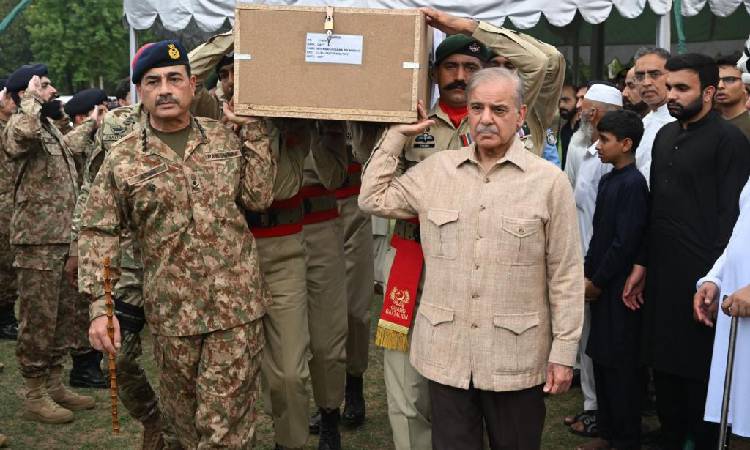
Text page image: General Asim Munir and Prime Minister Shehbaz Sharif, carrying to the grave, not the Pakistan Constitution, but a fallen soldier
Home page image: General Munir and PM Sharif lead the funeral prayers of a Pakistan Army officer
Banner: General Munir, in civilian attire, being received at the White House in September 2025
With Pakistan’s National Assembly approving the 27th Amendment bill that was adopted by its Senate this Monday, the country has transformed decades of its informal military dominance into a permanent constitutional principle of governance.
However, other than consolidating the Pakistan Army’s dominance in general, experts are calling it “a coup without a formal coup” by President Donald Trump’s most “favourite field marshal” General Asim Munir, who will now be in command of the entire Pakistani nation.
To begin with, what made this especially intriguing was ‘the urgency’ with which this amendment was enacted. Indeed, both Prime Minister Shehbaz Sharif and Field Marshal Asim Munir were away on a state visit to Baku (Azerbaijan) as the Cabinet approved the draft bill of the 27th amendment last Sunday, with the Prime Minister joining online.
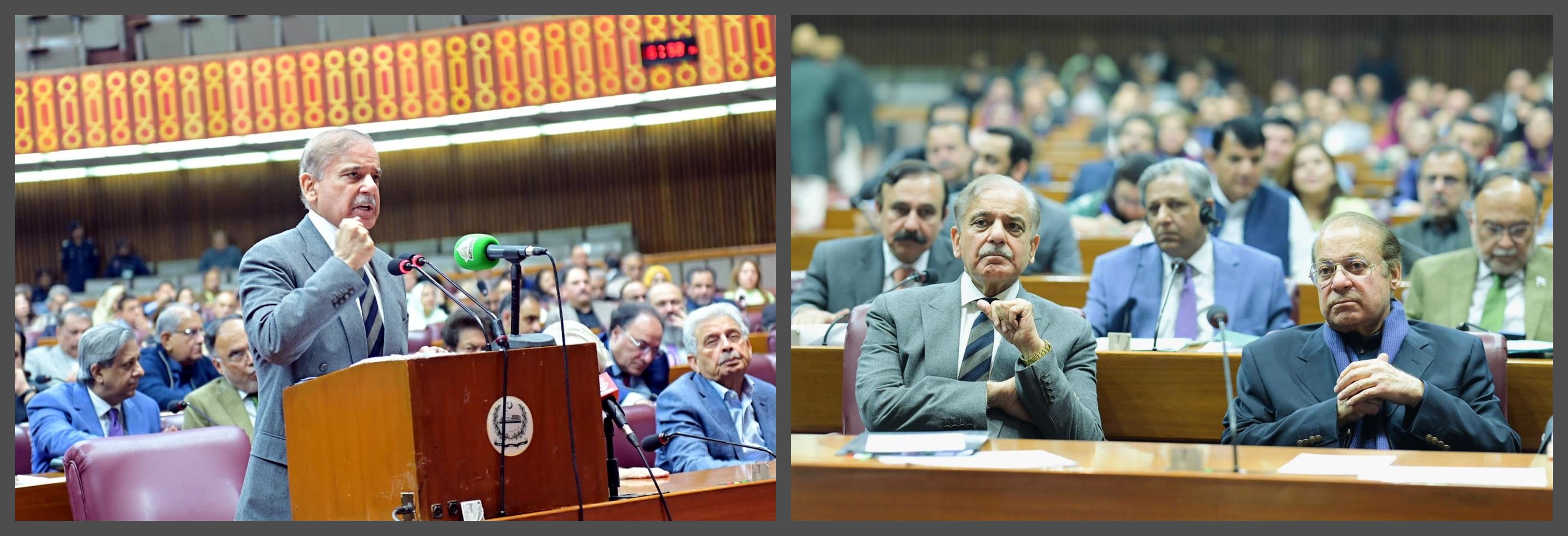
Image: Pakistan Prime Minister Shehbaz Sharif presenting (left) the 27th Amendment at the National Assembly on November 12th, with his brother and former PM, Nawaz Sharif (right) by his side
This draft bill was shared with the government’s coalition partners only on Monday, and hours later, it was passed by the Senate.
It was intriguing how the required 2/3rd majority in the Senate was managed with two opposition Senators voting against their party lines and members of the Pakistan Tehreek-e-Insaaf (PTI) staging a walk out allegedly for two of its members voting in favour of the bill. Getting 2/3rd majority in the National Assembly was a cake walk as the ruling coalition enjoys the support of 238 out of 336 members, i.e. over 70 per cent.
The Amendment now codifies a lifetime immunity (not limited to their term in office) from all criminal proceedings and arrests for all five-star rank military officers (like field marshals), as also for the Head of State. Accordingly, President Asif Ali Zardari will be too happy to append his signatures to officially make it a permanent recast on Pakistan’s destiny.
From de facto to de jure military rule
Historically, this may not be Pakistan’s first example of such hurried legislations or attempts at embedding the Army’s ‘praetorian logic’ into the country’s constitutional framework. The 26th constitutional amendment of October 2024 — modifying judicial appointments and powers and reducing the Chief Justice's term to three years — was also enacted in just four days’ time.
But, other than this rush, the 27th Amendment stands out as one of the most comprehensive and consequential in reshaping equations between the legislature, executive, judiciary, on the one hand and the Pakistan Army on the other. In effect, it has further narrowed Pakistan’s already fragile and frugal facade of primacy of civilian authorities.
Since its independence in 1947, Pakistan’s Army ruled the country directly for 33 of its 78 years: under Ayub Khan (1958–69), Yahya Khan (1969–71), Zia-ul-Haq (1977–88) and Pervez Musharraf (1999–2008). For the rest, the Army indirectly manipulated civilian leaders — often tossing them into prison or exile as inconsequential pigmies.
While Benazir Bhutto was assassinated and her father Zulfikar Bhutto’s imprisoned and executed, the ongoing imprisonment and low-life treatment of the Army’s once favourite poster boy, Imran Khan, marks its most recent case in this long list of the Army’s manipulation and misadventures in the civilian and democratic structures.
Recent history also brings back two instances in Pakistan’s constitutional evolution. First, the 8th Amendment of 1985, enacted under General Zia-ul-Haq, which gave the President the power to dissolve parliament under Article 58(2)(b), and was used to dismiss elected governments four times between 1988 and 1999.
Then came the 17th Amendment of 2003, under President Pervez Musharraf, which legitimised his dual role as President as well as Army Chief of Pakistan, and fused civilian and military command structures. Initially, following his coup of October 1999, Army Chief General Musharraf had appointed himself as Pakistan’s Chief Executive and stayed in that dual role till June 2001.

Image: In democracies, the civilian rule is supreme. In Pakistan, the Prime Minister here is visiting the Army's General Headquarters (GHQ) in Rawalpindi, the de facto power centre
Unlike those personalist amendments, this 27th amendment embeds Field Marshal Asim Munir’s supremacy institutionally — through structures, not just personality.
First of all, it abolishes the Joint Chiefs of Staff Committee under Article 243 which, by implication, also puts an end to the post of Chairman of Joint Chiefs of Staff Committee with the current incumbent, General Sahir Shamshad, retiring on November 27. This is being replaced by a new position of the Chief of Defence Forces (CDF) who will command all three Services — Army, Navy and Air Force.
Ensuring the Army’s primacy, the COAS will always be the CDF with a fixed tenure of five years.
This amendment also creates a new position of Commander of National Strategic Command (NSC) who will control nuclear weapons and missiles on land, in the air and at sea (of all three Services). He will also be from the Army and will be appointed by the Prime Minister, but on the advice of the CDF, who, again, will be the COAS.
In short, this Amendment slides Pakistan from hybrid governance to constitutional militarism — a shift that formalises what was for long a shadow structure of power. This shift indeed had been well displayed with Field Marshal Asim Munir being the star during his recent visits accompanying Prime Minister Sharif to the United States, China, Turkey, and, most recently to Azerbaijan last week.
Video: In his speech at the National Assembly, MNA leader Mehmood Khan Achakzai termed the 27th Amendment a "9/11 on Pakistan"
Judiciary, Parliament and federalism undermined
For a country where judicial activism was the only thing that had occasionally challenged the military power — as in the Iftikhar Chaudhry case (2007-2009), Asghar Khan case (2012) or the Panama Papers verdict (2017) — this marks a reassertion of military tutelage over the judiciary as well.
It means reversal of all the gains made during the Pakistan Lawyers’ Movement of 2007–2009 that had restored Chief Justice Iftikhar Chaudhry and briefly reasserted the independence of the judiciary. At worst, this may also see the military asserting oversight in all judicial transfers and appointments.
For instance, the transfer of judges from one high court to another will no longer require the concerned judge’s consent.
But the deeper challenge from the 27th Amendment comes in the changes made in Articles 184 and 199. This shifts constitutional and judicial review powers of the extant Supreme Court of Pakistan to a proposed Federal Constitutional Court (FCC) for which seven judges have already been shortlisted to immediately take office.
Pakistan now will have two Chief Justices, and there is no clarity about their order of protocol, except that the FCC judges will retire at the age of 68, compared to Supreme Court judges retiring at 65. What is clear is that the FCC now replaces the Supreme Court as the final arbiter on critical matters of national security, civil–military relations, and other federal and constitutional disputes.
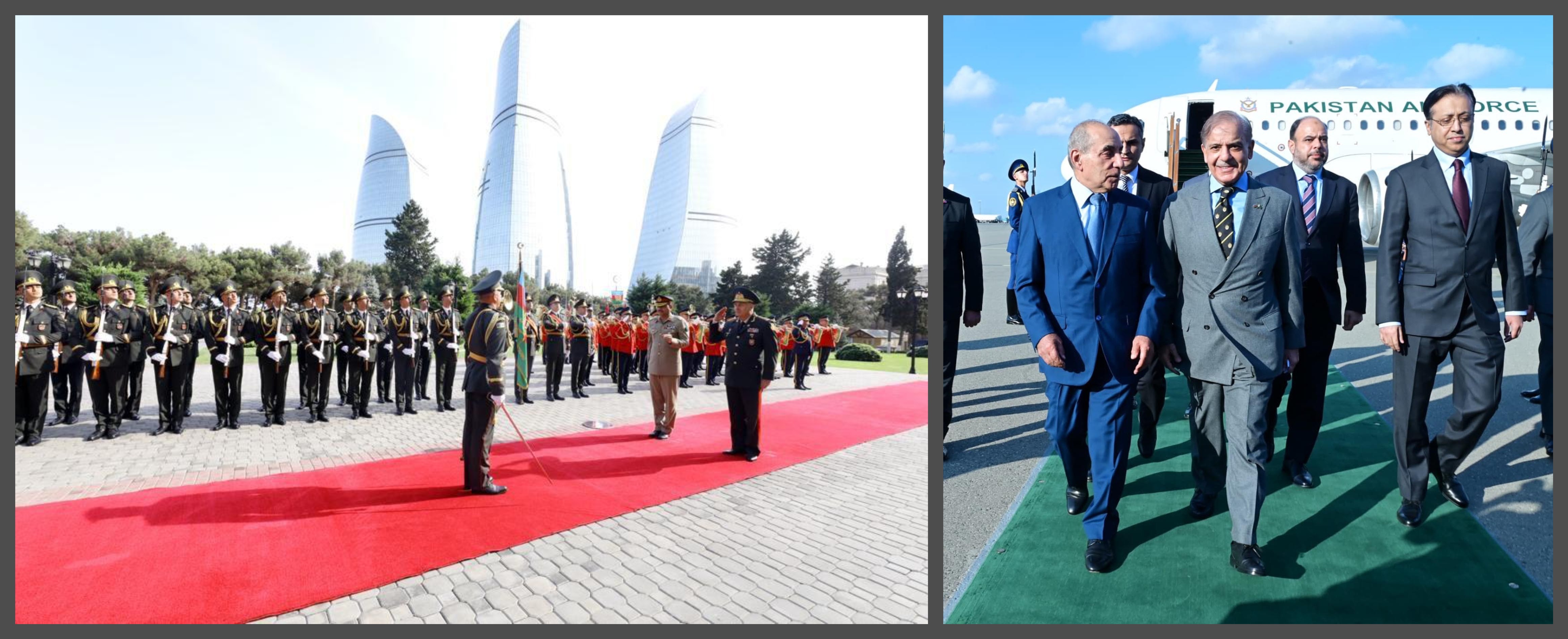
Image: General Munir being given a guard of honour in Azerbaijan (left) this August, and PM Sharif being received (right) at Baku airport in November
Likewise, Pakistan’s National Assembly — that is often so acrimonious, divided and fragile — was seen passing the 27th amendment with a surprising speed. The major parties — the PML(N) and PPP — in spite of their differences, presented their unity in the name of saving the country from political instability.
The parliamentary debate was kept remarkably short for an amendment that reorders Pakistan’s entire state architecture. The opposition remains divided and ineffective. Led by the PTI, it was calling for nationwide protests highlighting how this amendment is an attack on the basic structure of democracy, where several provisions are being changed ‘without public consultation.’
Smaller parties like the Jamaat-e-Islami called it a constitutional coup, decrying how the military has outlawed dissent. The media termed it as Pakistan’s ‘darkest moment’ in its constitutional history.
Pakistan’s federal structure likewise stands weakened. One of the subtler and less noticed effects of the 27th Amendment is its rollback of fiscal devolution achieved under the 18th Amendment of 2010. Provincial governments will now need federal — and implicitly, the Army’s — approval for foreign investments in strategic sectors.
This seems focused on taming the rebellious Sindh and Balochistan, where local elites have leveraged the ever-expanding Chinese and Gulf partnerships to build some economic autonomy from Islamabad (read Rawalpindi).
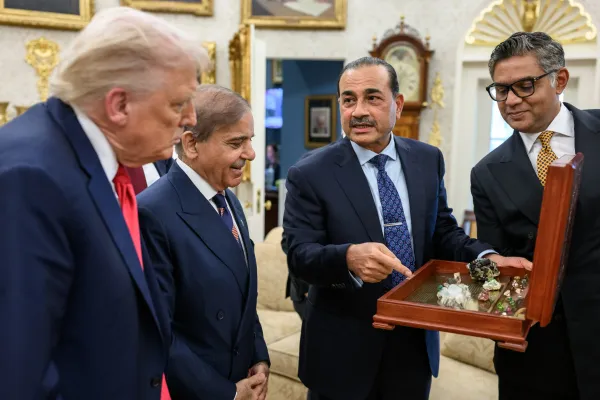
Image: General Munir displaying a box of 'rare earths' to US President Donald Trump, with PM Sharif, at the White House in September
What it bodes for India’s security calculus
Prima facie, with the recent thaw in India-China relations, China — Pakistan’s all-weather ally, may see this 27th constitutional amendment as positive assurance on the continuity for the China Pakistan Economic Corridor (CPEC) and stability for its western frontiers between Gilgit-Baltistan and Xinjiang.
But Field Marshal Asim Munir also has his newfound friends in Washington, DC, to whom he has signalled Pakistan’s military cooperation in fighting terrorism. Having enticed the Americans with his so-called large reserves of rare earth and oil, Munir may also offer them military bases, bringing US-China tensions closer home.
Pakistan’s worries about India and Taliban — that they now call India’s proxy — and American concerns about China will need General Munir to balance between Beijing and Washington.
In this, his constitutionally-empowered military — which controls not just the guns and borders, but also ports, telecoms, and energy policy, as well as the billions of dollars in the CPEC projects — may feel intoxicated in favour of adventurism, and ignite their next confrontation with India.
This emerging ‘security–economy complex’ of Pakistan is reminiscent of Egypt’s post-2013 order under President Abdel Fattah el-Sisi, where the military has legitimised its rule through economic management rather than mere coercion except that Pakistani economy has lately been alternating between slide and stagnation.

Image: General Munir with Chinese officials of the CPEC (left), and at an even to mark the 98th Anniversary of China's Peoples' Liberation Army (right)
Indeed, many see the 27th Amendment at least partially as a strategy to divert attention from Pakistani economic woes. Pakistan’s GDP growth had come to as low as 0.3 per cent for 2023 when its inflation was soaring at 29.5 per cent. Its external debt today exceeds USD 125 billion even as its defence budget continues to rise.
Though Pakistan's economy has seen a turnaround in the last two years, yet, in the midst of this fragile recovery, the Army’s deep commercial footprint through powerhouses like the Fauji Foundation and Army Welfare Trust bring it a disproportionate leverage, making it pompous and adventurous.
To New Delhi, it confirms that civilian diplomacy will play only a limited role in its strategic calculus for the foreseeable future. India, accordingly, must adjust its policy choices and also improvise its toolkit for dealing with Pakistan.
This will need, among others:
(a) Continuing but restricted backchannel communications on ceasefire maintenance and counterterrorism,
(b) Avoiding any high-visibility summits that can be sabotaged by spoilers in uniform, and
(c) Expanding regional economic and maritime networks with Central Asia via Iran, bypassing Pakistan’s obstructive gatekeeping for its partnership with Afghanistan and the rest of Eurasia.

Image: General Munir's civilian outreach - at a women's conclave in Peshawar (left) and meeting the national hockey team (right)
For India, this means dealing with a more centralised nuclear command structure that would be potentially less politically accountable. In the face of India outlining its policy of treating each terror attack as ‘an act of war,’ this new arrangement will further short-circuit Pakistan’s decision-making making which, in the absence of civilian moderation, could escalate their military face-offs with India at shorter notice than before.
As in the case of this week’s car bomb blasts in New Delhi and Islamabad, which are threatening another military confrontation, this amendment confirms what diplomats and strategic experts have long prophesied – that the Pakistan Army remains the final arbiter of Pakistan’s foreign and nuclear policies, especially so when it comes to Islamabad’s posturing vis-à-vis New Delhi.
Also, history teaches us that every phase of the India-Pakistan détente — from the Simla Agreement (1972) to the Lahore Declaration (1999) — collapsed when the military reasserted its control over political power.
By constitutionalising the same, Islamabad has finally codified that all future peace initiatives will require Rawalpindi’s explicit blessings.
Follow us on WhatsApp
Follow us on Facebook
Follow us on X @vudmedia
Follow us on Substack
