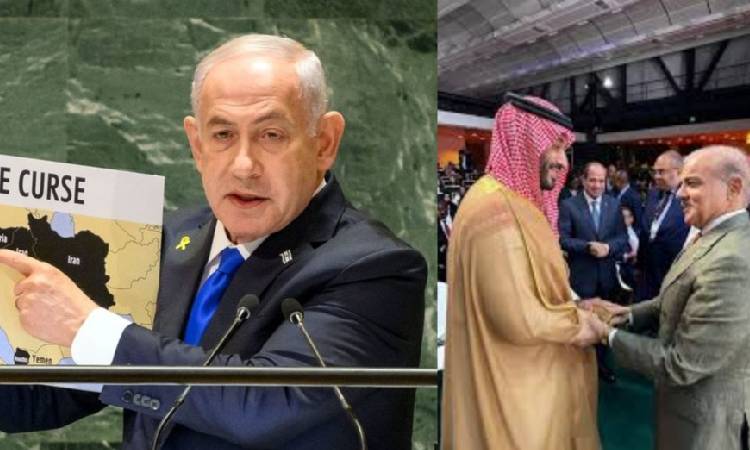
By any interpretation, the formalisation of Saudi Arabia’s long-standing defence cooperation with Pakistan does not augur well for India. This, however, is part of a larger ‘great game’ in West Asia, where Israel’s continued violence against various Islamic nations is propelling the Arab world towards a NATO-like security alliance. With the Trump regime insensitive towards these strategic realities in this part of the world, India must tread a tough rope walk, which involves consistent engagement with the Arab nations and ensuring that Pakistan’s newfound place of prominence does not undermine India’s strategic interests and security in this extended neighbourhood, says Professor Swaran Singh in this 8th edition of Asia Watch.
An unstoppable Israeli military operation in Gaza that has killed over 65,000 Palestinians in the last two years has seen it launch strikes on Lebanon, Iran, Qatar, and Yemen. Though belatedly, this has pushed Arab anxieties to the brink, stoking strong emotions into once again making efforts for an Arab/Islamic collective-security architecture, on the lines of the North Atlantic Treaty Organisation (NATO).
The novelty this time is that of nuclear Pakistan pitchforking itself to the centre-stage of this perilous prognosis about this region’s fast-changing strategic realignments.
On September 15th, the Emergency Summit of the Arab League and Organisation of Islamic Cooperation (OIC) in Doha had issued a joint statement initiating talks for their NATO-like “collective security” for Arab and Islamic States. Two day after Pakistan had attended this Emergency Summit, the region’s largest defence spending nation, Saudi Arabia, “institutionalised” its long-standing ‘deep cooperation’ with Islamabad into a defence pact.

This dramatic entry of Pakistan’s so-called ‘Islamic bomb’ into this strategic matrix has since introduced a new quirk of Islamabad providing the Arab nations a ‘nuclear umbrella’ against their arch-enemy, nuclear Israel.
All these regional realignments portend direct and dangerous consequences not only for Tel Aviv, but also for Washington and New Delhi as well. It was in July 2022 that the United States launched an I2U2 ‘Western Quad’ with Israel, the United Arab Emirates and India, front-loading economic and technical cooperation for regional stability and peace.
With this dangerous drift towards violence since October 2023, this growing regional volatility portends Islamabad not just adding to this region’s problems but also undermining New Delhi’s regional outreach to these countries that account for two-thirds of India’s energy imports and one-third of its USD 125 billion remittances.
Immediate triggers
The most immediate triggers for this revival of proposals for a NATO-like regional military arrangement have been long in the making. The ‘Arab Spring’ uprisings of 2011 had seen Saudi Arabia announce a 34-nation anti-terrorism military alliance with a joint operations centre to be in Riyadh.
Later, the rise of the Islamic State and the civil war in Yemen had seen the Arab League summit at Sharm el-Sheikh discussing President Abdul Fattah el-Sisi’s proposal for a 40,000-strong joint force operating from Cairo and Riyadh. Both Iraq and Iran, though, had then asked for more time.
Such sporadic knee-jerk reactions had made these initiatives more rhetorical than real.
However, the Israeli air strikes on the upmarket Doha of 9 September 2025, targeting senior Hamas leaders negotiating a peace deal with Tel Aviv, saw Qatar condemning this as an Israeli sabotage, demanding accountability and calling an emergency summit. What had worried Doha was how the American ambivalence had failed its security umbrella in preventing these attacks.
On June 23rd, Iran hit the US base, Al-Udeid, in Qatar in response to US attacks on its nuclear facilities. Interestingly, the US response had then also been muted and uncertain. Now again, Washington’s reaction to Israeli strikes at Doha was delicately ambivalent and confusing.
In spite of Qatar being home to the region’s largest American base and Qatar being designated as a Major Non-NATO Ally since 2022, the Trump team denied any advance knowledge of the Israeli attack, let alone neutralising those incoming missiles. The Israeli Prime Minister Netanyahu, for his part, claimed to have informed the Trump team about the strikes in advance.
Moreover, within a fortnight of the Doha emergency summit, Israel repeated the air and drone strikes in southern Lebanon (notably Bint Jbeil on September 21–22) and, from early this summer, these have been part of its operations against the Iranian-linked facilities in the region.
These events have since renewed fears of escalation across multiple countries. The Red Sea corridor has also been hit: a Houthi-launched drone that struck Eilat on September 24th, injuring 20 civilians, was followed by the Israeli action in Sana’a the very next day. The tempo and geographical spread of such strikes have converted Israel’s episodic military actions into a systemic scenario of regional insecurity for all.
Turning ideas into action
The political responses of Arab nations, as a result of this precipice, have been unusually robust. The Arab mobilisation has scaled up to include not just six nations of the Gulf Cooperation Council (GCC) but also the 22 nations of the Arab League, as well as the 57-member Organisation of Islamic Cooperation (OIC).
Together, the groups are trying to craft a consensus and chart forward movement for a united stand against Israel.
A parallel meeting of the GCC Joint Defence Council on September 15th, preceded by the meeting of their Supreme Military Committee, has since outlined their plan to reactivate their joint defence mechanisms and enhance operational cooperation. Such cooperation, it is perceived, must move beyond rhetoric to concrete interoperability steps like joint exercises, air-situation awareness, intelligence links, and accelerated work on a Gulf Joint Task Force.
Accordingly, the GCC’s pledge to “activate a joint defence mechanism” is being seen as the most actionable outcome of recent discussions. Their statements underline the axiom that an attack on any GCC state will be an attack on all, signalling collective deterrence in practice. It also focuses on specifics of technical parameters like staff-level planning, contingency matrices, and invitations to third-party militaries to participate in training and logistics.
At the same time, analysts also caution that doctrinal and command challenges are large. Yet, this political momentum matters: policy windows created by Israel’s transnational strikes are being used to institutionalise these collective security arrangements in the making.
With the intra-GCC tensions subsiding, the grouping is hopeful of moving from GCC to OIC, where they will need to constructively engage Tehran, which, in turn, seems possible in the face of recent Iranian-Israeli military strikes that seem to put them on the same side of this deepening divide.
Since the US President Donald Trump is seen abandoning ‘global responsibilities,’ Europe’s recent search for autonomy and self-sufficiency can also provide critical lessons for the Islamic nations to diversify their security partnerships. Saudi Arabia’s recent defence pact with Pakistan, for that matter, provides an apt example of similar impulses for innovation and diversification.
This is also part of Saudi Arabia’s Kingdom’s Vision 2030 that aims to reshape its global standing by balancing its security dependence on Washington with more eastern-facing connections, with other US-friendly nations like Pakistan.
Enter nuclear Pakistan
If there is one state whose agency has become unmistakable in underlining the gravity of these developments, it is Pakistan. The Strategic Mutual Defence Agreement between Riyadh and Islamabad has since seen the Pakistani defence minister publicly confirming that Pakistan’s nuclear programme will be made available to Riyadh.
Western capitals are reading this formulation as an extension of Pakistan’s deterrent posture into the GCC’s regional equation with Israel. Also, this defence pact promises to convert this Arab or Islamic military alliance in the making into a Saudi-centric collective-defence template compared to its earlier versions being Egypt-centric.
Any prognosis on Pakistan's future role must begin by asking why Pakistan matters. Four reasons can be listed:
First, Pakistan possesses the largest conventional Muslim-majority military, which is bigger than that of Egypt, which has the largest military force amongst Arab States.
Second, unlike the Arabs, Pakistani forces have had operational experience in fighting five wars with India, its proxy wars against India and in Afghanistan, as also its forces regularly training and exercising with various Gulf militaries.
Third, Pakistan is the only Muslim-majority nuclear-armed state — a fact that creates asymmetric deterrence options (and anxieties) given the long history of Saudi Arabia’s financial support to Pakistan’s ‘Islamic bomb’ driven nuclear weapons program.
Finally, the distinct political currency of the Islamic Republic of Pakistan across multiple Muslim capitals remains absent in the case of most Western powers.
Analyses by the Brookings Institution and Chatham House argue that their defence pact involves diversifying Saudi security suppliers and promises to offer Pakistan much-needed economic and diplomatic leverage. It is possible that in doing this, both Pakistanis and Saudis may have been guided by their American benefactors.
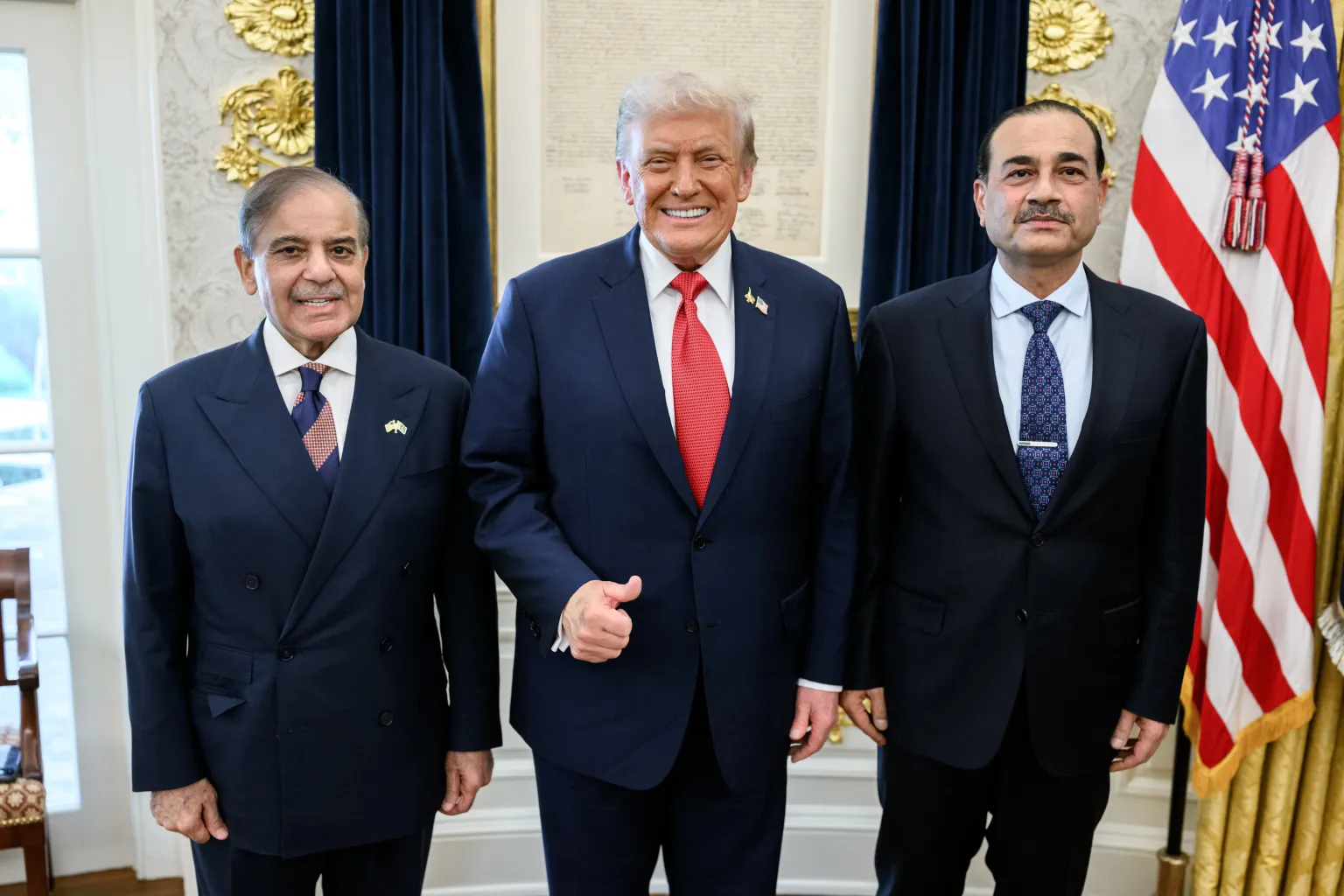
This is, however, more likely to be read as a Saudi attempt to explore alternatives to the Trump team’s ambivalence. Yet, Trump has lately shown an unusual indulgence with Pakistan, including hosting Field Marshal Asim Munir for a third time, on September 26th, in less than four months, this time in the company of his Prime Minister Shahbaz Sharif.
Just two days before this visit to White House, Prime Minister Shahbaz Sharif was also part of the eight Muslim nation leaders meeting President Trump on 24 September 2025 — the day of his address to the UN General Assembly (UNGA) — when he presented to them his 21-point plan for Palestine. This could be seen as aimed at pacifying Arab anxieties that are pushing these nations to collectively stand up against Israel, which happens to be Trump’s closest ally in the region.
India’s arithmetic
The gravity of security and diplomatic arithmetic of India being potentially replaced by Pakistan in West Asia remains immediate and multifaceted.
Economically, this region accounts for two-thirds of India’s petroleum imports and hosts millions of Indian workers whose remittances matter for India’s macro-stability. Militarily, a more institutionalised Gulf security architecture that embraces Pakistan can alter India’s threat perceptions along its western frontier, as also further complicate its immediate periphery.
With prospects of the Pakistani military being backed by Saudi financial muscle, India has already asked Riyadh to “keep in mind mutual interests and sensitivities,” underscoring how India sees the pact as consequential for India and South Asia.
Only in April this year, Saudi Arabia was the first Arab nation to ‘condemn’ the terrorist attacks in Pahalgam. However, their defence pact with Pakistan that says “any aggression against either country shall be considered as aggression against both” could bind Riyadh up against India.
For Indian policy makers, therefore, the options remain limited: intensify diplomatic outreach across the Gulf, including further strengthening ties with Qatar and the UAE, deepen maritime cooperation to keep sea-lanes free and open, and hedge through enhanced defence ties with Western partners and preserve channels of strategic communications with Saudi Arabia.
India has had the unique advantage of building friendship with all major powers of West Asia — from Saudi Arabia, to Israel, Iran, UAE, Qatar and Egypt — countries that have often had tensions with each other. This explains why President Biden chose India as the fourth member of the I2U2 ‘Western Quad.’ New Delhi, hence, must sustain and strengthen those partnerships built so assiduously over decades of piecemeal efforts.
Alongside, India must ensure strategic agility; protecting economic lifelines, securing maritime commons and crafting diplomatic postures that preserve ties to Riyadh and Abu Dhabi while hedging against spillovers that could embroil South Asian dynamics.
Challenges ahead
For Arab capitals, the priority remains in putting these ideas into practice by calibrating deterrence paired with robust crisis-management channels like hotlines, UN mediation mechanisms and confidence-building, etc. For Washington, the task is to convert its tactical reassurance into durable arrangements that keep the U.S. leadership viable without shutting any of the regional actors out of it.
Policy takeaways call for pragmatic choices.
The month of September demonstrated a simple strategic truth: the geography of military strikes now maps directly onto the geography of institutions. When bombs cross borders, treaties follow!
With Pakistan’s newfound prominence in Gulf security, India and the United States can scarcely afford to be complacent about the potential implications of these developments for their own peace and security. They must engage these events as a new, active primary arena of 21st-century strategic realignment.
Let me end with two sobering caveats.
First, institution-building is hard: interoperability, command and political trust across Arab, from GCC to OIC members, will take time to operationalise.
Second, nuclear semantics matter: Pakistani official denials notwithstanding, the public discussion about “extended deterrence” has already generated diplomatic alarms in capitals from Washington to Tel Aviv, Tehran and New Delhi. Escalatory feedback loops remain a real risk if signalling is misread in any ensuing crisis.
Assertions for Palestinian sovereignty by European leaders at the ongoing UN General Assembly session underline the alacrity needed from all their extra-regional stakeholders to these Arab initiatives for a NATO-like ‘collective security’ arrangement that must become broad-based, firm and piecemeal and allow these stakeholders time to understand and respond to these strategic realignments with implications much deeper and wider.
Follow us on WhatsApp
Follow us on Facebook
Follow us on X @vudmedia
