
By identifying caste with Hinduism, the courts and legislature have not just denied the benefits of affirmative action but also stripped the marginalised groups of protection from the atrocities historically heaped on them. The first part of this series – Forty years after Karamchedu, plight of Dalits remains unchanged – revisited Karamchedu and other incidents of extreme violence against Dalits in the country. In this second and final part, Palepu Krishna Vijay examines the intricacies of legal pronouncements that link caste with Hinduism and how this results in denying the right of the Scheduled Castes and Tribes to practice a religion of their choice, as guaranteed by the Constitution. In the process, these marginalised communities lose out not just on the opportunities for social upliftment but also continue to be vulnerable to violence, discrimination, and other atrocities they have historically faced.
Text page image courtesy: Vatican News
Banner image courtesy: The Swaddle
The plight of Dalits, as discussed in Part I of this series, is not limited to the atrocities against them; it is also about the age-old debate of reservations in India. The debate on affirmative action programmes in India evokes a lot of emotions. As this report will illustrate, the social status of the Dalit Christians continues to remain abysmal, with larger implications of the injustices meted out to Dalit Christians.
History and procedure of inclusion in the list
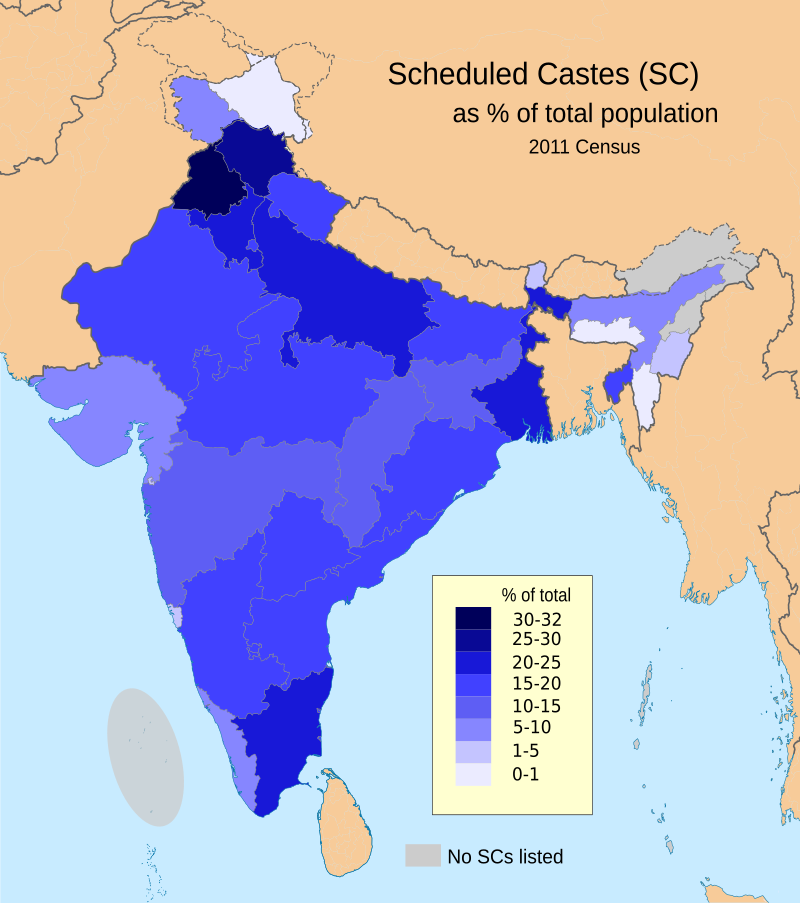
“The tradition of all dead generations weighs like a nightmare on the brains of the living,” said Karl Marx in his famous work, The Eighteenth Brumaire of Louis Bonaparte. The history and the horrors of the Caste System are well known in India. The word “Scheduled Caste” was preceded by the name “Depressed Classes.” A description of the Depressed Classes had been given in the Indian Statistical Commission Report (1930) under Chapter 4 of Part I.
It is here, in Paragraph 48, that Caste has been described as “the foundation of the Indian social fabric”. It has also been recognised in the report that caste is inherited from the parents and remains the same throughout.

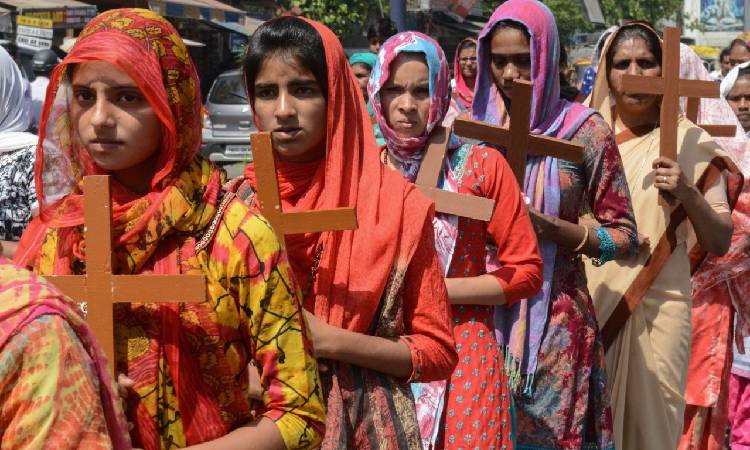
Image: Dalit Christians in protest. Photo credit: FORB Women's Alliance
In 1936, the Government of India (Scheduled Castes) Order was promulgated by the British Government in each province of British India, based on the Government of India Act, 1935. Accordingly, under the legislatures, reservation was provided under clause 18 (i) of the First Schedule. Similarly, under clause 8 of the First Schedule of the Act, it was also mentioned that the members of the legislatures from the Scheduled Castes shall be chosen by members of those castes. It is the 1936 order that has influenced the Constitution (Scheduled Castes) Order, 1950, in which the Scheduled Castes in each state are mentioned.
The procedure to modify the Order is mentioned under Article 341 of the Constitution of India where, it has been mentioned that the President may, in consultation with the Governor of the particular State, notify the particular castes as Scheduled Castes under clause (1) and Parliament may modify the same as mentioned under clause (2), with the same to be publicly notified.
No one else can tinker with the Order.
Situation of Dalit Christians
“Conversion has not brought about any change in the social status of the untouchable convert.”, said B. R. Ambedkar in an essay named The Condition of the Convert. As Sridhar Ketkar said in his book History of Caste in India, “if Hindus migrate to other regions on earth, Indian caste would become a world problem.” The same was quoted by Ambedkar in his thesis, Castes in India.
Historically, Dalits have converted to other religions, including Buddhism, Islam, and Christianity, due to many reasons, including social discrimination and non-entry into temples.
Babasaheb Bhimrao Ambedkar, the architect of the Indian Constitution, claimed in his essay that the situation of the Hindus could not be changed by Christianity. He observed that there existed a divide in the Christians along the lines of caste, into the higher and lower classes. He also points out that for a convert, his new faith is an “addendum,” rather than a replacement, of his old faith.
Justice O. Chinnappa Reddy, in his book The Court and the Constitution of India: Summits and Shallows, made a similar observation, where he said that conversion into Christianity becomes a suffix to their previous faith. He also remarked that, “…Christians of various other Hindu castes, none of whom would intermarry. A Christian Reddy would rather marry a Hindu Reddy girl but not a non-Reddy Christian girl.”
A document named “Policy of Dalit Empowerment in the Catholic Church in India” released by the Catholic Bishops’ Conference of India (CBCI) in 2016 observed that “…there is wider acceptance that the practice of untouchability and discrimination against Dalits exists in the Church and there is a need to address these issues urgently…”
In a report titled, the Report on Minorities by the High-Power Panel on the Minorities, Scheduled Castes, Scheduled Tribes and Other Weaker Sections (1983) of the Ministry of Home Affairs (also known as the Gopal Singh Committee) remarked that, “Christians and the neo-Buddhists need the same kind of concessions for their converts from the Scheduled Castes as are offered to the Hindus and Sikhs.”
The Report for the National Commission for the Religious and Linguistic Minorities (2007) (also known as the Ranganath Mishra Committee), made important observations into the issue at hand. The report has noted that caste discrimination does not go away due to a change in religion.
The report of the committee called for the recognition of caste as more of a social phenomenon rather than as a religious one. For the same, it had observed that there exists caste discrimination towards the converts and in non-Hindu religions also. The following remarks were made in the report:
“Reading all these constitutional provisions together, we are convinced that any religion-based discrimination in selecting particular castes for affirmative action will conflict with the letter and spirit of the constitutional provisions.”
The report recommended the de-linking of religion to the conferment of the Scheduled Caste status and remarked that the removal of benefits due to a wilful change in religion would be discriminatory in nature and against the basic constitutional values.
It has also been mentioned in the Mandal Commission Report that the Hindu converts, even after the conversion into religions like Islam, Christianity and others, have carried caste prejudices from their previous religion. The strong sense of social hierarchy has been seen even after conversion into other religions. Paragraph 12.14 of the report says, “…even after conversion, the lower caste converts continued to be treated as harijans by all the sections of the society…”
There have been repeated demands to delink religion from the 1950 Order to provide the benefits to all the Dalits, irrespective of their religion. The Legislative Assemblies of Andhra Pradesh and Tamil Nadu have passed resolutions for the same to be done.
What do the courts say?
In Indra Sawhney v. Union of India (1993) (famously known as the Mandal Commission case), Justice T. K. Thommen, in his dissenting opinion, said that merely due to conversion from one religion to another, a member from the Scheduled Castes and Scheduled tribes does not lose their benefits of reservation until they have ceased to become backward.
He also remarked that it is not caste or religion that should be identified but their social and economic backwardness and described them as “unfortunate classes of citizens bearing the badges of historical discrimination and naked exploitation.” He also remarked: “to deny them the constitutional protection of reservation solely by reason of change of faith or religion is to endanger the very concept of secularism and the raison d'être of reservation.”
Justice P. B. Sawant, in the same case, went into great lengths describing the ground realities and the history of the caste system in India. While describing the entry of Islam and Christianity into India, he said:
“…many from the lower castes embraced them to escape the tyranny and inequity, while some from the higher castes for pelf and power. However, the change of religion did not always succeed in eliminating castes. The converts carried with them their castes and occupations to the new religions.”
Justice Sawant, in his judgment, also described the social divisions among Christians in India and the prevalence of the sense of caste among different groups in different states of India, which they carried even after conversion. He observed in his opinion thus:
“It is unnatural to expect that the social prejudices and biases, and the notions and feelings of superiority and inferiority, nurtured for centuries together, would disappear by a mere change of religion.”
In S. Paul Raj v. The Tahsildar, Mettur and Anr. (2021), the case pertained to the issuance of an inter-caste marriage certificate for the purposes of getting a preference in government jobs, whereas the petitioner was a member of a Scheduled Caste, but was later issued a Backward Class certificate due to conversion into Christianity.
The petitioner was denied the issuance of an inter-caste marriage certificate and the case reached the High Court of Judicature, Madras. The High Court held that religious conversion would not mean the caste of the person has changed and said that the inter-caste marriage certificate cannot be issued merely on the ground of conversion.
In Mohammed Sadique v. Darbara Singh Guru, an election petition, the appellant was a singer who was elected as a Member of the Legislative Assembly from Bhadaur Constituency, reserved for Scheduled Caste members. His election was challenged in an election petition where it was contended that he was born into a Muslim family and that he could not be entitled to obtain the benefits of being a member of the Scheduled Caste.
The appellant contended that, though he was born to Muslim parents, he never practiced the same and that he converted to Sikhism in 2006. The Supreme Court held that, for being a member of a Scheduled Caste, one need not be born into Hinduism or Sikhism and that Caste is linked to birth and conversion does not change the caste.
In the case of Ganpat Rai v. Returning Officer and Ors. (1975), Justice Alagiriswami explained the caste divisions among Christians and explained that there were separate Churches for the members of the Scheduled Castes in South India. He also explained that there were advertisements for marriage proposals in newspapers by Christians with mention of their caste, looking for spouses from their own community.
Justice Alagiriswami then remarked: “All this is merely to indicate the difficulty of persons getting out of the caste customs and the mentality generated thereby. The monstrous curse of untouchability has got to be eradicated.”
In S. Anbalagan v. B. Devarajan and Ors. (1984), Justice O. Chinnappa Reddy remarked that even though the caste system is irrational, its existence is deep in the society and the minds of the people. Even though there has been conversion, Justice Reddy opined, the caste system does not seem to go away, even for those who had converted generations earlier. He cited the case of that Christian Reddys, Christian Kammas, or Christian Nadars, who would rather inter-marry in their own caste in the Hindu fold rather than persons from Christianity.
Justice Reddy, further, observed in his judgment:
“This appears to be particularly so in the case of members of the Scheduled Castes, who embrace other religions in their quest for liberation, but return to their old religion on finding that their disabilities have clung to them with great tenacity.”
In Principal, Guntur Medical College v. Y. Mohan Rao (1976), the Supreme Court considered the petition of a Principal who cancelled the admission of a student not born as a Hindu, but later converted and was accepted by the members of his former caste. Although it was argued that for obtaining a Scheduled Caste certificate, one must be born a Hindu, the SC held that for being a member of a Scheduled Caste, one need not be born a Hindu or a Sikh.
Considering that the law recognises the caste of a person before conversion and after conversion, given that he gets accepted by persons of his own caste, he is recognised as a member of the caste. To say that caste does not exist during the in-between period would mean injustice is being caused.
In Soosai v. Union of India (1992), the petitioner challenged the constitutionality of the 1950 Order. In this case, the petitioner was not provided a bunk free of cost, designated for the welfare of Scheduled Caste cobblers by the Social Welfare Department dated February 13, 1982, because he converted to Christianity. He challenged the 1950 Order of being violative of Articles 14, 15, and 25.
The Supreme Court said in its judgment that caste is retained even after conversion, but refused to hold that the 1950 order was violative of Articles 14, 15, and 25 for not mentioning Christianity and Islam. The judgment stated:
“References have been made in the material before us in the most cursory manner to the character and incidents of the castes within the Christian fold, but no authoritative and detailed study dealing with the present conditions of Christian society has been placed on the record in this case.”
A petition was again filed on the constitutionality of the 1950 Order in 2004 in the name of Centre for Public Interest Litigation v. Union of India (W.P. (C.) No. 180 of 2004). Accordingly, three issues were to be considered by the Supreme Court: (a) whether Paragraph (3) of the 1950 Order violative of Articles 14, 15, 16 and 25, (b) whether members of religions other than Hinduism, Sikhism and Buddhism be deprived of the benefit from Paragraph (3) of the 1950 Order, and (c) whether non-inclusion of Christianity and Islam in Paragraph (3) of the 1950 Order violative of Articles 14, 15, 16 and 25.
It is to be noted that the Government of India rejected the findings of the Ranganath Mishra Commission and constituted another commission under Section 3 of the Commission of Inquiry Act, 1952, headed by former Chief Justice of India, K. G. Balakrishnan. This commission was mandated to determine if members of the Scheduled Caste who had converted to religions other than the ones mentioned in Paragraph (3) of the 1950 Order can still avail themselves of the benefits as provided by virtue of the Order.
The Union Government has requested the Supreme Court to wait for the report of the commission in order to get proper material, as said by the Court in Soosai. The K.G. Balakrishnan Commission’s tenure has been extended till 10 October 2025.
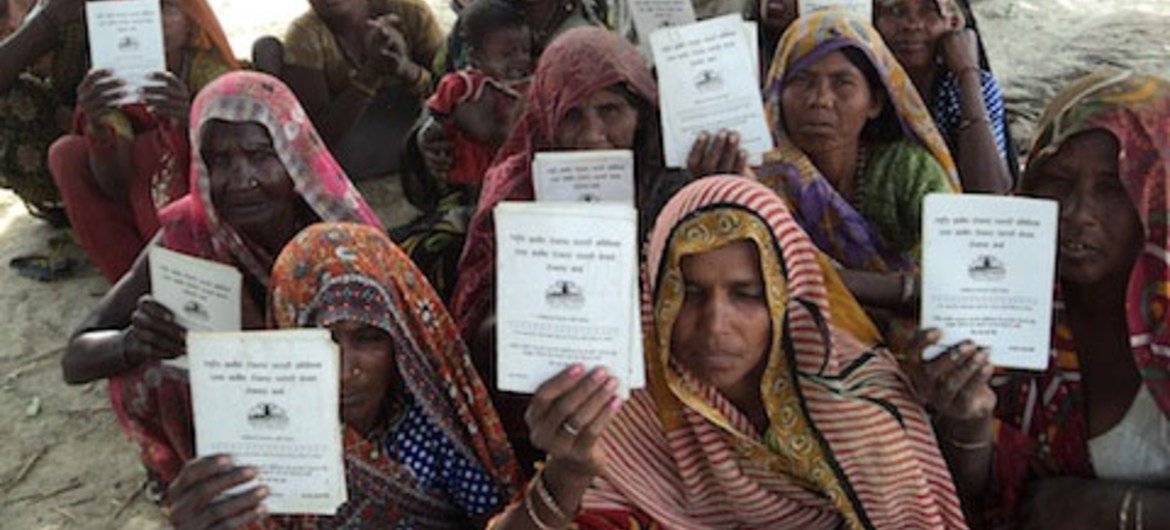
Image: Dalit women with job card in Chakrapanpur Village, Varanasi, Uttar Pradesh. Photo credit: Leena Patel/UN Women
Flaws in Atrocities Act as a catalyst
In the first part of this series, which coincided with the 40th anniversary of the Karamchedu massacre, we revisited some of the gruesome events involving extreme atrocities, including mass murder, against Dalits. The Karamchedu incident, like many before and after, was a standing testament to how the numerous legislations in the country had fallen short in ensuring justice to or in preventing atrocities against the marginalised communities.
Such organised violence has proven that shifting religious identities have not ended the social marginalisation of Dalits and other historically deprived sections, even while the conversion to another religion, in search of better social conditions, has denied them the benefits of social upliftment through the affirmative action of the State as promised in the Constitution.
As shown in the first part, the flaws inherent in the Atrocities Act, like the 1950 order on Scheduled Castes, remain at the core of the legislative lacuna in the country, which aggravates the historic marginalisation these sections have confronted in the Indian society.
The Atrocities Act was conceived for a very important purpose, in the light of many heart-wrenching events that occurred in this country. It is seen that there have been many attempts to raise obstacles to the effective implementation of the Act.
It is paramount for the judiciary to consider some vital questions that lie at the heart of the legal lacunae:
- Can the judiciary deny the benefit of a protective legislation merely due to the change of religion, given that religious convention has not shown to have transformed or improved the social status of the members of the Scheduled Castes?
- Considering this reality of social marginalization and societal deprivation being passed on generationally as a legacy, does it serve the purpose of social justice, as guaranteed by the Constitution, to deny the converted Dalits the protection and other rights of social upliftment enshrined in the Constitution
- Can the judiciary continue to tolerate the systemic violence and unimpressive record of convictions in cases of atrocities perpetuated against the Dalits, and allow long and vexatious trials at the trial courts that have caused the withering away of trust in the judiciary among the marginalized sections?
As seen in the Tsundur case, where Dalits were massacred, loaded in gunny sacks and thrown into canals, the police were seen to be hand in glove with the perpetrators. It was also evident that many attempts were made to derail and delay the verdict of the court.
One supposition may also be considered by the judiciary that, in the Tsundur case, if the perpetrators had proven indeed that the victims were Christians, could it mean that an atrocity against the Scheduled Caste community did not take place due to conversion? If yes, would that not mean grave injustice based on the mere supposition that conversion vitiates protection under the Atrocities Act, has been committed?
The Atrocities Act itself has been made in light of justice, including the social, economic and political dimensions of it, as mentioned in the Preamble and the Right to Equality (Part III) of the Constitution of India. Mere enactment of a legislation does not guarantee the protection of rights.
As mentioned in the Constitution, the Judiciary is the sentinel protecting the rights of its citizens. It is crucial to remind oneself at this juncture of the words of H. M. Seervai that, “Mere declaration of rights is worth little without the will or the means to enforce them.”
To endow credible protection to the members of the Scheduled Castes from all forms of atrocities and social discrimination, some concrete measures may be taken.
Sometime before his retirement, Abhay S. Oka J. said in a speech: “When we celebrate the so-called 75 years of the Constitution, we have to ask if we have fulfilled the constitutional guarantee extended to citizens of providing justice. The answer can be found with only proper introspection…”
For the interests of justice, the judiciary, known as the “Guardian Angel of Fundamental Rights,” is constitutionally and morally obliged to protect the rights of the oppressed classes of this country. Persons serving in the high echelons of power should remember, as Justice John Marshall in McCulloch v. Maryland (1819) said, “…we must never forget, that it is a constitution we are expounding.”
